Author Archives: Robin Helweg-Larsen

Unknown's avatar

About Robin Helweg-Larsen

Director, Andromeda Simulations International, Bahamas: a global education company providing online and in-person workshops in business finance. Series Editor, Sampson Low's 'Potcake Chapbooks'. Formal verse about traveling, family, love, etc...

Potcake Poet’s Choice: Michael R. Burch, ‘Neglect’

What good are tears?
Will they spare the dying their anguish?
What use, our concern
to a child sick of living, waiting to perish?

What good, the warm benevolence of tears
without action?
What help, the eloquence of prayers,
or a pleasant benediction?

Before this day is over,
how many more will die
with bellies swollen, emaciate limbs,
and eyes too parched to cry?

I fear for our souls
as I hear the faint lament
of theirs departing …
mournful, and distant.

How pitiful our “effort,”
yet how fatal its effect.
If they died, then surely we killed them,
if only with neglect.

Michael R. Burch writes: “This original poem has over 3,000 Google results, perhaps because it has been published by Daily Kos, Black Kos, Course Hero, Think Positive, Katutura (Namibia), Vanguard News (Nigeria), Best Naira News (Nigeria), The World News Platform, Darfur Awareness Shabbat, Genocide in Art, Genocide Awareness, and other human rights organizations including the UNHCR (United Nations Refugee Agency).”

Photo: “Carrying a lifeless and dying child (Famine Memorial)” by Can Pac Swire is marked with CC BY-NC 2.0.

My own comments: The statue in the photo is at House Quay, Dublin, and relates specifically to the Great Famine, the Great Hunger, the Irish Potato Famine of 1845-1852 in which a million died and two million left the country then and in the next couple of years. The potato blight also impacted continental Europe, causing a further 100,000 deaths there and becoming a contributory cause of the widespread Revolutions of 1848.

So let us be clear: whether children are dying from famine, climate disaster, pandemics, government inaction, or warfare (all present in today’s world)–dying without in any conceivable way being culpable–there is not just a moral duty to help, there is self-interest in helping, self-interest in preventing civil unrest and floods of refugees. Refugees are the product of an intolerable domestic situation: all other things being equal, people would rather make their future in the place they were raised, with familiar friends, family, foods, festivals. It is the duty of all governments to make all places so pleasant that no adults or children feel forced to leave, that no one is left to die.

Happy Easter. Happy Passover. Ramadan kareem.

Updated Call for Submissions: Potcake Chapbooks

I am always keen to read and consider rhymed and metered verse that has already been published. There are several chapbooks that are jostling in the queue for completion and publication:

City! Oh City! (urban life)
Just a Little Naughty
Portraits Unpleasant
Various Heresies (religion)
The Horror of Spring! (seasons)
a Christmas season chapbook, needs Hanukkah, Divali, Festivus, etc

and there are more; but a recent one, ‘Robots and Rockets’, wasn’t part of my original plans: I just ran across a bunch of Science Fiction poems that I liked, and they filled a chapbook nicely. So I’m an unashamed opportunist. I’ll modify my plans if I think something better is available. All the chapbooks listed above are nearly full already but, as with all of them, if I run across another poem I really like, I’ll include it. And if I receive enough good poems on an unplanned theme, that theme will get slotted in.

And if I receive more good poems than I can fit in a chapbook, there is a good chance of a second chapbook on the same theme. The most recent, ‘Travels and Travails’, is similar to the very first, ‘Tourists and Cannibals’; and the upcoming ‘Lost Love’ (which has gone to Alban Low for illustrating) is similar to the second chapbook, ‘Rogues and Roses’.

When there is enough good material on a single theme to fill 13 pages of a chapbook (still leaving room for Alban’s artwork, of course), then it may become the next project. But until a chapbook actually goes to print everything is subject to change. An even better poem may show up and displace one tentatively placed. A slew (or slough) of poems on a new theme may cause a reprioritisation of planned chapbooks.

This is one of the reasons that I prefer to consider only poems that have already been published–so that I don’t feel guilty about having a bunch of poems that will sit with me for months, years, and may or may not be included in the Potcake series. I have flagged a thousand poems that interest me; but I can only publish a dozen in a chapbook, and only a few chapbooks will get produced in a year.

Poems in the chapbooks run from two or three lines to some 40 lines in length–obviously, with space at a premium, poems over 20 lines and running over one page are less likely to be included… but it does happen. Other criteria: I’m looking for wit, elegance, a variety of traditional and nonce forms, a variety of voices and moods: happy, sad, angry, sardonic, meditative… anything interesting I can scrounge. If you have something you think I might like, on any topic, please send it along to robinhelweglarsen@gmail.com. Submit:

  • Formal, or traditional verse: rhymed and metrical
  • Previously published
  • Must be your own work, you must have the rights to it
  • Send 3 to 10 poems in a single attachment, or in the body of the email
  • In a covering note, include a link to where I can read more of your work

I can’t promise to use your work, but I will read it and reply!

Experimental Poem: ‘Pumpkins’

I said: “Look at the little kids playing Tag round the pumpkins – you can be that age again, if you close your eyes and remember pumpkins almost as big as you, too big to move – the massive newness, strangeness of them, never seen before, so big, but obviously to sight and touch a vegetable – you can reexperience the never before experienced, a world in which everything new absorbs your mind, and every minute you experience something new – playing Tag is a sensory delight, of running-and-not-falling (wobbly) in the half-dark (strange light) around pumpkins (absorbing color and texture) with an older sibling (touch and clutch) across strewn hay (a new but not difficult surface) and sometimes wooden pallets (a new and bizarre and impossible-to-run-on surface) but mostly the joy of running in the dark as a physical delight and not falling over – and then you stop and sit and throw straw in the air, and it doesn’t hurt (unlike gravel) and it doesn’t make a mess (unlike mud) and it doesn’t really get in your hair and eyes (unlike sand) and it also doesn’t really go anywhere no matter how hard you throw it (unlike any of them) and you laugh; you can remember all that if you can remember/imagine all the pumpkins three times as big, nearly as tall as you, too big to move – and adults become a different species, they go “Wa-wa-wa-wa-wa-wa-wa-wa” and make no sense, so you only really talk with other kids until finally an adult breaks into your world and tags your mind, and makes you hear with threats of violent pain, makes you give up your soul in self-defence,
Leaves you a narrow life of yes’m, no’m.”
She said: “You don’t make any sense.
Go write a poem.”

This is the last of five poems recently published in The Brazen Head. Technically it might be a quatrain… but unmetered, and with a very long first line. Neither this post nor The Brazen Head manage the format that I wanted, which is to have the bulk of the poem (everything that overflows the first printed line) inset half an inch from the left margin where the four lines start. This is designed to make that body of text look somewhat pumpkiny. Here I’ve settled for bolding the first words of each line.

The poem itself tries to recapture the flood of sensation that a child experiences in a new environment. A coffee shop in a wooded suburban area of Carrboro, North Carolina, had a large outdoor area of pallets, hay bales and enormous pumpkins in the run-up to Halloween, and small children were running riot in it as the evening drew in. For a moment I felt able to recapture the massive novelty of childhood experience.

Photo: “Pumpkin Patch Kid” by mountain_doo2 is marked with CC BY-NC-ND 2.0.

Potcake Poet’s Choice: Mindy Watson, ‘(Under)worlds Collide – (an ovillejo chain)’

Makaría, my girl, though you’ve heard 
Every word 
Of this myth I’ve recounted before, 
I implore 
You—indulge me again. For at last 
You’ve surpassed
Fragile childhood’s constraints. Now hold fast 
And let fantasy shift into creed. 
You’re Persephone’s daughter; please heed
Every word, I implore. You’ve surpassed 

Expectations I set at your birth.
From my dearth 
You drew bountiful joy; from disgrace 
You forged grace.
And it’s clear that your eyes could induce 
Mighty Zeus
To devise an elaborate ruse 
That would send you careening unseen
Down to Hades, where I was once queen. 
From my dearth, you forged grace mighty Zeus—

Who, three decades ago sent me bound 
Underground
As a chthonian bride—would aspire 
To acquire. 
Once, Demeter’s stray heart, all aglow
For the beau
She’d just met, allowed Zeus to sow woe.
He pared back the earth’s crust, laying waste 
To her harvest and left me displaced 
Underground to acquire. For the beau

Who then claimed me, I burned seven years. 
Through her tears, 
Fair Demeter cursed Earth and repealed
Springtime’s yield,
Vowing Winter would linger ‘til I
Bid goodbye 
To the underworld. Hades complied, 
For the innocent girl he’d once craved 
Was no more. As I rose, Mother waved 
Through her tears. Springtime’s yield bid goodbye

To its seven-year drought. But although
Status quo 
Seemed to flourish again, when detained
I’d retained 
Hades’ seed. It entrenched its black song
For so long 
In my belly, no matter how wrong,
The abyss still enthralled me. When eight 
More years passed, I spit out the innate 
Status quo I’d retained for so long,

And descended at twenty to reign
Hell’s domain.
Disavowing my schooling to seek 
Dark’s mystique,
In the city, I stripped on a stage
To assuage 
What convention had trapped in a cage.
And I deemed each male patron a thrall
On whose worship I’d draw to recall
Hell’s domain—dark’s mystique. To assuage 

The lacuna lost innocence spread 
In its stead,
I sought lust, ‘til a man who’d paid much 
Dared to touch 
Me as Zeus had once touched. But his ploy
To destroy
My esteem served instead to deploy 
Comprehension. Mercurial youth
Had to forfeit illusion that truth,
In its stead, dared to touch—to destroy.

While these decades I’ve learned to delight
In the light,
I acknowledge I’ll always endure
Dark’s allure. 
For the Hades against which I strain 
Lives to reign.
Makaría, I’ll need not explain
When, from underworld’s embers you rise
And return to me, blinking your eyes 
In the light—dark’s allure lives to reign.

Originally appeared in Star*Line, Fall 2018

Mindy Watson writes: “‘(Under)worlds Collide,’ which originally appeared in Star*Line’s Fall 2018 issue, constitutes my most ambitious attempt at restructuring a prior creative nonfiction/memoir essay (the initial ‘Underworlds Apart: A Story for Ailie’ piece appeared in Adelaide Magazine’s online March 2017 edition) into poetic form—in this case, an 8-stanza string of linked ovillejos. While the poem follows the original memoir’s metaphorical trajectory and overarching narrative—that is, a mother leverages a well-known Greek myth’s parallels to her own coming of age story to relay a “moral” (of sorts) to her burgeoning young daughter—I wanted the compressed, verse form to read less like a dark bedtime story and more like a literary song… but without losing the original’s intensity. While in hindsight I concede that my chosen form’s line/length constraints hampered my ability to clearly align my real-world characters to their mythological counterparts (a far easier feat via prose), I believe the form’s stipulation that each terminal ovillejo line contain a convergence of previously distinct phrases conferred a sense of interconnectedness between one elapsed past and another possible future that no mere prose ever could. I applaud George Simmers for penning ‘Strip,’ which made me remember my prior manifesto, and Robin for posting it.”

Mindy Watson is a formal verse poet and federal writer who holds an MA in Nonfiction Writing from Johns Hopkins University. Her poetry has appeared in venues including Snakeskin, Think Journal, the Poetry Porch, Orchards Poetry Journal, Better Than Starbucks, Eastern Structures, the Quarterday Review, and Star*Line. She’s also appeared in Sampson Low’s Potcake Poets: Form in Formless Times chapbook series and the Science Fiction and Fantasy Association’s 2019 Dwarf Stars Anthology. You may read her work at: 
https://mindywatson.wixsite.com/poetryprosesite.

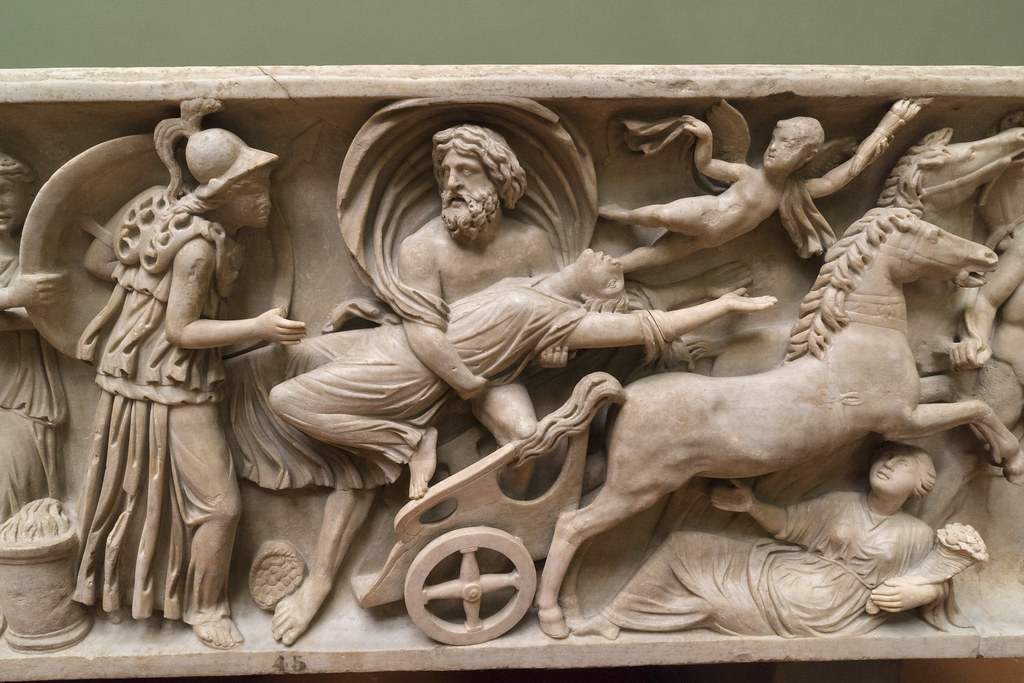
Photo: “Persephone’s Rape at Uffizi -II” by Egisto Sani is marked with CC BY-NC-SA 2.0.

Potcake Poet’s Choice: George Simmers, ‘Strip’

The pub’s old-fashioned, and is somewhat seedy.
The clientele, all male, look lumpish, needy,
And when the stripper comes, their eyes are greedy.

A smile fixed firm upon her painted face,
She starts gyrating with a teasing grace,
Smoothly undressing at a languorous pace.

She struts through routine choreography
Removes her bra, and lets her breasts go free
The silent men watch her impassively.

And still they stare unmoving as she slips
The golden panties from her mobile hips,
Pauses a sec, then sensually unzips

Her smooth pink skin, and flings it open wide, 
To show the flesh and beating heart inside.
Her audience observes all this, dead-eyed.

The flesh from bone she now expertly rends,
And now it’s just her skeleton bops and bends
Seductively until the music ends.

Silence. She picks up flesh and skin, and drawers
So often dropped before on grubby floors.
The men are stirred to offer mild applause.

She dresses quickly, picks up a pint glass,
And then begins the customary pass
Among the men, who goggle at her arse,

Say nothing, but poke fivers in the pot
Because that is expected. They do not
Even try to meet her eye, or speak of what

They’ve seen, but, weekly ritual complete,
Get up, and, bodies drooping with defeat,
They head out to the grey indifferent street.

George Simmers writes: “It must be thirty years ago that I was in a run-down district of some industrial city, looking for a pub that would sell me a pint and a sandwich. I passed one with a sign that said ‘Stripper: 1.30’ and I thought: ‘Why not?’
The audience was very much as described in the poem, though the performance was less extreme. It was a fairly melancholy occasion, and one that stayed in my memory. It was a long while ago, and the pot that day probably filled with £1 notes (maybe even ten bob) rather than fivers, but I thought £5 would be the appropriate donation today – if lunchtime pub strippers still exist. They’re an endangered species in the North of England, I gather, and lockdown has probably killed them off completely.
I wrote this in triplets because the first three lines came to me together, and I thought I’d see how well I could continue. I feel the form somehow suits the subject, or at any rate is better than couplets, which tend to be faster-moving. The triplets seem (to me at least) sluggish and a bit unusual.
I dimly remember years ago seeing an animated film in which a stripper goes on to unzip her skin, so to that extent the poem is not original. But it was the deliberately unimpressed audience I really wanted to write about, and making them still stolid even after watching the impossible made my point, I hoped.
This is one of a series of poems that I’ve written over the past couple of years, telling stories that are extreme or somewhat gothic. I may get some of them together into a short collection later in the year.”

George Simmers used to be a teacher; now he spends much of his time researching literature written during and after the First World War. He has edited Snakeskin since 1995. It is probably the oldest-established poetry zine on the Internet. His work appears in several Potcake Chapbooks.
https://greatwarfiction.wordpress.com/
http://www.snakeskinpoetry.co.uk/

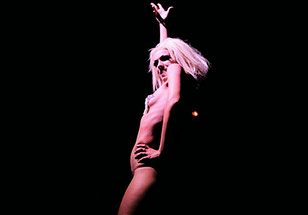
Photo: “luchavavoom stripper” by ourcommon is marked with CC BY-NC-ND 2.0.

Poem: ‘Poems Like Motes of Dust’

Like tiny midges, poems in the air
were unseen all my life, presence unclear,
occasionally one would land, bite, sting…
I’d be aware
a poem had come, was singing by my ear.
Now everything, literally every thing,

is a poem: a car, a dog, a glass,
a chair, a seagull, every blade of grass,
all people and each thing they pass.
Now I see swarms, millions of flies,
or like light’s dots of darkness thickening as day dies,

the poems are visible in the air around,
a pointillist canvas, every dot
a poem in itself, an image, word, rhyme, thought,
or like neutrinos streaming from the sun,
billions a second passing with no sound
unseen, unfelt, through everyone,
the poetry of existence, raw, untaught.

The Universe: a cloud of dust that hangs and floats,
dust like a drive of cattle on the range,
or when you fill a barn with dusty motes
by sudden action, and a sunbeam’s slice;
or as Sumerian gods convene, converse,
swarming like flies around burnt sacrifice,

summoned by smell of sacrificial meal…
was it my sacrifices made this change,
made poems visible like motes of dust?
Is this the Universe’s thrust?
Hide them, and then reveal?
For all the poems make one UniVerse.

This is the fourth of a series of five poems recently published in The Brazen Head. It is semi-formal: written in iambics with lines of uneven length, fully rhymed but not to any pattern. My model for this style of verse is Matthew Arnold’s ‘A Summer Night‘, a poem that I have loved and recited since high school. (We can leave for another time the debate about whether his poem should have stopped as originally at the final question mark, or whether the years-later addition of the subsequent lines is an improvement.)

Smoky Dusty Light Rays Texture” by Sprogz is marked with CC BY-NC 2.0.

Epigram: ‘The Gods Compete’

The gods compete; some harvest verse, some tears,
Some deaths in battle, some vague hopes and fears.

This epigram is nondenominational–in the sense that I don’t have any preference for how people view, or are attracted to, some particular god.

More challenging is the punctuation. Good punctuation definitely helps guide the reader through the meanings of the passage, but what is ‘good’ varies by culture. Many Americans loathe the semicolon beloved by writers of convoluted passages. Many people argue for or against comma placements. In this piece, a 17-word sentence, the first line seems clearer than the second. “Some deaths in battle” might in this case be better written as “Some, deaths in battle” but that would suggest following it with “some, vague hopes and fears.” Then it might be preferable to separate those two parts of the line with a semicolon… but then perhaps the previous line should end in a semicolon too… but then what about the semicolon after “The gods compete”? Replace it with a colon.

I can’t help thinking of the remark often attributed to Oscar Wilde, or, as David Galef pointed out in the New York Times, Gustave Flaubert: “I spent the morning putting in a comma. In the afternoon I removed it.”

The poem was originally published in The Asses of Parnassus–thanks, Brooke Clark!

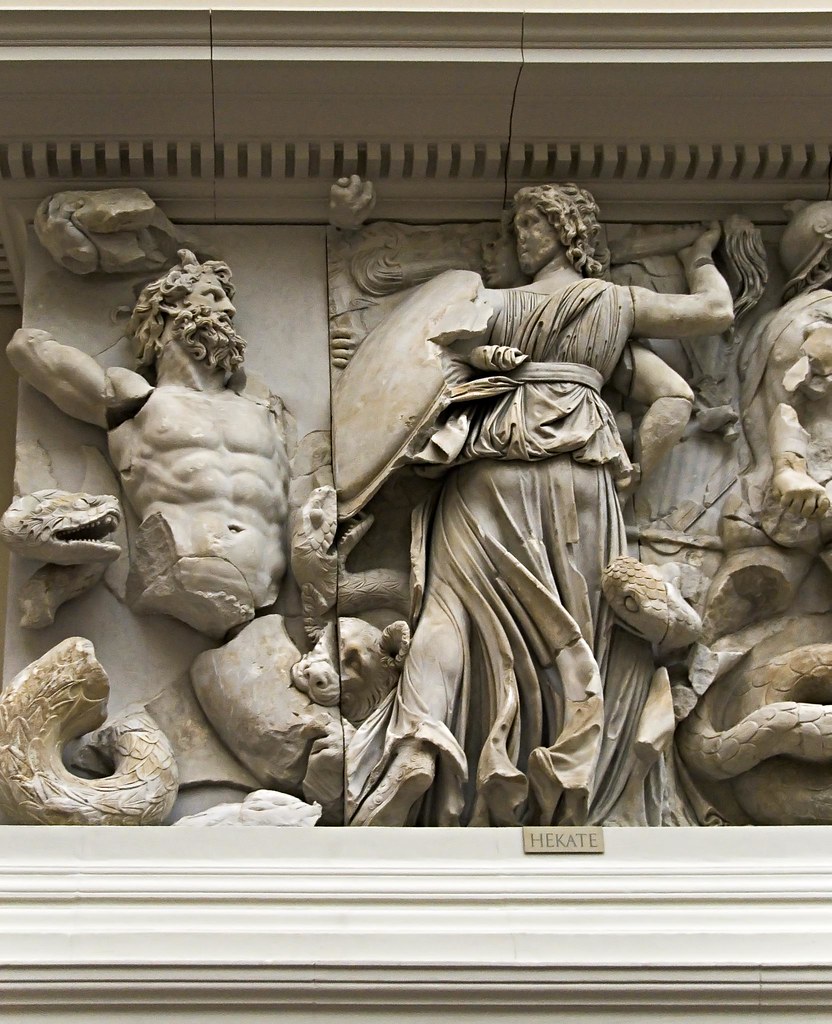
Photo: “Pergamon Museum _DSC17798” by youngrobv is marked with CC BY-NC 2.0.

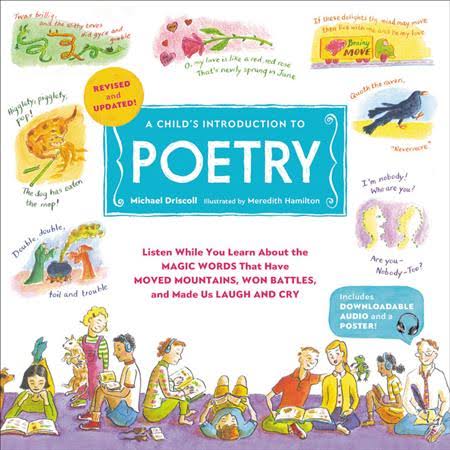
Review: ‘A Child’s Introduction to Poetry’ by Michael Driscoll

This book, “A Child’s Introduction to Poetry” by Michael Driscoll, illustrated by Meredith Hamilton, is the single best introduction to poetry that I have ever seen. It is part of a series of books aimed at 8 to 10-year-olds, and is divided into two parts: ‘The Rhymes and Their Reasons’, with two to four large pages on topics as diverse as Nonsense Rhymes, The Villanelle, Free Verse and Poems Peculiar; and ‘Poetry’s Greats’ with a couple of pages each on 21 poets such as Homer, Wordsworth, Dickinson, Belloc, Auden, Paz and Angelou. The book is richly illustrated on every page, and is packed with bits of biography, commentary, prosody, explanation and definition. Purely as a book, it is superb.

But wait! There’s more! The original edition came with a CD of all the poems, and the Revised and Updated edition comes with downloadable audio and a poster. These audio aspects are not as brilliant as the book, for two reasons: first, the poems are read “professionally” which unfortunately means without the joy, excitement, teasing, energy or naturalness that I listened for. They are clear, flat and boring, with unnecessarily exaggerated pauses between lines. I listened to the first three poems, and quit. Secondly, the CD version (which is what I have) may have been obsoleted, but the major item of comment in the Amazon reviews is that there are no explanations for downloading the audio, and that it was difficult for reviewers to figure out how to do it.

Ignore the audio, then. If you already have an interest in poetry you will probably do a better job than the unfortunate “professionals” in reading aloud from the book, and your child will have a richer experience anyway from your personal involvement and introduction. The book will soon enough be one for the child to dip into and skip back and forth in, moving from biographies to poems to illustrations to factoids as the mood takes them.

In terms of the variety of poetry–forms, moods, eras, nationalities–I have never seen anything so rich and satisfying for a good young reader as this Introduction. I wish all English-speaking children everywhere could have a copy.

Poem: ‘Leadership Transition’

Julius Caesar, Antony, King Lear,
Hamlet, Macbeth – corrupted, vain, impure,
Irrational, bombastic, insecure –
He’s no more clarity or veritas
Than the deceptions of a covert war,
All morals blurred.

That tyrant rant, Tyrannosaurus roar,
Forecasts he’ll suffer a dictator’s fate:
His proud obsessed confusion first seems great,
Then grates, unravels at the seams, slips gear,
Loses its moral metaphors, grows crass;
He dies absurd.

Octavius, Malcolm, Edgar, Fortinbras,
Comes from the wings and strides to centre stage –
Competent, measured, reasonable, sane –
To rule the wreckage of the tragic reign;
Restores some structure, closes out the age,
Speaks the last word.

This archetypal character’s strong thump
Will get his nation out of the morass;
The raucous self-styled hero being dead,
A truer leader takes the throne instead.
(How Shakespeare’d end the Tragedy of Trump
Can be inferred.)

The common fate of Shakespeare’s flawed protagonists–death, and replacement by a more worthy ruler–is a story that humans enjoy and wish applied in their own times and countries… although they may naturally disagree on which ruler is disgraceful and which would be more worthy. Speaking for myself, I don’t need to see a death–I’d be happy for Putin and Trump to avoid assassination or jail by going into comfortable exile at a golf hotel in southern Russia. (You read it first here.) But Shakespeare would deal with them more definitively.

This poem is the third of the five poems published this month in The Brazen Head. Its four stanzas are in iambic pentameter with a short 6th line. The rhymes largely carry over between stanzas–the 6th lines only rhyme with each other. The rhymes and the stanza structure are designed to create a sense of satisfactory achievement–exactly what I feel with Biden taking over from Trump. (Similarly I would love to see Navalny take over from Putin, and almost anyone replace Boris Johnson.)

York Minster – June 2013 – Emperor Constantine – One Cool Dude” by Gareth1953 All Right Now is marked with CC BY 2.0.

Resources: Formal-friendly magazines for unknown poets

Some of the best-known and longest-established poetry magazines have either changed (often under a new editor) from being receptive to being hostile towards formal verse; others are receptive, but only to already well known poets. So it can be difficult for an unknown formalist to break into publication. For what it’s worth, here is a list of places where I have been able to publish my own uneven and very varied pieces, with some comments about what is appropriate for where.

Alabama Literary Review – US, lyrical, positive; only takes snailmail submissions (unless you have a genuine need for email)
Allegro – UK, contemporary, looking for more formal submissions than they receive
Amsterdam Quarterly – Netherlands, English-language, must address the issue’s theme
Asses of Parnassus – Canada, short, witty, formal poems, snarky is fine, hosted on Tumblr.
Better Than Starbucks – US/Canada, large magazine with many departments including formal; children’s; experimental; etc.
Bewildering Stories – Canada/UK/US, speculative and science fiction pieces
Bosphorus Review of Books – Turkey, English language
Brazen Head – UK, ideas-rich
Chained Muse – US, prefers classical themes
Libretto – Nigeria, prefers African/Afro-American/Afro-European/post-colonial pieces
Light – US, large biannual issue, also the home of weekly topical light verse
Lighten Up Online (LUPO) – UK, light formal verse, quarterly
Lyric – US, “Founded in 1921, The Lyric is the oldest magazine in North America in continuous publication devoted to traditional poetry.” Lyrical, positive… flowers and countryside.
Metverse Muse – India, publishes simple traditional verse. No website. The email for editor Dr. Tulsi is metverse_muse@yahoo.com
Obsessed With Pipework – UK, “strangeness and charm… prefers dreams to deathbeds”
Orchards Poetry Journal – US, more rural than urban
Penwood Review – US, religious streak
Poetry Porch – US, lyrical
Pulsebeat Poetry Journal – US, new; more urban than rural
Rat’s Ass Review – US, irreligious streak; whatever appeals to the editor, including things you can’t get published elsewhere.
Road Not Taken: The Journal of Formal Poetry – US, hard to find online because of its name, but a good small publication for formal and semi-formal verse.
Shot Glass Journal – US, max 16 lines, lots of international poets
Snakeskin – UK, probably the longest-established poetry zine in the world; has no interest in submission bios, only in the poems; likes work that begins light and becomes heavier.
Star*Line – US, Science Fiction poetry
The HyperTexts (THT) – US, an enormous assemblage of verse from all times and places; the editor’s preference for formal and leftist verse doesn’t rule out Walt Whitman or Ronald Reagan! The works are mostly republications, but if you have a body of strong work the editor may be interested in creating a page for you.
Verse-Virtual – US, a monthly publication for a caring community of poets
Visions International – US – I’m not sure what the status is of this magazine these days, or who is editing it…

This list doesn’t include magazines not relevant for me (like Mezzo Cammin: An Online Journal of Formalist Poetry by Women), or that moved away from formalism (like Ambit), or that have unfortunately folded (14 by 14, The Rotary Dial, Unsplendid). And there must be a lot more worthy magazines that I simply haven’t run across – I would be very glad of your recommendations about others to list.

And of course, as ever, don’t just fire off a handful of poems at random – read some samples online, determine the magazine’s orientation and moods, check whether the editor wants anything particular, note whether they love or loathe attachments, etc…

Good luck!

Magazines” by theseanster93 is marked with CC BY-SA 2.0.