Category Archives: Poems

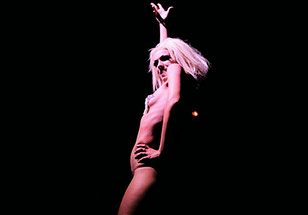
Potcake Poet’s Choice: George Simmers, ‘Strip’

The pub’s old-fashioned, and is somewhat seedy.
The clientele, all male, look lumpish, needy,
And when the stripper comes, their eyes are greedy.

A smile fixed firm upon her painted face,
She starts gyrating with a teasing grace,
Smoothly undressing at a languorous pace.

She struts through routine choreography
Removes her bra, and lets her breasts go free
The silent men watch her impassively.

And still they stare unmoving as she slips
The golden panties from her mobile hips,
Pauses a sec, then sensually unzips

Her smooth pink skin, and flings it open wide, 
To show the flesh and beating heart inside.
Her audience observes all this, dead-eyed.

The flesh from bone she now expertly rends,
And now it’s just her skeleton bops and bends
Seductively until the music ends.

Silence. She picks up flesh and skin, and drawers
So often dropped before on grubby floors.
The men are stirred to offer mild applause.

She dresses quickly, picks up a pint glass,
And then begins the customary pass
Among the men, who goggle at her arse,

Say nothing, but poke fivers in the pot
Because that is expected. They do not
Even try to meet her eye, or speak of what

They’ve seen, but, weekly ritual complete,
Get up, and, bodies drooping with defeat,
They head out to the grey indifferent street.

George Simmers writes: “It must be thirty years ago that I was in a run-down district of some industrial city, looking for a pub that would sell me a pint and a sandwich. I passed one with a sign that said ‘Stripper: 1.30’ and I thought: ‘Why not?’
The audience was very much as described in the poem, though the performance was less extreme. It was a fairly melancholy occasion, and one that stayed in my memory. It was a long while ago, and the pot that day probably filled with £1 notes (maybe even ten bob) rather than fivers, but I thought £5 would be the appropriate donation today – if lunchtime pub strippers still exist. They’re an endangered species in the North of England, I gather, and lockdown has probably killed them off completely.
I wrote this in triplets because the first three lines came to me together, and I thought I’d see how well I could continue. I feel the form somehow suits the subject, or at any rate is better than couplets, which tend to be faster-moving. The triplets seem (to me at least) sluggish and a bit unusual.
I dimly remember years ago seeing an animated film in which a stripper goes on to unzip her skin, so to that extent the poem is not original. But it was the deliberately unimpressed audience I really wanted to write about, and making them still stolid even after watching the impossible made my point, I hoped.
This is one of a series of poems that I’ve written over the past couple of years, telling stories that are extreme or somewhat gothic. I may get some of them together into a short collection later in the year.”

George Simmers used to be a teacher; now he spends much of his time researching literature written during and after the First World War. He has edited Snakeskin since 1995. It is probably the oldest-established poetry zine on the Internet. His work appears in several Potcake Chapbooks.
https://greatwarfiction.wordpress.com/
http://www.snakeskinpoetry.co.uk/

Photo: “luchavavoom stripper” by ourcommon is marked with CC BY-NC-ND 2.0.

Poem: ‘Poems Like Motes of Dust’

Like tiny midges, poems in the air
were unseen all my life, presence unclear,
occasionally one would land, bite, sting…
I’d be aware
a poem had come, was singing by my ear.
Now everything, literally every thing,

is a poem: a car, a dog, a glass,
a chair, a seagull, every blade of grass,
all people and each thing they pass.
Now I see swarms, millions of flies,
or like light’s dots of darkness thickening as day dies,

the poems are visible in the air around,
a pointillist canvas, every dot
a poem in itself, an image, word, rhyme, thought,
or like neutrinos streaming from the sun,
billions a second passing with no sound
unseen, unfelt, through everyone,
the poetry of existence, raw, untaught.

The Universe: a cloud of dust that hangs and floats,
dust like a drive of cattle on the range,
or when you fill a barn with dusty motes
by sudden action, and a sunbeam’s slice;
or as Sumerian gods convene, converse,
swarming like flies around burnt sacrifice,

summoned by smell of sacrificial meal…
was it my sacrifices made this change,
made poems visible like motes of dust?
Is this the Universe’s thrust?
Hide them, and then reveal?
For all the poems make one UniVerse.

This is the fourth of a series of five poems recently published in The Brazen Head. It is semi-formal: written in iambics with lines of uneven length, fully rhymed but not to any pattern. My model for this style of verse is Matthew Arnold’s ‘A Summer Night‘, a poem that I have loved and recited since high school. (We can leave for another time the debate about whether his poem should have stopped as originally at the final question mark, or whether the years-later addition of the subsequent lines is an improvement.)

Smoky Dusty Light Rays Texture” by Sprogz is marked with CC BY-NC 2.0.

Epigram: ‘The Gods Compete’

The gods compete; some harvest verse, some tears,
Some deaths in battle, some vague hopes and fears.

This epigram is nondenominational–in the sense that I don’t have any preference for how people view, or are attracted to, some particular god.

More challenging is the punctuation. Good punctuation definitely helps guide the reader through the meanings of the passage, but what is ‘good’ varies by culture. Many Americans loathe the semicolon beloved by writers of convoluted passages. Many people argue for or against comma placements. In this piece, a 17-word sentence, the first line seems clearer than the second. “Some deaths in battle” might in this case be better written as “Some, deaths in battle” but that would suggest following it with “some, vague hopes and fears.” Then it might be preferable to separate those two parts of the line with a semicolon… but then perhaps the previous line should end in a semicolon too… but then what about the semicolon after “The gods compete”? Replace it with a colon.

I can’t help thinking of the remark often attributed to Oscar Wilde, or, as David Galef pointed out in the New York Times, Gustave Flaubert: “I spent the morning putting in a comma. In the afternoon I removed it.”

The poem was originally published in The Asses of Parnassus–thanks, Brooke Clark!

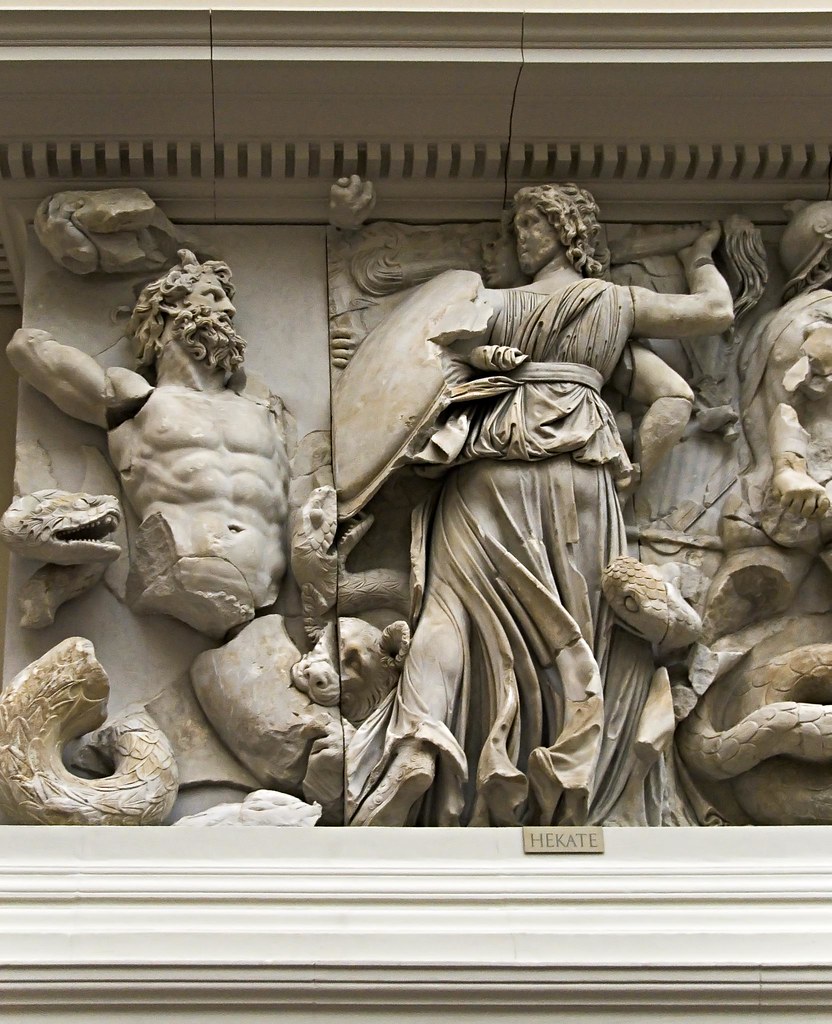
Photo: “Pergamon Museum _DSC17798” by youngrobv is marked with CC BY-NC 2.0.

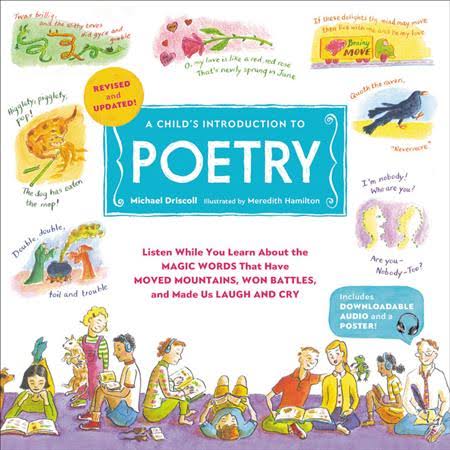
Review: ‘A Child’s Introduction to Poetry’ by Michael Driscoll

This book, “A Child’s Introduction to Poetry” by Michael Driscoll, illustrated by Meredith Hamilton, is the single best introduction to poetry that I have ever seen. It is part of a series of books aimed at 8 to 10-year-olds, and is divided into two parts: ‘The Rhymes and Their Reasons’, with two to four large pages on topics as diverse as Nonsense Rhymes, The Villanelle, Free Verse and Poems Peculiar; and ‘Poetry’s Greats’ with a couple of pages each on 21 poets such as Homer, Wordsworth, Dickinson, Belloc, Auden, Paz and Angelou. The book is richly illustrated on every page, and is packed with bits of biography, commentary, prosody, explanation and definition. Purely as a book, it is superb.

But wait! There’s more! The original edition came with a CD of all the poems, and the Revised and Updated edition comes with downloadable audio and a poster. These audio aspects are not as brilliant as the book, for two reasons: first, the poems are read “professionally” which unfortunately means without the joy, excitement, teasing, energy or naturalness that I listened for. They are clear, flat and boring, with unnecessarily exaggerated pauses between lines. I listened to the first three poems, and quit. Secondly, the CD version (which is what I have) may have been obsoleted, but the major item of comment in the Amazon reviews is that there are no explanations for downloading the audio, and that it was difficult for reviewers to figure out how to do it.

Ignore the audio, then. If you already have an interest in poetry you will probably do a better job than the unfortunate “professionals” in reading aloud from the book, and your child will have a richer experience anyway from your personal involvement and introduction. The book will soon enough be one for the child to dip into and skip back and forth in, moving from biographies to poems to illustrations to factoids as the mood takes them.

In terms of the variety of poetry–forms, moods, eras, nationalities–I have never seen anything so rich and satisfying for a good young reader as this Introduction. I wish all English-speaking children everywhere could have a copy.

Poem: ‘Leadership Transition’

Julius Caesar, Antony, King Lear,
Hamlet, Macbeth – corrupted, vain, impure,
Irrational, bombastic, insecure –
He’s no more clarity or veritas
Than the deceptions of a covert war,
All morals blurred.

That tyrant rant, Tyrannosaurus roar,
Forecasts he’ll suffer a dictator’s fate:
His proud obsessed confusion first seems great,
Then grates, unravels at the seams, slips gear,
Loses its moral metaphors, grows crass;
He dies absurd.

Octavius, Malcolm, Edgar, Fortinbras,
Comes from the wings and strides to centre stage –
Competent, measured, reasonable, sane –
To rule the wreckage of the tragic reign;
Restores some structure, closes out the age,
Speaks the last word.

This archetypal character’s strong thump
Will get his nation out of the morass;
The raucous self-styled hero being dead,
A truer leader takes the throne instead.
(How Shakespeare’d end the Tragedy of Trump
Can be inferred.)

The common fate of Shakespeare’s flawed protagonists–death, and replacement by a more worthy ruler–is a story that humans enjoy and wish applied in their own times and countries… although they may naturally disagree on which ruler is disgraceful and which would be more worthy. Speaking for myself, I don’t need to see a death–I’d be happy for Putin and Trump to avoid assassination or jail by going into comfortable exile at a golf hotel in southern Russia. (You read it first here.) But Shakespeare would deal with them more definitively.

This poem is the third of the five poems published this month in The Brazen Head. Its four stanzas are in iambic pentameter with a short 6th line. The rhymes largely carry over between stanzas–the 6th lines only rhyme with each other. The rhymes and the stanza structure are designed to create a sense of satisfactory achievement–exactly what I feel with Biden taking over from Trump. (Similarly I would love to see Navalny take over from Putin, and almost anyone replace Boris Johnson.)

York Minster – June 2013 – Emperor Constantine – One Cool Dude” by Gareth1953 All Right Now is marked with CC BY 2.0.

Potcake Poet’s Choice: Marcus Bales, ‘Miniver Cheever III’

Miniver Cheevy Junior’s kid
Despised his own contemporaries,
Like his poetic forebears did,
As functionaries.

Miniver missed old apartheids,
South Africa and Mississippi,
And longed to go on freedom rides
And lay a hippie.

Miniver yearned for days gone by,
For free love’s newly bra-less boobies,
For Woodstock, rock and roll, tie-dye,
And smoking doobies.

Miniver mourned for Owsley Blue,
The name, he understood, for acid.
At Kool-Aid Tests and love-ins, too,
He’d be less flaccid.

Miniver loved the Beatles, Stones,
Frank Zappa, Zep, and, yes, the Monkees;
He didn’t care, he had a jones
For tuneful junkies.

He cursed the mosh-pit debutantes,
And viewed hip-hop with open loathing;
He missed the sight of Mary Quant’s
Bell-bottomed clothing.

He metaphored and analogued
And similed to try to flout it;
Miniver blogged, and blogged, and blogged,
And blogged about it.

And so there’s Miniver number three,
Who’s no more dour but no less bitter.
He shakes his head and sighs. Then he
Logs in to Twitter.

Marcus Bales writes: “Here’s one that has its own built-in reason for writing it: DF Parry had done such a good job, who could resist? But Miniver Cheevy III was written so long ago, now, that possibly it’s time to explore IV.”

Not much is known about Marcus Bales except that he lives and works in Cleveland, Ohio, and that his work has not been published in Poetry or The New Yorker. However his “51 Poems” is available from Amazon. He has been published in several of the Potcake Chapbooks (“form in formless times”), and would like you to be familiar with the forerunners to his ‘Miniver Cheevy III’:

‘Miniver Cheevy, Jr.’ by D.F. Parry

Miniver Cheevy, Jr., child
Of Robinson’s renowned creation
Also lamented and reviled
His generation.

Miniver similarly spurned
The present that so irked his pater,
But that langsyne for which he yearned
Came somewhat later.

Miniver wished he were alive
When dividends came due each quarter,
When Goldman Sachs was 205
And skirts were shorter.

Miniver gave no hoot in hell
For Camelot or proud Troy’s pillage;
He would have much preferred to dwell
In Greenwich Village.

Miniver cherished fond regrets
For days when benefits were boundless;
When radios were crystal sets
And movies soundless.

Miniver missed the iron grills,
The whispered word, the swift admission,
The bath-tub gin, and other thrills
Of Prohibition.

Miniver longed, as all men long,
To turn back time (his eyes would moisten),
To dance the Charleston, play mah jong
And smuggle Joyce in.

Miniver Cheevy, Jr., swore
And drank until the drink imperiled
Health, then sighed, and read some more
F. Scott Fitzgerald.

The original, of course, is Miniver Cheevy‘ by Edwin Arlington Robinson:

Miniver Cheevy, child of scorn,
Grew lean while he assailed the seasons;
He wept that he was ever born,
And he had reasons.

Miniver loved the days of old
When swords were bright and steeds were prancing;
The vision of a warrior bold
Would set him dancing.

Miniver sighed for what was not,
And dreamed, and rested from his labors;
He dreamed of Thebes and Camelot,
And Priam’s neighbors.

Miniver mourned the ripe renown
That made so many a name so fragrant;
He mourned Romance, now on the town,
And Art, a vagrant.

Miniver loved the Medici,
Albeit he had never seen one;
He would have sinned incessantly
Could he have been one.

Miniver cursed the commonplace
And eyed a khaki suit with loathing;
He missed the mediæval grace
Of iron clothing.

Miniver scorned the gold he sought,
But sore annoyed was he without it;
Miniver thought, and thought, and thought,
And thought about it.

Miniver Cheevy, born too late,
Scratched his head and kept on thinking;
Miniver coughed, and called it fate,
And kept on drinking.

Experimental Poem: ‘Pointillist’

(Note: this poem is so named because if you look at it closely you may not find as much meaning as if you step back, let it flow past you, and see an outline of a story.)

Awake
Anew
Awhile
Askew;
Afoot
Among
Amass
Along;
Abet
Aback
Ado
Alack;
Alas!

Abroad
Again
Astride
Amain;
Atop
Alight
Aglow
Afright;
Afar
Ahead
Aloft
Abed;
Alone!

Aware
Amused
Affair
Accused;
Away
Aboard
Affray
Abhorred;
Aground
Alive
Abound
Arrive;
Ahoy!

Array
Await
Assay
Abate;
Appraise
Accord
Amaze
Adored;
Apprise
Appoint
Arise
Anoint;
Adieu!

This poem started (if I remember correctly) as four or five of the early words coming into my head with a sense of rhyme and rhythm when I was on the point of falling asleep. I roused myself enough to write the words down, doing what I consider an essential part of the communication I long for with my unconscious, my Muse–acknowledge the Muse by writing whatever is offered to you, whether or not it is complete or makes sense.

The next day I wrote more, keeping to iambic monometer and words of Anglo-Saxon derivation beginning with A. As a hint of a story took shape, I kept writing. After the first two stanzas I moved over into words of Latin derivation and went for more intense rhyme. Long lists of words were involved. After four days I had the whole poem.

As for the story itself… I see a hero setting out, failing, trying again, under threat, escaping by boat, shipwrecked, and finally rewarded. Are they male or female, and of what age? Did they have a love affair? Did they end up at home or in foreign lands? If you look at the poem sideways you may find an answer that suits you. Or (of course) not.

‘Pointillist’ was the second of five poems recently published in the Poetry section of The Brazen Head.

Pointillistically abstracted” by readerwalker is marked with CC BY-NC-SA 2.0.

Potcake Poet’s Choice: Max Gutmann, ‘Raindroppings’

Can anyone make out
The quality inherent
In being with an umbrella, that makes people without
Completely transparent?

On the rainiest days,
In the hardest of showers,
People with umbrellas courteously step out of other umbrella’d people’s ways
Right into ours.

Or, if as it starts
To really pour, ya
Dash for the shelter of a little awning, sure as rain’s wet someone with an umbrella darts
Under it before ya.

And you look at the fella
As you stand in the steady
Downpour, but he ain’t gonna budge, ’cause, as any one-eyed idiot could plainly see, his umbrella
Is wet enough already.

Beyond disputation,
We already hear a lot
About the many forms of indiscriminate discrimination
Our world has got.

Still, I wish some teller’d
Deign to tell us
The reasons for the way the umbrellered
Treat the umbrell’less.

Max Gutmann writes: “In ‘Raindroppings,’ a line of OgdenNashian length is part of each otherwise regularly metered quatrain. These lines get longer and longer, and then shorter and shorter. I hope this helps the poem feel both sillily loose, and formally structured: the topic, though it may sound invented, is an actual aspect of human nature, trivial in itself but reflective of more serious attitudes.”

Max Gutmann has worked as, among other things, a stage manager, a journalist, a teacher, an editor, a clerk, a factory worker, a community service officer, the business manager of an improv troupe, and a performer in a Daffy Duck costume. Occasionally, he has even earned money writing plays and poems.

linkmaxgutmann.com

‘Raindroppings’ was first published in Light Quarterly

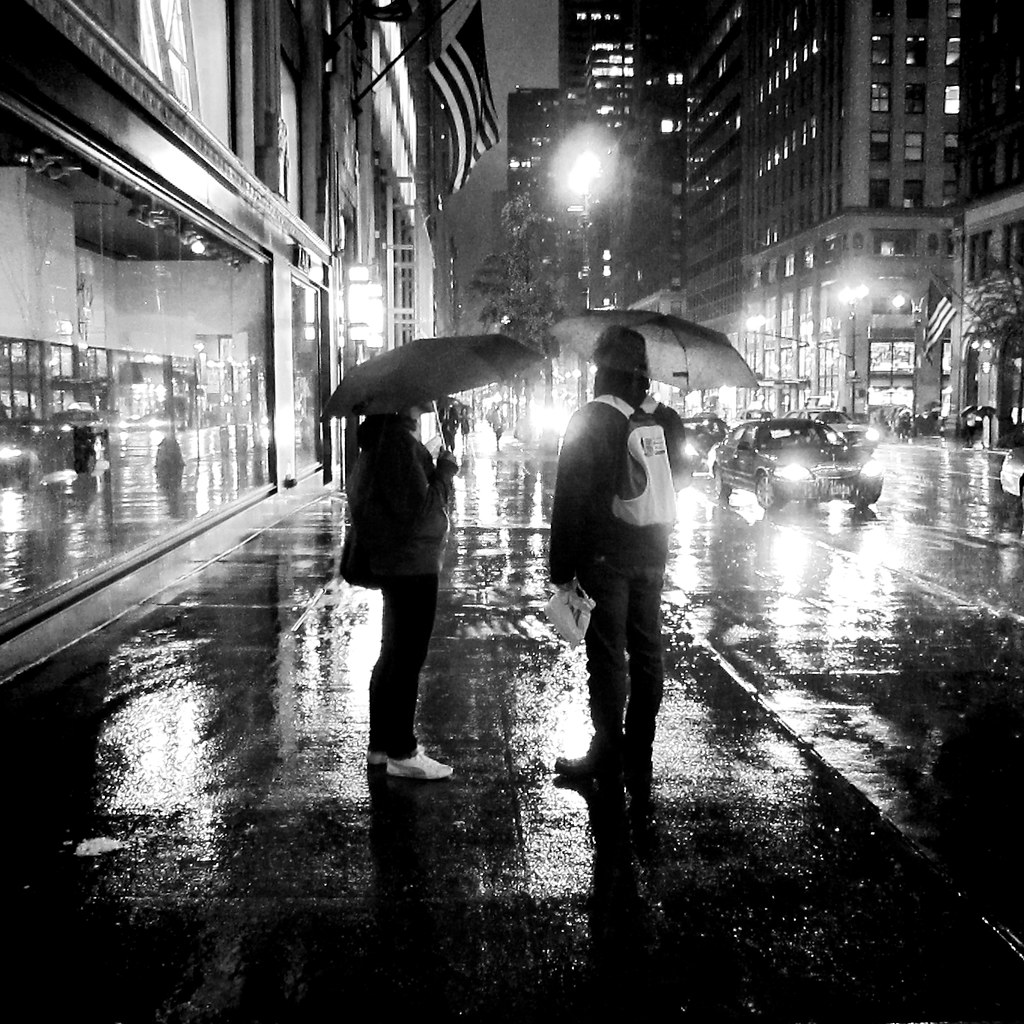
Photo: “Downpour” by roeyahram is marked with CC BY-NC-ND 2.0.

Odd poem: Edward Lear, ‘Imitation of the Olden Poets’

Time is a taper waning fast!
Use it, man, well whilst it doth last:
Lest burning downwards it consume away,
Before thou hast commenced the labour of the day.

Time is a pardon of a goodly soil!
Plenty shall crown thine honest toil:
But if uncultivated, rankest weeds
Shall choke the efforts of the rising seeds.

Time is a leasehold of uncertain date!
Granted to thee by everlasting fate.
Neglect not thou, ere thy short term expire,
To save thy soul from ever-burning fire.

This poem is a gorgeous piece of deliberately bad verse. Edward Lear had a wonderful ear for rhythm, and this appalling piece is a great jab at poets who, even to a Victorian like Lear, were long out of date: meaning, syntax and prosody are all garbled, wrapping around bland but unclear moralising exhortations.

The first line of each stanza ends with an exclamation mark even if, as in verse three, it is in the middle of a sentence.

The very first line has four simple feet in iambic tetrameter, eight syllables.
The second line also has eight syllables but manages to make the rhythm stumble through poor phrasing.
The third line has ten syllables; it can be read as iambic pentameter, but the previous lines encourage an attempt to keep to four slightly crowded feet.
The fourth line goes to twelve syllables, at which point the prosody is collapsing towards Lear’s younger contemporary, William McGonagall–you either cram everything into four feet, or let the stanza dribble out in too many iambics.

The second stanza begins “Time is a pardon of a goodly soil!” Very affirmative, but what does it mean? And are we back to pentameters now? It’s not clear–the second line is definitely tetrameter… so how to read the third and fourth lines?

The last stanza is pure iambic pentameter. The chaos is in the confused understanding of time, “a leasehold of uncertain date”, but is somehow part of “everlasting fate”. Similarly “thy short term” is shadowed by “ever-burning fire”. On balance, time appears to be represented as infinite–events are portrayed as everlasting–but time is also called “a leasehold of uncertain date”; that phrase is merely a poor expression that confuses Time with the time of a human’s life.

The poem has been set to music by Bertram Wooster with a Betty Boop video. They credit Lear, and the poem shows up in PoemHunter and a couple of other places… and I want to believe it is Lear… but I’d be happier if I could find more about the origin of the piece.

Candle” by kkalyan is marked with CC BY-SA 2.0.

Poem: ‘His Mad Skull’s Like’

His mad skull’s like
a motorcycle cage of death,
the engines roaring over and beneath:
conflicting paths, crashless machinery –
the crowd roars, hoping for catastrophe.

an alchemist’s laboratory,
he strives through Universal symmetry
alone to conquer nature, friendlessly,
transmuting hopeless to hope endlessly.

a planet with its atmosphere,
blossoming gaudy after starting drear;
from grand extinctions and tectonic faults
life reaches out to loot galactic vaults.

a plant with taproot down the spine
side-nerve extractors reaching out to mine
the Universe’s minerals of sense,
make sense, and raise to Mind the mind’s pretense.

This poem along with four others of mine has just been published in The Brazen Head in the UK. I came across the magazine through Marcus Bales who published three sonnets in it in October 2021. The magazine is an idiosyncratic quarterly blog with a diversified structure and a wealth of unexpected ideas in poetry and prose. My poem felt quite at home. I will post the other poems in the next little while–a couple of them have even more unusual forms; the five make a nice set.