Category Archives: Robin Helweg-Larsen

Sonnet: “We’ve Reached Earth’s Edge”

The Earth’s explored, and flat. And I know this
despite Earth’s shadow in lunar eclipse,
and how horizons hide the hulls of ships.
We’ve reached Earth’s edge, stare into the abyss
with Branson, Musk, NASA and the Chinese,
toppling into blackness, falling prey
with Kurzweil, CRISPR, Google, Bostrom, de Grey,
businesslike scientists battling disease,
entrepreneurs with dark unearthly schemes:
the outer darkness space’s endlessness,
the inner darkness immortality.
Pushing and leaning into stellar space,
the event horizon of our thoughts and dreams,
the black hole of our post-humanity.

Published in the Formal & Rhyming Poetry section of this month’s Better Than Starbucks, the “Earth’s edge” idea is just another way of trying to express my ongoing fascination with the end of humanity-as-we-know-it, and the beginning of something that we can’t even visualize yet, let alone make confident predictions about. Close to the idea of the “posthuman god” at the bottom of the Wikipedia page.

Technically, this is a poorly-structured sonnet (ABBA CDDC EFG FEG), with a really weak rhyme of endlessness / space. Sorry about that. But I hope you can enjoy it for the ideas, anyway!


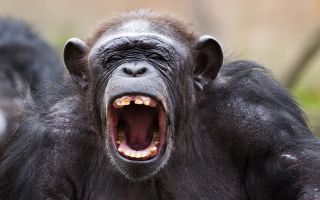
Poem: “The Ape in the Landscape”

Ape

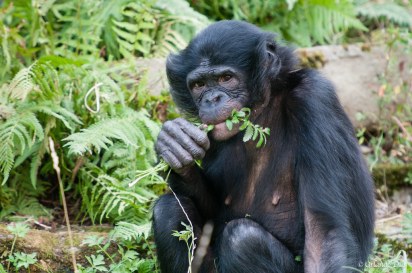
I. THE APE

Like a chimp in a storm
we revert to a norm,
tree-swinging, branch-breaking,
stick-shaking, noise-making;
each baby’s a bomb
and their poise and aplomb
is a jack-in-a-box
full of fireworks and shocks,
full of colour, noise, light
full of anguish, delight,
rending, mending and tending,
exploiting, befriending,
and losing and finding,
abusing and minding,
both stupid and clever
but moving forever,
and dancing and singing
thought-prancing, word-winging,
for there’s no escape
from the million year ape,
from our in-built, inherited shape.

II. EXTERNAL LANDSCAPE

Somewhere a cleft cliff overhang, a cave
where we can stay dry, have a fire, and sleep;
though lions and bears growl outside, we feel brave–
Worship the Cave, Earth’s Deep.

Somewhere, huge in an open plain, a tree–
to climb for refuge, or the whole world see,
loving its fruit, leaves, wood, its shade from glare–
Worship the Tree, Earth’s fountain into air.

Somewhere a river ends where sea’s begun
and marshlands hold vast clouds of birds and fish,
and moon and tides swing like the winds and sun–
Worship the Waters, fresh, salt, both Earth’s gifts.

Somewhere the lightning strikes, a forest burns;
only one thing runs to it, not away,
one creature uses it to make night day,
cook food, stay warm, make tools, dance round and play–
Worship the Fire, on which being human turns.

Somewhere the landscape most potential shows:
more people, and some wary bird or beast;
by integrating them the human grows
into the landscape’s richness, Nature’s feast–
Worship the Richness with which life’s increased.

III. INTERNAL LANDSCAPE

Climbing, foraging and hunting,
running, loping, chasing something–
we were built for this.

An open field with a large tree,
a path towards a far blue sea–
the landscape we think bliss.

Keeping dogs, cats, birds as friends,
sharing food for no clear ends–
extended family.

Pigs, cows, sheep, ducks, geese as pets,
eating them without regrets–
that’s humanity.

And talking, dancing, running, singing,
friends and lovers, parents, children,
social, single, energetic,
meditative or frenetic…
we’re a tribal ape at heart,
without the wild we fall apart,
the ape’s our essence, end as well as start.

This poem was just published in Snakeskin, a very appropriate magazine from the point of view of its name, whose meaning is spelled out in the Credo in its first issue back in 1995:

The serpent whispered unto Eve:
“Think and feel; don’t just believe.”
This made the earth’s foundations shake.
We are the kindred of that snake. (…)

We trust no level tones; we ride
The roller-coaster of our pride.
The gonads’ rage, and yearning’s ache
Speak through the kindred of the snake.

In other words, no matter how much we develop our civilisation, no matter how much we tinker with our genetics, no matter how much we turn our decision-making over to AI, we need to acknowledge and work with – and enjoy – the primitive drivers and needs that are inherent in our physical and psychological makeup.

In other words (this time Nietzsche’s), “Stay true to the earth, my brothers,” even while looking forward to the coming of the Superman, for we are still part ape, and our coheret progress depends on our awareness of that, and of self-knowledge in general.

Technically the poem is a mish-mash of forms, somewhat casual in structure by formal standards, but rich in rhythm and rhyme. And this too is in keeping with Snakeskin’s Credo:

Nor shall we sit to lunch with those
Who moralise in semi-prose.
A poem should be rich as cake,
Say the kindred of the snake.

Enjoy! And my thanks to Snakeskin’s George Simmers.

 

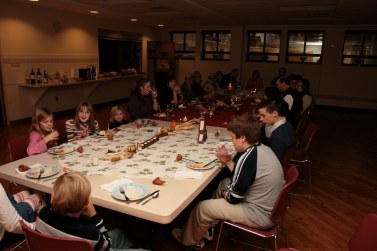
Poem: “Head of the Table”

Your grandparents die
And your children are born;
Then your parents die
Then grandchildren are born;
And you move one more seat
Round the mad table
To the head of the table,
At which point you’re expected to go.

As when the crow came
Wild, not tame – all the same
It cawed you the news
That confirmed death and time;
So when your time comes
And you feel in your bones
That the body is over
Where will you, the guest, go?

Then bring food and drink!
Glasses clink! Glance and wink
As you move to the brink
Of eternity.
Who knows what follows next?
“Afterlife” is absurd –
But then all life’s absurd –
We just know, when it’s time, that we go.

This is about as religious as I’ve found myself in the past 30 or 40 years – in other words, I waver between mild atheism (“None of this God stuff makes sense”) and militant agnosticism (“I don’t know, and neither do you.”) But at least you have a seat at the table! Enjoy the party while you can (preferably while being pleasant to others).

Originally published in Snakeskin No. 232 (or #232).

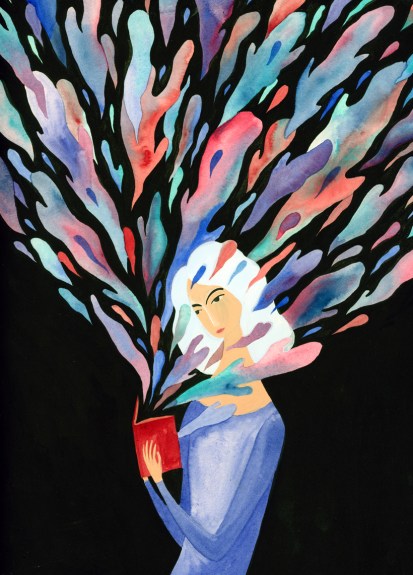
Poem: “Post-literacy”

Yes, I know it seems unlikely
but I simply can’t help feeling
there’s an urgency to writing:
and in verse, and fluently.

We’ve our cultural traditions
that have coevolved with language
and each language has its verse forms
that are aids to memory.

It’s all fine that we are moving
to post-literate existence
where the things all talk and tell you
everything you need, you must

when the neon signs and fridges
can discuss with you their content,
you don’t need to read or count, if
their integrity you trust.

But embedded in our braincells
are the patterns of our language
and our need to think in patterns
drives our songs, makes us a folk,

it gives dub and rap and hip hop,
it drives rhetoric in speeches,
and the false anticipation
of the punchline of a joke.

With our cultures integrating
with AI and with each other,
we risk losing all our history,
all our culture and, what’s worse,

Our minds! So sing to babies,
have kids memorise long poems,
learn the maths of songs and music –
learn and read and write in verse!

This poem, recently published in Bewildering Stories, speaks to the heart of the matters that this blog deals with. Songs and music, rhyme and rhythm, dance, melodies, alliteration and assonance, structures and patterns and verses and choruses, are all part of something that is deeply human. It starts for us with the heartbeat in the womb, is nurtured with lullabyes and rocking, carries on through the songs and music and dance that are important to every generation of teenagers. It is such a fundamental part of our humanity that educational systems that ignore it are ignoring a powerful natural teaching tool.

The issue is larger than the fact that learning verse by heart is easier than learning prose by heart. Larger than the benefits of developing the ability to remember and memorise accurately. It is about recognising and nurturing those inner forces that make us human. It is about not letting our humanity be eroded by a culture that doesn’t acknowledge the rhythms that permeate our lives.

This blog is about the value of formal verse. Part of that value is poetry’s contribution to the sanity that comes from being a complete human being.

Technically this poem’s lines could be described as iambic tetrameter, which each fourth line being truncated and rhymed. But I prefer to read it almost as a patter song with each line composed of two tertius paeons, Short-foot-meter.svg Short-foot-meter.svg Long-foot-meter.svg Short-foot-meter.svg (each fourth line still being truncated and rhymed). In other words, it is designed to have the third and seventh syllables in each line be the ones with the greatest stress or emphasis. And that includes the rhymes, naturally.

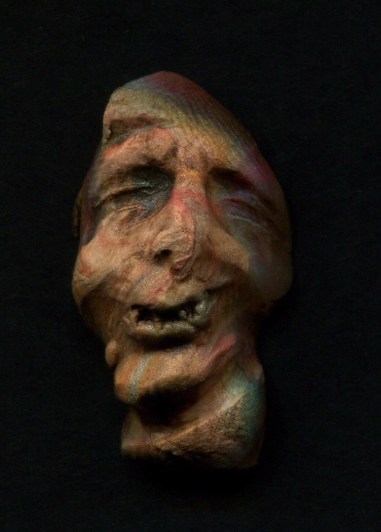
Poem: “Rubble Faced”


Because my mind and life’s so active
my face has been reduced to rubble.
I’m glad I think I’m unattractive –
it helps to keep me from worse trouble.

The Asses of Parnassus published this as their Valentine’s Day post in 2018. Thanks, Brooke Clark!

As for the truth of the poem, who knows. Maybe it applies to all of us to some extent, as we age?

Poem: “Seasonal”

When Mr. Warm-as-winter-under-the-covers
Meets Cool-as-summer-in-the-evening-breeze
He’ll spring to leave ideas they could be lovers –
But her thoughts fall away like leaves from trees.

First published in Lighten-Up Online.

Poem: “Post-Adult”

Adults — earthworn, careweary,
grave, gravid and gravity-constrained —
take it all so seriously, furiously, fearsome and wearisome,
spuriously furious over the small stuff,
incessantly never having enough,
insensibly insatiable, insensate,
irrational, irascible,
driven by status, riven by expense,
dismissive of all greater age and experience.

How fortunate to age into osteoporosis,
bones lightening like a bird’s as you get older,
the wearying weights lifting off the shoulder,
and you drift up into the sky with your levity,
leaving behind adult cares and gravity,
unattached, detached,
careful but careless, unlatched.

This poem was recently published in Bewildering Stories. But what is it, technically? Does it have any form? It has elements of form–alliteration, assonance, scattered rhyme, the kind of rhythm (in parts) that you find in rap with emphasis on stresses, not on syllables–but none of it is organized, structured, codified, repeated…

I think it could be improved. If I come up with a significant improvement, I’ll switch it out. But there’s always the danger that the later “improvement” loses primal energy for the sake of trying to achieve an intellectual outcome. As with Auden’s poetic progress. But a little more formal structure would be good, I think.

Poem: “Cinderella”

Cinderella

Cinderella, by Arthur Rackham

Every youngest daughter’s
Always Cinderella:
Never at the party,
Always in the cellar;

Tired of washing dishes,
Tired of sweeping dirt;
Wants to be a lady,
A scientist, a flirt;

Wants to travel world-wide,
Read till reading’s done;
Wants to be a mother,
Playing in the sun;

Wants to be the princess,
Beauty of the Ball –
Fairytales happen –
Watch, she’ll have it all!

First published in Lighten-Up Online (“LUPO”), the quarterly edited by Jerome Betts in the UK; republished in The HyperTexts, the massive anthology of poetry curated by Michael R. Burch. Good poets, both of them.

Poem: “The Knife of Night”

Dark Woods

“Dark Trees” by MonoStep

The knife of night
Spreads swirls of black and white
Over the slice of here.

The taste is bold:
A pinch of cold,
Spiced with primeval fear.

This little poem was first published in Candelabrum, a British print magazine that ran twice yearly from 1970 for some 40 years. Its editor, Leonard McCarthy, was a lone voice dedicated to keeping traditional poetic sensibilities of metrical and rhymed
verse alive.

The poem itself came from a nighttime ramble in the forests that cut through the residential areas of Chapel Hill, North Carolina. Hundreds of acres in town are undevelopable because of steep slopes, creeks and ravines. Where the night woods are unlit except by moon and stars, there are deer, possums, foxes, flying squirrels, owls… copperheads… poison ivy… The night is beautiful, but you can’t help moving through its darkness in a different state of being, compared with daylight.


Poem: “Zombie Apocalypse”

Zombie Apocalypse –
humans have always had
end-times fear: Ragnarok,
Judgement Day, World War III,
comet strike, Y2K,
supervolcano – well,
you get my drift.

Zombie Apocalypse –
there’s a pandemic and
AI has run amuck –
this is no practice round,
this is for real!

Zombie Apocalypse –
head for a tropic isle,
live on fish, coconuts –
solar will last a few
years, then corrode.

Zombie Apocalypse –
walls can be built without
concrete or plastering,
fight infestations of
zombies and dogs.

As the world splits in two
all the Enhanced are gone,
gone to the Cloud and space;
only the Left Behind
scrabble, deteriorate,
left in the dirt and ash,
left on the Earth.

I, the last poet am
here on Earth’s farthest beach,
toweled, not panicking,
waiting for Branson and
Musk in their ships.

Yes, humans love the threat of the end of the world, the collapse of civilisation, all apocalyptic disasters. We don’t want the disasters to be inflicted on us… but we love thinking about them. Perhaps it’s a way of thinking about our own mortality, without actually thinking that it is we who will die one day.

The Zombie Apocalypse is wonderful because it is both a complete fantasy (as in the photo) and an image for the kind of catastrophic real-world disaster that an out-of-control plague can inflict–a medieval Black Death killing a third of the population… an early 20th century Spanish Flu infecting a third of the world’s population (but “only” killing maybe 50 million)… or, of course, a coronavirus leaping out of a food market in Wuhan and spreading around the world before anyone can get a proper handle on it. Death is real. Around the world, 150,000 people die every day. What can you do but work to minimize death–and laugh at it?

And then there’s the fantasy of being one of the lucky few survivors, faced with the difficulties of a post-apocalyptic world, a post-nuclear Wasteland, a flooded Waterworld, a Biblical Left Behind, reminiscent of Nevil Shute’s On The Beach, John Christopher’s The Death of Grass (No Blade Of Grass in the US), even Ursula Le Guin’s post-alien-invasion City of Illusions. Carrying a towel like Ford Prefect to hitchhike through the galaxy, away from doomed Earth. Dramatically, heroically, surviving the destruction of the world as we know it. As though you can dramatically, heroically, survive the time-driven destruction of your body…

The poem itself (yet another one published in Bewildering Stories) is unrhymed, but written in a form inspired by double dactyls. Technically double dactyls are eight-line poems with a few additional requirements–the form was created by Anthony Hecht, Paul Pascal and Naomi Pascal in 1951, and popularized by Hecht’s and John Hollander’s collection Jiggery Pokery… the name of the book being a double dactyl, naturally. So this poem is only “inspired by” double dactyls. But, as with limericks, the bouncy rhythm adds to a mood of flippancy, frivolity, which is always suitable (in my mind) when discussing existential catastrophe. I tip my hat to Country Joe and the Fish for the I Feel Like I’m Fixin To Die Rag, and to all political cartoonists everywhere.

Life is short; enjoy each day.