Category Archives: Poetics

Poem: ‘Nymph’

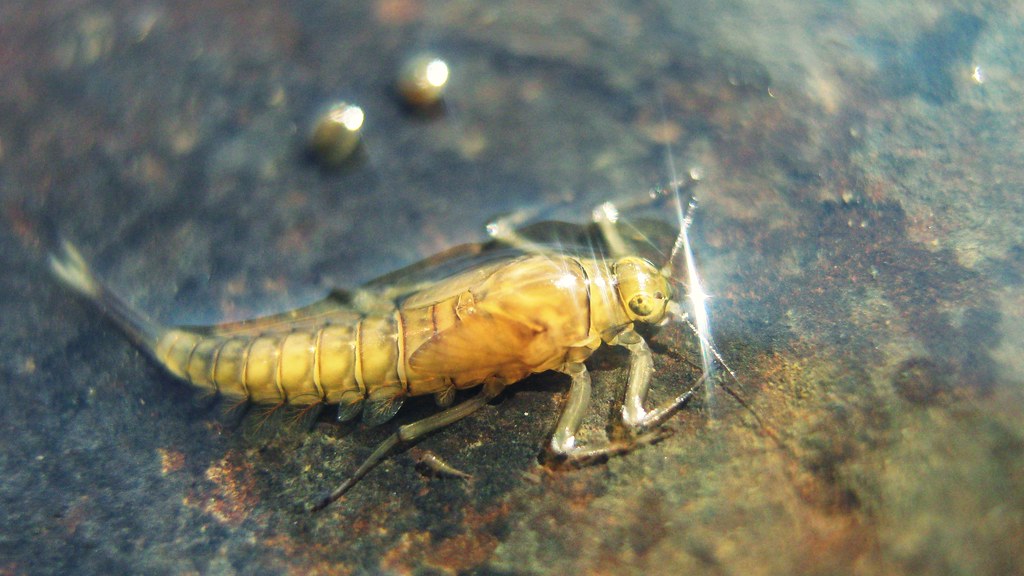
A mayfly nymph, in water for a year,
transforms into a beauty of the air
for just one day – one day to mate, breed, die.
The essence then’s the nymph, and not the fly
which we see only thronging in death throes,
death throes of riotous sex. Everyone knows,
though, that the fly’s the cycle’s pinnacle
to artists, if not to the clinical.
Though humans for long eons lived on land,
at Science’s Nietzschean precipice we stand,
transform to things that freely live in space,
or formless Cloud-based online lives embrace…
and may survive but briefly in that state,
but, dying, will seed new worlds as we mate.

Nature poem? Piece of science fiction? The observation of how nature works and a hypothetical extrapolation of human nature into the future are not really two different things – it’s all part of life, the universe and everything… though that future will be is anyone’s guess. The only thing for sure is that tomorrow is not going to be like today.

Is a 14-line poem in iambic pentameter a sonnet, if it just rhymes as couplets? I think not. This poem has a volta after the eighth line, but it still doesn’t feel like a sonnet to me. The feel comes from a couplet closing the poem out after a series of three quatrains, or from the shift from ABBAABBA to CDCDCD. That finalising shift, that sense of completion, is integral to the feel of the sonnet. This poem fails to meet that criterion.

‘Nymph’ was first published in the Orchards Poetry Journal, whose latest issue has just come out – free online, or available in print.

Photo: “mayfly” by ian boyd is licensed under CC BY-NC 2.0

Sonnet: ‘Drifting’

Drifting and drifting in an eddying stream
The leaf cannot recall the maple tree;
Pieces fall off; it has nor plan nor scheme;
How could a leaf have sense of destiny?
Its work is done; tree-feeding fades like dream,
Tree-making’s not a possibility.
It drifts and rots, nibbled by perch and bream
Or reaches finally the endless sea.

The sea itself moves, rhythmical and blind:
Is calm, or sprays salt as the waves make foam.
Seas have no will, no parliament of mind,
To make directives like hives make bees roam
To pollinate the world, defend their kind,
And with their mind create their honeycomb.

This sonnet drifts in several ways. The rhythm of iambic pentameter is meditative, rambling. The rhyme scheme is slow, repetitive, changing between the octave and sestet: ABABABABCDCDCD. And the ideas drift: the leaf is left behind when it reaches the sea, and the sea is abandoned for bees. The form seems suitable for the content.

‘Drifting’ has just been published in this month’s Snakeskin, whose editor commented “I like the way it moves from one idea to another that you don’t expect.” Thanks, George Simmers!

Photo: “Like a Leaf in a Stream” by Referenceace – Working! is licensed under CC BY-NC-SA 2.0

Poem: ‘Body Surfing’

Standing hip deep in the sea
Is nice in itself, but the reason for being there
Is the wait for a big wave.

A wave rising, a sudden tower
Smooth with devouring power
But one you can launch yourself forward in tune with – and
Hurtle ecstatic, unseeing and breathless
For as long as breath can hold
Through the water and up along over and onto the sand,
Sand thick in your hair, jammed in every fold,
Scraped, battered and rolled,
Triumphant, beached, deathless.

For this the saint prays,
For this the artist stares open-eyed,
For this the poet lets wounds bleed unstanched,
For this: this hope of being launched,
Controlled and uncontrolled
By what can’t be withstood or denied.

(Or else you could duck under the wall,
Let it pass over while you count three,
Hear the boom of its crested fall,
Yourself unbroken, inactive, safe, free.)

The sea is always there
Whether or not you are in it
Standing hip deep in it
Waiting for the next big wave.

Another of my “Is it formal?” poems. How much rhyme, rhythm and consistent structure do you need in order to consider it formal? Where is the cut-off between form and free? I don’t know. But I felt the alternation – between quiet waiting sections and the breathless rush of a good wave – was an appropriate expression in itself.

The poem was originally published in Snakeskin. Thanks, George Simmers!

“Superman body position while body surfing” by benaston is licensed under CC BY 2.0

Poem: ‘Warfare’

The mother’s nightmare
The child’s terror
The rapist’s freedom
The girl’s death.
The killer’s ecstasy
The band’s brotherhood
The youth’s excitement
The dying breath.

The glory of the lucky
The scream of the unlucky
The lost limbs, blindness, madness
The lifelong PTSD, homeless in the streets.
The poet’s puzzle
The politician’s porn
The aphrodisiac
The power-soaked sheets.

The demagogue’s cause
The demagogue’s solution
The warmonger’s profits
The fearmonger’s skill.
The blacksmith’s trade
The scientist’s incentive
The human fascination
The tribe’s need to kill.

The acceptance by the boys
The eagerness of teens
The avoidance by the men
The manipulation by the old.
The girl’s adoration
The woman’s greed
The widow’s grief
The body cold.

The king’s invocation
The priest’s sanctification
The scared population
The desolation.

The peasant’s loss
The trader’s loss
The teacher’s loss
The city’s loss.

The mortician’s gain
The tombstone maker’s gain
The coffin maker’s gain
The graveyard’s gain.

The medal maker’s gain.

And over it all God sits in His rocking chair
On His front porch in the sky
Saying, A crop, a very fine crop, an excellent crop this year.

Sits in His deck chair to look at the warfare waves
In the shade of a cloud in the sky
Watching the sandcastles washing away.

Sits in the night coming down on the battlefield
Watching crows, ravens, hyenas, stray dogs
Men and women pulling gold teeth from the dead.

Sits in His laboratory, looking at His guinea pigs
Sits in His concert hall, listening to the music
Thinking, All this is so interesting
All this is so tragic
All so inspiring
How far will they get till they blow themselves up?
Will these ones escape? Will they figure it out?
Can they conquer themselves and discover the universe?

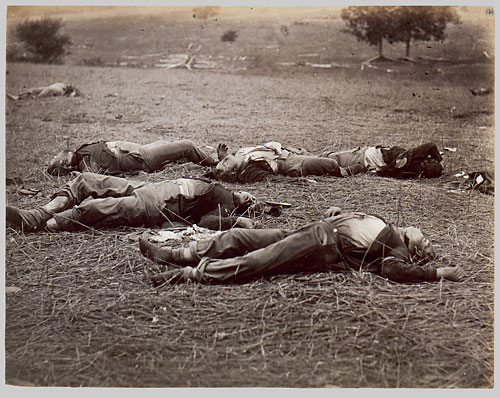
Maybe it’s out of line to put this poem into a ‘formal verse’ blog… But there are two points to consider. First, there is a lot of form in the outraged chant of the beginning half–rhyme, rhythm, balance, some alliteration. Second, transitioning from that form to a less structured meditation in itself a use of form; it transitions the entire poem from one viewpoint to another by making the two halves so different. That’s my argument, anyway. Is it reasonable?

The poem originally appeared in Bewildering Stories. Thanks Don Webb and John Stocks!

Photo: “Battlefield Dead After the Battle of Gettysburg” by elycefeliz is licensed under CC BY-NC-ND 2.0

Potcake Poet’s Choice: Daniel Galef, ‘Proverbs for Engraving onto Imperial Monuments’

War is the price of freedom. Depths bewilder.
The blow aimed at the beast hits him who shields it.
The sword of Justice best serves him who wields it.
The gibbet’s final victim is its builder.
A round coin rolls to him who most deserves it.
A tree outlives its leaves; an age, its fashions.
A carthorse needs its blinders; man, his passions.
The word of Justice best shields him who serves it.
The ardent spirit breaks the firm retort.
Power bears scrutiny like the sun the gaze.
God speaks His queer commands one thousand ways.
The worm awaits. The butterfly is dreaming.
The price of peace is bondage. Chains support.
Persuasion is a proof. Seeing is seeming.

Daniel Galef writes: “I majored in philosophy in college, and it’s very rare that I get a chance to use my degree in any way! (Even everyday critical thinking I engage in not without a little self-conscious embarrassment to be reliving those madcap cogitating days of my youth.) This sonnet began as an un-metrical list of aphorisms, vaguely inspired by Blake’s Marriage of Heaven and Hell, but with an eye less to individual ideas and more to “ideology.” I’m very interested in how philosophy is appropriated by the state, in the form of slogans or anthems or little red books—it’s all fine and dandy to debate competing theories of morality until it’s time to order the transplant waiting list, or convene the board of censors.

“I don’t always do a lot of surgical revision on a poem, but it was after about two years of lying in a drawer [a digital drawer] that I took the loose collection of prose sentences and started pruning, finding and inserting rhymes, and arranging them into pentameter. I’m a poor free verse poet, and verses that start off free end up in metrical shackles much more often than the reverse, even though logically it ought to be tougher to turn prose into verse than vice-verse-a.

“I could write a page on every line in this sonnet, which says much more about my own pretentiousness than about the poem, but will limit myself to saying I chucked in snips and snatches from Plato, Maimonides, Zhuangzi, Lucullus, David Hume, Thomas Jefferson, Aesop, W. H. Auden, Slavoj Žižek, Wernher von Braun, George Orwell, and Groucho Marx. Just about every maxim in the poem has certain levels, interpretations, or applications that I agree with and others which lead to perverse, abhorrent, or outright dangerous positions—which is of course what makes them so useful.

“The poem was published in Philosophy Now, a glossy magazine with a specialized readership but a glossy magazine nonetheless, and one of the highlights of the first summer after I graduated was driving to the Barnes and Noble in Clifton Commons and finding myself there on the shelf along with the movie tie-in reprints and tote bags with snarky quotations on them. It’s probably normal for most poems published, even in larger or well-respected publications, to go essentially unnoticed. I don’t hear back from strangers about the majority of poems I send out into the world and my meager stream of fanfiction is archived in an email folder I dip into when depths start to bewilder. Yet this is the poem that keeps coming back—and the comments I receive on it indicate that different readers draw very different conclusions from it. The year after it was published it was awarded second place in the “Best Poems of 2020” list at the Society of Classical Poets Journal. Someone sent me a Chinese blog where it had been translated into Mandarin, with (Google Translate revealed) a spirited discussion in the comments section as to whether the “blinders” were the same device whether the line was translated as “horse” or as “donkey” (the verdict: they are distinct: the blindfold put on a donkey driving a wheel totally blocks its vision, whereas the blinders put on a horse drawing a vehicle do so only selectively).”

Daniel Galef is a graduate instructor of English at Florida State University and Associate Poetry Editor of Able Muse. His poetry has appeared in Atlanta Review, Able Muse, Measure, The Lyric, Light, First Things, The Christian Century, and Philosophy Now. He is listed in Webster’s dictionary under the entry for “interfaculty (adj.),” which means “brilliant and handsome.” Besides poems he also writes short fiction, humor, and plays, with a story published last year in Juked just awarded a spot in the 2020 Best Small Fictions anthology. He is currently searching for a publisher for a debut poetry collection, Imaginary Sonnets.

More of his work is listed at http://goo.gl/mpRUrs

Poem: ‘Hail Deth’

Hail Deth, that from alle Natur’s birth
Hast kept each living thing thy thrall!
Teech me to love thy quiet call,
To rest
Among the blest,
To be at peace with every thing on earth.

Come soft, without impediment;
Let mee slide sleeping to thy armes,
Discover alle thy soothing charmes;
And kill
My every ill,
Leave mee uninterrupted sediment.

This is one of my very earliest poems, with the form, theme and erratic spelling all obviously influenced by studying the Metaphysical Poets in school. I’ve always been fascinated by death–at least since the time I gave up Christianity, thanks to my excellent Church of England schooling. The poem was written tongue-in-cheek, of course: I’m in no hurry to die.

‘Hail Deth’ has just been published in the Shot Glass Journal which, in accordance with Shakespeare’s “brevity is the soul of wit”, publishes both formal and free verse so long as a poem doesn’t exceed 16 lines. It also divides contributions into American and International groups and lists them separately, which is interesting if not necessarily useful in any functional sense.

Photo: “NS-01023 – Death Head” by archer10 (Dennis) is licensed under CC BY-SA 2.0

(Loosely) Anapestic Sonnet: ‘A Run’

Over the island from beaches this side where it’s blowing,
it’s only a mile to the side where today it’s flat calm;
so over the hill’s potholed tarmac, to tracks of sand going
along under southern pine, seagrape, gum elemi, palm;
and then between sea-oats and cocoplums over the dunes
and down to the beach where the sand is as dusty as powder,
then lower across the high tide mark that seaweed festoons,
to harder packed sand under sun hot as bird-pepper chowder —
the sand at the ocean low tide, flat and hard as a ledge,
so flat you don’t feel that you’re running the side of a slope
where the ocean runs up inches deep and you splash through its edge,
one more mile to the end, where the sand is as pink as fresh hope,
is as pink as a conch shell, as pink as the still morning skies —
and you rest on the rocks in the shade while the southern pine sighs.

Eleuthera, the island where I was raised and where I live, is long and skinny like many of the Bahama Islands. A hundred and ten miles long, mostly a mile or two wide. I live on the south side (local name), the west side (tourist name), the sea side, the Sound side, the Caribbean side. It’s a great run of a mile over a 60 foot hill to the north side (or east side, ocean side, Atlantic side). On the south side the sand is white, and all the way out to the horizon the water is only 20 feet deep or so. On the north side the sand varies from powdery white to coarse pink, and long before you got to the horizon you would be in 8,000 feet of water. You can tell immediately from a photo which side you’re looking at: vegetation, beach, colour of the water, they’re all different.

This poem was published this month in Snakeskin, edited for 25 years by George Simmers. He is receptive to both traditional and free verse, everything depending on what appeals to him at the time. This is good for me, because I am inconsistent with what I produce. With this one, I went for the rhythm, the da-da-dum, da-da-dum which may not be the sound one person makes when running, but for me captures the mood of running. I can’t define it more than that. And so long as that rhythm is in the heart of each line, I don’t have a problem with being a syllable short at the beginning, or having an extra one at the end, so long as it all flows from one line to the next without a big hiccup.

Political poem: Amanda Gorman’s ‘The Hill We Climb’, excerpts

First: a warning: I haven’t seen the printed version, but I have modified a transcription to try to catch the essence of the various types of wordplay that the poet engaged in, with bold for rhyme and italics for alliteration and repetition. These excerpts are from the earlier parts of her poem, skipping some less poetic portions.

When day comes we ask ourselves where can we find light in this never-ending shade?
The loss we carry, a sea we must wade.
We’ve braved the belly of the beast.
We’ve learned that quiet isn’t always peace.
In the norms and notions
of what just is
isn’t always justice.
And yet, the dawn is ours before we knew it.
Somehow we do it.

And yes, we are far from polished,
far from
pristine,
but that doesn’t mean
we are striving to form
a union that is perfect.
We are striving to forge
our union with purpose.
To compose a country committed to all cultures, colors, characters, and conditions of man.
And so we lift our gazes not to what stands between us,
but what stands before us.
We close the divide
because we know to put our future first, we must first put our differences aside.
We lay down our arms
so we can reach out our arms
to one another. We seek harm
to none and harmony
for all. Let the globe, if nothing else, say this is true.
That even as we grieved, we grew.
That even as we hurt,
we hoped.

That even as we tired,
we tried
that will forever be tied
together victorious. Not because we will never again know defeat,
but because we will never again sow division.

Scripture tells us to envision
that everyone shall sit under their own vine and fig tree and no one shall make them afraid.
If we’re to live up to her own time, then victory won’t lie in the blade,
but in all the bridges we’ve made.
That is the promise to glade
the hill we climb if only we dare. It’s because being American is more than a pride we inherit.
It’s the past we step into and how we repair it.
We’ve seen a force that would shatter our nation rather than share it.
Would destroy our country if it meant delaying democracy. This effort very nearly succeeded.

Amanda Gorman’s poem for President Biden’s inauguration was an extremely well received performance of Spoken Word. As the Wikipedia entry states, Spoken Word focuses on “the aesthetics of recitation and word play, such as the performer’s live intonation and voice inflection.” With its roots in preliterate societies, it searches for all possible tricks for both capturing the audience’s attention, and making it easier to memorise the words. Amanda Gorman did this extremely well in her recitation, with clarity and with effective pacing, pausing and emphasis, carrying the thoughts along in a chant-like flow of rhymes, half-rhymes, puns and alliteration. It was a superb piece of Spoken Word, and left listeners enthused and uplifted. It was perfect for the mood of the inauguration.

But it wasn’t flawless. In places either the transcription is flawed or the poet has sacrificed meaning for the sake of a rhyme. Take “even as we tired, we tried that will forever be tied together victorious”. There is a flow of suggestion that imparts a meaning, but looked at under a bright light the words sound like those of a drunk.

Or take the rhyme sequence “afraid, blade, made, glade”. OK, but I stumbled over “That is the promise to glade”. Perhaps she means “the promise to make an open clearing through the forested hill we are climbing.” My bias is that I think of a glade as a flat clearing in woodland–I didn’t see the meaning of the verb she created, I didn’t think of a hill being climbed as being forested, but that may all be my problem. Similarly, I like the rhyming of “inherit” with “repair it” and “share it”; but what does this mean: “We’ve seen a force that (…) would destroy our country if it meant delaying democracy.” This is clumsy. It’s not clear exactly what is being said. If “would” means “is intended to”, then presumably she should have inverted the phrase: the force wanted to delay democracy, even if it meant destroying the country. Yet it is clearly all part of a political message: the end of Trump’s deliberate White America divisiveness, a return to the modern world’s multiethnic inclusiveness. As she triumphantly ends her piece:

The new dawn blooms as we free it.
For there is always light.
If only we’re brave enough to see it.
If only we’re brave enough to be it.

So we have an inspiring piece of performance art, of spoken word, by a 22-year-old who has a lot of talent and a great stage presence. I’m sure we’ll hear a lot more from her. But I suspect that if her words are to last, she will have to develop a stronger control of meaning. The jagged nature of her lines is not a problem; the lack of structure to her rhyme is not a problem; in some ways she seems close to Old English and other Germanic poetry with their emphasis on a heavy beat (rather than a set number of syllables), and a long way from the “modern poetry” that, without metre or rhyme, tries to get an effect by being laid out provocatively on a page.

Amanda Gorman is an interesting but unformed poet, and a superb presenter. You can see the recitation here towards the bottom of The Guardian coverage. And the full transcript is here.
Odd poem: ‘When I Was Fair and Young’, by Queen Elizabeth I

When I was fair and young, and favour gracèd me,
Of many I was sought, their mistress for to be;
But I did scorn them all, and answered them therefore,
‘Go, go, go, seek some otherwhere,
Importune me no more!’

How many weeping eyes I made to pine with woe,
How many sighing hearts, I have no skill to show;
Yet I the prouder grew, and answered them therefore,
‘Go, go, go, seek some otherwhere,
Importune me no more!’

Then spake fair Venus’ son, that proud victorious boy,
And said, ‘Fine Dame, since that you be so coy,
I will so pluck your plumes that you shall say no more,
‘Go, go, go, seek some otherwhere,
Importune me no more!’

When he had spake these words, such change grew in my breast
That neither night nor day since that, I could take any rest.
Then lo, I did repent that I had said before,
‘Go, go, go, seek some otherwhere,
Importune me no more!’

Elizabeth (Ms. Tudor, if you prefer) was born in 1533 and became Queen of England at age 25, in 1558. This poem dates from some three or four years later, and the painting above is from the same time. Given how youthful she looks in her late 20s, the poem may be more playful than self-pitying–but she was also well past the age that sex and marriage would have been expected. As it was she had had to lead an extremely careful life: England was weak and unstable when she came to the throne: her father Henry VIII had broken with the Pope and formed the Church of England; her older sister Mary, on becoming Queen, had turned the country back to Catholicism and Elizabeth had narrowly escaped death as a traitor; Elizabeth inherited a country where people were burnt at the stake for not being of the correct faith… but the correct faith kept changing.

By her late 20s the Court was trying hard to have her married to a powerful European monarch to strengthen the country by alliance. The Catholic Philip II of Spain was one possiblity, the Lutheran Erik XIV of Sweden was another. Again, everything involved a religious balancing act. Meanwhile flattering portraits showing vitality and power were created and exchanged as part of the negotiations–and Elizabeth sent her court painter to Sweden to paint Erik. But for whatever reason she never married. In 1588 Philip attempted a full scale invasion with his Armada, but that failed as well. Elizabeth died in 1603 aged almost 70, still nicknamed (though probably unfairly) ‘the Virgin Queen’.

Regarding the poem: technically, the first three lines of each stanza are in iambic hexameter and are followed by an uneven refrain. The first two lines rhyme, and the third rhymes with the end of the refrain. It looks very singable. There is some unevenness in the scansion, and Elizabeth has marked the midpoint of most of the hexameters with a comma; this divides the line into two natural clauses or parts, and also signals a little pause for the sake of smooth reading–particularly useful in the shortened second line of the third stanza and the lengthened second line of the fourth.

Photo: Painting of Elizabeth I in 1562, probably painted by her court artist Steven van der Meulen, or his workshop.

Sonnet: ‘The Poem’

Poems are merely words you can remember
word for word. Question: What makes them so?
Think of the earliest nursery rhymes you know,
held from child’s January to old December:
rhymes, rhythms, imagery—rich as meringues.
Then complicate discussion, don’t reduce
odd imagery, words foolish, strange, diffuse—
aim for rijsttafel with tongue-tingling tangs.
Use richness to engage the memory:
conflicting quotes from Bible, Shakespeare, Yeats,
with Bach-like sense of heaven’s opening gates
or hall of mirrors, or sun-scattering sea…
Mesmerized readers have to puzzle out
in memory mazes what it’s all about.

My firm belief is that poetic structures originate as nothing more than memory aids, so that a work can be recited word for word. This was invaluable in preliterate societies and was used for tribal histories and spiritual revelations (Muhammad was illiterate, and the most powerful passages of the Quran are in strongly rhythmical rhyme) as well as for lullabyes and love songs. But the use of our human love of rhythmic beat, and our enjoyment of rhyme and wordplay, have helped verse develop into elaborate, engaging, memorable forms, varying by culture because of the different opportunities of the different languages. Enjoy the diversity, and the complexity!

This sonnet, like ‘The Four Duties‘, has just been published in the Winter 2020 edition of The Orchards magazine of formal poetry.

Photo: “Indonesisch Rijstafel” by johl is licensed under CC BY 2.0