Category Archives: poets

Potcake Poet’s Choice: ‘Squelch’ by Nina Parmenter

I heard the squelch of death again –
or was it just a neuron firing
deep within my boggy brain,

or possibly a cell expiring
down amongst a mucus mess?
It could have been my heart perspiring

(that may be a thing I guess)
or, deep down in the adipose,
the squealing of a fat-lump pressed

to serve as fuel, and I suppose
it might have been a small mutation –
‘Pop!’ (we get a lot of those),

a bronchiole’s sharp inhalation,
‘Hiss!’ a membrane’s gooey breath,
a bile-duct’s bitter salivation…

Probably, it wasn’t death.


Nina Parmenter writes: “I had such a good time writing this poem. For a start, I got to have a lovely little geek-out researching a few anatomical details. I do like writing poems which require a little research, and biology seems to be a favourite subject at the moment. With bronchioles and bile ducts firmly in place, I granted myself permission to fill the rest of the poem with as many gooey, yucky words and noises as I pleased. And who wouldn’t enjoy doing that?

To compound the pleasure, I wrote the poem in terza rima form – such an elegant, flowing puzzle of a form, and one of my favourites to write in.

Honestly, this is one of those poems that I wish had taken me longer, because I didn’t want the (slightly dark) fun to stop.”

Nina Parmenter has no time to write poetry, but does it anyway. Her work has appeared in Lighten Up Online, Snakeskin, Light, The New Verse News and Ink, Sweat & Tears, as well as the newest Potcake Chapbook, ‘Houses and Homes Forever‘. Her home, work and family are in Wiltshire. Her blog can be found at http://www.itallrhymes.com. You can follow the blog on Facebook at http://www.facebook.com/itallrhymes
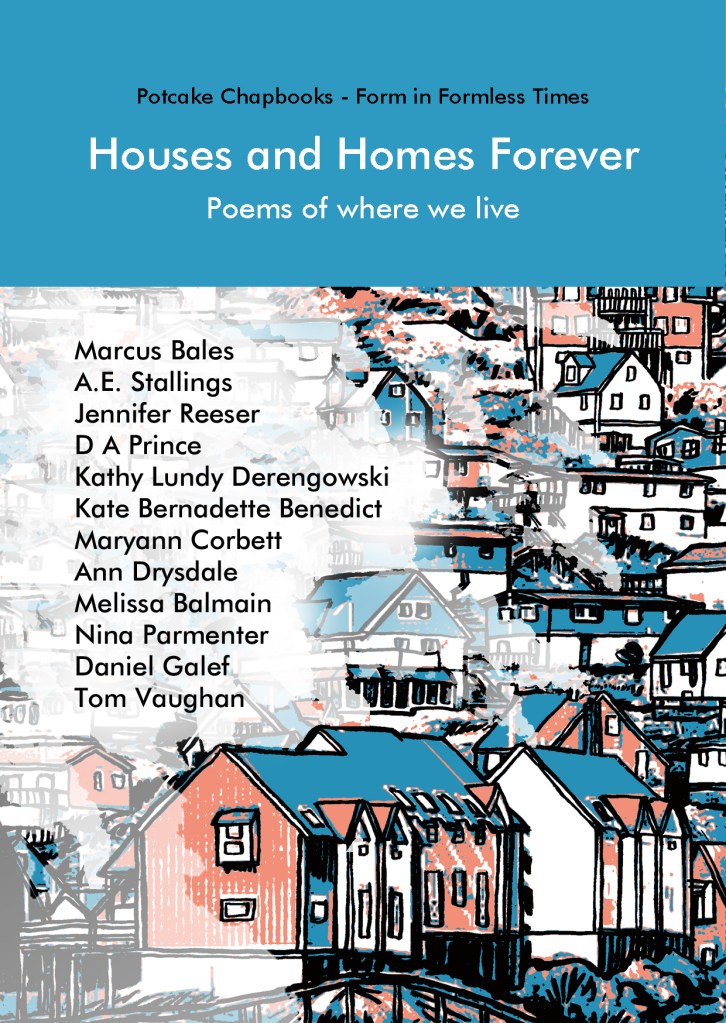

Launch: Potcake Chapbook 8, ‘Houses and Homes Forever’

Home is where you hang your hat, as they say, but it’s more than that. It can be a place of endless work and frustration, or a place of peace and relaxation and deep, strong memories. Houses and homes are part of what makes us who we are.

These poems–all formal, of course!–are as usual in a variety of forms. They were authored by Potcake newcomers Melissa Balmain, Kate Bernadette Benedict, Kathy Lundy Derengowski, Nina Parmenter and Jennifer Reeser, and returning contributors Marcus Bales, Maryann Corbett, Ann Drysdale, Daniel Galef, D A Prince, A.E. Stallings and Tom Vaughan. And well illustrated, as always, by Alban Low.

For the price of a fancy greeting card you can, through the wonders of PayPal, get this 16-page chapbook online for £2.60 + £1.20 P&P to a UK or European address, or £2.60 + £2.20 P&P to a Worldwide address; the seven earlier chapbooks in the series are available as well.

An overview with photos and bios of all the Potcake Chapbook poets is here, all having a home in this big, rambling house.

Odd poem: Jimmy Carter, on dead people voting in Georgia

‘Progress Does Not Always Come Easy’

As a legislator in my state
I drew up my first vote to say
that citizens could never vote again
after they had passed away.

My fellow members faced the troubling issue
bravely, locked in hard debate
on whether, after someone’s death had come,
three years should be adequate

to let the family, recollecting him,
determine how a loved one may
have cast a vote if he had only lived
to see the later voting day.

My own neighbors warned me had gone
too far in changing what we’d always done.
I lost the net campaign, and failed to carry
a single precinct with a cemetery.


Jimmy Carter’s collection of poems ‘Always a Reckoning’ is unexpectedly good for a politician, and it was a best seller when published in 1995. And this particular poem is not only amusing, but it resonates strangely with 2020 presidential election, and claims of fraud in the Georgia results. It would appear from the poem that Georgia politics is more honest than it was in the 1960s, anyway.

Jimmy Carter followed a bizarre and contradictory path in politics, always having been firmly committed to racial integration and equality, but having to constantly support people like Alabama segregationalist George Wallace in order to get elected. Then, once elected, trying to move the state’s politics in a direction that many of his backers did not like. Whether things played out the way they are presented in the poem is not something I can determine from a superficial review of his career. But it’s a fun poem, anyway.

Photo: “39 Jimmy Carter” by US Department of State is marked with CC PDM 1.0

Review: ‘Selected Poems’ by Louis MacNeice

Louis MacNeice was born in 1907. By his early 30s he had published four volumes of verse (as well as other material), sufficiently good and well-received for him to publish this early selection in 1940. The tone is set with the opening lines of the first piece, ‘An Eclogue for Christmas’:

A:  I meet you in an evil time.
B:                                The evil bells
    Put out of our heads, I think, the thought of everything else.
A:  The jaded calendar revolves,
    Its nuts need oil, carbon chokes the valves,
    The excess sugar of a diabetic culture
    Rotting the nerve of life and literature.

Throughout the book we have the passage of time with the deterioration of society, culture and one’s own life, expressed in a blending of old and new images, in rhyme. They are poems of the 1930s, of the Great Depression and the imminent war, all from the same man, all on the same theme.

And yet one or two stand out: ‘The Sunlight on the Garden’ is one of the best poems in the English language, casting a spell with its dazzling intricate rhymes sustained over four stanzas, insightful, wistful, immediately memorable, endlessly anthologised. It relates specifically to his first wife having left him – he wrote this “love-song” for her after their divorce was finalised.

The sunlight on the garden
Hardens and grows cold,
We cannot cage the minute
Within its nets of gold,
When all is told
We cannot ask for pardon.

‘Bagpipe Music’ is also very commonly anthologised because of its bounce, cynicism and humour:

The Laird o' Phelps spent Hogmanay declaring he was sober,
Counted his feet to prove the fact and found he had one foot over.
Mrs. Carmichael had her fifth, looked at the job with repulsion,
Said to the midwife 'Take it away; I'm through with over-production'.

A good question, then, is why these two poems stand out against the rest in the book. What makes them so successful, with their very different moods? I think their common quality, largely lacking in all the other pieces, is that they are very easy to learn by heart and recite, they are almost singable even on a first reading. Pure poetry.

Odd Poems: Thomas M. Disch, ‘A Child’s Garden of Grammar’

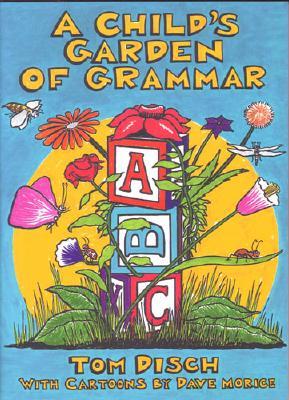
Thomas M. Disch (1940-2008) was a New Wave Science Fiction author, poet, theater critic, computer game designer, and much else. Not surprising, then, that his Grammar is a strange book. Sadly, it’s not really informative for either the grammar-beginner (it’s too obscure) or the grammar-expert (there’s nothing new). It has odd poems, some nice and simple like ‘Either/Or’:

Either and Or came to a door.
Either would enter, but not before Or,
So still they stand outside that door,
But now their names are Neither and Nor.

Some playing little games, as in the explanation of ‘The Indirect Object’:

I have to hand it to you, dear:
You’re the indirect object here–
Along with Thelma, Hank and Hugh.
I tip my hat to all of you.
You’ve set a fine example to me–
But I don’t get it, and I’m gloomy.

OK, so “to you” is the indirect object… and “I” can’t be an indirect object, it can only be a subject… Cute, but rather spoiled for me by the rhyme of “to me” (which I unthinkingly stress on the last syllable, as with all the previous lines of the poem) but then, having to rhyme it with the next line’s “gloomy”, have to go back and reread to get the rhyme…

And every poem is illustrated with simple cartoons by Dave Morice. If you’re addicted to strange, by all means buy it. To me it’s just an oddity, and without either the visual or verbal charm of other cartoon-illustrated short poetry collections such as Piet Hein’s Grooks. But after all, Disch is best-known for his SF, not his verse.

Review: James Joyce, ‘Pomes Penyeach’

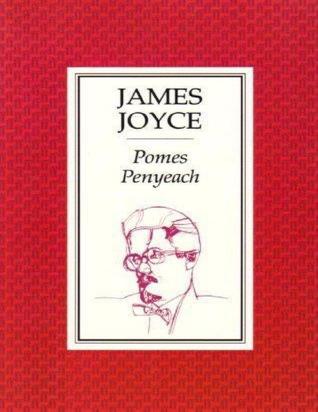
That James Joyce would have written and published formal poetry seems out of keeping with his image of the writer of chaotic language (as in how he chose to spell his work’s title rather than Poems, a penny each), but the poems he wrote in the early 20th century are in the language of the time… moderated by his rich words.

Wind whines and whines the shingle,
The crazy pierstakes groan;
A senile sea numbers each single
Slimesilvered stone.

His poetry is often repetitive, but occasionally rich and memorable. (Another of his slim volumes, “Chamber Music”, is arguably more interesting than “Pomes Penyeach”.)

Pomes Penyeach was so small–14 poems of less than a page each–that when Faber republished it they added three more pieces: The Holy Office, Gas from a Burner, and Ecce Puer. The first two are early, crude and bombastic multi-page rants against poets and publishers:

Thus I relieve their timid arses,
Perform my office of Katharsis.

Ecce Puer (“Behold the Boy”) is a later light, sweet meditation on his newborn grandson:

Young life is breathed
On the glass;
The world that was not
Has come to pass.

You never know quite what you’re going to get with Joyce, and that in itself is one of the pleasures of reading him.

Odd poems: Tennyson dialect verse, ‘The Northern Farmer’, Old Style and New Style

Wheer ‘asta beän saw long and meä liggin’ ‘ere aloän?
Noorse? thoort nowt o’ a noorse: whoy, Doctor’s abeän an’ agoän;
Says that I moänt ‘a naw moor aäle; but I beänt a fool;
Git ma my aäle, fur I beänt a-gawin’ to breäk my rule.

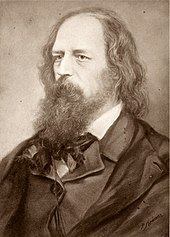
This is the opening stanza of Alfred, Lord Tennyson‘s poem ‘The Northern Farmer: Old Style’. The farmer is dying, but obstinately overrules the doctor’s order that he not drink any more ale, just as he obstinately clings to traditional attitudes towards land and class, farming and money.

Where have you been so long and me lying here alone?
Nurse? You’re no good as a nurse; why, the doctor’s come and gone:
Says that I mayn’t have any more ale; but I’m not a fool;
Get me my ale, because I’m not going to break my rule.

It’s one of a series of poems he wrote that recapture the dialect of his Lincolnshire youth, and that reflect the old traditions and the modern changes of that part of the country. It is paired specifically with ‘The Northern Farmer: New Style’–Here the “new style” farmer, out in a cart with his son Sammy, hears the horse’s hooves clip-clopping “Property, property” and chides his son for not thinking enough about money:

Me an’ thy muther, Sammy, ‘as been a’talkin’ o’ thee;
Thou’s beän talkin’ to muther, an’ she beän a tellin’ it me.
Thou’ll not marry for munny–thou’s sweet upo’ parson’s lass–
Noä–thou ‘ll marry for luvv–an’ we boäth of us thinks tha an ass.

Seeä’d her todaäy goä by–Saäint’s-daäy–they was ringing the bells.
She’s a beauty, thou thinks–an’ soä is scoors o’ gells,
Them as ‘as munny an’ all–wot’s a beauty?–the flower as blaws.
But proputty, proputty sticks, an’ proputty, proputty graws.

or, in more modern words:

Me and your mother, Sammy, have been talking of you;
You’ve been talking to mother, and she’s been telling me.
You don’t want to marry for money–you’re sweet on the parson’s daughter–
No, you want to marry for love–and we both think you’re an ass.

Saw her today going by–Saint’s day–they were ringing the bells.
She’s a beauty, you think–and so are scores of girls,
Those with money and everything–what’s a beauty?–a flower that fades.
But property, property sticks, and property, property grows.

Tennyson was meticulous in trying to recapture the life and language of his youth. He wrote:

When I first wrote ‘The Northern Farmer’ I sent it to a solicitor of ours in Lincolnshire. I was afraid I had forgotten the tongue and he altered all my mid-Lincolnshire into North Lincolnshire and I had to put it all back.

And apart from the accuracy of the dialect, Tennyson was as skilled as ever with his carefully conversational metre, and natural rhymes working comfortably with the natural breaks of the lines.

The Nobel Prize for Literature: Louise Glück

Archaic Fragment

I was trying to love matter.
I taped a sign over the mirror:
You cannot hate matter and love form.

It was a beautiful day, though cold.
This was, for me, an extravagantly emotional gesture.

…….your poem:
tried, but could not.

I taped a sign over the first sign:
Cry, weep, thrash yourself, rend your garments—

List of things to love:
dirt, food, shells, human hair.

……. said
tasteless excess. Then I

rent the signs.

AIAIAIAI cried
the naked mirror.

Source: Poetry (January 2006)

So Louise Glück has won the 2020 Nobel Prize for Literature, “for her unmistakable poetic voice that with austere beauty makes individual existence universal.” This is all very well–she has powerful insights, strong images, and these translate well into other languages. But as an advocate of the use of poetic tools inherent in language–rhyme and rhythm in particular, for English–I can’t classify the expressions of her poetic voice as poetry.

The simplest touchstone is this: How easy is it learn the passage by heart, to recite it word for word from memory? Because that is why we developed the tricks of poetry, the different rhythms for different moods, the different forms for different levels of complexity. Poetry is song with the emphasis shifted from the melody to the words; but the music is still there in shadow form.

It is very hard to keep the actual poetry when a poem is translated from one language to another. It is easy enough to translate the insights and imagery, but what of the music of the language? It can be done by a skilful translator, but the fidelity is often compromised to remake the poetry. Yeats was very free with the French of Pierre de Ronsard when he wrote

When you are old and grey and full of sleep,
And nodding by the fire, take down this book,
And slowly read, and dream of the soft look
Your eyes had once, and of their shadows deep;

but he captured the poetry and made it into one of his own best-loved pieces. James Joyce translated the German of Gottfried Keller as

Now I have fed and eaten up the rose
Which then she laid within my stiffcold hand.
That I should ever feed upon a rose
I never had believed in liveman’s land.

It’s Keller, but it’s also poetry, and with Joyce’s own voice. Glück indeed has a voice, but how simple is it to learn her work and recite it word for word, compared with the Yeats or Joyce work above? And if you learn it by heart, will you still be able to recite it verbatim years later? I think not. So I submit that her work is not poetry.

That doesn’t mean that it isn’t literature. It just means that we need a word for such work, writing that is too poetic to be called prose, but too prosaic to be called poetry. Poetry needs its undercurrent of song. When the Nobel Prize was being awarded for poetry, Bob Dylan was a far wiser choice than Louise Glück.

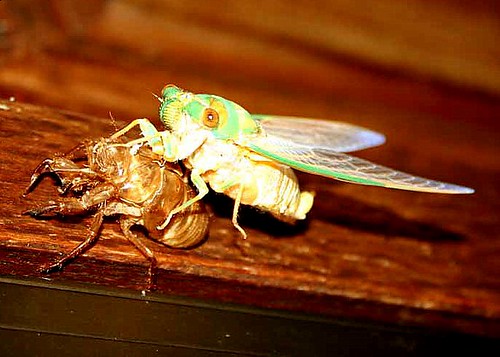
Poem: ‘Chrysalis’

After a billion years of larval hit-and-miss
humans emerged, stood up, and fed, and grew,
started to build their city chrysalis
from which, 3,000 years entombed, now formed anew,
they burst in wild bright flight with wings deployed
out to the stars. The egg case of this final birth,
the Earth,
was, naturally, destroyed.

We have good news and bad news. The bad news is that the rate of change is ever-increasing in all aspects of human life–from our bodies to our planet–and we will never return to the old normal. The good news is that this is the process by which life advantages to higher levels of organisation and intelligence.

This poem was originally published in Star*Line, one of the two magazines of the Science Fiction and Fantasy Poetry Association (SFPA). The other magazine is Eye to the Telescope (ETTT).

The poem rhymes and is written in iambics; but the rhymes are not structured to a pattern, and the lines are of uneven length. This casual form is used by Matthew Arnold and T.S. Eliot among others, in some of my favourite poems such as A Summer Night (I have always loved the three paragraphs beginning with:

For most men in a brazen prison live,
Where, in the sun’s hot eye,
With heads bent o’er their toil, they languidly
Their lives to some unmeaning taskwork give,
Dreaming of naught beyond their prison wall.
)

and The Love Song of J. Alfred Prufrock. The form doesn’t have the musicality of more regular forms like the sonnet or limerick, but it provides all the memorising strength of rhythm and rhyme within a more conversational flow, and facilitates different lengths of thought including, if wanted, a punchline.

We live in difficult times, what with the unprecedented challenges of climate change, mass migration, infectious diseases, unpredictable technological advances in weaponry, and more. And the problems will continue to multiply and get larger, even as we develop solutions to the smaller, simpler ones. And from the inevitable destruction of our form of life will emerge… what? We cannot know, we probably cannot even imagine.

Photo credit: “Cicada emerging from old exoskeleton” by Shek Graham is licensed under CC BY-NC 2.0

Review: “The Listeners and other poems” by Walter de la Mare

The poem ‘The Listeners’ is one of de la Mare’s best–evocative, ghostly, inconclusive, easy to read and to recite.

‘Is there anybody there?’ said the Traveller,
Knocking on the moonlit door;

It justly appears in any short sampling of his work. Several of the other poems in this collection are of that quality, mostly those of portraits of individuals: Old Susan, Old Ben, Nod the Shepherd

Softly along the road of evening,
In a twilight dim with rose,
Wrinkled with age, and drenched with dew,
Old Nod, the shepherd, goes.

and, at the other end of life, Little Louisa in ‘The Keys of Morning’:

The thinness of his coal-black locks,
His hands so long and lean
They scarcely seemed to grasp at all
The keys that hung between:

Those poems are all at the beginning of the book, and after them the poems degenerate into unequal attempts to catch the evocative spirit.

De la Mare produced a lot of verse. If a dozen or two of his poems are memorable, that is a remarkable achievement that (almost) anyone writing verse would be proud of. And the way to reach those one or two dozen is to write down everything that occurs to you, good or bad, and then to work on it as best you can. There is no way to decide “Today I will write a good poem” and produce it unless you are already in an appropriate state of mind–inspired, or bemused as it were. But to not write when a line or thought occurs to you is to turn off the taps of creativity. So all must be written.

No one should fault a poet who has produced verse good enough to sell, when they a) continue to write material of uneven quality, b) continue to publish it. It is a good process for keeping the lines of communication open with the muse, and hopefully producing even better work in future.

As for this particular collection: I like the first 13 poems, and the title poem. I forgive the rest.