Author Archives: Robin Helweg-Larsen

Unknown's avatar

About Robin Helweg-Larsen

Director, Andromeda Simulations International, Bahamas: a global education company providing online and in-person workshops in business finance. Series Editor, Sampson Low's 'Potcake Chapbooks'. Formal verse about traveling, family, love, etc...

RHL, ‘Boy With Scab’

The boy he’s always been still takes delight
In testing scabs on elbows, knees,
To see if fingernails can assert their right
To lift with satisfying ease
The lid from off the mystery healing box
And see the flesh beneath the skin
Where the wise body-mind slowly unlocks
Corpuscles and white pus within.
The hint of pain, like some itch that you scratch,
Is fun alongside look-and-see.
What does the boy do with that useless patch,
The scab? Easy: autophagy.

*****

Curiosity is a useful aspect of intelligence. This poem first published in Lighten Up Online (aka LUPO). Thanks, Jerome Betts!

Photo: “War Stories” by Noël Zia Lee is licensed under CC BY 2.0.

Poems on poems: Ogden Nash, ‘The Collector’

I met a traveler from an antique show,
His pockets empty, but his eyes aglow.
Upon his back, and now his very own,
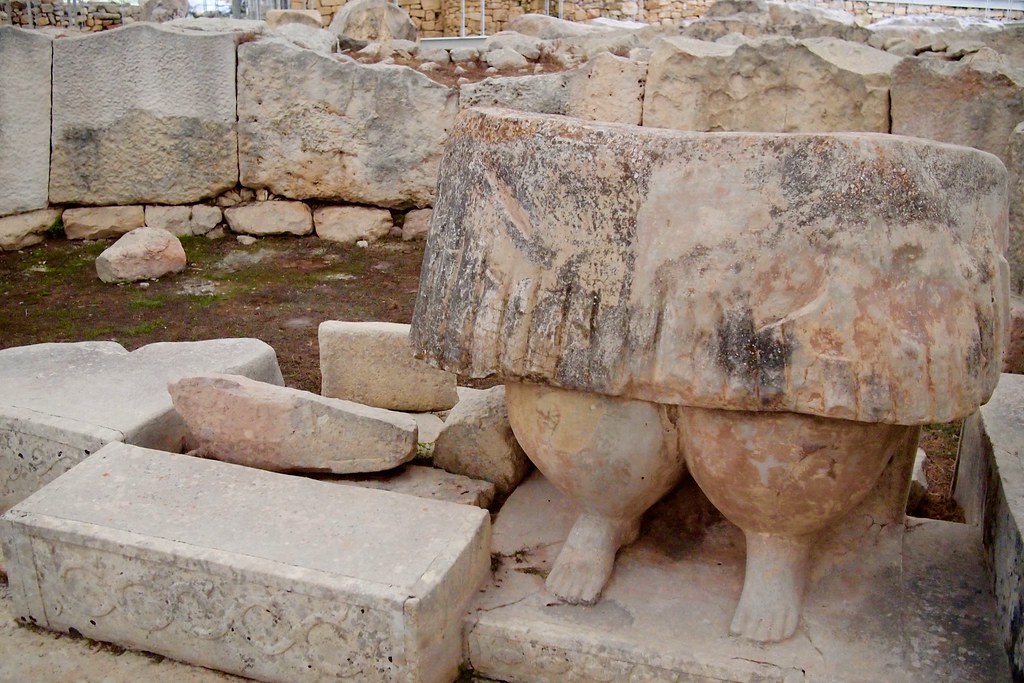
He bore two vast and trunkless legs of stone.
Amid the torrent of collector’s jargon
I gathered he had found himself a bargain,
A permanent conversation piece post-prandial,
Certified genuine early Ozymandial
And when I asked him how he could be sure,
He showed me P. B. Shelley’s signature.

*****

Ogden Nash‘s teasing take on Shelley’s Ozymandias is collected in ‘The Old Dog Barks Backwards’.

Photo: “Two vast and trunkless legs of stone” by skittledog is licensed under CC BY-NC-SA 2.0.

Unforgettable nonsense: Anon, ‘I Eat My Peas With Honey’

I eat my peas with honey;
I’ve done it all my life.
It makes the peas taste funny,
But it keeps them on the knife.

*****

The staying power of well-turned nonsense rhymes is testament to the value of rhythm and rhyme for keeping something intact, perfectly remembered. The poem’s joke is well done, with a good punchline; but the word-for-word memorability comes from the magic of verse.

The Poetry Foundation recognises this poem as having been recited in the American comedy/quiz show ‘It Pays to Be Ignorant‘ on 2nd February 1944 (or more likely 7th February 1944), you can hear Harry McNaughton read it here, and my guess is that he (or another of the show’s writers) was the author. Apparently some people have thought it was written by Shel Silverstein (1930-1999), but this is denied by his Estate and its archivists. Others in the US have stated it is by Ogden Nash. In the UK it has been labeled as Spike Milligan’s. It is an object lesson in optimistic (i.e. false) attribution. But even in Arnold Silcock’s collection ‘Verse and Worse’ (Faber & Faber, 1952) it is only credited to Anonymous… whose birth was a long time ago, and whose death is not expected any time soon.

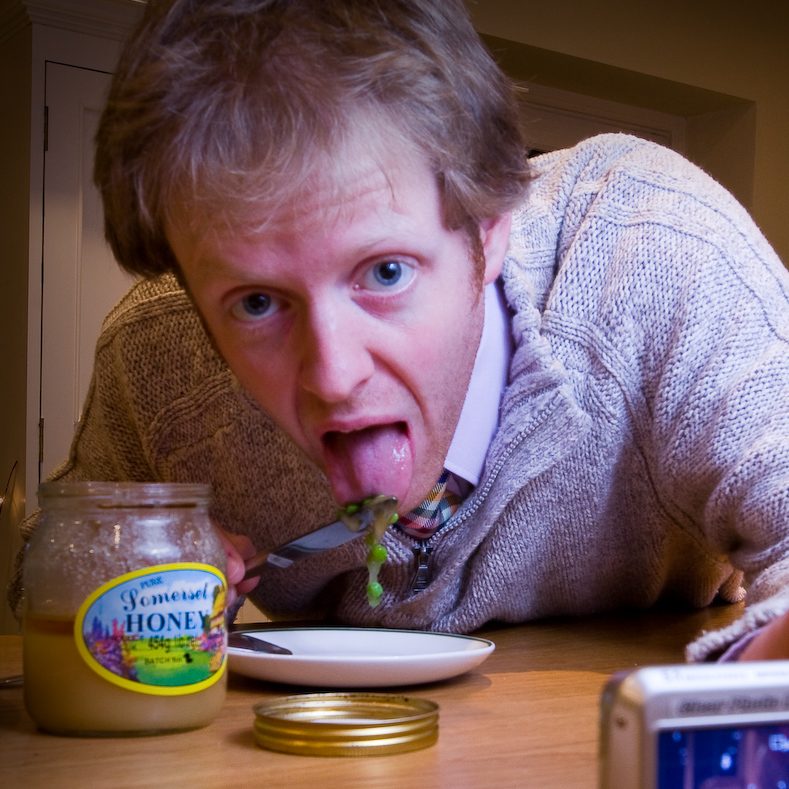
Photo: “I eat peas with honey – Day 101 of Project 365” by purplemattfish is licensed under CC BY-NC-ND 2.0.

Resources, updated: 50 formal-friendly poetry magazines

It can be difficult for a formalist to find a home for their poetry. Some of the best-known and longest-established poetry magazines have either changed (often under a new editor) from being receptive to being hostile towards formal verse (e.g. Ambit, in the UK); others are receptive, but only to already well known poets (e.g. Poetry, in the US). For what it’s worth, here is a list of places where I have been able to publish 400 of my own uneven and very varied pieces (plus several where I’m still unpublished, but you may be a better fit), with some comments about what is appropriate for where.

14 Magazine – UK: 14-line poems… sonnets etc.
32 Poems – US
Alabama Literary Review – US: lyrical, positive; only takes snailmail submissions (unless you have a genuine need for email)
Alchemy Spoon – UK
Allegro – UK: contemporary, looking for more formal submissions than they receive
Amethyst Review – US: “with a connection to spirituality and the sacred”, meaning very Christian
Amsterdam Quarterly – Netherlands, English-language: must address the issue’s theme
Asses of Parnassus – Canada: short, witty, formal poems, snarky is fine, hosted on Tumblr.
Bad Lilies – UK
Bewildering Stories – Canada/UK/US: speculative and science fiction pieces
Blue Unicorn – US: prefers formal but will take other work
Bombay Literary Magazine – India
The Borough – Australia: new in 2024, committed formalist
Brazen Head – UK: ideas-rich
Carmen et Error – UK: “a poem and a mistake”…
Cerasus – UK
Chained Muse – US: prefers classical themes
Consequence – US: addressing the impact of war
Consilience – UK/US/Canada: poems on science (themed)
Crow and Cross Keys – UK: speculative, gothic, folk… should sound as good as it reads
Dawntreader – UK: “myth, legend; in the landscape, nature; spirituality and love; the mystic, the environment”
Empty House – US: abandoned spaces (mental and physical), historical sense
Eye To The Telescope – US: SF, themed: Nov 2024 is “(Non-)Binaries”
Grand Little Things – US: “Returning versification to verse”
Griffith Review – Australia: themed
iamb – UK: audio recordings
Juniper – Canada: would like to see more formal submissions
Libretto – Nigeria: prefers African/Afro-American/Afro-European/post-colonial pieces
Light – US: large biannual issue, also the home of weekly topical light verse
Lighten Up Online (LUPO) – UK: light formal verse, quarterly
Lyric – US: “Founded in 1921, The Lyric is the oldest magazine in North America in continuous publication devoted to traditional poetry.” Lyrical, positive… flowers and countryside.
Magma – UK: themed (‘Ownership’ for November 2024)
Metverse Muse – India: publishes simple traditional verse. No website. The email for editor Dr. Tulsi is metverse_muse@yahoo.com
New Criterion – US: conservative
New Verse Review – US: new in 2024, impressive
Obsessed With Pipework – UK: “strangeness and charm… prefers dreams to deathbeds”
Orbis – UK: (Editor may suggest/request multiple edits, but will accept your decision.)
Orchards Poetry Journal – US: more rural than urban
Oxford Poetry – UK
Penwood Review – US: religious streak
Poetry Porch – US: lyrical
Pulsebeat Poetry Journal – US: more urban than rural
Rat’s Ass Review – US: irreligious streak; whatever appeals to the editor, including NSFW things you can’t get published elsewhere.
Rattle – US: large print circulation, a variety of different opportunities
Road Not Taken: The Journal of Formal Poetry – US: hard to find online because of its name, but a good small publication for formal and semi-formal verse.
Shot Glass Journal – US: max 16 lines, equally weighted between US and international poets
Snakeskin – UK: probably the longest-established poetry zine in the world; has no interest in submission bios, only in the poems; likes work that begins light and becomes heavier.
Sonnet Scroll – US: a sonnet-specialized alcove on the Poetry Porch
The HyperTexts (THT) – US: an enormous assemblage of verse from all times and places; the editor’s personal preference for formal and leftist verse doesn’t rule out selections by Walt Whitman or Ronald Reagan! The works are mostly republications, but if you have a body of strong work the editor may be interested in creating a page for you.
Think – US: formalist, conservative, Christian
Verse-Virtual – US: a monthly publication for a caring community of poets
Visions International – US: I’m not sure what the status is of this magazine these days, or who is editing it…
and finally:
Wergle-Flomp Humor Poetry Contest, No Fee – US: $3,750 in prize money

This list doesn’t include magazines not relevant for me (like Mezzo Cammin: An Online Journal of Formalist Poetry by Women), or that moved away from formalism and no longer publish me (like Ambit, and Star*Line), or that have unfortunately folded (14 by 14, Better Than Starbucks, Bosphorus Review of Books, Candelabrum, The Rotary Dial, Unsplendid), or that show no apparent interest in formal verse in current issues despite their guidelines (3rd Wednesday, Westchester Review).

And there must be a lot of worthy magazines that I simply haven’t run across – let me know!

And of course, as ever, don’t just fire off a handful of poems at random – read some samples online, determine the magazine’s orientation and moods, check whether the editor wants anything particular, note whether they love or loathe attachments, etc…

Good luck!

Photo: “Magazines” by theseanster93 is licensed under CC BY-SA 2.0.

Unforgettable nonsense: Samuel Wilberforce, ‘If I Were a Cassowary’

If I were a cassowary
On the plains of Timbuctoo
I would eat a missionary,
Cassock, bands, and hymn-book too.

*****

Yes, cassowaries are from Australia and New Guinea, and Timbuktu is in Africa… but so what? The rhymes are too good to ignore. ‘Bands’, btw, refers to the pseudo-necktie thingies that priest-types and lawyer-types affect in some countries – little cloth flaps, plural because you wear two of them.

The probable author is Bishop Samuel “Soapy Sam” Wilberforce, best known nowadays for debating  Thomas Henry Huxley on evolution in 1860. Huxley (Aldous Huxley’s grandfather) was commonly referred to as ‘Darwin’s bulldog’. Wilberforce is remembered for his question as to whether it was through his grandmother or his grandfather that Huxley considered himself descended from a monkey. Huxley is said to have replied that he would not be ashamed to have a monkey for his ancestor, but he would be ashamed to be connected with a man who used his great gifts to obscure the truth.  Apparently everyone enjoyed the debate, and they all went off happily to dinner together afterwards.

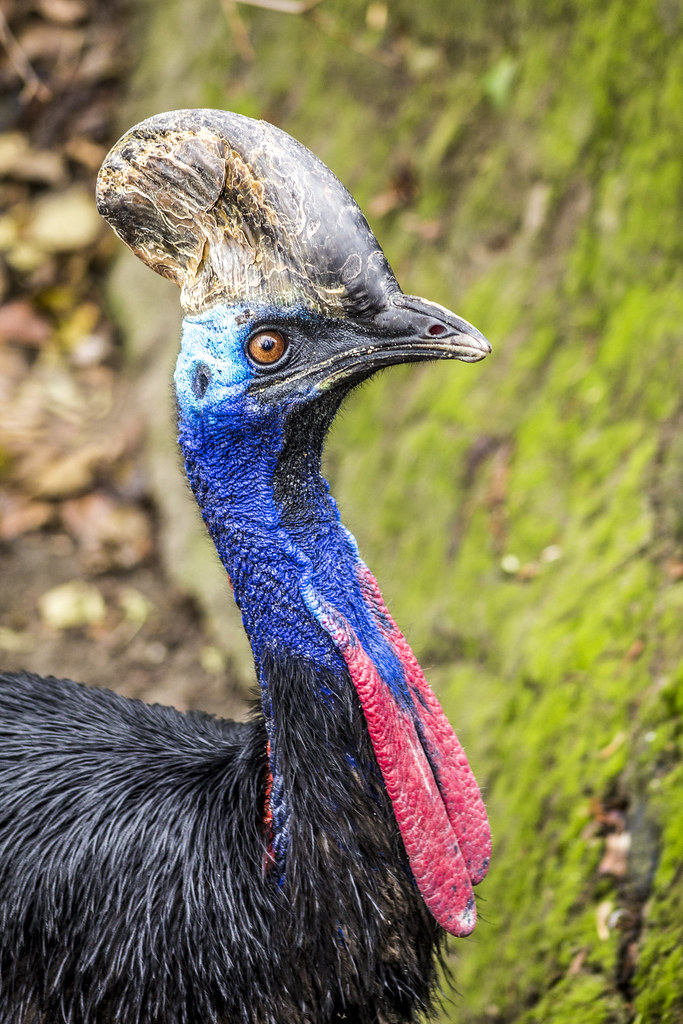
Cassowaries are more formidable than either Wilberforce or Huxley. Standing over six feet tall, capable of running at 30 mph (and good swimmers in rivers and sea), and able to leap and strike chest-high with razor-sharp 5-inch talons, they are omnivores not to be confronted. Yes, they might well eat a missionary. Also, the cassowary’s bands are more impressive.

Photo: “Cassowary at the Budapest zoo” by brenkee is marked with CC0 1.0.

Terza Rima: Louise Walker, ‘The Swing’

I hold you on my lap; I think you’re dead.
Next to us hangs a rusty, creaking swing.
I look down as my white dress blooms with red.

Such fun to pull the seat right back, then fling
it free. You’re two, I’m four, so I’m to blame;
now I’m screaming bloody murder to bring

someone to the garden to witness my shame
where swaying grimly like a tolling bell
the swing is the proof of the deadly game.

It’s a story my mother liked to tell
while tracing the faint white mark on your brow:
how she found me soothing you after you fell.

The truth is, I can’t remember why or how
I hurled that dead weight directly at you.
Did she wonder at all, as I do now

if I pushed it so hard because I knew
the swing’s unpredictable to and fro
showed love and jealousy can both be true?

You never reproached me, but even so
I still bear the scar of that reckless throw.

*****

Louise Walker writes: “The Swing was my second effort at writing a poem in terza rima; my first was a complete disaster, written in response to an assignment set by Cahal Dallat during a course I did with Coffee-House Poetry earlier this year. That novice attempt followed the rules of the form perfectly, with 3-line stanzas rhyming aba  bcb  cdc   ded  efe fgf gg. However, my poem was pompous, stilted and vacuous. It also took me an entire day. The next morning, a memory from early childhood came to me and I thought I would try terza rima one more time. To my surprise (and joy!) the poem called ‘The Swing’ came very quickly, was a pleasure to write and didn’t require my usual endless revisions and tweakings. What’s more, I found that the terza rima form became a little engine for generating my poem – for example, searching for a rhyme for ‘you’ threw up the word ‘fro’ which made think of the swing as a metaphor for the oscillating feelings of a child when a younger sibling arrives. I also found that the chain-like effect of the form, swinging back for rhymes, and then forward, suited the subject matter perfectly. Deep in my subconscious, the terza rima form had been working its magic overnight!

I was not at all delighted to get the terza rima assignment at first, but I learnt such a valuable lesson: sometimes one has to write a really bad poem to be able to write a decent one. ‘The Swing’ became an important poem in my recent debut collection ‘From Here to There’ published by Dithering Chaps, which has at its core my journey from childhood, through the death of my brother in our twenties, then onwards.”

Louise Walker was born in Southport and now lives in London. After reading English at Magdalen College, Oxford, where she was a member of the Florio Society, she taught English for 35 years at girls’ schools. Her work has been published in journals such as Acumen, Oxford Poetry, South, Prole and Pennine Platform. Highly Commended in the Frosted Fire Firsts Award and longlisted in in The Alchemy Spoon Pamphlet Competition, in 2023 she was shortlisted in the Bedford Competition and won 3rd prize in the Ironbridge Poetry Competition. Commissions include Bampton Classical Opera and Gill Wing Jewellery for their showcase ‘Poetry in Ocean’. She has recently published her debut collection with Dithering Chaps:
https://www.ditheringchaps.com/from-there-to-here
Instagram @louise_walker_poetry

Photo: “The Garden Swing” by theirhistory is licensed under CC BY-NC-SA 2.0.

Sonnet: Richard Fleming, ‘Sunny Afternoon’

Book discarded, like excess baggage shed
by someone who has rapidly pushed on
into uncharted regions far ahead,
he sleeps in an old deck chair on the lawn.
Gulls circle, skaters on an ice-blue lake,
while he dreams on, oblivious, his face
unshaded by a hat which, when awake,
he wears with equanimity and grace.
What does he dream? Is the unreal more real
than those pale gulls that spiral high above?
In sleep, has youth returned? No longer frail,
does he relive time when impatient love
was everything and all his heart desired,
before life tricked him, left him old and tired?

*****

Richard Fleming writes: “I suppose Sunny Afternoon reflects my own station in life, that is, drifting steadily towards the end, with the usual collection of regrets that most of us have.”

Richard Fleming is an Irish-born poet (and humorist) currently living in Guernsey, a small island midway between Britain and France. His work has appeared in various magazines, most recently Snakeskin, Bewildering Stories, Lighten Up Online, the Taj Mahal Review and the Potcake Chapbook ‘Lost Love’, and has been broadcast on BBC radio. He has performed at several literary festivals and his latest collection of verse, Stone Witness, features the titular poem commissioned by the BBC for National Poetry Day. He writes in various genres and can be found at www.redhandwriter.blogspot.com or Facebook https://www.facebook.com/richard.fleming.92102564/

Photo: posted by Richard Fleming

Sonnet: Eric McHenry, ‘Lives of the Poets’

They rubbed two sticks together and made friction.
They made a fist but couldn’t make a hand.
Their dictionary wasn’t made of diction.
Their diction made them hard to understand.

Trying to make a poem, they made a list.
Trying to make the team, they made the choir.
They made up stories whose protagonist
would rub two sticks together and make fire.

Mistakes were made, and mixtapes to go with them.
They made a couch their bed and made their bed.
They tried to make a joke at the expense
of love and money. “Make me,” money said.
They made up stories but they made no sense.
They rubbed two cents together and made rhythm.

*****

Eric McHenry writes: “Strangely, I remember almost nothing about writing this poem, except that I was thinking about the etymology of ‘poet’ (‘maker’) and about the versatility of the verb ‘make’.”

‘Lives of the Poets’ was first published in Literary Matters.

Eric McHenry is a professor of English at Washburn University and a past poet laureate of Kansas. His books of poetry include Odd Evening, a finalist for the Poets’ Prize; Potscrubber Lullabies, which received the Kate Tufts Discovery Award; and Mommy Daddy Evan Sage, a collection of children’s poems illustrated by Nicholas Garland. He lives in Lawrence, Kansas, with his wife and two children.
Eric McHenry – The Waywiser Press
Eric McHenry, Author at The American Scholar

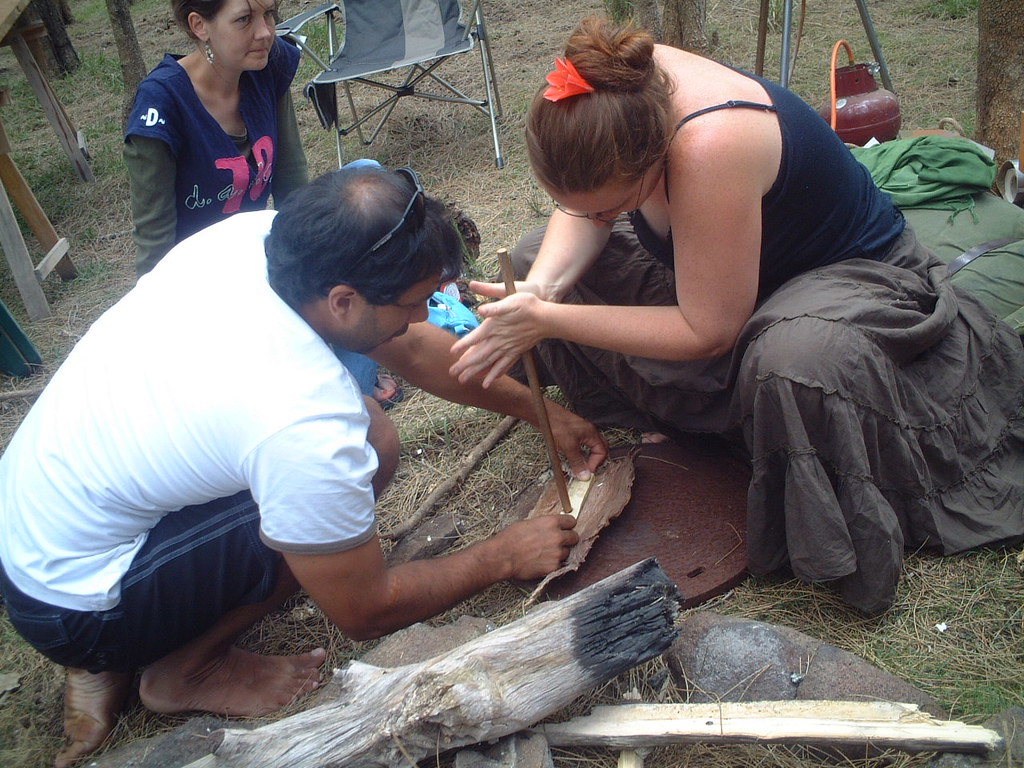
Photo: “Master Sacha twirls the fire stick” by one thousand years is licensed under CC BY 2.0.

Sonnet: RHL, ‘Communication Breakdown’

I love you with that love floppy and large,
As one of us a man – the other, dog;
Involved, detached, our life’s a travelogue
Of countrysides seen from a rented barge,
“Travels With You” along some river’s marge,
Failing at interspecies dialogue
Till tries at talk are lost in night and fog,
Drifting with batteries we can’t recharge.

Yet there’s no option but to travel on,
Each varied day no different than before,
Wondering if we’ll find some magic door
Which, risking entry, gives communion;
And if, by talking, love would be enhanced,
Or if we’d then destroy all we have chanced.

*****

Sonnet originally published in Candelabrum in 2007.

Photo: “Accordion player” by eltpics is licensed under CC BY-NC 2.0.

Armen Davoudian, ‘Coming Out of the Shower’

I shut my eyes under the scalding stream,
scrubbing off last night’s dream,
when suddenly I hear your voice again
as though it caught in the clogged drain

and was sent bubbling back up from the other
world where you’re not my mother.
This time, it’s really you. I’m really here.
I blink. We do not disappear.

Dad left, you say, to shower at the shop
so I don’t need to stop
just yet—and yet I do, unable to
resume old customs, unlike you.

In a one-bath four-person household, we
learn what we mustn’t see,
growing, in time, so coolly intimate
with one another’s silhouette

behind the opaque frosted shower screen
that once more stands between
us two. While at the mirror you apply
foundation and concealer, I

wash out my hair with rosewater shampoo,
which means I’ll smell like you
all day. Mama, I shout, I’m coming out,
and as you look away I knot

around me tight your lavender robe de chambre,
cinching my waist, and clamber
out of the tub, taking care not to step
outside the cotton mat and drip

on the cracked floor you’ve polished with such zeal
we’re mirrored in each tile.
Yet, you’d forgive spillage, or forget.
What else will you love me despite?

*****

‘Coming Out of the Shower’ by Armen Davoudian is reprinted with permission from Tin House Books from the book The Palace of Forty Pillars (2024). The poem was originally published in Literary Matters.

Armen Davoudian is the author of the poetry collection The Palace of Forty Pillars (Tin House, US; Corsair, UK) and the translator, from Persian, of Hopscotch by Fatemeh Shams (Ugly Duckling Presse, US; Falscrhum, Germany). He grew up in Isfahan, Iran, and is a PhD candidate in English at Stanford University.

Shower Silhouette” by tausend und eins, fotografie is licensed under CC BY 2.0.