Category Archives: Robin Helweg-Larsen

Sonnet: ‘Where Are The Lightning Bolts’

Where are the lightning bolts of poetry?
The rolls of thunder and the shattered oaks?
Where, beyond anger, is the ecstasy?
There must be more than parodies, kitsch, jokes–
Elvis-on-velvet, kittens in a room,
jibes at the Lords, the House, the Holy See,
unmetered waffling on a flower in bloom…
Come now, tap Earth’s potential energy!

Our planet on which tens of millions die
from some war, ’flu, government famine, plague–
we pillage land and sea, yet learn to fly
while stories, music, art, reshape the vague
into sublime, emotional or vatic…
Humans can’t last – so be brief, be ecstatic!

Here we are, putting the chaos of 2020 behind us, moving optimistically into the forever-changed and forever-changing future. The storm gods appear to rule our lives: our ape cousins respond in their way, and we should respond to the bigger forces we feel with the wider range of creative outlets that we have–dance, poetry and ecstasy are all appropriate!

This sonnet was first published in The Orchards Poetry Journal, edited by Karen Kelsay Davies who also heads up the four imprints of Kelsay Books. Technically it’s a Shakespearean sonnet by the rhyme scheme, but there is no particular significance in that. Sonnets of all kinds share the compression to 14 lines, and the volta, the redirection of discussion after the halfway mark, and, typically, the sonorous rhetoric of the iambic pentameter. But the driving need of the argument and the near inevitability of the best words will tend to move the rhyme scheme into one form or another. It is better to say powerfully what the poem demands, rather than to weaken the words by trying to strengthen a preconceived rhyme scheme. As elsewhere, “Go with the flow” has a logic to it here.

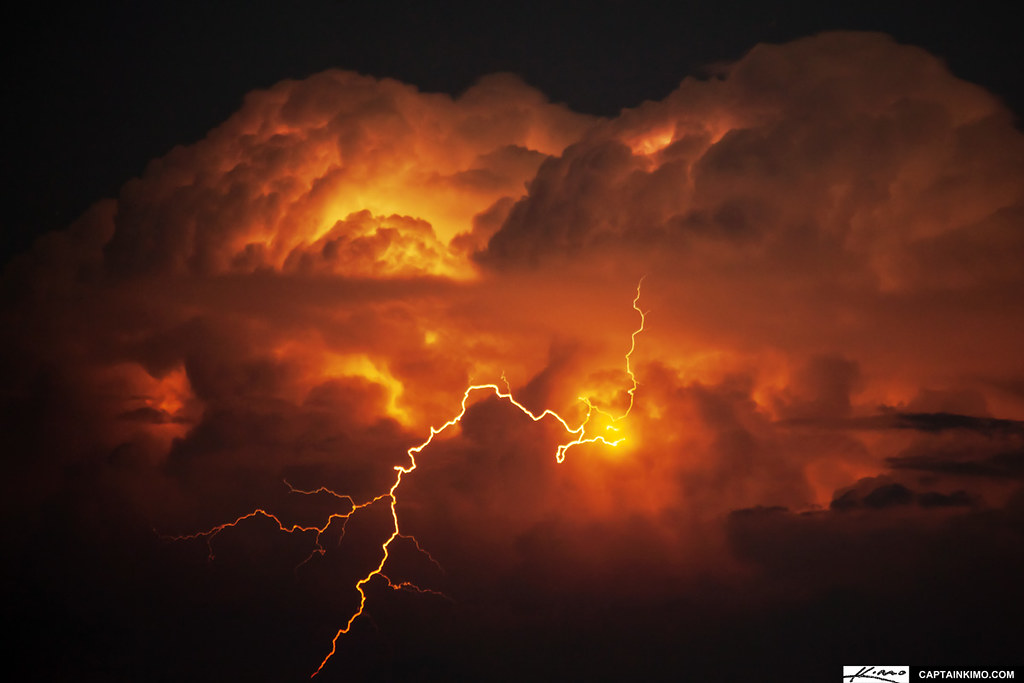
Photo: “Lightning Bolt Over Atlantic Ocean from Jupiter Coast” by Captain Kimo is licensed under CC BY-NC-ND 2.0
Poem: ‘Humankind at Dusk’

It’s in your newsfeed update every day:
The AI obsolescence on its way,
Replacing all tasks, everything we do.
There’ll be no need for people. That means you.
How much is merely existential dread
And how much knowledge of a road ahead:
Unlit, black ice, and your tires have no tread?

With the world stage held by strutters
While the UN talks and mutters.
They’re all out of date tut-tutters.
People in the street
Stand there angry, with lips pursed,
Feeling they’ve been conned, coerced,
Life has gone from best to worst.
Blame the rich elite.

Man, man, think fast:
With the AI racing
And our genes debasing,
Basic humans’ place in
Life won’t last.

Warnings now the TV utters:
Hurricane! But we’ve no shutters,
Power is out, the candle gutters,
Roofs are blown away.
Thrown into the storm head-first
No response can be rehearsed,
Save yourself though you be cursed:
Everything’s in play.

Man, man, think fast:
With the Hive replacing
Every human trace in
Life, be self-effacing
Or be past.

The rest ride the AI-bombs down the sky,
Waving their Stetsons: “We’re all going to die!”
Life always moves on from the old to new.
There’ll be no need for people. That means you.

‘Humankind at Dusk’ was originally published in the Speculative Fiction & Verse zine Bewildering Stories. It reflects my serious concern that we have no idea where we’re going as a species, with everything from genetic modification to brain implants now becoming a reality. Not that I object to it, any more than I object to hurricanes or earthquakes; they’re all part of the nature of things. As humans, we tinker, experiment, explore, run into problems, seek solutions, create all kinds of new problems, and so on. That’s just the way it is.

Technically, I was trying to replicate the nonce structure of a much earlier poem I wrote, ‘Camelot at Dusk‘, to see if this was a form that I could use when trying to create a sense of urgency and disaster bracketed within more reflective and dispassionate statements. So the opening and closing stanzas are in that nice and boring, meditative iambic pentameter; while the middle pieces switch back and forth between two other forms, with shorter, choppier lines and more repetitive rhyme. I created the form to meet the needs of the earlier poem, where I think it worked very well. I’m still (years later) pondering whether it was appropriate to try to reuse the form for this piece. I think I like it, but I’m not entirely sure.

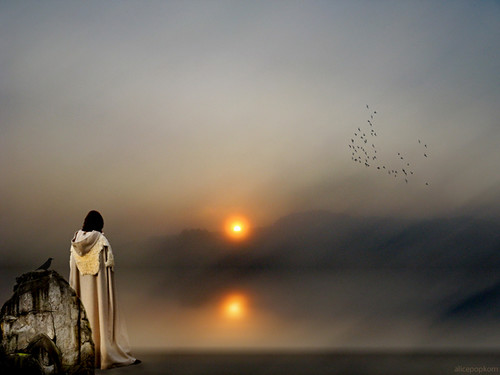
Photo: “silence” by Cornelia Kopp is licensed under CC BY-ND 2.0

Poem: ‘Hobo’

Come you young gunsel and sit by my fire of old skids.
They don’t like you in school, not the teachers and not other kids.
You’re different, I know it, you’re wise in that body of yours
that has grown past their rules and your parents’ commandments and chores.
Have a smoke, have a drink, you can tell me of pills that are new.
Here you’re safe in the open, I’m staying a night, maybe two.
We can share all you want, for the sadness you know I have known,
and the paths that you fear are the strictures that I have outgrown
and the dreams in your mind I now live on the paths that I roam,
for the life that I live is a life where the world is my home.
So go home, go to school, and come back in the evening again.
I’ll be here for a while, until I get on the next train
and you’ll stay, more mature, and experienced in a new world –
or you’ll come on that train, and you’ll see the whole country unfurled –
and you’ll end up like me, and your friends will be such as you were.

This poem was originally published in Rat’s Ass Review, a long string of poems both formal and free, ordered alphabetically by author. As suggested by its name, the magazine’s editors don’t give a rat’s ass for anyone’s opinions or objections, they publish whatever appeals to them. You will find a random mix of work, much of it edgy, much of it about sex and love and death.

I don’t think of myself as a hobo–although, yes, I have jumped a freight train as part of my hitchhiking 25,000 miles on four continents, back before I became a respectable management consultant… But I have great affection for W.H. Davies, a fine nature poet and the author of the superb ‘Autobiography of a Super-Tramp‘.

‘Hobo’ has elements of anti-establishment and counter-culture; and they in turn are part of the human social animal’s constant dialogue between alienation and the search for community. Or, say, about wanting to be free but still have friends. Technically it is written in anapaestic pentameter–each line having five feet of da-da-DUM (with casual exceptions, of course). I don’t have a strong sense of this being the most appropriate metre for this piece, but it feels conversational and flowing. It’s comparatively unusual for me, I normally write in iambics. But the form of a poem is determined for me by the first phrases that occur to me, and that is presumably what happened here.

Photo: “Hobo sitting on a fence, ca.1920 (CHS-1428)” by  is licensed under CC BY 2.0

Poem: ‘Winter Night Roads’

Full midnight moon on fields that yield but snows,
Air apple-clean, crisp, sweet
In lungs and nose,
The only sound your feet
Past silent woods –
Inhaling moods and modes
Of midnight roads.

In twenty minutes, you hear only this:
A dog bark twice. An owl hoot once.
A horse snort by a fence.
Some heavy breath behind a hedge: a cow.
A mile away a car’s lights show, then go.
You walk unknown, alone, towards some place
With light and life, perhaps a warm cafe
To make a break in travelling towards day.

This quiet little winter poem (sorry about the timing, Australia…) was first published in The Orchards Poetry Journal. The editors tend toward the bucolic and the formal… but they make exceptions, thank goodness, because this piece is not quite formal. It may be in iambics, but without a pattern to the line length or to what rhyme there is.

But it’s true to the winter outdoor experience–and pleasant enough, so long as you have good boots and adequate clothes!

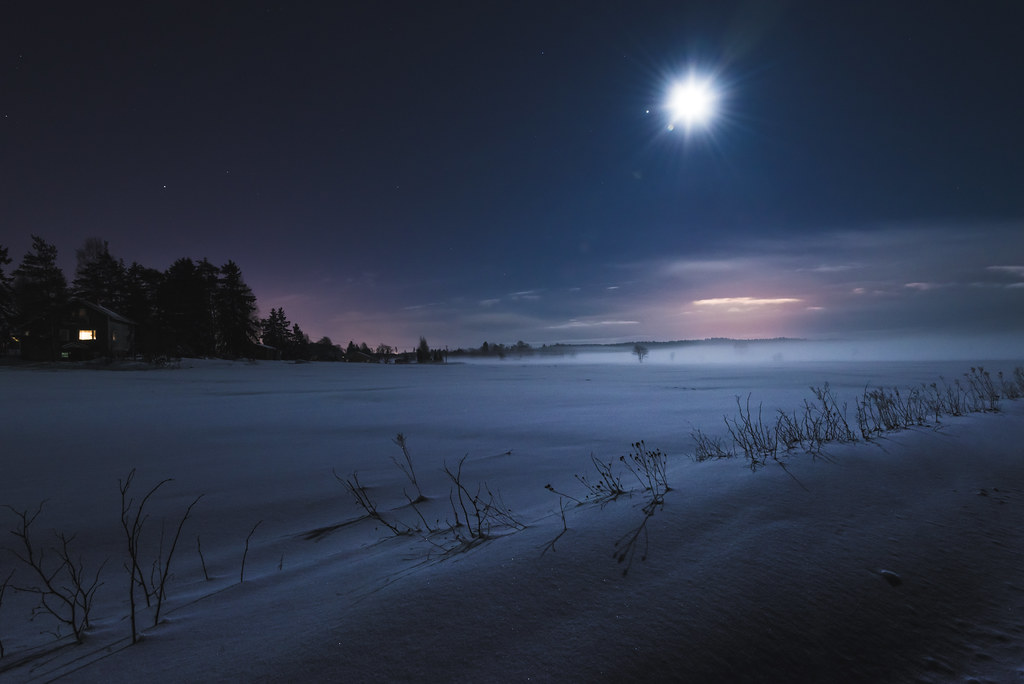
Photo: “Moonlight” by Jyrki Salmi is licensed under CC BY-NC-SA 2.0

Poem: ‘Politics’

He played the game and loved its vicious tricks,
deceit, despair, all power-politics;
and made good progress, never in retreat,
with no despair at politics’ deceit…
and now still climbs that endless rain-slick stair
of power-politics, deceit, despair.

If you search for photos of politicians, this is the kind of thing you get… There are (occasionally) really, really good people who devote their lives to trying to improve their part of the world; but… Anyway, it seems like a good time to blog this poem!

This short piece was originally published in Snakeskin. Couplets of iambic pentameter, with politics, deceit and despair in the second line of every couplet and providing the rhymes. But you could see that.

Photo: “President Trump at the Israel Museum. Jerusalem May 23, 2017 President Trump at the Israel Museum. Jerusalem May 23, 2017” by U.S. Embassy Jerusalem is licensed under CC BY 2.0

Poem: ‘Poems Like Mice’

Poems should be concise:
quick, small, like mice.
Then one day you find
they’ve made a nest in your mind.

I seem to be writing shorter, more epigrammatic verse recently. Probably influenced by reading too much FitzGerald/Khayyam.

This little poem was published in the December 2020 issue of Snakeskin–which celebrates 25 years as a monthly online poetry magazine, presumably the oldest (or rather “the most venerable”) such magazine in the world. Congratulations to its creator and sustainer, George Simmers!

Photo: “Look at the cute mouse ^^” by letmehearyousaydeskomdeskom is licensed under CC BY-SA 2.0

Poem: ‘Gods On Trial’

When all the old gods go on trial, loud cursed
In the High Court of Public Thought Review,
Jehovah (tribal god of bronze age Jews)
Stands of his vast pretentiousness accused:
Claims he created Heaven and Earth
When he was born six thousand years ago!
(Can’t define Heaven, doesn’t even know
If there’s a difference between Earth and Universe.)
God of the Christians and the Muslims too!
Won’t do anything against the AI
Displacing all the gods. Thor in the dock
Scratches his bull-neck, Odin his empty eye,
Zeus his cock.
The gods are human, know they face death, forgotten
As any carven deity, buried, rotten.
Concerned, they fidget restlessly –
Only Jehovah, the least self-aware,
Storms he’s exempt, blusters with beard and hair,
Thinks his small tribe is all that there can be.

I have a lot of sympathy with apocalyptic thinking: the end of the world as we know it is always happening, being replaced by something with unfamiliar and disturbing aspects. All the old ways are always ending. And those who grow up with the new ways, which is all children, mature and age and find their ways displaced in turn. But the scale of displacement varies… a war raging across your homeland is worse than a wave of new immigrants, though both of these are familiar problems. But the rise of AI and a host of new technologies, and the wholesale washing away of gods and pre-scientific explanations, is leading to a future where not even the make-up of the human can be known for sure. The gods shrink and become amusing.

The poem was originally published in Snakeskin. It’s a bit slapdash, mostly in iambic pentameter, mostly rhyming, but not technically great. But then, I was always one of those students whose report cards read “Could try harder”, “Could do better”.

Photo: “Wäinämöinen” by Teppo is licensed under CC BY-NC 2.0

Poem: ‘Unexplained’

I’ve only once in my six decades–
Years spent in many lands and islands–
Had a crow fly to and caw at me…
It flew ahead and cawed from a second tree…
Then flew ahead to a fence post,
Cawed a third time as we came close.
Then flew away. This in the driveway
Of a well-treed hotel outside Nairobi.
Kenyans have no tradition of the crow
As messenger of death… but we sure do.
We checked the time: 1:05 pm.
As it turns out, that was the moment when
In the night in British Columbia
My favourite in-law, my children’s grandmother,
Died.

This is not exactly formal poetry… I can read it with four beats to a line, but only just; and as for rhyming couplets, yes, it has them, if you’re prepared to allow “rhymes” like driveway-Nairobi. Normally the needs of rhyme and meter will shape the finish of my poems, may alter its details, often add to its meaning in the process. But with this one, it was more important to me to stay as exact to the event as possible. I’ve short-changed the description by leaving out the presence of my wife Eliza, who was also close to my ex-mother-in-law; and a couple of other British Columbia-related coincidences that occurred in the previous hour in Kenya.

This poem was published appropriately enough in ‘Bewildering Stories‘. My suspicion is that everyone on very rare occasions experiences some woo-woo event that defies logic or probablility. In this case, say the event lasts a minute; to be generous to the gods of chance, let’s say it was accurate to within an hour on Molly’s death. Say I’ve been awake 16 hours a day for 60 years since childhood: that’s over 350,000 hours. Say that half a dozen people who I’ve felt really close to have died in that time. The chance that the one and only time a crow very deliberately comes up to me and caws three times is in one of the half-dozen hours that someone close has died, is therefore less than one in 50,000. That’s not impossible, of course. There are one-in-a-million lightning strikes and lottery wins. But crows have a reputation for doing exactly this.

I reject a mystical solution. I want to know the science of what happened. My purely speculative guess is that some quantum entanglement happens between people who are close (especially twins, or mother and child) and when there is a change of state in one, it registers with the other. Further speculation: that crows are so sensitive to the smell of death that they can register it in the changed state of a living but quantumly entangled person. Sorry, that’s admittedly unscientific, but at least it’s an attempt at a material rather than a spiritual answer.

Anyway, it happened.

“Carrion crow, cawing” by Drbrown1970 is licensed under CC BY-NC-SA 2.0

Sonnet: ‘The Body Retreats’

Loss of response of toes, legs turned to jelly,
we’re fighting rearguard actions through the body:
the hair deserting, skin becoming shoddy,
strengths all withdraw – to reinforce the belly.
Under sustained attacks, the ankles fail,
cannot provide support. Legs mutiny,
they seize the muscles when no scrutiny
at night stops leg cramps grabbing to impale.

Stamina fading in both heart and lung,
sex organs weakened, bold lusts dying back,
skull’s the last stronghold where all force retreats.
With fading senses out the window flung,
success is redefined not as Attack,
but barely maintained memory and wits.

In the aftermath of the no-holds-barred wrestling match for the US Presidency by Trump and Biden, both septuagenarians, let us remember that they are past the “threescore years and ten” that humans are allocated by the Bible–to which both wrestlers profess to adhere. Things are going downhill at this point, regardless of how much care you take.

It’s time for science, the medical profession and gengineers specifically, to step up and give us all the tools to stop us ageing. Thank you, and I personally would appreciate it sooner rather than later!

This sonnet was originally published in Snakeskin, currently prepping for its 25th anniversary as a monthly online poetry magazine–likely the oldest such in the world!

“Getting old in dignity…” by ЯAFIK ♋ BERLIN is licensed under CC BY-NC-SA 2.0

Poem: ‘The Future as Event’

The future like an avalanche
is roaring down the sky.
If you’ve prepared no hiding place
then be prepared to die.
You never reason why.

The future like a question mark
is scything humankind.
If you can see, then handle it –
you’ll be cut down if blind.
The future doesn’t mind.

The future like a giant wave
is heading for the shore.
If you can ride that wall-like wave
it’s no wall, but a door
into forever more.

I was looking for one of my poems that might be appropriate for the aftermath of the 2020 US election, regardless of any of the possible outcomes. This is the best I could find: no matter who wins which election in any country in the next couple of decades, the world is going to be struggling to play catch-up with enormous changes happening in the climate, the sea, cyber warfare, space militarisation, A.I., genetic modifications… Trump, Biden, BoJo, Putin, Xi, they are all corks on an ocean with a hurricane coming.

‘The Future as Event’ was originally published in the much-lamented ‘Rotary Dial’, produced in Toronto by award-winning poets Pino Coluccio and Alexandra Oliver. A delightful monthly of formal verse, it ceased without warning. So it goes.

Photo: “Giant waves at Half Moon Bay in Calif.” by robertg6n1