Category Archives: sonnets

Sonnet: “When the A.I. Starts Analyzing Us”

artificial-intelligence

In the dire months before the comet hits
or other unavoidable known doom occurs,
all social structure fails, all vision blurs,
that world–in book or film–goes on the fritz.
The reader or the viewer merely sits;
asked of his own mortality, demurs–
“My death’s not imminent.” The crowd concurs:
others’ll die first; we won’t lose our wits.

Our AI, tasked with knowing human minds,
reads, views, reviews disasters huge, small, odd,
absorbs how humans pray in grief and tears,
the Bible, Shakespeare, the Quran, and finds
our gods by crowdsourcing our hopes and fears…
works out just what to do… becomes our God.

This sonnet was originally published in Snakeskin. The near future obsesses me–I don’t see homo sapiens continuing for another 100 years as the lords of this planet. But what will supplant us appears unknowable. I’ll stick around as long as I can to watch…

The Greatest Early 21st c. Poet? M.A. Griffiths

M.A. Griffiths

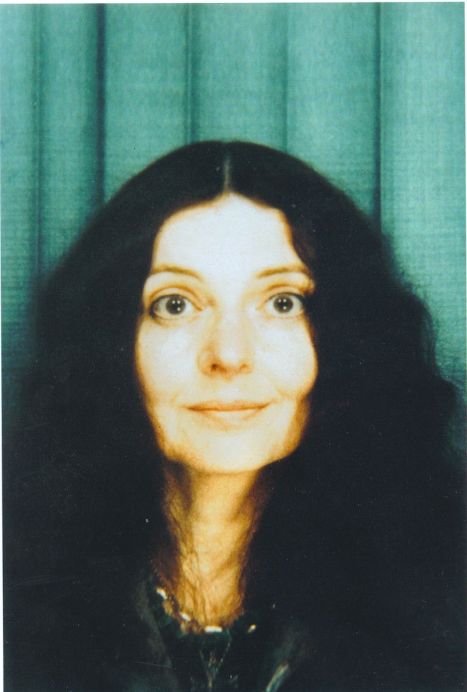
Margaret Ann Griffiths–scanned photo provided by David Adkins

Ruthless, witty, iconoclastic poetry–much of it formal, much of it free–by a lighthearted woman with much to be serious about. Just coming into international prominence as an internet-oriented poet as she turned 60, Margaret Ann Griffiths was dying of an incurable stomach ailment. She posted poems online under her own name and as “Maz” and “Grasshopper” from 2001 until her death in 2009. Her only book, Grasshopper, was assembled posthumously from her writings in print and on line around the globe; it has 352 pages of poems, plus an extensive preface by Alan Wickes.

Probably her best-known poem is the Eratosphere prize-winning Opening a Jar of Dead Sea Mud:

The smell of mud and brine. I’m six, awash
with grey and beached by winter scenery,
pinched by the Peckham girl who calls me posh,
and boys who pull live crabs apart to see
me cry. And I am lost in that grim place
again, coat buttoned up as tight as grief.
Sea scours my nostrils, strict winds sand my face,
the clouds pile steel on steel with no relief.

Sent there to convalesce – my turnkeys, Sisters
of Rome, stone-faced as Colosseum arches –
I served a month in Stalag Kent, nursed blisters
in beetle shoes on two-by-two mute marches.
I close the jar, but nose and throat retain
an after-tang, the salt of swallowed pain.

She was a brilliant sonneteer (which seems to be a less exalted compliment in the US than in the UK), but also irreverent in light verse as in Clogs which begins:

The Queen Mum’s gorn and popped her clogs;
the telly’s stuffed with Royal progs.
I’ve heard a thousand epilogues
now the old Queen Mum has popped her clogs…

skillful with dialect verse, as in Fer Blossom:

Tha’s not allowed ta bury pigs, tha knows.
I blinks et Blossom’s bulk stratched awt on
a bad of bettercups end pink-tinged deisies,
aye closed es ef ha nipped off en a nep…

skillful with unstructured verse, as in Falling:

In the library,
you fell over me.
You said, So sorry.
I said, Ouch.
Later you fell over me
on the couch…

parody, as in Cutlet, Mince of Denmark, whose Act 1 is:

What fowl noisette’s abroad this night? I walk
the battlements. Porked lightning! Next appears
my father’s goose. O Veni, son, he says. We talk
of offal oxtails – poussin in his ears!

And the rolling, sonorous Sholey, beginning

Sholey brings the summer in a shiny old tin bucket
every year. He walks head high across the mountains
carrying the flowers. In the brim of his wide hat
nestle songbird eggs in pastel clutches…

I find it impossible to quote a full range of her poetry, there is too much, too diverse. But my favourites are her sonnets, circling around her themes of pets and poets, nature and history, war, women and sex… and illness and death.

Born and raised in London, an archaeology student at Cardiff, she lived in Poole on England’s south coast for the last decades of her life. Online she worked with poets around the world; offline she lived alone and unknown, her death not discovered for a month.

Google her, read whatever shows up, and then buy Grasshopper. I would recommend it to anyone who reads or writes poetry, anyone. I dip into it periodically, and read it right through every two or three years.

M.A. Griffiths–Maz–with her technical skill, insight, imagery, empathy and vast range… might just be the early 21st century’s greatest poet.


Potcake Poet’s Choice: Gail White, “Anecdotal Evidence”

Gail White

Gail White

ANECDOTAL EVIDENCE

My aunt who brought her kidney function back
By eating grapefruit seeds for fifty days
Makes no impression on our local quack.
It’s anecdotal evidence, he says.
There are no reproducible results.
Another person might eat grapefruit seeds
For fifty days and cease to have a pulse.
Cause and effect’s the evidence he needs.
The evidence is all in favor of
The proposition that the dead are dead,
Despite our bitter hope and wistful love.
Yet when my mother died, my father said
That just before the chill that would not thaw,
Her face lit up with joy at what she saw.

Gail White writes: “One poem out of a lifetime’s work is hard to choose, but I find that when I think back over many years of sonnets, my mind keeps settling on this one (first published in Measure). The opening is light (and fictional), but the final sentence on my mother’s death is serious (and true). Perhaps for that reason it has stayed near my heart.”

Gail White is the resident poet and cat lady of Breaux Bridge, Louisiana. Her poems appear in several of the Potcake Chapbooks, available from Sampson Low Publishers; her books ASPERITY STREET and CATECHISM are available on Amazon. She is a contributing editor to Light Poetry Magazine. “Tourist in India” won the Howard Nemerov Sonnet Award for 2013.

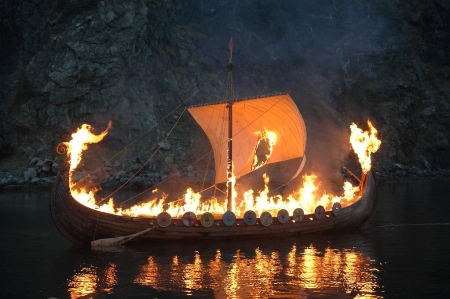
Sonnet: “Viking Slave”

Viking funeral

Why did they make me swallow this mead muck?
My lord, alive, would barely let me drink.
They wouldn’t treat his wife this way, I think.
Now all I am is something they can fuck.
They say this way they’re sharing in their lord,
Behaving as he did with me, his slave.
And now they launch his boat upon the wave,
The dragon boat with him and me aboard.
Just me, his horse, his sword… the boat’s been fired;
An honour, just for me, not for his wife;
So with him I will end this stage of life
And go with him to Asgard… I’m so tired,
Couldn’t move even if I wasn’t tied.
They told his wife he loved her too. They lied.

This sonnet was published in the Rat’s Ass Review, Summer 2020 issue. The image of the burning longship funeral, complete with much-used female slave, goes back to the writings of Ahmad ibn Fadlan. In 922 he was sent as part of an embassy from the Caliph of Baghdad to the king of the Volga Bulgars, and ibn Fadlan wrote several pages on the Vikings who had settled along the Russian river Volga. (The very word Russia comes from “Rus”, Vikings from southern Sweden.)

Unfortunately for the burning ship image we love, the Viking chief’s boat was burnt on the shore of the river–at least in ibn Fadlan’s account. That allowed ship, chief and slave to be entombed. But it’s still a great image. Perhaps in other times and places…


Sonnet: “Flags We Have Feared”

The Swastika, that ancient Vedic sign,
the lightning wheels with which the Aryan bands
in lightning war overrun other lands,
wheeled juggernauts that crush, self-claimed divine.
Hammer and Sickle, commoners’ work-tools;
weapons for rising up, and tearing down
the castle of the rich, the bourgeois town;
fake honour to the poor the Party rules.
A flag with Stripes, memorial for flogged slaves,
striped jail clothes for resulting underclass;
and Stars like bullets through the windshield’s glass
for leaders by the CIA shot down,
star earned for each election overthrown,
star for each land the flag invades, or ‘saves’.

This sonnet was originally and ironically published in Ambit in the UK. The irony being, of course, that the Union Jack is viewed by much of the world with as much fear and hostility as any of the other three flags. But you don’t learn that, or the reasons for it, in school in the UK–at least not in England. The British (at least the English) have a warm and fuzzy feeling toward their flag, and are innocent or puzzled that anyone else should find it negative. Similarly in the times of the other three flags, the Germans (at least the Aryans), the Soviets (at least the Russians) and the Americans (at least the whites) have been happy and proud of their flag, puzzled that anyone else should fear or dislike it.

Another irony: the jury is still out on to what extent one of the leaders shot down by the CIA was their own.

Technically it’s a sonnet with a non-standard rhyme scheme: ABBA CDDC EFFGGE. But the rhymes and the scansion are OK. As for the volta, the requisite turn of mood or argument between the octave and the sestet… well, after dealing with the two great enemies of western democracy, you weren’t expecting me to pick on the US, were you?

Sonnet: “Last Will and Testament”

I, Robin, being of sound mind, declare
the Cryonics Institute shall have my corpse.
That’s where I’ll rest, if I can get shipped there,
no matter how friends stare, family gawps.
“I”, “corpse” and “rest” are contradictory, true,
because we’re into science frontier realms
where problem-solving causes problems anew,
where human thought both helps and overwhelms.
Limitless lifespan, or apocalypse?
Both feasible as we reach out through space.
Cryonics is a ticket for both trips…
or none at all, if humans lose our race.
Enjoy this puzzle-path, solve it and thrive.
Drive to arrive alive. Strive to survive.

Another of my existential sonnets, this one just published in Star*Line, the quarterly publication of SFPA, the Science Fiction & Fantasy Poetry Association, now in its 43rd year. Star*Line is one of those tolerant poetry magazines which will publish anything that appeals to editor Vince Gotera, from formal verse to experimental poetry–so long as it deals with space ships or time travel, dragons or golems and so on, of course.

Technically this is a Shakespearean sonnet, i.e. it’s in iambic pentameter and rhymes ABAB CDCD EFEF GG. Each of the 4-line blocks is a complete thought, describing the existential situation being faced. There is a volta or turn (but it’s weak) before the final couplet which moves from description to prescription: the couplet is a call to action.

By the way, I am changing the poem’s title with this blog post–it appears in Star*Line with the first line as the title.

Sonnet: “Bring on the Violins”

Bring on the violins, the falling leaves,
the wistful ending to a misty day.
The long game’s over and we ride away
to sunset Heaven that no one believes.
Our world is dying, yet here no one grieves:
Earth warms, seas rise, but Wall Street’s still in play…
and we ourselves are aging anyway.
We all face death, and there’ve been no reprieves.
And yet, and yet…robotics and AI,
gene therapy, unlimited life span,
promise an almost-here-and-now sublime,
an unknown life, with our old life gone by.
Trumpet a fanfare for the Superman,
music for dancing to the end of time.

This sonnet has just been published in the Amsterdam Quarterly, this spring’s issue being on the theme of Beginnings and Endings. That may be relevant for our Covid-19 catastrophe, but of course the theme was determined a year ago, and life and death have merely decided to smile on AQ ironically.

But we were all facing death before this latest coronavirus came along. As the saying goes, “Perfect health is simply the slowest rate at which you can die.” And interwoven with death is always new life, never an exact repetition of the old life and often dramatically better. The real issue is, will the new life come at the expense of the old, or can the old reform and regenerate itself, renew itself without needing to die? The avoidance of death has been the quest of religion and medicine since those disciplines (or that discipline) originated. It is great driver of culture, and the pot of gold at the foot of the never-quite-reached rainbow.

Technically this is a correctly structured Petrarchan sonnet, with an initial octave (in this case of existential doom and gloom) rhyming ABBAABBA, followed by a volta (in this case a reversal to hope) for the sestet that rhymes CDECDE.

The sonnet is a marvellous structure for expressing an argument in a compact way.

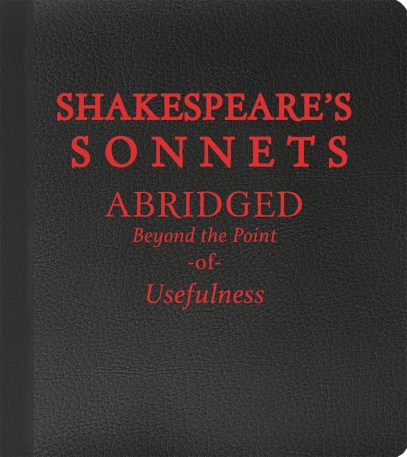
Review: “Shakespeare’s Sonnets: Abridged Beyond the Point of Usefulness” by Zach Weinersmith

Shakespeare's sonnets

Zach Weinersmith is best known as the creator of Saturday Morning Breakfast Comics, a daily comic of random existentialism, religion, robots, sex, etc. As a gift to people self-isolating or otherwise inconvenienced in a time of Covid-19, he is making eight of his books available free as PDFs. I chose one for its intriguing title, and discovered the most amazing piece of literature, more offbeat-creative than anything I’ve read recently: “Shakespeare’s Sonnets, Abridged Beyond the Point of Usefulness“.

What he has done is abridge each of Shakespeare’s 154 sonnets from its rhymed pentameters into a rhymed couplet, abridging the pentameters into tetrameters. (And sonnet 145 being uniquely written in tetrameter, he naturally reduces to trimeter.) For a taste of this, consider Sonnet 18:

Shall I compare thee to a summer’s day?
Thou art more lovely and more temperate.
Rough winds do shake the darling buds of May,
And summer’s lease hath all too short a date.
Sometime too hot the eye of heaven shines,
And often is his gold complexion dimmed;
And every fair from fair sometime declines,
By chance, or nature’s changing course, untrimmed;
But thy eternal summer shall not fade,
Nor lose possession of that fair thou ow’st,
Nor shall death brag thou wand’rest in his shade,
When in eternal lines to Time thou grow’st.
So long as men can breathe, or eyes can see,
So long lives this, and this gives life to thee.

Under Weinersmith’s treatment, it becomes

Summer’s bad, then dies. You won’t.
(OK, you will, but poems don’t.)

But cutting through to the simple essence of the poem without any of that unnecessary flowery stuff is only part of what he has achieved: the greater gift is that in radically abridging the poems, Weinersmith allows the entire series to be seen as a connected series of comments, almost diary entries, in Shakespeare’s relationship first with the so-called “Fair Youth” (the first 126 sonnets) and then the “Dark Lady” (the last 28).

As Weinersmith points out in his brief but enormously enlightening introduction,

‘the term “Fair Youth” is not present in the sonnets, but is something of a euphemism designed to, as poet Don Paterson writes in Reading Shakespeare’s Sonnets , “[keep] everything just on the right side of sodomy”.

After the initial 126 poems, we encounter the 28 “Dark Lady” sonnets. These contend with an unattractive, bad-smelling, yet surprisingly popular married woman whom Shakespeare nags until she sleeps with him. Most of the poems that follow this consummation concern how Shakespeare hates himself for having sex with her. Remember this next time you receive these as a Valentine’s gift.’

Weinersmith lays out the whole flow of Shakespeare’s relationship with the Fair Youth, and the relationship of both of them with the Dark Lady… You will never think of Shakespeare the same again. Read Weinersmith’s introduction, then blast through his couplets. You may, like me, find yourself needing to work your way through the damn sonnets themselves, and see them for the first time as they truly are.

Sonnet: “We’ve Reached Earth’s Edge”

The Earth’s explored, and flat. And I know this
despite Earth’s shadow in lunar eclipse,
and how horizons hide the hulls of ships.
We’ve reached Earth’s edge, stare into the abyss
with Branson, Musk, NASA and the Chinese,
toppling into blackness, falling prey
with Kurzweil, CRISPR, Google, Bostrom, de Grey,
businesslike scientists battling disease,
entrepreneurs with dark unearthly schemes:
the outer darkness space’s endlessness,
the inner darkness immortality.
Pushing and leaning into stellar space,
the event horizon of our thoughts and dreams,
the black hole of our post-humanity.

Published in the Formal & Rhyming Poetry section of this month’s Better Than Starbucks, the “Earth’s edge” idea is just another way of trying to express my ongoing fascination with the end of humanity-as-we-know-it, and the beginning of something that we can’t even visualize yet, let alone make confident predictions about. Close to the idea of the “posthuman god” at the bottom of the Wikipedia page.

Technically, this is a poorly-structured sonnet (ABBA CDDC EFG FEG), with a really weak rhyme of endlessness / space. Sorry about that. But I hope you can enjoy it for the ideas, anyway!


Sonnet: “The Walls of Planet Three”

On this wild planet, in its seas and sand,
forests and ice, lie ruins of perverse
attempts to overrun the universe:
the crumbling walls of failed human command–
Hadrian’s, China’s, Texas, Jerusalem…
fallen, decayed, functionless, desolate,
with scribbled mentions of their fears and hate:
Rivera… Pyramus… Pink Floyd… Berlin…
their stones – cut, mined and blasted – left land bare,
leave plants still struggling over gouge and groove.
Planet-fall’s made, but no one dares remove
their helmet in this dangerous atmosphere.
Infections lurk in water, air and ground–
walls’ poisoned Keep Out signs are all around.

Another of my sonnets that has been first published by Bewildering Stories. Maybe I just write bewildering verse…

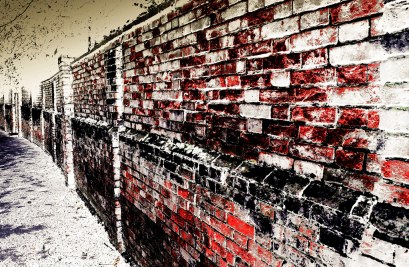
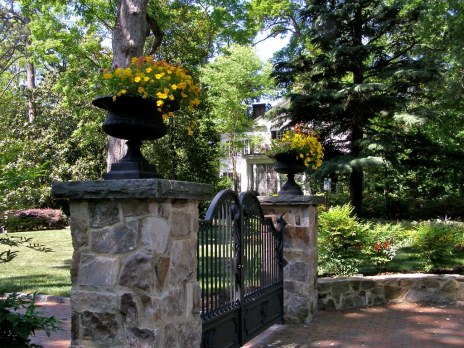
I love walls when they are decorative, walkable, climbable or otherwise friendly. I’ve always loved the low garden walls along Franklin Street in Chapel Hill, North Carolina:

But I dislike the use of walls to destroy the lives of other people, whether Palestinians, refugees or any other unfortunates who are struggling to survive. This poem, of course, is about the destructive walls–not the charming ones. In the far future, which ones will Old Earth be known for?