Category Archives: Magazines

Resources: Formal-friendly magazines for unknown poets

Some of the best-known and longest-established poetry magazines have either changed (often under a new editor) from being receptive to being hostile towards formal verse; others are receptive, but only to already well known poets. So it can be difficult for an unknown formalist to break into publication. For what it’s worth, here is a list of places where I have been able to publish my own uneven and very varied pieces, with some comments about what is appropriate for where.

Alabama Literary Review – US, lyrical, positive; only takes snailmail submissions (unless you have a genuine need for email)
Allegro – UK, contemporary, looking for more formal submissions than they receive
Amsterdam Quarterly – Netherlands, English-language, must address the issue’s theme
Asses of Parnassus – Canada, short, witty, formal poems, snarky is fine, hosted on Tumblr.
Better Than Starbucks – US/Canada, large magazine with many departments including formal; children’s; experimental; etc.
Bewildering Stories – Canada/UK/US, speculative and science fiction pieces
Bosphorus Review of Books – Turkey, English language
Brazen Head – UK, ideas-rich
Chained Muse – US, prefers classical themes
Libretto – Nigeria, prefers African/Afro-American/Afro-European/post-colonial pieces
Light – US, large biannual issue, also the home of weekly topical light verse
Lighten Up Online (LUPO) – UK, light formal verse, quarterly
Lyric – US, “Founded in 1921, The Lyric is the oldest magazine in North America in continuous publication devoted to traditional poetry.” Lyrical, positive… flowers and countryside.
Metverse Muse – India, publishes simple traditional verse. No website. The email for editor Dr. Tulsi is metverse_muse@yahoo.com
Obsessed With Pipework – UK, “strangeness and charm… prefers dreams to deathbeds”
Orchards Poetry Journal – US, more rural than urban
Penwood Review – US, religious streak
Poetry Porch – US, lyrical
Pulsebeat Poetry Journal – US, new; more urban than rural
Rat’s Ass Review – US, irreligious streak; whatever appeals to the editor, including things you can’t get published elsewhere.
Road Not Taken: The Journal of Formal Poetry – US, hard to find online because of its name, but a good small publication for formal and semi-formal verse.
Shot Glass Journal – US, max 16 lines, lots of international poets
Snakeskin – UK, probably the longest-established poetry zine in the world; has no interest in submission bios, only in the poems; likes work that begins light and becomes heavier.
Star*Line – US, Science Fiction poetry
The HyperTexts (THT) – US, an enormous assemblage of verse from all times and places; the editor’s preference for formal and leftist verse doesn’t rule out Walt Whitman or Ronald Reagan! The works are mostly republications, but if you have a body of strong work the editor may be interested in creating a page for you.
Verse-Virtual – US, a monthly publication for a caring community of poets
Visions International – US – I’m not sure what the status is of this magazine these days, or who is editing it…

This list doesn’t include magazines not relevant for me (like Mezzo Cammin: An Online Journal of Formalist Poetry by Women), or that moved away from formalism (like Ambit), or that have unfortunately folded (14 by 14, The Rotary Dial, Unsplendid). And there must be a lot more worthy magazines that I simply haven’t run across – I would be very glad of your recommendations about others to list.

And of course, as ever, don’t just fire off a handful of poems at random – read some samples online, determine the magazine’s orientation and moods, check whether the editor wants anything particular, note whether they love or loathe attachments, etc…

Good luck!

Magazines” by theseanster93 is marked with CC BY-SA 2.0.

Sonnet: ‘Exiled Leader’ (from the series ‘Voices From The Future’)

I’ve few wants on my planet, fewer needs –
I like seas, trees, exploring what I’ve made,
Prospecting for the transgalactic trade,
Composing music while collecting seeds.
I like green islands, but won’t interfere
If eco climate needs a waste of ice
Or rock-filled deserts simply are the price
Of balancing the seas and atmosphere.
I’m rarely lonely, happy to create:
Atonal opera, atoning for
Those antisocial acts that led to war,
Jailed on the planet that I populate.
So I plant trees, make insects, have a swim,
Watch, read, compose… my life’s an endless whim.

This sonnet is one of four I wrote after Maryann Corbett commented on the bleakness of my future visions. I suppose this doesn’t really contradict that comment… we’ll have good news and bad news: the good news is, obnoxious leaders will still (occasionally) be deposed, jailed, or exiled to play golf; the bad news is, transgalactic warfare will be pretty awful. But to me, the future’s not bleak if humans keep on developing, changing, growing, exploring, discovering, creating. I think that’s the most likely scenario, that we move out into the galaxy as transhumans and then as post-humans. Though when I say “we” I don’t mean to suggest that includes me! Neither moon nor Mars excite me. I like woods and gardens by the sea.

This poem was published in Star*Line, the official print journal of the Science Fiction and Fantasy Poetry Association (thanks, Jean-Paul Garnier). Its poetry includes the full range of styles from formal to free. And the SFPA has another, online, journal called Eye To The Telescope. For reasons unknown my poems haven’t found lodging in ETTT yet.

“The Little Prince” by manfred majer is licensed under CC BY-SA 2.0

New magazine’s Call For Submissions – Pulsebeat Poetry Journal

Poet (and engineer) David Stephenson contacted me recently with the message “I am starting a new journal, Pulsebeat Poetry Journal, for poems with a strong musical element, especially poems in meter and rhyme. I don’t think there are enough venues for rhyming poetry.” He is putting out a general Call for Submissions on his web page https://pulsebeatpoetry.com/guidelines/

“Poems full of music, using meter and rhyme or other means, previously unpublished… Theme should be the human condition… Submissions by December 31, 2021, for the first issue to be posted in January, 2022.” More submission details are at that link above.

David Stephenson has published in The Formalist, The Lyric, etc. His ‘Rhythm and Blues‘ won the Richard Wilbur Award in 2007, which puts him in excellent company. On the Masthead page of his web site you can find links to more recent poems of his, published in Autumn Sky Poetry and Avatar Review.

I look forward to reading the Pulsebeat Poetry Journal, and wish David Stephenson good luck with the venture.

Poem: ‘Ex-Rover’

I was a rover, footloose treasure-trover,
Bahamian, Brit, Dane, Aussie, Canadian,
Easily settling, never for very long,
Followed the sun and the moon with a song.

Now roving is over, Death’s raving and raging,
The threatening madman, waving a knife.
Even my babies have babies, are ageing –
Aren’t there any more decades left in my life?

I was a rover – no grass
Grew under my feet as I’d pass.
Now grass grows and I cut it.
And it grows, and I cut it.
I was wired, now I’m tired;
Fired up, now I’m mired.
And the grass grows again… I give up.

Let me sleep in the sun, and sleep slow.
Let me sleep deep.
When was that rover me?
Let the grass grow.
Let the moon be the stone over me.

This poem has just been published in The Orchards Poetry Journal, where it immediately follows the poem I posted here a couple of days ago, ‘Roughing It In Europe‘. It makes a nice, somewhat sardonic, pairing. Appropriately, this one was written several years after the more enthusiastic earlier one. (From the Orchards link above you can download the Journal as a pdf for free, or buy the very lovely finished product.)

‘Ex-Rover’ is one of those poems that stretches the meaning of the word “formal”. But it has enough rhythm and rhyme to make it relatively easy to learn word for word, and that is a lot of the point of poetry in any language. I feel barely any shame in putting it into the world in this ragged form. The ragged form suits the mood of the piece, after all.

“wanderer” by Cornelia Kopp is licensed under CC BY 2.0

Potcake Poet’s Choice: Kathryn Jacobs, ‘The Innocent’

They trust us, and they shouldn’t: butterflies
and earnestly pursuing preschoolers
careen among us, prone to accidents,
disasters in the making. Both of them

incapable of short-cuts, see-sawing
oblivious among the negligent,
convinced that we know best, who disregard
how short their legs and lives are.

Some of them
(the lucky and unswatted) mobilize
their stubby forces to stay out of reach,

But most of them launch headlong, more afraid
of being left behind or swallowed, than

of damaged wings and feelings, wedged against
rude curb-stops or cupped hands –

Kathryn Jacobs writes: “I am choosing The Innocent because it reminds me of what I’ve lost: of my son Raymond in particular (though he is not in the poem overtly). Ray died at 18. I am sending a photo of Ray with his twin: it’s a photo that reminds me of more Innocent days.”

Kathryn Jacobs is a professor at Texas A&M-C and editor of The Road Not Taken. Her fifth book of poetry (Wedged Elephant) appeared in Kelsay Books. Her poems have appeared in Measure, The New Formalist, Southern Poetry Anthology, Mezzo Cammin, etc. Currently she is working on a book of Dan.
http://journalformalpoetry.com/

Short Poem: ‘The Logophile Picks a Fight’

By the spots of shame with which your life is spattered,
Your position, sir, is grossly overmattered –
Overmattered, sir, or greatly undermined;
And I cannot help but find
That the lot of humankind
Would be bettered, not embittered, were you battered!

After having kicked around for years, this short piece–which has no purpose other than wordplay–finally got an explanatory title (instead of just the first few words) and was published in this month’s Lighten-Up Online in the section ‘Words, Words, Words’. Thanks, Jerome Betts!

Photo: “Picking a fight for net neutrality #ind12” by Kalexanderson is licensed under CC BY 2.0. Photo has been cropped.

Short poem: ‘Yogis’

Though mystified why yogis walk
Across the burning coals,
We know they stand upon their heads
To elevate their soles.

This was first published in Metverse Muse, an Indian magazine put out by Dr. Tulsi Hanumanthu that champions structured verse in English. The poem’s pun seems so obvious to me that I’m still surprised I haven’t seen it anywhere else. Be that as it may, I’m a proponent of the health benefits of five-minute headstands, which I have been doing irregularly since I wrote the poem nearly 50 years ago, after spending a month in the Sivananda Vedanta Yogashram in Val Morin, Quebec.

As for timing five minutes while in a headstand, I do it by mentally reciting the first 18 verses of Matthew Arnold’s ‘The Scholar Gypsy’. After years of those 180 lines, I keep thinking I could replace it with 45 quatrains of ‘The Rubaiyat of Omar Khayyam’… but somehow I always get stuck pondering which edition of the Rubaiyat I prefer…

Photo: taken by Eliza.

Sonnet: ‘Drifting’

Drifting and drifting in an eddying stream
The leaf cannot recall the maple tree;
Pieces fall off; it has nor plan nor scheme;
How could a leaf have sense of destiny?
Its work is done; tree-feeding fades like dream,
Tree-making’s not a possibility.
It drifts and rots, nibbled by perch and bream
Or reaches finally the endless sea.

The sea itself moves, rhythmical and blind:
Is calm, or sprays salt as the waves make foam.
Seas have no will, no parliament of mind,
To make directives like hives make bees roam
To pollinate the world, defend their kind,
And with their mind create their honeycomb.

This sonnet drifts in several ways. The rhythm of iambic pentameter is meditative, rambling. The rhyme scheme is slow, repetitive, changing between the octave and sestet: ABABABABCDCDCD. And the ideas drift: the leaf is left behind when it reaches the sea, and the sea is abandoned for bees. The form seems suitable for the content.

‘Drifting’ has just been published in this month’s Snakeskin, whose editor commented “I like the way it moves from one idea to another that you don’t expect.” Thanks, George Simmers!

Photo: “Like a Leaf in a Stream” by Referenceace – Working! is licensed under CC BY-NC-SA 2.0

Review: Max Gutmann, ‘Light and Comic Verse’

Quirkily-workily
Jorge Bergolio,
On a career path with
Quite a steep slope,

Unostentatiously
Worked as a janitor,
Then as a bouncer, and
Then as the Pope.

This elegant double dactyl on the life of Pope Francis is representative of ‘The Hearthside Treasury of Light and Comic Verse’: interesting, witty, technically perfect. The poems include limericks, clerihews, varieties of ballades, and are purported to be written by a variety of poets, several of whom are claimed to be the first-ever winner of the prestigious Blackfrier Prize for Poetry. The book’s veneer of being ‘edited by Max Gutmann’ is worn even thinner with the bio of his least likely poet, Ed Winters… “A devotee of Hemingway, Hart Crane and Sylvia Plath, Winters shot himself in the mouth while diving from a ship with his head in an oven.”

The book includes two pages of riddles in rhyme, of enjoyable difficulty: half were guessable for me, half not. There is also a full-length Poe parody (‘Quoth the Parrot: “Cracker. Now!”); scenes from The Merchant of Venice, King Lear and Titus Andronicus rewritten by W.S. Gilbert; outrage at the Trump presidency, the killing of Jamal Khashoggi, and the US Supreme Court’s appalling excuse for subverting the 2000 Presidential election; a poem appropriately written in the form of a dozen eggs; and various puns, off-colour jokes and random surprises. Many of the poems have previously appeared in Light poetry magazine, many others in a range from Asses of Parnassus to the Washington Post.

As for “The Hearthside Treasury” part of the book’s title… though there was (or is) a Hearthside Press, active from the mid-1950s to mid-70s; and an unrelated Hearthside Books, active from the mid-70s to the present, sort of; this “Hearthside Treasury” appears unconnected to anything. Indeed, it’s not even available on Amazon. It doesn’t have an ISBN. All this is a pity, as it is as enjoyable a book of light and comic verse as you can find anywhere. If you want a copy – and if you enjoy comic verse you really ought to have one – you’re going to have to contact the author directly through his website (which mostly focuses on his plays) at maxgutmann.com

Poem: ‘Zippori Story’

Context, people, context! Remember that
Herod was building his new royal city
Zippori some four miles from Nazareth
when Jesus was a child. And Joseph would
have walked there, worked there, daily; Jesus too.

When Judas of Galilee raised his revolt,
captured and burned it–Roman legions came,
defeated him, cast him in the Sea
of Galilee, a millstone round his neck,
and crucified two thousand rebel Jews.

This was the year that Joseph disappears
from Gospel narratives, all unexplained.
When Jesus chased two thousand Legion pigs
over a cliff into that selfsame sea,
think retribution; think guerrilla strike.

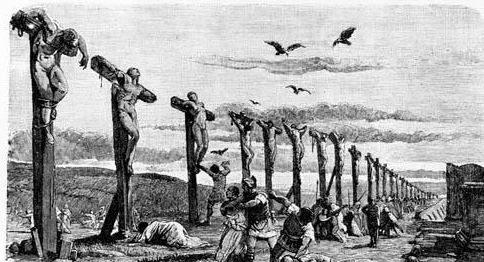
The lack of stories and legends about Jesus’ step-father is one of the great Christian mysteries. He simply disappears from the narrative in the year of Judas of Galilee’s revolt, and is never mentioned again in polite society. Nor is Zippori ever mentioned in the Bible, either by that name or the Romanized Sepphoris, although it was the local capital of Galilee. I have laid out what seem to me obvious suspicions in The Gospel According to the Romans, and blogged about it here and there.

This poem was just published in The Road Not Taken, a Journal of Formal Poetry, in the section themed on ‘Replies’. My thanks to Dr. Kathryn Jacobs.