Review: “Strange Victory” by Sara Teasdale

“Strange Victory” is a thin, competent but uninteresting collection of short poems by Sara Teasdale, produced shortly before her suicide.

Moon, worn thin to the width of a quill,
In the dawn clouds flying,
How good to go, light into light, and still
Giving light, dying.

However, as this is neither her best selling “Rivers to the Sea” nor her Pulitzer Prizewinning “Love Songs”, perhaps one of those volumes would provide a better assessment of her worth as a poet.

Not recommended.

Poem: Sonnet: “From Cavemen to Post-Human”

This sonnet looks at the way humans have deliberately explored into challenging new

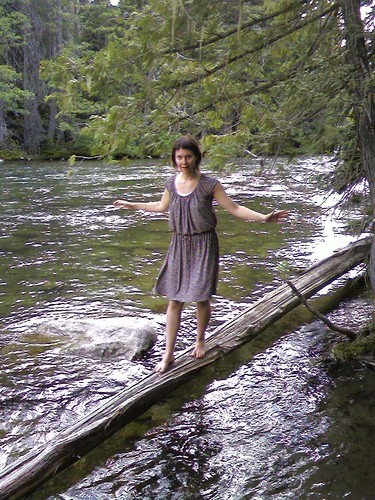
Girl on Log.jpg

“Mary, river daredevil” by magnetbox

environments, and suggests we will keep doing this until we’re human no longer. Not that this is necessarily a bad thing, any more than our past changes appear bad to us now.

The poem was published last week in Bewildering Stories, the online science fiction (or speculative fiction) magazine which has been running for some 18 years. And with poetry, of course!

The link that I have given to the poem takes you to a further link where the editor solicits opinions about the meaning of some of the poem’s statements. The Challenge questions are an interesting addition.


From Cavemen to Post-Human

From the first cavemen clinging to some logs,
escaping with their lives from flood or slaughter,
to mega-palaces that cruise the water,
humans became amphibious as frogs.
Then into space: hostile environment,
no barrier to ways to stay alive,
no worse in Mars domes, modules at L5
than in an igloo or a desert tent.
Next, thought balloons by tech cut free of place,
drifting connecting through ethereal skies,
where we upload ourselves as thought and rise
into the cloud as a post-human race
in new non-human landscapes without land,
pure energy as a new tribal band.

Poetry Resources: The Economist’s ‘Johnson’ blog

You may be surprised to hear of The Economist magazine as a poetry resource, but it is a much wider-ranging weekly than most people realise. Start from the back with its chosen Obituary (eccentric and eclectic, it has included Alex the African Grey parrot, writers such as Ray Bradbury written up in their own style, and dictators, deposed kings, and UFO abductees). Move forwards into the Books and Arts section, further into Science and Technology… there’s a lot there, before you get to the finance, business and politics that is the purpose of it all.

Apart from the half dozen book reviews (eccentric and eclectic, of course), the weekly ‘Johnson’ column or blog post covers all things word and language related. The current edition’s Johnson is headed ‘Degrees of Separation’ in the print edition, while online it calls itself ‘Words, like people, have tangled and extensive family trees – surprising connections emerge if you look back far enough’.


The article is focused on Proto-Indo-European’s development into the whole range of modern languages from Gaelic to Bengali; how different the origins may be of words that have identical spelling and pronunciation and have apparently related meaning (a pawn and to pawn); and the surprising common ancestry of apparently unrelated words (such as ‘divine’ and both halves of the word ‘Tuesday’).

Inasmuch as writing relies for much of its power on the richness of words and their ripples of meaning, association and derivation, The Economist’s Johnson column is a worthwhile and engaging weekly read for all writers, and especially poets.

Poem: Haiku: “Haiku on Haiku”

Despite my complaints yesterday about Haiku not being poetry, I can see a solution to the problem:

HAIKU ON HAIKU

Syllables are prime,
But words do more than count time;
Haiku should still rhyme.

This was originally published in Asses of Parnassus, 14 March 2018

Poem: Haiku: “Haiku on Verse”

Japanese haiku qualify as formal verse in Japanese, and in some ways in English. Traditionally they have three standard aspects as explained in Wikipedia:

The essence of haiku is “cutting” (kiru). This is often represented by the juxtaposition of two images or ideas and a kireji (“cutting word”) between them. This is the equivalent of the volta in a sonnet, the turn from the initial argument or exposition to its extension or contradiction.
Traditional haiku often consist of 17 “syllables” in three phrases of 5, 7, and 5. This is not standard in English verse, where the number of stressed syllables (i.e. the number of feet) has always been more important than the total number of syllables. Even where there are a fixed number of syllables in the foot of the particular meter being used, the feet overrule the syllables.
A kigo (seasonal reference), usually drawn from an extensive but defined list of such terms. English verse is by no means hostile to seasonal references, but is considered superior when it uses fresh words rather than drawing on a predefined list.

In addition, there is no value placed on rhyme, on the meter of the lines, or on the inclusion of either alliteration or assonance. It may be verse in Japanese, but in English the haiku (as defined above) will normally be a sentence of prose that has been artificially broken into three lines.

HAIKU ON VERSE

Haiku challenge my
Fundamental sense of verse:
(Insert last line here).

The above was published in Snakeskin in April 2017. And it doesn’t even have a kigo.

Poem: Sonnet?: “The Antikythera Mechanism”

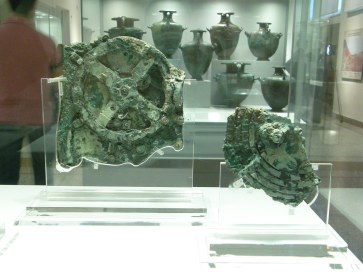
In 1900, sponge divers found a shipwreck in 150 feet (45 m) of sea off the Greek island of Antikythera. It proved to be a Roman cargo ship from the first century BC. Among the objects subsequently retrieved was a mechanism for calculating astronomical positions and eclipses centuries in advance of its time, generally considered to be the world’s earliest known analogue computer.

This poem was originally published in Snakeskin in June 2017

ANTIKYTHERA MECHANISM

The Antikythera Mechanism fits
Comfortably in no category I know;
A thing of Metal, from the Earth below,
For studying the heavens (Fire or Air)
While trapped in Water for two thousand years.
This ancient artefact from cultures past,
Designed to calculate future events,
Has a contemporary feel at last –
Making allowance for its steampunk look.
Not a computer, less whole than distressed,
It sits anomalously, missing bits,
But speaks loud of that loss much more intense
When the religious dogmas of The Book
Destroyed the nascent scientific quest.

This is a Sunday blog post, so I put a bit of religion in it. I recognise pros and cons to religion. (“All religions united with government are more or less inimical to liberty. All, separated from government, are compatible with liberty.”) It’s nice for people to use religions to explore their relationship with the universe, but I hold the inherent intolerance of monotheism responsible for setting civilisation back a thousand years.

On the use of form: well, the poem has aspects of form – it’s in iambic pentameter, like a regular sonnet; it has 14 lines, ditto; it rhymes… but there’s no structure to the rhyme. The combination of structure and chaos suits the mood of the poem, the odd position in history of this mechanism, and its odd state of semi-survival. Reconstructions of the Antikythera Mechanism have been made confidently, and put on display next to its fragments in the National Archaeological Museum in Athens

Poem: Limerick: “Monomiscommunication”

This poem was published in Light, August 2017

MONOMISCOMMUNICATION

To be true to myself and quite clear
I whispered into my own ear;
I nodded, replied;
But, suspecting I lied,
I’m pretending I just didn’t hear.

About the use of form: pfft, it’s just a limerick. Limericks are designed with a bouncy, sassy meter and rhyme scheme. If ever there was a form that demonstrated how the use of rhyme and meter is part (and, I argue, an essential part) of the creation of the mood of the poem, it is the limerick. Perfect for puns, satire, rudeness and general frivolity, it is impossible to have any emotion of great seriousness when reading thoughts written in this form.

Therefore if you want to maximise the seriousness, for example, with which your verse is read, realise that an appropriate form is one of the requirements. And if you want your thoughts to be memorable word for word, then rhyme, rhythm, alliteration and assonance will be among the tools you use.

Poem: Sonnet: “The Unconscious Gets No Respect”

Today’s poem is about the unconscious, again. It was paired with the “Thunder-Galloping” one when published in Snakeskin, November 2016.

THE UNCONSCIOUS GETS NO RESPECT

The unconscious is a melancholy drunk
It prattles on in dreams with brutal truth.
“I’m getting ugly and I’ve lost my youth.”
“In useless youth I was a stupid punk.”
It evilly summons loved ghosts from the past –
Bobs this one’s hair and dyes it a rich red –
Conflating one who’d never shred their head
With unrelated one who lives life fast.
It sings its nonsense songs like Lear’s poor fool,
Nonsense that turns out sane in retrospect;
Is treated with contempt, or else neglect;
Unrecognized for what it is: a tool,
A genius program for decoding life,
A mental multi-blade Swiss Army knife.

This poem was written four weeks after “My Thunder-Galloping Unconscious Mind”. It repeats my attitude towards the unconscious: that it is powerful, deserves respect, and when respected provides health, direction and inspiration. I go through periods of writing about the same subject, just as an artist may do several versions of the same landscape either to try to capture the ineffable or simply to experiment with different weathers and lights and moods.

The structure of the poem – well, it is in reasonable iambic pentameter, but I’d say it’s a technically weaker sonnet than its twin, with a regular but less admirable rhyme scheme. The octet breaks satisfactorily into two quatrains and the volta is acceptable; but though the sestet has a concluding couplet, it’s actually a bit scrappy.

Be all that as it may, I like the poem; and publication in Snakeskin is always a good seal of approval.

Poetry Resources: A.Word.A.Day

One of the greatest resources for any lover of words is the (free) email subscription to A.Word.A.Day from wordsmith.org, founded by Anu Garg in 1994. Of course, you may well be getting this already as one of the 400,000 subscribers in 170 countries, enjoying the definition, pronunciation, etymology, usage and visual illustration of a not-quite-random word five days a week. Added bonuses include a quotation from a writer on their birthday, and limericks, anagrams and puns in the readers’ comments on the weekend.

This week’s theme is words used by singer-songwriter Roy Zimmerman, and is the trigger for my posting about A.Word.A.Day. Roy Zimmerman, as guest editor for A.Word.A.Day, writes:

“When my wife Melanie and I write a song, the Idea is out in front. People often ask which comes first, the melody or the lyrics. We say the Idea, with a capital I. The Idea takes shape as a hook — a little snatch of lyrics and melody — and the hook gives birth to a tune, a meter scheme, and a rhyme scheme.

We both love words. We’re both aware that words do real work in the world, especially words that rhyme and meter well. That’s what we’re trying to do with these songs — provide context, history, laughter, and encouragement for the work of social justice.

The description of the sequence for songwriting is virtually identical to that for writing poetry – and although poetry doesn’t necessarily have a tune, poetry definitely has a tone, a mood, that forms in the same place. Songs and poetry are very close siblings. Sometimes songs are forgiven weak lyrics because of a strong melody; sometimes poems are forgiven their lack of rhythm and rhyme because of their strongly expressed ideas and images. But at their most memorable they fuse as catchy songs that can also be fully enjoyed as poems without the music.

In either case, they are completely dependent on words. And to prod your word awareness, there is nothing simpler than the daily email from Anu Garg.

Poem: Sonnet: “My Thunder-Galloping Unconscious Mind”

A sonnet from a couple of years ago, published in Snakeskin, November 2016 :
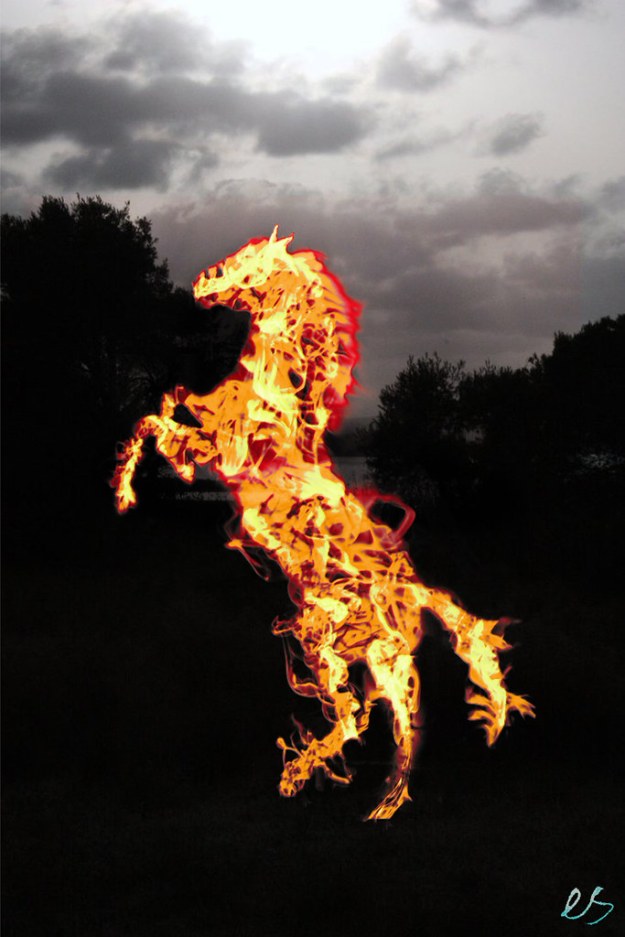
Fire Horse

“fire horse” by sk8rboi90 is licensed under CC BY-NC-SA 2.0


MY THUNDER-GALLOPING UNCONSCIOUS MIND

My thunder-galloping unconscious mind –
On which I, jolly joking jockey, perch
And whose divine intentions I besmirch
With claims its selfishnesses I’ve divined –
This powerhouse, this generator blind,
With pattern-seeking data-crunch research,
Unschooled, ungoverned, then will trip and lurch
Drunk as a soul must be in a mad mind.
But loved and honoured it’s a thundering horse
That powers all the body’s work and health
And flushes poisons in its daily course
And monitors all dangers in its stealth
And feeds uplifting feelings, love and right…
And gifts these images to me at night.

This encapsulates a lot of my thoughts about the way the world works: a lot goes on under the surface of the mind, and we are not as much in charge as we think. In that sense I agree with those who say there is no free will – we think we are consciously deciding to act, but when the brain is monitored we find that we begin to act before the conscious decision – the conscious mind merely rubber-stamps the decision already taken by the unconscious and then, like any figurehead, takes credit for the action.

Also, I am of the opinion that acknowledging the power and healthfulness of the subconscious is key to a happy, balanced and creative life.

The structure of the poem – well, it’s a sonnet, but not pure in form. The first lines rhyming ABBA ABBA are Petrarchan, but after the (weak) volta the CDCD EE is Shakespearean. The effect to a purist is messy, muddy. But honestly, the awareness of four-line chunks is driven by either of those types of fundamental rhyme, just as it is by a rubaiyat’s AABA. When the final couplet comes, the sonnet feels complete – and this couplet is the strength of the Shakespearean sonnet. (The Petrarchan would have ended CDE CDE.)

I am only aware of one sonnet where switching between Petrarchan and Shakespearean was done deliberately and appropriately: a sonnet by Keats in which he was discussing form, and clarifying his new-found preference for the Shakespearean over the Petrarchan.

In anyone else, switching is not ideal, but it’s also not a major obstacle. It is a sign of slight imperfection. But I think this poem still holds.