A pounding beat to drug, enhance, enfold –
iambics are the dance floor of the old.
*****
Published in The Asses of Parnassus, home of “short, witty, formal poems”. Thanks, Brooke Clark!
Illustration: ‘Iambics’ by RHL and ChatGPT

A pounding beat to drug, enhance, enfold –
iambics are the dance floor of the old.
*****
Published in The Asses of Parnassus, home of “short, witty, formal poems”. Thanks, Brooke Clark!
Illustration: ‘Iambics’ by RHL and ChatGPT

It has arrived—the long rag rug
multiply folded. On top, one alien hair.
I put my face to the folds and smell despair
palpable as salt air
in all those rooms and houses, small and smug—
enclosures I passed through on my way where?
Whoever did the weaving appears old
in my mind’s eye. I can’t make out her face,
can only conjure up the faintest trace
of an abstracted grace,
clack of the loom. Does she know they’ll be sold
these precious things, in some unheard-of place?
I perch her on a hill, precariously
beyond the reach of waves’ daily boom.
Sun blazes overhead, but her dim room
(no bigger than the loom)
is proof against the violence of the sky
From it I further spin what I once called my home:
Endless horizons fading into haze,
the mornings dawn came up so rosy clear;
snails in the garden, sheep bells everywhere,
the brightness of the air,
terraces, valleys organizing space
and time’s cessation. So this package here
I’m now unwrapping, in New York, today
(rugs like rainbows, woven with a grace
my strands of language barely can express;
dishrags of dailiness
dispersed and recombined and freshly gay)
comes to me imbued with images,
slowly and faithfully across the water,
across the world. It represents a time
I myself snipped and recombined as rhyme
as soon as I went home,
if that is where I am. These rugs recover
the sense of stepping twice into a single river.
*****
Rachel Hadas writes: “Rag Rug, written probably around 1980 or sometime in the early Eighties, describes my experience opening packages of rag rugs handwoven by a woman or women in Samos, the Greek island where I’d lived between 1971 and 1974. The rags in question were blue jeans, pajamas, tablecloths, you name it – I’d cut these into narrow strips which I sewed together and rolled into a ball, and when I had enough such balls I mailed them to my former mother-in-law in Samos; she eventually sent me the finished project, long rag rugs perhaps eighteen inches wide, colorful, washable, which eventually faded and blended as madras does. The evocative smell of the cloth; the memories of the island and my life there; the fact that poetry, like the making of these rugs, like quilting, is a piecing together, recombining and recycling of fragments – reading the poem now brings all this back.”
Rachel Hadas’s recent books include Love and Dread, Pandemic Almanac, and Ghost Guest. Her translations include Euripides’s Iphigenia plays and a portion of Nonnus’s Tales of Dionysus. Professor Emerita at Rutgers-Newark, where she taught for many years, she now teaches at 92Y in New York City and serves as poetry editor of Classical Outlook. Her honors include a Guggenheim fellowship and an award from the American Academy-Institute of Arts and Letters.
Photo: “Colourful rag rug” by theihno is licensed under CC BY-ND 2.0.

Dear poets, I know that you hunger for meaning, and that is why you reflect on how faith questions life. (…) Poetry is open; it throws you into another realm.
In light of this personal experience, today I would like to share some thoughts with you on the importance of your service.
The first thing I want to express is this: you are eyes that see and dream. Not only do you see, but you also dream. A person who has lost the ability to dream lacks poetry, and life without poetry does not work. We humans yearn for a new world that we may never fully see with our own eyes, yet we desire it, seek it, and dream of it. A Latin American writer once said that we have two eyes: one of flesh and the other of glass. With the eye of flesh, we see what is before us; with the eye of glass, we see what we dream. Woe to us if we stop dreaming—woe to us! (…) Indeed, poetry does not speak of reality from abstract principles but rather by listening to reality itself: work, love, death, and all the little and great things that fill life. Yours is — to quote Paul Claudel — an “eye that listens.” (…)
I would also like to say a second thing: you are the voice of human anxieties. Often, these anxieties are buried deep within the heart. You know well that artistic inspiration is not only comforting but also unsettling because it presents both the beautiful realities of life and the tragic ones. Art is the fertile ground where the “polar oppositions” of reality — as Romano Guardini called them — are expressed, always requiring a creative and flexible language capable of conveying powerful messages and visions. For example, consider when Dostoevsky, in The Brothers Karamazov, tells the story of a little boy, the son of a servant, who throws a stone and hits one of his master’s dogs. The master then sets all the dogs on the boy. He runs, trying to escape the fury of the pack, but ultimately, he is torn apart under the satisfied gaze of the general and the desperate eyes of his mother.
This scene has tremendous artistic and political power: it speaks to the reality of yesterday and today, of wars, social conflicts, and our personal selfishness. It is just one poetic passage that challenges us. And I’m not only referring to the social critique in that passage. I speak of the tensions of the soul, the complexity of decisions, the contradictions of existence. There are things in life that, at times, we can’t even understand or find the right words for: this is your fertile ground, your field of action. (…)
That is what I want to ask of you today as well: go beyond the closed and defined borders, be creative, do not domesticate your anxieties or those of humanity. I fear this process of taming because it stifles creativity, it stifles poetry. With the words of poetry, gather the restless desires that inhabit the human heart so they do not grow cold or die out. This work allows the Spirit to act, creating harmony amidst the tensions and contradictions of human life, keeping the fire of good passions alive, and contributing to the growth of beauty in all its forms, beauty that is expressed precisely through the richness of the arts.
This is your work as poets: to give life, to give form, to give words to all that human beings live, feel, dream, and suffer, creating harmony and beauty. It is a work that can also help us better understand God as the great “poet” of humanity. Will you face criticism? That’s okay, bear the weight of criticism while also learning from it. But never stop being original, creative. Never lose the wonder of being alive.
So, eyes that dream, voices of human anxieties; and therefore, you also have a great responsibility. And what is it? It’s the third thing I want to say: you are among those who shape our imagination. Your work has an impact on the spiritual imagination of the people of our time. Today, we need the genius of a new language, powerful stories, and images. (…)
Dear poets, thank you for your service. Continue dreaming, questioning, imagining words and visions that help us understand the mystery of human life and guide our societies toward beauty and universal fraternity.
Help us open our imagination so that it transcends the narrow confines of the self and opens up to the entire reality, with all its facets, thus becoming open to the holy mystery of God. Move forward, without tiring, with creativity and courage!
I bless you.
*****
The above is a substantial excerpt from the letter Pope Francis wrote for the book ‘Verses to God: An Anthology of Religious Poetry‘ (published by Crocetti Editore), curated by Davide Brullo, Fr. Antonio Spadaro, and Nicola Crocetti. The letter is given in full in the Vatican News.
The Economist’s obituary for Pope Francis states he insisted on: “no papal cape or red slippers, just a plain white cassock and his ordinary black shoes. (…) No crest-embellished dinner plates, no new pectoral cross; he kept the iron-plated one he had worn, from 1998, as archbishop of Buenos Aires. No 12-room apartment in the Vatican, but a two-room suite in the guests’ hostel, and meals in the dining room with everyone else. “We’ll see how long it lasts,” said one aide, uncomfortable. It lasted until he died; for in Buenos Aires, after all, he had cooked his own meals and travelled by bus. (…) In Buenos Aires he was called the “Slum Bishop” for insisting that he, and his priests, should go out in the streets and on the margins. (…) He made a point of reaching out, feeding hundreds of homeless with pizza at the Vatican and adopting several families of Syrian refugees.”
So, sympathy for the homeless, and refugees… and poets. There’s a spiritual resonance to that grouping!
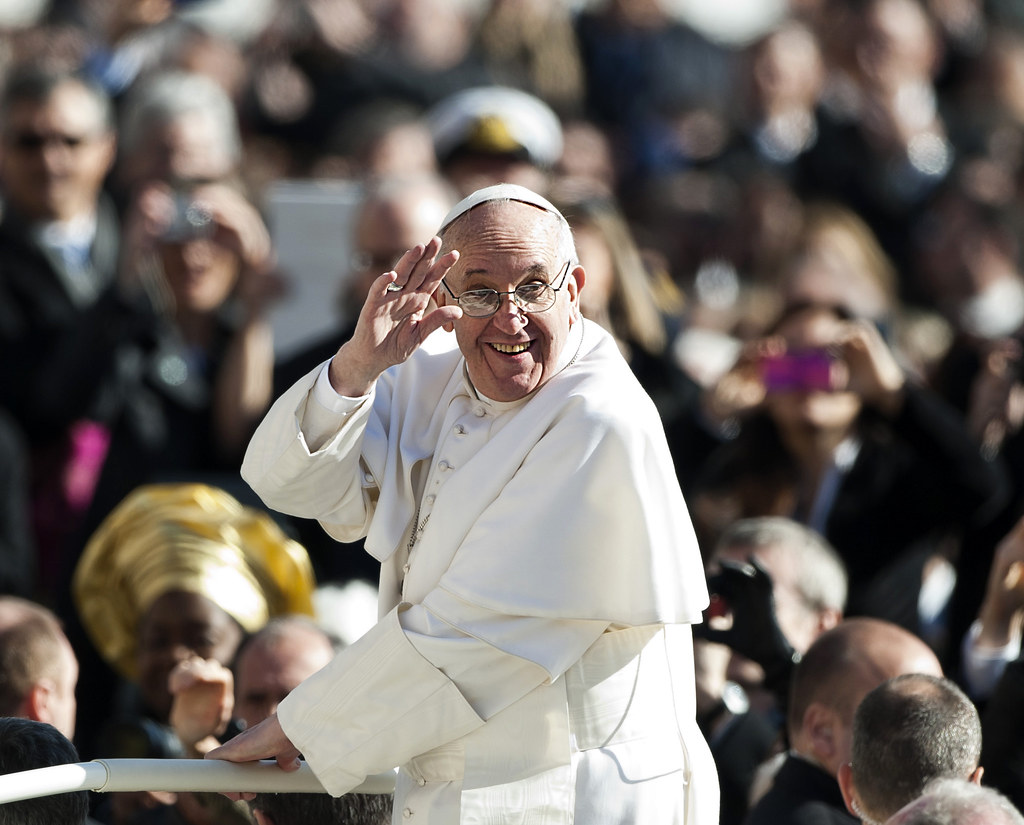
Photo: “The Inauguration Mass For Pope Francis” by Catholic Church (England and Wales) is licensed under CC BY-NC-SA 2.0.

It can be difficult for a formalist to find a home for their poetry. Some of the best-known and longest-established poetry magazines have either changed (often under a new editor) from being receptive to being hostile towards formal verse (e.g. Ambit, in the UK); others are receptive, but only to already well known poets (e.g. Poetry, in the US). For what it’s worth, here is a list of places where I have been able to publish 400 of my own uneven and very varied pieces (plus several where I’m still unpublished, but you may be a better fit), with some comments about what is appropriate for where.
14 Magazine – UK: 14-line poems… sonnets etc.
32 Poems – US
Alabama Literary Review – US: lyrical, positive; only takes snailmail submissions (unless you have a genuine need for email)
Alchemy Spoon – UK
Allegro – UK: contemporary, looking for more formal submissions than they receive
Amethyst Review – US: “with a connection to spirituality and the sacred”, meaning very Christian
Amsterdam Quarterly – Netherlands, English-language: must address the issue’s theme
Asses of Parnassus – Canada: short, witty, formal poems, snarky is fine, hosted on Tumblr.
Bad Lilies – UK
Bewildering Stories – Canada/UK/US: speculative and science fiction pieces
Blue Unicorn – US: prefers formal but will take other work
Bombay Literary Magazine – India
The Borough – Australia: new in 2024, committed formalist
Brazen Head – UK: ideas-rich
Carmen et Error – UK: “a poem and a mistake”…
Cerasus – UK
Chained Muse – US: prefers classical themes
Consequence – US: addressing the impact of war
Consilience – UK/US/Canada: poems on science (themed)
Crow and Cross Keys – UK: speculative, gothic, folk… should sound as good as it reads
Dawntreader – UK: “myth, legend; in the landscape, nature; spirituality and love; the mystic, the environment”
Empty House – US: abandoned spaces (mental and physical), historical sense
Eye To The Telescope – US: SF, themed: Nov 2024 is “(Non-)Binaries”
Grand Little Things – US: “Returning versification to verse”
Griffith Review – Australia: themed
iamb – UK: audio recordings
Juniper – Canada: would like to see more formal submissions
Libretto – Nigeria: prefers African/Afro-American/Afro-European/post-colonial pieces
Light – US: large biannual issue, also the home of weekly topical light verse
Lighten Up Online (LUPO) – UK: light formal verse, quarterly
Lyric – US: “Founded in 1921, The Lyric is the oldest magazine in North America in continuous publication devoted to traditional poetry.” Lyrical, positive… flowers and countryside.
Magma – UK: themed (‘Ownership’ for November 2024)
Metverse Muse – India: publishes simple traditional verse. No website. The email for editor Dr. Tulsi is metverse_muse@yahoo.com
New Criterion – US: conservative
New Verse Review – US: new in 2024, impressive
Obsessed With Pipework – UK: “strangeness and charm… prefers dreams to deathbeds”
Orbis – UK: (Editor may suggest/request multiple edits, but will accept your decision.)
Orchards Poetry Journal – US: more rural than urban
Oxford Poetry – UK
Penwood Review – US: religious streak
Poetry Porch – US: lyrical
Pulsebeat Poetry Journal – US: more urban than rural
Rat’s Ass Review – US: irreligious streak; whatever appeals to the editor, including NSFW things you can’t get published elsewhere.
Rattle – US: large print circulation, a variety of different opportunities
Road Not Taken: The Journal of Formal Poetry – US: hard to find online because of its name, but a good small publication for formal and semi-formal verse.
Shot Glass Journal – US: max 16 lines, equally weighted between US and international poets
Snakeskin – UK: probably the longest-established poetry zine in the world; has no interest in submission bios, only in the poems; likes work that begins light and becomes heavier.
Sonnet Scroll – US: a sonnet-specialized alcove on the Poetry Porch
The HyperTexts (THT) – US: an enormous assemblage of verse from all times and places; the editor’s personal preference for formal and leftist verse doesn’t rule out selections by Walt Whitman or Ronald Reagan! The works are mostly republications, but if you have a body of strong work the editor may be interested in creating a page for you.
Think – US: formalist, conservative, Christian
Verse-Virtual – US: a monthly publication for a caring community of poets
Visions International – US: I’m not sure what the status is of this magazine these days, or who is editing it…
and finally:
Wergle-Flomp Humor Poetry Contest, No Fee – US: $3,750 in prize money
This list doesn’t include magazines not relevant for me (like Mezzo Cammin: An Online Journal of Formalist Poetry by Women), or that moved away from formalism and no longer publish me (like Ambit, and Star*Line), or that have unfortunately folded (14 by 14, Better Than Starbucks, Bosphorus Review of Books, Candelabrum, The Rotary Dial, Unsplendid), or that show no apparent interest in formal verse in current issues despite their guidelines (3rd Wednesday, Westchester Review).
And there must be a lot of worthy magazines that I simply haven’t run across – let me know!
And of course, as ever, don’t just fire off a handful of poems at random – read some samples online, determine the magazine’s orientation and moods, check whether the editor wants anything particular, note whether they love or loathe attachments, etc…
Good luck!
Photo: “Magazines” by theseanster93 is licensed under CC BY-SA 2.0.

They rubbed two sticks together and made friction.
They made a fist but couldn’t make a hand.
Their dictionary wasn’t made of diction.
Their diction made them hard to understand.
Trying to make a poem, they made a list.
Trying to make the team, they made the choir.
They made up stories whose protagonist
would rub two sticks together and make fire.
Mistakes were made, and mixtapes to go with them.
They made a couch their bed and made their bed.
They tried to make a joke at the expense
of love and money. “Make me,” money said.
They made up stories but they made no sense.
They rubbed two cents together and made rhythm.
*****
Eric McHenry writes: “Strangely, I remember almost nothing about writing this poem, except that I was thinking about the etymology of ‘poet’ (‘maker’) and about the versatility of the verb ‘make’.”
‘Lives of the Poets’ was first published in Literary Matters.
Eric McHenry is a professor of English at Washburn University and a past poet laureate of Kansas. His books of poetry include Odd Evening, a finalist for the Poets’ Prize; Potscrubber Lullabies, which received the Kate Tufts Discovery Award; and Mommy Daddy Evan Sage, a collection of children’s poems illustrated by Nicholas Garland. He lives in Lawrence, Kansas, with his wife and two children.
Eric McHenry – The Waywiser Press
Eric McHenry, Author at The American Scholar
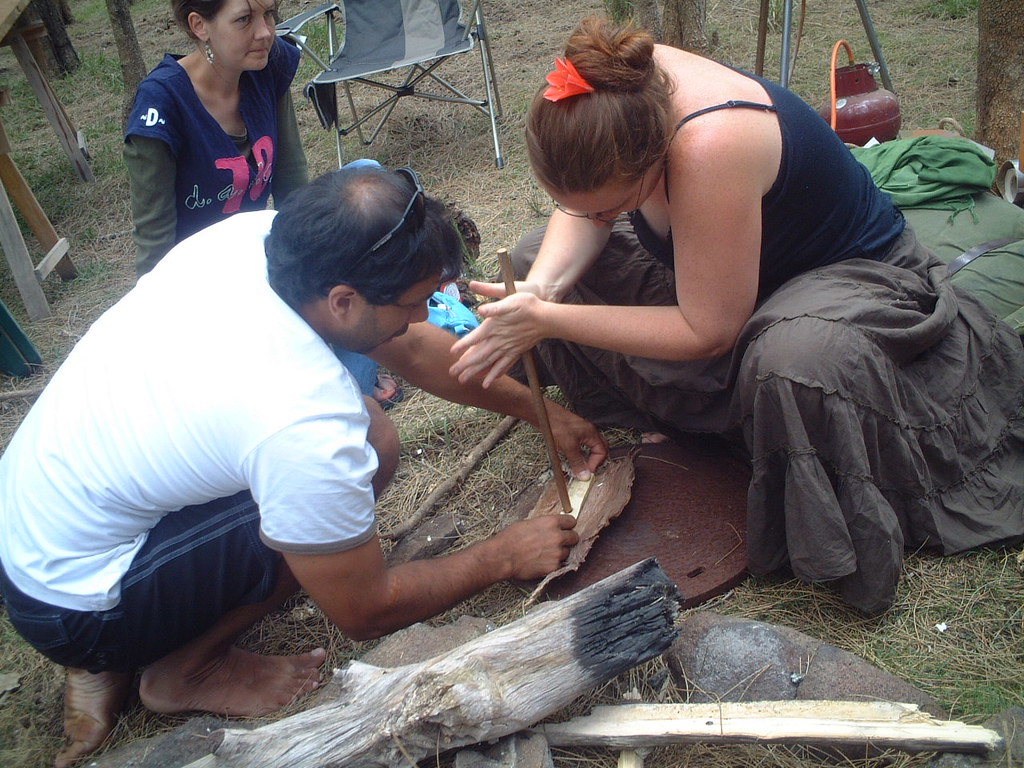
Photo: “Master Sacha twirls the fire stick” by one thousand years is licensed under CC BY 2.0.

I know you have no use for them,
poems with their sly quicksilver words
that won’t just speak their minds,
but carom through your head like startled birds.
Is that despair or longing in their cries?
Their dolors make no sense.
They’ll never buy you larger-screened TVs
or seats at sports events.
But someday, as you watch a pair hold hands
and leap from a burning tower,
as you wait for test results or hear
your phone ring at an unaccustomed hour,
what you feel will circle wordlessly—
tense, accusing, gaunt.
You’ll find that you are tested and found wanting,
and these are what you’ll want.
*****
Susan McLean writes: “As a professor myself and a person who once worked on writing standardized tests, I am familiar with the complaint of teachers that they are often forced to “teach to the test,” i.e., teach only the sort of knowledge and skills that students need for passing that sort of test. But as a poet, I know that we are tested in life in all sorts of ways. Most people think that they can get through life just fine without poetry. They tend to find poetry annoying and impenetrable, something that needs to be decoded, that has no practical use. Yet in tragedies, when all hope and comfort are gone, there is some comfort in hearing that others who have been in similar situations were able to put into words the feelings that you can’t. And the most memorable and condensed of those responses are often poems.
This poem is rhymed and metrical, but the lines are of different lengths in unpredictable patterns, a form called “heterometric,” and the rhymes occur only every other line. That unpredictability is meant to mirror life, in which the bad news always seems to come out of nowhere. The poem originally appeared in Able Muse and later in my second poetry collection, The Whetstone Misses the Knife.”
Susan McLean has two books of poetry, The Best Disguise and The Whetstone Misses the Knife, and one book of translations of Martial, Selected Epigrams. Her poems have appeared in Light, Lighten Up Online, Measure, Able Muse, and elsewhere. She lives in Iowa City, Iowa.
https://www.pw.org/content/susan_mclean
Photo: “When Young Children ‘Hate’ School” by wecometolearn is licensed under CC BY 2.0.

What a worthless thing is poetry,
a product of hard labor I adore;
a counter full of year-old toiletries
will always fetch considerably more.
A merchant selling gift-wrapped bars of soap
will come away with profit and some change;
to sell a poem is no more than a hope
washed clean of what a market can arrange.
Here! Have a few of mine, two for a quarter—
a dime apiece—the bargain of the day…
just name it! I’m here to take your order.
Hard labor’s even hard to give away.
*****
Donald Wheelock writes: “I have spent most of my life as a composer of vocal, orchestral and chamber music. While remuneration for song cycles and string quartets is not unknown, the profits from commissions and other sources rarely exceed the expenses. I don’t have to tell the readers of formalverse that the same could be said for formal poetry. The conceit of this poem has been an assumption in my life for many years, and equivalent jokes among composers of “classical concert music” are not uncommon.
I have written formal poetry for almost as long as I have music, often to set to music. But it is relatively recently that I have submitted it to journals welcoming formal poetry. Snakeskin (where this poem was first published), Able Muse, Think, Blue Unicorn, Rue Scribe, Quadrant and many other journals have published my poems. My first full-length book, It’s Hard Enough to Fly, was published by Kelsay Books in 2022. My second book, With Nothing but a Nod, will appear in May of this year from David Robert Books.”
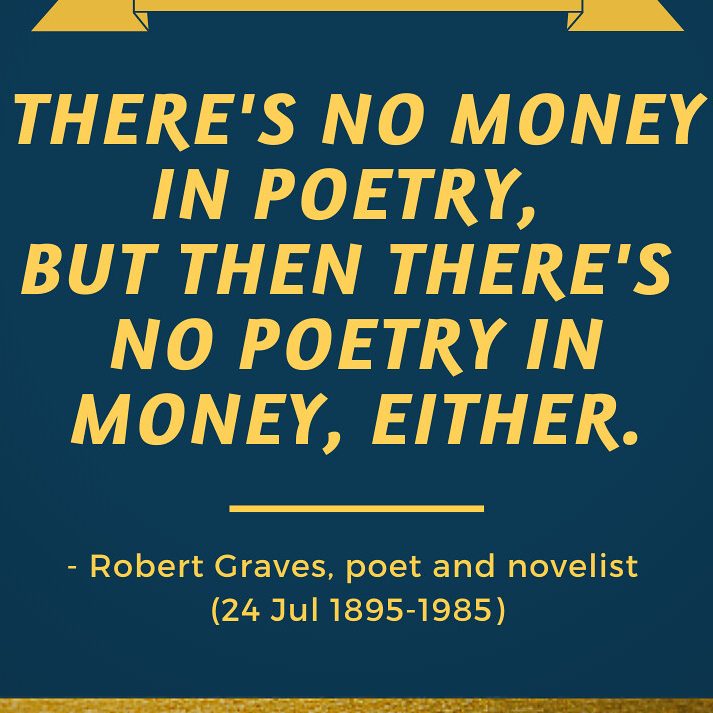
Photo: “A THOUGHT FOR TODAY from A.Word.A.Day” by Wordsmith.org is licensed under CC BY-NC-SA 2.0.

Richer than mother’s milk
is half-and-half.
Friends of two minds,
redouble your craft.
Our shelves our hives, our selves
a royal jelly,
may we at Benares and Boston,
Philly and Delhi
collect our birthright nectar.
No swarm our own,
we must be industrious, both
queen and drone.
Being two beings requires
a rage for rigor,
rewritable memory,
hybrid vigor.
English herself is a crossbred
mother mutt,
primly promiscuous
and hot to rut.
Oneness? Pure chimera.
Splendor is spliced.
Make your halves into something
twice your size,
your tongue a hyphen joining
nation to nation.
Recombine, become a thing
of your own creation,
a many-minded mongrel,
the line’s renewal,
self-made and twofold,
soul and dual.
*****
Editor’s comments: Being Anglo-Danish from birth and with the subsequent acquisition of other passports, I am naturally biased in favour of multiculturalism. It was interesting a couple of months ago to hear Britain’s Home Secretary Suella Braverman say “Multiculturalism has failed.” As one commentator noted, “She’s descended from Goan Indians from Mauritius and Kenya, married to a Jewish husband, and is in a senior cabinet position in a government headed by Britain’s first Hindu PM, himself the son of immigrants… Hello???” Suella Braverman left the cabinet shortly after.
Indians in particular, having been invaded and occupied by the Portuguese, French and British in the past couple of centuries, have used those connections to move out into the world – not just as entrepreneurs, but also in the arts, sciences… and politics. In mid-2023 the Prime Ministers of Ireland, Mauritius, Portugal and the UK, and the Presidents of Guyana, Mauritius, Seychelles, Singapore, Suriname and Trinidad & Tobago, all had Indian origins.
Amit Majmudar is a poet, novelist, essayist, translator, and the former first Poet Laureate of Ohio. He works as a diagnostic and nuclear radiologist and lives in Westerville, Ohio, with his wife and three children. He is the author of twenty books so far in a variety of categories, with different bodies of work published in the United States and in India.
His poetry collections include 0’, 0’ (Northwestern, 2009), shortlisted for the Norma Faber First Book Award, and Heaven and Earth (2011, Storyline Press), which won the Donald Justice Prize. These volumes were followed by Dothead (Knopf, 2016) and What He Did in Solitary (Knopf, 2020). His poems have won the Pushcart Prize and have appeared in the Norton Introduction to Literature, The New Yorker, and numerous Best American Poetry anthologies as well as journals and magazines across the United States, UK, India, and Australia. Majmudar also edited, at Knopf’s invitation, a political poetry anthology entitled Resistance, Rebellion, Life: 50 Poems Now.
One of Majmudar’s forthcoming volumes is a hybrid of prose, drama, and poetry, entitled Three Metamorphoses (Orison Books, 2024). A new poetry collection is forthcoming from Knopf in 2026.
For links to Majmudar’s Nonfiction, Fiction, Mythology and Translations, please see his website.
Photo by Ami Buch Majmudar.

When all the bright young women studied law
and medicine, I thought a PhD
in Women and the Novel would unthaw
the frozen heart of Academe for me.
When all the bright girls married, where was I?
Still shacking up with poets that I met
in bars, convinced that genius and rye
would write us into fame and out of debt.
The bright girls made investments by the rules.
I kept on writing novels in my mind.
They sent their handsome kids to private schools
and I became the girl they left behind.
Bright girls got married and ahead and rich,
while I’m in debt again, and life’s a bitch.
*****
Gail White writes: “The Girls Who Got Ahead is a poem from the 90’s. Yes, everyone was in the professions or in graduate school but me. I was a poet and that means taking a vow of poverty. I thought I might as well make a sonnet out of it.”
Gail White is the resident poet and cat lady of Breaux Bridge, Louisiana. Her books ASPERITY STREET and CATECHISM are available on Amazon. She is a contributing editor to Light Poetry Magazine. “Tourist in India” won the Howard Nemerov Sonnet Award for 2013. Her poems have appeared in the Potcake Chapbooks ‘Tourists and Cannibals’, ‘Rogues and Roses’, ‘Families and Other Fiascoes’, ‘Strip Down’ and ‘Lost Love’. ‘Money Song’ is collected in ‘Asperity Street‘. Her new light verse chapbook, ‘Paper Cuts‘, is now available on Amazon.
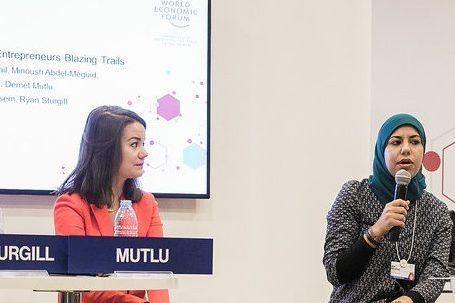
Photo: “Women Entrepreneurs Blazing Trails” by World Economic Forum is licensed under CC BY-NC-SA 2.0.
Bit by bit they deconstruct the thing:
no frets, no pegs, no bridge, removing its
harmonic parts until at last each string
is slack, and lacking resonating bits.
They put the rest, the body, neck, and head,
aside as too much like a prop for those
whose earnestness is all they need instead
of craft and art to fake that they can sing.
So there they are, on either stage or page:
The foremost poets of the modern age,
Who, writing their relineated prose,
Will swagger as they grimace, strut, and pose
Pretending they are better than they are
While playing nothing but an air guitar.
*****
Marcus Bales writes: “Back in the day I spent more time than I should have arguing that freeverse was prose, and that freeversers are prose writers, not poets at all. Of course, when you strike at the core of a belief-system those who believe it feel you are attacking them personally, and respond with insults. They cannot address the reasoning of the arguments, so they resort to ad hominem. I was searching for a metaphor to substitute for argument, something that would reveal the fundamental paucity of the entire freeverser credo that prose is poetry if only they say it is. What I was looking for was something to demonstrate the posers as mere posers. What, besides writing prose and then arbitrarily or whimsically relineating it to resemble the ragged-right look of poetry on the page and calling it poetry, was an even more ridiculous example of that pose? Here it is.”
Not much is known about Marcus Bales except that he lives and works in Cleveland, Ohio, and that his work has not been published in Poetry or The New Yorker. However his ’51 Poems’ is available from Amazon. He has been published in several of the Potcake Chapbooks (‘Form in Formless Times’).
Photo: “Airnadette: Air Bass Guitar” by DocChewbacca is licensed under CC BY-NC-SA 2.0..