Just ask the poet, life’s a dumb thing. Button, button, eating, swilling. Life isn’t much but, still, it’s something.
Existence is a rule-of-thumb thing. Buying now with later billing. Just ask the poet, life’s a dumb thing.
To dream, to sleep, a ho-and-hum thing. Boring, boring, mulling, milling. Life isn’t much but, still, it’s something.
Mum’s the word, the word’s a mum thing. Button lips and no bean spilling. Just ask the poet, life’s a dumb thing.
Life, of course–the known-outcome thing. Death and taxes. God is willing. Life isn’t much but, still, it’s something.
Life is short, a bit-of-crumb thing. Dormouse summer, daddies grilling. Just ask the poet, life’s a dumb thing. Life isn’t much but, still, it’s something.
*****
In his 2021 collection ‘That Shakespeherian Rag‘, Ed Conti threads poetic references throughout (the title is from Eliot); ‘Button, Button’ appropriately begins with:
When one subtracts from life infancy (which is vegetation),–sleep, eating and swilling, buttoning and unbuttoning–how much remains of downright existence? – The Summer of a Dormouse, Byron’s Journals.
Much of ‘That Shakespeherian Rag’ (including Button, Button) was first published in Light. The collection is divided into 11 sections, organised from youth through adulthood to the prospect of mortality, and each prefaced with a quote from Shakespeare. The preface for the final Section reads:
Make no noise. Make no noise. Draw the curtains– – King Lear, Act II Scene 6
There is no poem after it.
The charming, delightful, witty and tolerant Edmund Conti died on November 12th, aged 96.
I Because I do not do the limerick line Because I do not do Because I do not do the limerick Desiring this man’s schtick or that man’s joke I will stick to knocking out free verse (If here and there a rhyme so much the worse) In mournful moans Presented ragged-right upon the page.
II There once was a Lady with three White leopards, a juniper tree, And a bag full of bones That sang their sad moans Of what they had once hoped to be.
III At every turning of the turning stair, Your breathing hard, your eyesight edged with dark, You see the face of hope and of despair.
You breathe the vapor of the fetid air And toil as if some atmospheric shark At every turning of the turning stair
Was hunting through the gathering darkness there, While back and forth across the narrative arc You see the face of hope and of despair.
At every turning there’s a window where You contemplate a drop that’s still more stark At every turning of the turning stair.
Instead you circle upward as you swear Like you are looking for a place to park. You see the face of hope and of despair.
You can’t endure the future’s dismal dare Nor drag yourself to put out your own spark At every turning of the turning stair.
You’re learning how to care and not to care And whether you will make or be a mark. You see the face of hope and of despair At every turning of the turning stair.
IV Higgledy piggledy Here we are all of us Trudging along where some Billions have trod
Smelling the flowers and Trusting religionists’ Tergiversational Rodomontade.
V If the word that is lost isn’t lost, And the word that is spent isn’t spent Then silence is actually speaking, And meaning is something unmeant.
If the meaning is what is unheard And the word is the thing that’s unspoken Then how do you hear if a word Has a meaning that hasn’t been broken.
If the unspoken word must be still And the unheard is what it’s about To have heard the unhearable meaning The inside has got to be out.
If the unheard were out of this world And the light shone in darkness were dark Then the unlit unheard would be meaning If the snuffer provided the spark.
If the yadda can yadda its yadda And the pocus was what hocus took Then gobble must surely be gobble Though dee separates it from gook.
VI Awake! Your hope to turn or not to turn Is wasting time – but go ahead and yearn To see the light or hear the word to know A heaven human beings can’t discern.
There’s nothing there for such as you and me; We make our meaning up from what we see And hear and touch and taste and smell and think — But all there is is fragments and debris.
The steps are just the steps, the stairs the stairs, The rest is merely human hopes and prayers That do no more than hopes and prayers can do, And nothing’s chasing you except your heirs.
No unmoved mover writes upon some slate That mortals may abate or not abate; No hope and no despairing of that hope Reveals what nothing states, or doesn’t state.
Whatever happens happens because of us We get a muss when we don’t make a fuss Demanding right from wrong not mere convenience: We’re all complicit underneath this bus.
Awake! Don’t hope to turn or not to turn, Don’t pray that this is none of your concern. Awake! What will it take for you to learn That if it all burns down you, too, will burn?
*****
Marcus Bales has produced this wonderful set of parodies of the long T.S. Eliot poem ‘Ash Wednesday‘, beginning with a piece in the poem’s style for Part I, Because I do not hope to turn again Because I do not hope Because I do not hope to turn Desiring this man’s gift and that man’s scope
but then moving into a limerick for Part II’s Lady, three white leopards sat under a juniper-tree
and a 22-line villanelle for Part III’s At the first turning of the second stair
and a double dactyl for Part IV’s Who walked between the violet and the violet
and quatrains for Part V’s If the lost word is lost, if the spent word is spent If the unheard, unspoken Word is unspoken, unheard;
and finally rubaiyat with a strong flavour of FitzGerald’s Omar Khayyam for Part VI’s Although I do not hope to turn again Although I do not hope Although I do not hope to turn
‘Ash Wednesday‘ has proved one of Eliot’s best-known and most quoted poems, with its signature mixture of Christian mysticism, personal emotion, loose form and scattered rhyme, rich imagery and memorable wordplay. Bales’ ‘Slash Wednesday‘ is an appropriate tour de force of a back-handed homage, mocking Eliot’s ragged rambling with a sampling of forms that could have been used (inappropriately) instead.
Not much is known about Marcus Bales except that he lives and works in Cleveland, Ohio, and that his work has not been published in Poetry or The New Yorker. However his ’51 Poems’ is available from Amazon. He has been published in several of the Potcake Chapbooks (‘form in formless times’).
This is being posted a couple of days late for Ash Wednesday, but as it’s for the already late T.S. Eliot that shouldn’t matter too much…
Christian culture’s crucifixation nails us to our seats as, station by station, we travel the trammelled line until we find that terminal more primal.
The humanstrain’s end-of-line stop is Ragnarok. Everyone please disembark into the dark– no light, no map. Mind the Ginnungagap.
*****
This is as close as I get to religion: existential uncertainty. I’m a Militant Agnostic: “I don’t know… and neither do you!” Yet this attitude is apparently compatible with religion, being not that different from Eliot’s ‘East Coker‘: O dark dark dark. They all go into the dark, The vacant interstellar spaces, the vacant into the vacant, The captains, merchant bankers, eminent men of letters (…) I said to my soul, be still, and let the dark come upon you Which shall be the darkness of God. But Christianity? I think not. Altogether too unlikely, with so many impossibilities packed into such a small understanding of the cosmos. We don’t know where we are headed, not just as individuals with finite lives, but as a species that is simultaneously developing space travel and genetic modifications… the possibilities are endless and the future, dark as well as light, is unknowable.
The poem is semi-formal with its loose iambics and paired rhymes or slant rhymes, but no structure beyond its natural flow. It was originally published in the Experimental section of a 2019 issue of Better Than Starbucks, and republished as part of work being spotlighted in The HyperTexts in August 2024.
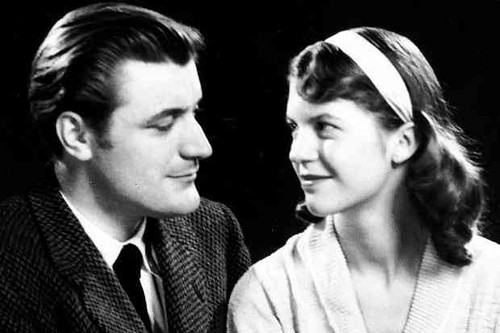
From the files of Sylvia Plath How unpleasant to meet Mrs. Hughes, Who’s so thoroughly, willfully odd. It’s a wonder Ted happened to choose Such a creature. (He’s rather a god.)
Her lipstick is always a mess. She’ll go on for an hour or three About Nazis or bees—as you’d guess, This does not get her asked out to tea.
Her headbands aren’t quite comme il faut. (They’re a match for her queer Yankee frocks.) She knows more than a lady should know Of low-voltage electrical shocks.
Come to think of it, lately she’s been More appalling than ever before. She looks sullen and terribly thin; If you knock, she won’t answer the door.
Her complexion grows whiter and whiter. She wears the most horrible shoes. You can certainly tell she’s a writer. How unpleasant to meet Mrs. Hughes!
*****
Melissa Balmain writes: “I believe this one started when a contest—probably in The Spectator—called for poems riffing on Edward Lear’s self-mocking ‘How Pleasant to Know Mr. Lear’ (and T.S. Eliot’s equally self-mocking parody of it). I found it funny and sad to imagine Sylvia Plath writing about how her English neighbors might see her. The poem was published in Mezzo Cammin.”
Melissa Balmain’s third poetry collection, Satan Talks to His Therapist, is available from Paul Dry Books (and from all the usual retail empires). Balmain is the editor-in-chief of Light, America’s longest-running journal of light verse, and has been a member of the University of Rochester’s English Department since 2010.
Poets do tricks with words, play games, weld rhyme, but we don’t do this nicely all the time– we’ve also anger at unfairness, anger hot-white at wasteful power, at greed and spite, where fear meets selfishness, drives right and left to persecution, torture, war and theft.
Each trick sticks bricks, fixed and unfixed, into an apartheid verbal wall that warbles claims to separate sense from nonsense–though we appreciate all’s one, all’s all the same, word walls are just a Jenga game, and all bricks fall.
We can play games with words, thread and unthread them in a silly tangle, loom and illuminate light warp, dark weft, wrong them and wring them ringing through a mangle as sometimes the only way to find a new way to say things said ten thousand times before: how brightness has a rightness, whether in the sky, the sea, a face or an idea.
So cook with words, mix, bake, packing in raisins, nuts, half cherries for a cake with flour just enough for a pretence that it’ll hold together and make sense.
*****
Formal? Free? The arguments about the appropriate structure for poetry in English never seem to end. The semi-formal compromise has been around for a long time: take the rhythmic, rhyme-rich ramblings of Arnold’s ‘A Summer Night’ from 170 years ago, or Eliot’s ‘Prufrock’, written in 1911. To me, the test of good verse is that it is easy to memorise and recite: the ideas and imagery have to be memorable, but so does the expression, word for word. The tricks may vary by language and culture, but whatever tricks the poet can manage to achieve memorableness are legitimate.
‘A Summer Night’ was in my English A Level curriculum <cough> years ago, and the middle section which I still know by heart encouraged me to run away from school. (I was found trying to sleep in a phone booth while waiting for a morning train, and brought back to school at 2 in the morning.) The poem’s semi-formal structure has always appealed to me with its rhetorical power, and over the years I’ve often used that freedom when writing about poetry, as in ‘Some Who Would Teach‘ and ‘Inspiration 2‘ and ‘Memorableness‘.
‘Poets Do Tricks With Words’ has just been published in Orbis, edited by Carole Baldock.
The Head was ambitious and nobody’s fool, A big man, efficient, and proud of his school.
At the start of the term, as he sorted his post, The item of mail that intrigued him the most
Was a piece puffing National Poetry Day, Including a list of the poets who’d stay
And workshop and somehow persuade the whole school That poets were ‘groovy’ and poems were ‘cool’.
‘Here’s status,’ the Head thought. ‘It’s not to be missed.’ The one problem, though, was the names on the list;
Though doubtless they wrote quite respectable stuff, Not one of them, frankly, was famous enough.
His school deserved more; his ambition took wing, And so he decided to do his own thing.
With his usual flair, and with chutzpah exquisite, He invited the whole English canon to visit.
Geoffrey Chaucer came first, on an equable horse, And Spenser, and Marlowe, and Shakespeare, of course
(Who was grabbed by the teachers of English, imploring ‘Do come and persuade the Year Nines you’re not boring.’)
Keats arrived coughing, Kipling marched vigorously; Matthew Arnold began to inspect the school rigorously –
Which delighted the Head, who with pride and elation Showed the bards of the ages today’s education.
Vaughan was ecstatic, though Clough was more sceptical. Ernest Dowson puked up in a litter receptacle.
Coleridge sneaked off to discover the rates Of an unshaven person outside the school gates;
Soon he’d sunk in a private and picturesque dream, While Auden was ogling the basketball team.
Plath lectured the girls: ‘Get ahead! Go insane!’ Algernon Swinburne cried: ‘Bring back the cane!’
Dylan Thomas soon found the head’s cupboard of booze, And Swift was disdainfully sniffing the loos.
And then the Head twigged, with a horrified jolt, That something had sparked a Romantic revolt.
Shelley’d gathered the students out in the main quad, And roused them to rise against school, Head, and God.
Byron soon joined him, and started to speak. (He showed his best profile, and spouted in Greek.)
The bards of the thirties were equally Red, And Milton explained how to chop off a head.
Decadents undermined all the foundations. Surrealists threw lobsters and rancid carnations.
Pre-Raphaelites trashed the technology room And the First World War poets trudged off to their doom.
Sidney with gallantry led a great charge in (Tennyson cheering them on from the margin).
The Deputy Head, who was rather a dope, Got precisely impaled on a couplet by Pope
(Who, while not so Romantic, was never the chap To run from a fight or keep out of a scrap).
Then the whole solid edifice started to shake As it was prophetically blasted by Blake.
Soon the School was destroyed. Eliot paced through the waste, And reflected with sorrow and learning and taste,
Which he fused in a poem, an excellent thing, Though rather obscure and a little right-wing.
He gave this to the Head, who just threw it aside As he knelt by the wreck of his school, and he cried
Salty tears that went fizz as they hit the school’s ashes. He said words that I’d better imply by mere dashes:
‘——– Poets! ——– Poetry – rhyme and free verse! Let them wilt in the face of a Headmaster’s curse!
‘Let poetry wither! How sweet it would be If all of the world were prosaic as me!’
*****
George Simmers writes: “Poets in Residence was written as a celebration of National Poetry Day many years ago. Several people had been mouthing blandly off about how lovely poetry was in contrast to that horrible pop music young people listen to. Schools were being encouraged to give children a lot of poetry because it was nice and beautiful, and would make them nice. ‘Do these people have no idea of how incendiary the English canon is?’ I wondered. I really enjoyed demolishing the school around the ears of the pompous and pretentious head. I was a teacher at the time.”
George Simmers used to be a teacher; now he spends much of his time researching literature written during and after the First World War. He has edited Snakeskin since 1995. It is probably the oldest-established poetry zine on the Internet. His work appears in several Potcake Chapbooks, and his recent diverse collection is ‘Old and Bookish’.
There’s shouting by the stove (it’s Plath & Hughes) as Wystan wanders off without his shoes and Whitman picks the Cheetos off his beard. The Larkin-Ginsberg chat is getting weird, for after countless hours they have found bizarre pornography is common ground. Old Emily is not As prim as billed— When Dylan finds her bra-hooks— She is thrilled. Poe strokes his bird; Pound yawps that it’s a pity Eliot can’t sleep without his kitty. Rimbaud’s on eBay searching for a zebra while sneering, “Oui, a cheemp can write vers libre!” The Doctor’s soggy chickens start to smell and Stevens has insurance he must sell. The readings are spectacular, I know, but is there any way to make them go?
*****
A.M. Juster writes: “This was first published in The Barefoot Muse. It looks like I wrote it in late 2008, it was a fairly prolific period for me and I was a little distracted because I was running the Social Security Administration. (Under his unpoetic name, Michael J. Astrue. – Editor). I don’t remember now the impetus for writing it, but I did enjoy taking these poetry idols off their pedestals and making them more human for a few laughs. This was about the time that I finished my translation of Horace’s Satires in something like 1850 heroic couplets, so I was much more comfortable with the form than I would have been five years before. I think the imitation of Emily Dickinson’s form is an amusing touch for the reader, although it is undetected when I read it because it remains in rhymed iambic pentameter.”
A.M. Juster’s poems and translations have appeared in Poetry, The Paris Review, The Hudson Review and other journals. His tenth book is Wonder and Wrath (Paul Dry Books 2020) and his next book will be a translation of Petrarch’s Canzoniere, which W.W. Norton will release in early 2024. He also overtweets about formal poetry @amjuster.
I Because I do not do the limerick line Because I do not do Because I do not do the limerick Desiring this man’s schtick or that man’s joke I will stick to knocking out free verse (If here and there a rhyme so much the worse) In mournful moans Presented ragged-right upon the page.
II There once was a Lady with three White leopards, a juniper tree, And a bag full of bones That sang their sad moans Of what they had once hoped to be.
III At every turning of the turning stair, Your breathing hard, your eyesight edged with dark, You see the face of hope and of despair.
You breathe the vapor of the fetid air And toil as if some atmospheric shark At every turning of the turning stair
Was hunting through the gathering darkness there, While back and forth across the narrative arc You see the face of hope and of despair.
At every turning there’s a window where You contemplate a drop that’s still more stark At every turning of the turning stair.
Instead you circle upward as you swear Like you are looking for a place to park. You see the face of hope and of despair.
You can’t endure the future’s dismal dare Nor drag yourself to put out your own spark At every turning of the turning stair.
You’re learning how to care and not to care And whether you will make or be a mark. You see the face of hope and of despair At every turning of the turning stair.
IV Higgledy piggledy Here we are all of us Trudging along where some Billions have trod
Smelling the flowers and Trusting religionists’ Tergiversational Rodomontade.
V If the word that is lost isn’t lost, And the word that is spent isn’t spent Then silence is actually speaking, And meaning is something unmeant.
If the meaning is what is unheard And the word is the thing that’s unspoken Then how do you hear if a word Has a meaning that hasn’t been broken.
If the unspoken word must be still And the unheard is what it’s about To have heard the unhearable meaning The inside has got to be out.
If the unheard were out of this world And the light shone in darkness were dark Then the unlit unheard would be meaning If the snuffer provided the spark.
If the yadda can yadda its yadda And the pocus was what hocus took Then gobble must surely be gobble Though dee separates it from gook.
VI Awake! Your hope to turn or not to turn Is wasting time – but go ahead and yearn To see the light or hear the word to know A heaven human beings can’t discern.
There’s nothing there for such as you and me; We make our meaning up from what we see And hear and touch and taste and smell and think — But all there is is fragments and debris.
The steps are just the steps, the stairs the stairs, The rest is merely human hopes and prayers That do no more than hopes and prayers can do, And nothing’s chasing you except your heirs.
No unmoved mover writes upon some slate That mortals may abate or not abate; No hope and no despairing of that hope Reveals what nothing states, or doesn’t state.
Whatever happens happens because of us We get a muss when we don’t make a fuss Demanding right from wrong not mere convenience: We’re all complicit underneath this bus.
Awake! Don’t hope to turn or not to turn, Don’t pray that this is none of your concern. Awake! What will it take for you to learn That if it all burns down you, too, will burn?
*****
Marcus Bales has produced this wonderful set of parodies of the long T.S. Eliot poem ‘Ash Wednesday‘, beginning with a piece in the poem’s style for Part I, Because I do not hope to turn again Because I do not hope Because I do not hope to turn Desiring this man’s gift and that man’s scope
but then moving into a limerick for Part II’s Lady, three white leopards sat under a juniper-tree
and a 22-line villanelle for Part III’s At the first turning of the second stair
and a double dactyl for Part IV’s Who walked between the violet and the violet
and quatrains for Part V’s If the lost word is lost, if the spent word is spent If the unheard, unspoken Word is unspoken, unheard;
and finally rubaiyat with a strong flavour of FitzGerald’s Omar Khayyam for Part VI’s Although I do not hope to turn again Although I do not hope Although I do not hope to turn
‘Ash Wednesday‘ has proved one of Eliot’s best-known and most quoted poems, with its signature mixture of Christian mysticism, personal emotion, loose form and scattered rhyme, rich imagery and memorable wordplay. Bales’ ‘Slash Wednesday‘ is an appropriate tour de force of a back-handed homage, mocking Eliot’s ragged rambling with a sampling of forms that could have been used (inappropriately) instead.
Not much is known about Marcus Bales except that he lives and works in Cleveland, Ohio, and that his work has not been published in Poetry or The New Yorker. However his ’51 Poems’ is available from Amazon. He has been published in several of the Potcake Chapbooks (‘form in formless times’).
This is being posted two days late for T.S. Eliot’s birthday, but as it’s for the already late T.S. Eliot that shouldn’t matter too much…
You learn to call, to pray, and to invoke the gods with incense, roasting meat and smoke, the smell drawing the gods like flies. They like being honoured, they like gifts and sacrifice. How do you gift a god of writing? Write! Write when you have a thought, write day, write night. How do you sacrifice? Accept this hardship: you give up all activities (regardless of your duties, your proclivities, relationships) – for bardship, because you don’t have time for them and writing. Downgrade all love, work, striving, fighting – for you must write. You read, read, write, recite, write and rewrite, reread and rerecite. (The modes you read impact the words you write, impact the thoughts you have, and how they’re phrased. Read novels, you’ll have thoughts in prose: straight, trite; read verse, your thoughts will ramble, rhyme, be crazed.) How bargain with the gods? Well, you can offer. Can you demand? Well, no; you can’t. Do they play fair? Take care with what they proffer; you’re never sure if it’s a loan or grant. How long will favours last? While you’re in favour; a god or goddess owns you like a slaver. And while for them you still produce, still honour them… you still have use. So keep on writing until you collapse, and they’ll continue liking you. Perhaps.
*****
This is the sixth in the 15-poem sequence on Calling the Poem. The basic idea is that if you pay attention to the little scraps of poetry that come your way, in a random rhyme, a stray image; if you write them down and expand on them as you can; if you respect what comes to you, even if it isn’t what you want to hear; if you spend more time immersed in the medium that you want to develop… then you are encouraging the further communication from the mysterious force that provides the insights and images and words, the force that appears to be both inside and outside of you, the force that can be thought of as a muse or god. But the process is unreliable, because gods are unreliable, being inherently uncontrollable by us.
Matthew Arnold has a typically lugubrious and pessimistic overview of ‘The Progress of Poesy’:
Youth rambles on life’s arid mount, And strikes the rock, and finds the vein, And brings the water from the fount, The fount which shall not flow again.
The man mature with labour chops For the bright stream a channel grand, And sees not that the sacred drops Ran off and vanish’d out of hand.
And then the old man totters nigh And feebly rakes among the stones. The mount is mute, the channel-dry; And down he lays his weary bones.
But that’s Matthew Arnold for you. He had a remarkably mournful muse. Perhaps he spent too much time as a responsible Victorian, a dedicated Inspector of Schools, and not enough time in the state T.S. Eliot called the “necessary receptivity and necessary laziness” of the poet. Eliot again: “The progress of an artist is a continual self-sacrifice, a continual extinction of personality.” You are striving to be at the mercy of forces outside your conscious control – there can be no guarantee that it will work out exactly the way you want.
Can you handle the wild poem? Can you tame the thing, or kill? The certainty, uncertainty, of writing as a skill, The being told to “find your voice”, the crawling like an ant Across the skin of Literature, that giant, to implant Some token of your individuality, some pin To jab into the giant’s vast and ant-infested skin, To make your mark by scrawling words, tattoos, to claim a win… You can’t succeed alone against such odds! But there are gods…
*****
This is the third poem in the ‘Calling the Poem’ chapbook sequence in Snakeskin. The question of self-belief can be difficult for any artist – given the thousands of years of recorded paintings, sculptures, poems, music, etc, how can you know that your tiny ant-like efforts will be enough to make a mark in the world? Can you hope to succeed? The choice might seem to be between the hubris of Yes and the defeatism of No – but you have a secret ally, if you pay attention: the Muse. If you are self-aware and mindful, if you stay alert for scraps from the unconscious, the dream-world including daydreams, if you are respectful enough to try to capture the little hints you are given, then the Muse (She, or He, or Them, Yourself, your unconscious, God or Gods or Angels, however you visualise this force and process) will provide you with insights and material you never knew you could access.
Your Muse is available to you… if you stop and listen, remain open and respectful of the unexpected. Again, the learning and the workloads imposed by others tend to act against this attitude. Take heart from T.S. Eliot: “a poet ought to know as much as will not encroach upon his necessary receptivity and necessary laziness.” That was not a flippant comment of his: it goes to the heart of learning to work with your Muse.
Photo: 8/17/09 Houston – Fire Ant Bite by stefan.klocek used under OpenVerse license





 Form in Formless Times