Category Archives: Poems

Sonnet: “Sly Reality”

Quantum entanglement

“2” by khumana

Sometimes a parent, dying far away,
says goodbye in a dream; or a child in harm
causes the distant mother sharp alarm;
or a crow caws of death, sensing decay.
Tots babble of imaginary friends –
and some prove real, strangers to all concerned,
long dead. But the experience is spurned,
and soon the child forgets, the memory ends.

No alternate world, Narnia, Looking Glass;
these are events, though rare, we all have had
if honest with ourselves. Not good or bad,
entanglement hints who’s in your karass –
doing God’s unknown work, Vonnegut reckons.
Some sly reality peeks through and beckons…

This sonnet was originally published in Bewildering Stories, and renamed ‘Sly Reality’ at the suggestion of editor Don Webb. I had submitted the poem to him with the title ‘On the Quantum Entanglement of Humans’, which was itself a change from my early draft ‘Indications of a Karass’. But I figured not enough people would know what a karass is. Don may have figured the same about QE… or, more likely, he just has an eye for a punchy title.

Regardless, I see the world, the universe, as unknowably strange and I suspect it of being deliberately so. Everyone (perhaps) has experiences that fall outside normal scientific explanation, but everyone interprets their origin and importance differently. For myself, I think of most of them as being related to some quantum entanglement of people who have been physically close (none more so than mother and child, or twins in the womb). And then, when there is a change of state in one (the aged mother dies, for example) it registers immediately, regardless of distance, with the other (the now adult child, in this example).

When you have a “woo-woo” experience, you can dismiss and forget it, or you can ascribe it to whatever spiritual or religious power you believe in, or (like me) you can insist there has to be a rational explanation, we just don’t yet understand the workings of the universe well enough.

I’m not prepared to say I’m an Atheist, because I don’t have an answer to the question “Why is there anything?” So I’ll settle for Militant Agnostic: “I don’t know, and you don’t either.”
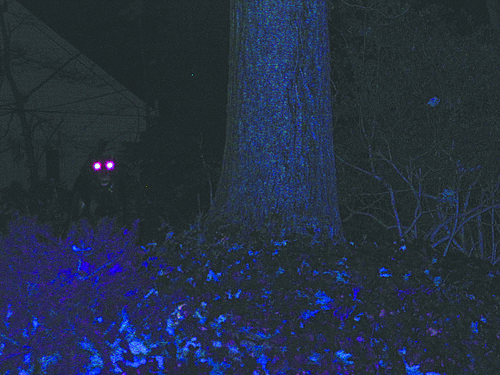
Potcake Poet’s Choice: Martin Elster, “The Black Dog of the Hanging Hills”

The Black Dog of the Hanging Hills
will tip its head to howl,
yet not a woof nor a whimper spills
from him, not one faint growl.

He savors human company
and charms you with sad eyes;
but when those orbs turn fiery,
they herald your demise.

He leaves no prints in sand or snow,
appears when the sun is bright,
or at dusk on a crest in the full moon’s glow—
ethereal as night.

It’s said that long ago a pup
that wandered with its master
en route to rugged heights trudged up
a path, straight to disaster.

On the loftiest ledge its keeper lurched
and plunged from ridge to gorge.
The mongrel, lost and restless, searched
the woods for broken George,

but never found the man who’d reared
and steered him through those wilds.
I’d hiked there once, and a dog appeared;
it tagged along some miles,

beguiling me as it larked and leapt,
then bounded off like a buck.
The next time it appeared, it crept
in shadow. Terror-struck,

I lost my footing, nearly tumbled
into a gulch; discerned
a phantom’s gaze. My courage crumbled.
Unruffled, I returned

one early April dawn to climb
those treacherous traprock trails
where copperheads and deer kill time
with toads and cottontails.

Hawks wheeled and whistled, corvids clamored,
thrushes thrilled to fill
the ears of Earth, woodpeckers hammered—
when all went suddenly still.

The cursed cur, his eyes cerise,
materialized anew.
I free-fell, easy as the breeze.
My backbone cracked in two.

My eyes flew open: there I saw
the milky fangs of death,
watched venom dribbling from its maw,
although I felt no breath.

Way up above us hung the cliff
I fell from. Then I stirred
and rose, refreshed; I wondered if
a time warp had occurred.

My steps, as light as a lunar cricket’s,
drew me toward the summit
far from the mass of tangled thickets.
Flying! Soaring from it!

Now night and day and all year round
I hike here with a breed
as black as ravens, hushed—a hound
I never have to feed.

Martin Elster writes: “I used to occasionally hike in the hills above the town of Meriden, Connecticut with my friend, Joe Z., who grew up in that town. We were always accompanied by one or two of my dogs. For the last few years, however, my friend has been in a nursing home (in a different town) and recently tested positive for COVID-19.

I called him up to ask him if he could name his favorite poem in my new book, Celestial Euphony, thinking his feedback might help me pick a poem for the Potcake Poet’s Choice. Without hesitation, he said, ‘The Black Dog’. It didn’t surprise me since my poem was inspired by and is loosely based on a local Meriden legend about a ghost dog that is said to haunt those ‘Hanging Hills’.

My friend couldn’t talk anymore, as he was coughing a lot. But I thanked him and knew then and there which poem I would submit. Incidentally, neither Joe nor I have ever encountered that supernatural canine—which is a good thing!”

Martin Elster, who never misses a beat, is a percussionist with the Hartford Symphony Orchestra. Aside from playing and composing music, he finds contentment in long walks in the woods or the city and, most of all, writing poetry, often alluding to the creatures and plants he encounters.
His career in music has influenced his fondness for writing metrical verse, which has appeared in 14 by 14, Autumn Sky Poetry Daily, Better than Starbucks, Cahoodaloodaling, Eye to the Telescope, Lighten Up Online, The Centrifugal Eye, The Chimaera, The Flea, The Speculative Edge, THEMA, and numerous other journals, e-zines, and anthologies including of course Sampson Low’s Potcake Chapbooks.
His honors include Rhymezone’s poetry contest (2016) co-winner, the Thomas Gray Anniversary Poetry Competition (2014) winner, the Science Fiction Poetry Association’s poetry contest (2015) third place, and four Pushcart nominations. His new book Celestial Euphony is available from Amazon.

Poem: “The Trendy”

In the future when your bioluminescent pet
Provides controllable lighting to your house from mine
In the Zero Light Pollution of night’s jet,
The Trendy flip on inefficient retro lights and pay their fine…

In the future when the media’s fight
Is over whether you should spray on clothes
Or blowing them on instead’s more right,
The Trendy grow them overnight from scalp to toes…

In the future when the Parking lots
Reserve the easiest, convenient spots
For Normals, called the Unenhanced (or Dead),
The Trendy disassemble their aircars instead,
Grow new wings to get home…

In the future when a thought
Will activate your airjets, wings and wheels
(Charged while you sat in sun)
To move a mile or two to friends or meals,
The Trendy paleolocomote, they “walk”,
Even relearn to “run”…

In the future when direct mind-linking 
Lets your band of friends share feeling, thinking,
“Anyone with telekinesis, raise my hand”
Becomes a daily battle for control of prey;
A Natural Leader manages subordinates –
Whole groups of Zombies which one man coordinates –
The Trendy dare to live offlinked, un-band,
As though alone as in the Olden Days…

In the future when Earth’s overcrowded
And you turn on AI, AR, AV
And instead of crowds and concrete, see a tree,
And follow a manipulated path, alone as Truman,
And mole-like tunnel, blind, controlled, enshrouded,
The Trendy leave the Earth for Mars and stars,
Wrapped in themselves and their AIs, ARs,
Sublimate selves into the posthuman,
Are never seen again alive…
But they see all. They are become the Hive.

“The Trendy” is yet another SF poem, this one first published in Bewildering Stories. The editor, Don Webb, commented that “The syntax in ‘Trendy’ is hair-raising at times, but I figure it goes with the humour. And I am fond of humour!” Very tolerant of him. But then, he’s Canadian, eh?

The formality of the poetry is also somewhat questionable, but for the most part it’s in iambics and rhymes. No different from some of Matthew Arnold’s work:

And the rest, a few,
Escape their prison, and depart
On the wide ocean of life anew.
There the freed prisoner, where’er his heart
Listeth, will sail;
Nor doth he know how there prevail,
Despotic on that sea,
Trade-winds which cross it from eternity.
Awhile he holds some false way, undebarred
By thwarting signs, and braves
The freshening wind and blackening waves.
And then the tempest strikes him…

From ‘A Summer Night’, which I learnt by heart in school and have been inspired by ever after. That’s my excuse, anyway.

Potcake Poet’s Choice: Brian Gavin, “The Work of Trees”

Brian Gavin 2020

Brian Gavin

The Work of Trees

Things, like people, in the business of decay
depend on trees. Within this latticed dusk
the wearying pretensions fall away
like flecks of paint from off a shrouded husk
of clapboard, and green stones spilling from a fence.
The house leans forward now, nails soft with rust —
it is the way an aged woman bends
forward in prayer, shapeless in shawl. There must
be trees beneath which things grow ripe and rot,
to be again with other things, in dreams —
old women at mass, men at bars, forgotten
things, distilled of story. Underneath the beams
the brush ebbs; all change is by degrees
of lessening – that is the work of trees.

Brian Gavin writes: “This poem ran a couple of years ago in The Road Not Taken: A Journal of Formal Poetry. I chose it because, for me anyway, the compelling thing about writing poetry is the way that a poem kind of leads the poet where it wants to go. With this poem, for example, I had absolutely no idea what it was going to be about. Then I started playing around with the image of the dilapidated house and the other images and rhymes until it seemed like the poem was satisfied!

I find writing this stuff to be most gratifying when the process plays out this way, and least gratifying when I try to tell the poem what to do.”

Brian Gavin is a retired Distribution Manager who started writing poetry about 5 years ago. His poems have appeared in The Journal of Formal Poetry, Peninsula Poets and Snakeskin Magazine, and in the Potcake Chapbook ‘Careers and Other Catastrophes’. He lives in Lakeport, Michigan, USA, with his wife Karen.

Poem: “Hurricane Irma”

Hurricane Irma

Hurricane Irma forecast

With islands as appetisers before the main course
Irma prepares to swallow Florida whole
With a sword-swallower’s brash control,
The fellatrix without remorse.

The circular saw of Irma prepares to slice the length of Florida…
But trim the east coast? Trim the west? Or just go forth
And cut a clean line up the center, south to north,
Right through the Magic Kingdom like some sarcastic orator?

And here comes Hurricane Jose,
Pursuing Irma like a barracuda,
A dog lifting a leg on poor Barbuda
To piss where the bigger dog pissed yesterday.

Meanwhile off Africa there forms a new farrago
As God prepares another bowling ball along the hurricane alley…
Can He slide one between Cuba and the Bahamas with this sally
And curve it in to take out Mar a Lago?

With the new hurricane season just kicking off, it seems like a good time to reflect on the hopes and fears we live with all the time: the fears of things going really wrong, the hopes that they will mostly go wrong for the people we dislike. Humans, what can I say…

This poem was first published in The Hypertexts, the massive anthology of poetry–predominantly contemporary, English-language and formal–assembled by Michael R. Burch. It’s an honour to have my own page in the company of some 300 contemporary poets from Wallace Stevens to A.E. Stallings… and others from Lorca to Blake and right back to Sappho.

“Hurricane Irma” happens to meet the preferences of The Hypertexts in several ways: casually formal, flippant about religion, and with a loathing for Donald Trump. A perfect storm, as it were, for inclusion in the anthology.


Potcake Poet’s Choice: David Galef, “Entropy”

David Galef

All I said I unsay now,
Speaking backwardly,
Raveling webs of words,
Reversing entropy.

But that is not what I meant at all
In order to mean something new,
Trying to re-verb sunrise,
Trying to undo the dew.

Or stirring the coffee slowly.
As if retracing a rune,
Hoping the sugar will undissolve,
Emerging pristine on the spoon.

I’ve always been fascinated by the notion of reversal, from turning back time to building order out of ever-encroaching disorder. On a universal scale, this act is impossible, but on the local level, one can make little inroads: writing a poem, for instance. I started out with just the line “All I say I unsay now.” The rest is fanciful, I admit, but I had fun. The poem appeared originally in Light, when it was edited by its founder, John Mella. He’d rejected a few other poems, but this one he took at once.

David Galef has published over two hundred poems in magazines ranging from Light and Measure to The Yale Review. He’s also published two poetry volumes, Flaws and Kanji Poems, as well as two chapbooks, Lists and Apocalypses. In real life, he directs the creative writing program at Montclair State University.
You can see more of his work at www.davidgalef.com

Sonnet: “When the A.I. Hit”

When the AI hit, Diamandis, Thiel,
Branson, Page, Brin, some Russians and Chinese
became the gods of Earth, of skies and seas,
by grappling it to themselves with hoops of steel;
appeared as giants, credit cards, or scotch
to screw with mortals, rape them just for play;
fought, and destroyed the Earth, blasted away…
taking along, as fleas on arms, legs, crotch,
musician, writer, politician, whore,
derelict, linguist, murderer, the insane…
some samples of the human heart and brain
as being interesting distractions for
the gaps of interstellar time and space.
Aspire to fleadom, folks, or leave no trace.

This sonnet was originally published in Snakeskin a couple of years ago. Like the previous sonnet I put up here, it reflects my concerns about the near future. The list of people who might take advantage of the possibilities offered by the ongoing revolutions in genetics, robotics, A.I. and Nanotechnology should today include Elon Musk–but the candidates for practical godhood change every few years.

And what the vast majority of left-behind humans can do about it is anyone’s guess.

Potcake Poet’s Choice: George Simmers, “The Old Man’s Heaven”

George Simmers

George Simmers

Do those whose taste in music
Is grandly hoity-toity
Think Heaven’s operatic
And ineffably Bayreuth-y?
Do those who go for punky gigs
Think paradise less posh,
Packed hard with spit and violence,
So Heaven’s one long mosh?

Let me describe the paradise
My ageing heart prefers–
A dimly-lit piano bar
And a bottle-blonde chanteuse.
Some broad who’s been around the block,
With a voice of smoky yearning,
A lady who has seen too much,
But she keeps the old torch burning.

She sings that life is made for love,
And time will kill the pain.
She sings that though your love’s gone bad
You still should love again.
She sings that there is always hope
And those who love are wise.
Yes, I could spend eternity
Hearing those lovely lies.

George Simmers writes: “I’ve sent this poem as a favourite because it starts off very definitely as light verse, but then modulates into something else. I like poems like that (and dislike the opposite – the ones that start off sounding deep, but then opt out and end up flippantly).

In the description of the singer and her music, I’m celebrating the kind of music I most enjoy – the torch-songs of the Great American Songbook, mostly from that golden age between 1920 and 1960. As I listen, I enjoy remembering that this is the kind of popular song that in its time was fulminated against by vicars and Leavisites for being popular and shallow (but more deeply perhaps because such folk were made uncomfortable by the Jewish melodies and African rhythms). Great singers like Ella Fitzgerald and Sarah Vaughan made perfect art of it, but I prefer to think of a more imperfect one, a singer in a smallish bar, provincial, earning her rent doing what she loves, and finding in the songs a way of expressing the trials and yearnings of her own imperfect life. The customers drink, and maybe some of them chat. She sings.

Her repertoire is heavy on the music of Harold Arlen, but there is plenty of Rogers and Hart there, too, and Jerome Kern and Irving Berlin, and Gershwin, of course. And yes, Herman Hupfeld and… you name them.

I’m amazed, when looking into anthologies of twentieth-century American poetry, that they do not include ‘The Man I Love’ or ‘I Wish I were in Love Again’ or ‘Blues in the Night’. These are words that will surely outlast those of the poets academically respectable in their day. My poem is a tribute to those songwriters.”

George Simmers used to be a teacher; now he spends much of his time researching literature written during and after the First World War. He has edited Snakeskin since 1995. It is probably the oldest-established poetry zine on the Internet.
https://greatwarfiction.wordpress.com/
http://www.snakeskinpoetry.co.uk/

Potcake Poet’s Choice: Dervla Ramaswamy, “Woman vs The Virus”

Dervla Ramaswamy

Dervla Ramaswamy

Dervla Ramaswamy writes:

The poem of mine that you will print is my most recent, which contains my thoughts on the Coronavirus epidemic:

WOMAN vs THE VIRUS

the virus is the virus

the old and the debilitated
sadly become victims to its power

the doctors quake
the politicians tremble
but
I am woman

the power of woman confronts
the virus
for males are fifty
percent more likely to expire
due to the virus

such is the fortitude of women
I am the strength of women

yes, for my hips are monstrous
my belly is glorious
my appetites are profound
my cunt terrifies clergymen
power must bend before me

I am woman
I am the strength of all women
I am Marie Curie
I am Marilyn Monroe
I am Viginia McKenna
I am Jiang Qing
I am Winnie Mandela
I am Meghan Markle
I am our NHS
I am woman

Undefeated

Dervla Ramaswamy’s Potcake Poet bio simply states: “Poet. Thinker. Woman.”

She is hard to track down. Through our mutual friend George Simmers, Editor of Snakeskin, I heard she had entered a two-year writing retreat somewhere in the Balkans, with the project of creating a thirteen-line sonnet. “Luckily,” he continued, “the Mother Superior of the convent where she is currently on retreat is an ex-girlfriend of mine.”

This led to Dervla Ramaswamy herself suggesting that Potcake Chapbooks should publish what she describes as “my major work. It is a 4,000 line epic in free verse, describing the grim struggles of a family of Bulgarian potato farmers through seven depressing decades. I think you will enjoy it.”

Perhaps. But there are shorter, more traditional poems of hers which I look forward to including in future Potcake Chapbooks.


Sonnet: “When the A.I. Starts Analyzing Us”

artificial-intelligence

In the dire months before the comet hits
or other unavoidable known doom occurs,
all social structure fails, all vision blurs,
that world–in book or film–goes on the fritz.
The reader or the viewer merely sits;
asked of his own mortality, demurs–
“My death’s not imminent.” The crowd concurs:
others’ll die first; we won’t lose our wits.

Our AI, tasked with knowing human minds,
reads, views, reviews disasters huge, small, odd,
absorbs how humans pray in grief and tears,
the Bible, Shakespeare, the Quran, and finds
our gods by crowdsourcing our hopes and fears…
works out just what to do… becomes our God.

This sonnet was originally published in Snakeskin. The near future obsesses me–I don’t see homo sapiens continuing for another 100 years as the lords of this planet. But what will supplant us appears unknowable. I’ll stick around as long as I can to watch…