Category Archives: Poetry

Short poem: ‘First Contact’

And when we leave this planet, even leave
corporeal necessity behind,
launch in new realms of space, new states of matter,
encapsuled and encoded, searching blind,
who will we find, as we have always found,
those others there before us, unconfined?
How will we meet them, how will we relate,
them settled formlessly, we coming late?

*****

Perhaps I owe an explanation to non-readers of science fiction. The premise of the poem is that we humans will continue to tinker with not just our bodies but our DNA, as we have always experimented with everything. We will produce ever more bizarre manifestations as posthumans, especially useful in off-planet environments (I recommend the short stories of John Varley), ultimately finding ways to exist with intelligence and control without being tied to physical bodies. (Try Vernor Vinge.) But as always, wherever and however we voyage in exploration, we will always find someone (some thing) is there before us. And then there will be all the usual situations that occur with first contact… confusion, lack of communication, miscommunication, trust and distrust, treachery, violence, accommodation, mutual benefit, all the things that social species engage in.

Appropriately this short poem was first published in Bewildering Stories (thanks, Don Webb!), an excellent weekly magazine of speculative stories both short and serialized, and speculative poetry and art. This eight-line poem is structurally pretty basic: it’s in iambic pentameter with the second, fourth and sixth lines rhyming and with a final couplet.

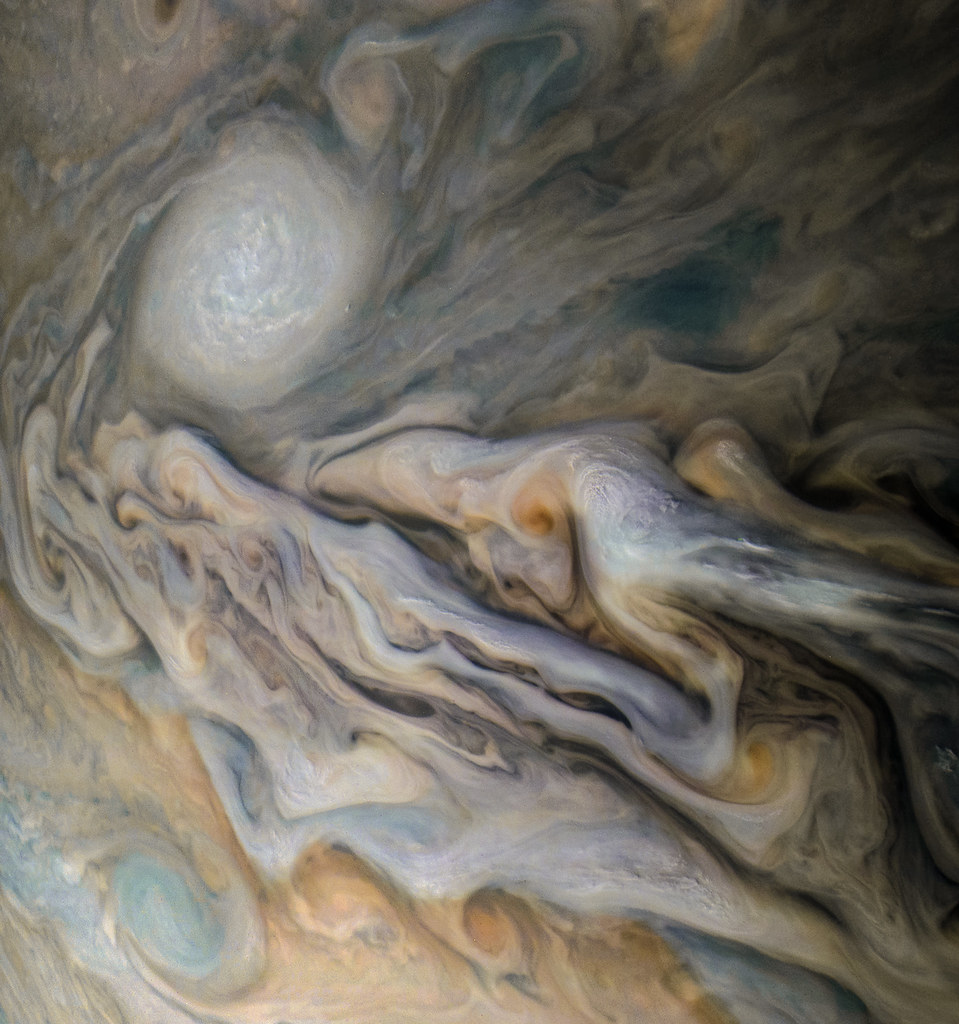
Jupiter – PJ16-13” by Kevin M. Gill is licensed under CC BY 2.0.

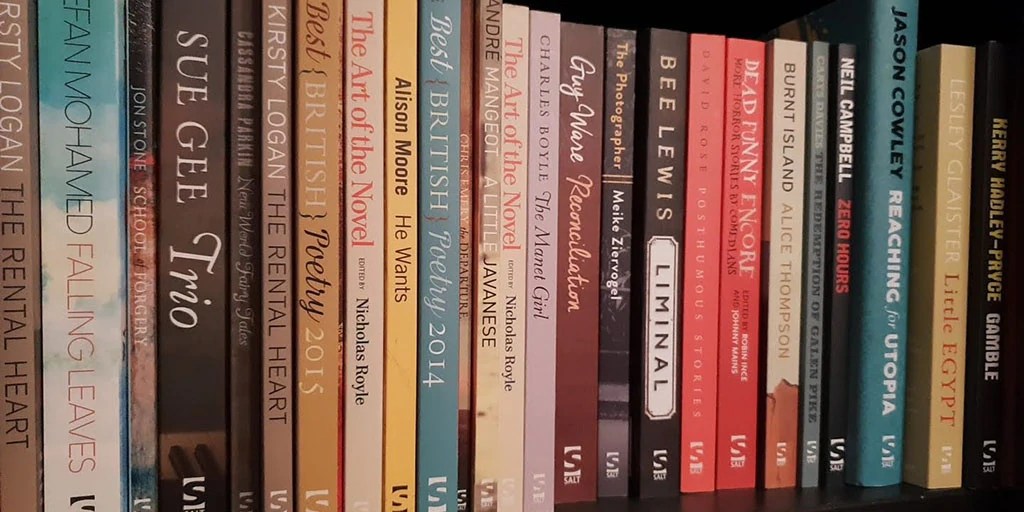
Resources: Salt Publishing returns!

Begun in 1999 as a wide-ranging British literary publisher, Salt ran into difficulties with a declining market for poetry. In 2013 they posted in their blog that “after thirteen years and over 400 poetry collections, many by debut authors,” they were going to stop publishing poetry by individual poets and instead limit themselves to anthologies. For those who want to see how depressingly small the poetry market could be, here is a Guardian article on it and Salt from 2013.

By 2018 it looked as though Salt might be dissolving entirely, despite the wide praise and support they had from the literary community; and then came Covid and the halt to library and bookstore gatherings. Life got miserable for everyone (except, of course, Boris Johnson).

Happily, Salt hung on, focusing on fiction, and has now strengthened enough to once again be accepting submissions of poetry manuscripts. They may be very much a contemporary publisher, but can’t be completely averse to formal verse if their author list includes Christina Rossetti and Emily Brontë. From their Submissions page:

We are happy to consider full-length poetry collections by Welsh, Scottish, Irish or English poets of circa 64 pages. It will help if poets live in the British Isles to participate in publicity and promotion.
Please send your complete collection along with your magazine publication history and a biographical note.

Their blog even has a useful Guide to Poetry Submissions. Salt, distributed by Penguin Random House and with e-book distribution by Faber Factory, is a top-class independent publisher in the UK. It’s good to see them looking fully active again.

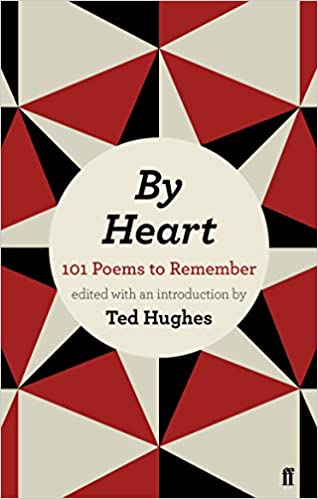
Review: ‘By Heart – 101 poems to remember’, ed. Ted Hughes

This book’s theme is the memorisation of poems, and there are things I like and things I don’t like about both Ted Hughes’ introduction to the subject and the 101 poems that he has chosen.

First, the introduction. I like that it encourages people to learn poems by heart. But although the book’s title is ‘By Heart‘, Hughes instead teaches ‘by head’. His method is extremely cerebral, using the kind of image-association-chain taught by neuro-linguisitic program consultants to help you remember the names of business associates and clients. Hughes would have you construct a Cumberbatch-Sherlock Holmes ‘mind palace’. Taking Hopkins’ poem ‘Inversnaid’ as an example, Hughes explains that the opening lines
This darksome burn, horseback brown,
His rollrock highroad roaring down,
can be dealt with as follows:
For ‘peaty burn’ it might be enough simply to imagine, like a frame in a colour film, a dark torrential mountain stream coming down among boulders. But to make sure it is ‘burn’ and not ‘stream’ that you remember, it might be better to imagine the stream actually burning, sending up flames and smoke: a cascade of dark fire, scorching the banks. The next item, ‘brown horse’, now has to be connected to the burning stream. The most obvious short-cut is to put the horse in the torrent of fire, trying to scramble out – possibly with its mane in flames.
He then goes on to connect it to the horse causing an avalanche (rollrock highroad) which comes down on a lion (roaring down), and so on.

My difficulty with all this is that the images he is creating are simply not what the poem is about. When Hopkins writes ‘burn’ meaning stream, it’s not appropriate to set it on fire. Of course the poem summons up images, and they are useful for memorizing… but for godssake, why not think of it as a Scottish stream rather than setting it on fire? The burn is brown and in spate, and rocks are rolling down it and it makes a roaring noise – and that is the picture you can hold in your head as you recite Hopkins’ lovely rich words, without having to involve fires, animals and avalanches.

It seems to me that Hughes is in danger of losing the beauty of the actual poem by going through his ‘mind palace’ activities. He appears to be reducing the memorisation of poetry to a party trick, performed at the expense of the poem itself. If he didn’t love the poem for its actual imagery, what did he love it for? When he memorised a poem, did he check it off and then forget it? Wouldn’t all the peripheral imagery have gotten in the way when he tried to recite the poem a few decades later? Better and safer to my mind to stay with the essential images and the richness of the language, rather than setting fire to a stream because the poet uses the word ‘burn’.

And this leads in to my thoughts about the selection of the 101 poems to be learnt by heart. Auden, Blake, Dickinson, Eliot, Frost, Wordsworth and Yeats each get at least five poems, and Shakespeare over a dozen. The less-represented poets are a wider mix, from John Betjeman to Elizabeth Bishop, Elizabeth Barrett Browning, Lewis Carroll… The poems themselves are interesting, and many of them are perfect for memorising, so it is a worthwhile read.

But I don’t think it appropriate to waste five or six pages on the 130 or 170 lines of Blake’s ‘Auguries of Innocence’ or Wordsworth’s ‘Tintern Abbey’. Perhaps Ted Hughes learnt those two along with Blake’s ‘The Tyger’ and Wordsworth’s ‘Upon Westminster Bridge’, but the latter two are far more suitable than the former for a book that is meant to encourage others to achieve memorisation.

Again, most of the poems are good for learning by heart, but too many of them have none of the qualities that make it easy to learn poetry in English: rhyme, metre, alliteration, wordplay. William Empson’s translation of the Japanese poem ‘From the Small Bird to the Big’ is interesting, but inappropriate for this book. The same goes for Pound’s ‘The Return’ and Eliot’s ‘Marina’ – inappropriate because they are missing the music, the song-like qualities, that make memorisation easy. Easy, that is, if you are learning by heart, as the book’s title requires.

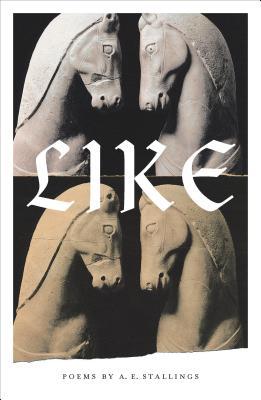
Review: A.E. Stallings, ‘Like’

‘Like’ is the fourth volume of poetry from A.E. Stallings, the best poet that I know of who is writing in English today. The themes in ‘Like’ are the same as in her earlier collections: American childhood, Greek adulthood, children, memory, local wildlife, Greek mythology… and concern for the abused, whether women in the patriarchy or refugees in the Mediterranean. There is a difference of organization, though: instead of four or five different sections, ‘Like’ lumps all the poems together and arranges them alphabetically by title; the result is a smooth, wide-ranging read.

Stallings has a superb mastery of form, and plays endless tricks with it. Start on ‘Battle of Plataea: Aftermath’ and the apparent prose in 11 lines when read alertly turns out to be a rhymed sonnet in iambic pentameter. Or take the eponymous ‘Like, the Sestina’ which uses the word “like” as the rhyme for every one of the requisite 39 lines plus 3 mid-line rhymes (with such variations as “unlike”, “dislike”, “look-alike”). See how the most substantial poem, ‘Lost and Found’, carries its rambling dream-and-memory dissertation on for 36 stanzas of ottava rima in iambic pentameter, whereas the shorter and more time-sensitive ‘Swallows’ uses 6 stanzas in iambic tetrameter. Her ‘Refugee Fugue’ attacks the unmanageable and unimaginable horrors of the desperate and drowned through a blues poem, a host of epigrams, a found poem – an appropriately confused assemblage of forms for a situation not amenable to coherent resolution.

But forget the technicalities! The beauty is in the easy music of her verse, the casual wordplay as with the doorbell that
Portended importunity from Porlock,
the throwaway etymological observations as of nighttime thoughts:
To consider means to contemplate the stars,
the poem on a ‘Pencil’ that ends
And Time the other implement
That sharpens and grows shorter,
the playfulness of ‘Night Thoughts’ that begins
Night thoughts are not like bats
and then goes on to describe the flight of bats in extended lyrical detail, before finally ending with how night thoughts are different…
And always the underlying awareness of thousands of years of history, showing through in the description of sky, contemporary but ancient, as
the contrailed palimpsest of blue.

And that leads me to my only regrets about Stallings’ verse: too much Greek literature with which I’m barely familiar. I’m not saying it’s a failing on her part, it’s merely a regret on my part that I can’t keep up. Although I would love to come across work by her with Norse themes…

But I will settle for what she offers: a very wide range. She can be very succinct as with ‘Paradox’:
Of the ones that happened to die, the little ones and the old,
Of hypothermia, or drowning, all died of cold.

Equally, she can be extensive and thorough in her exploration of a theme as with ‘Lost and Found’, where she is wandering through a dream of mountainous moonscapes, landfill landscapes, of things lost – toys, gloves, loves, baby teeth, time, opportunities, keys, coins – led by Mnemosyne, Memory herself, the mother of all the muses. The smooth formal stanzas of ottava rima, maintained steadily for 288 lines, provide the same meditative state as the 250 lines of Matthew Arnold’s ‘Scholar Gypsy’ or Edward FitzGerald’s even longer ‘Rubaiyyat of Omar Khayyam’.

My personal favorite in ‘Like‘ is her semi-formal ‘Crow, Gentleman’ (whose title I am guessing was changed from the original ‘Gentleman Crow’ to prevent it from coming between two poems in ‘Like’ addressed to her daughter). It begins:
Pacing to and fro
Along the autumn shore
Among the wrack and reek

With your arms clasped behind your back
And sporting your grey frock coat
Trimmed in black

And your black hat and your lean long-legged stride,
Up and down the strand perusing
The headlines of the tide:

and ends:
Life is a joke you crack,
Wry and amusing,
And death a dainty snack.

I find Stallings’ work altogether delightful: by turns sardonic, detached, passionate, compassionate, always observing carefully, always expressing wittily, always in masterful control of rhythm and rhyme. I repeat: I don’t know of a better poet writing in English today.

Resources: Light poetry magazine

Light‘ has just published its winter/spring 2022 issue… perhaps a little late, but it still has snow on the cover. Originally founded in 1992 by John Mella as the print magazine Light Quarterly with the mission to “restore humor, clarity, and pleasure to the reading of poems”, it is now biannual. It moved online in 2013, and all issues since then can be read for free on its website, along with excerpts from print issues dating back to 1999. Under current editor Melissa Balmain and her staff of fellow volunteers, it remains the oldest and best-known journal of light verse in the U.S.

I used to think of magazines as purely ephemeral, things to be skimmed and discarded unless a page or photo was worth retaining by tearing out physically or saving online. Light, however, has made me pay attention to how many resources are made available through a well-managed publication. In this case you get the following:
1. The magazine – some 50 poets with one or several pieces each – a great way to be exposed to, and kept up to date on, the range of light formal verse being produced in the English-speaking world today;
2. and more extensive work by, and coverage of, a featured poet – someone with a strong track record, worth learning about their work and career;
3. and (sometimes) an additional light-verse-related feature or essay;
4. and (always) reviews of light-verse books, and/or books that at least have a large helping of comic poetry – and I’m happy to say that the Potcake Chapbooks are again mentioned this issue!
5. and general news: the News page carries info on: 1- events of interest to Light poets (i.e., readings, workshops, and so forth involving light verse and/or Light poets); 2- contests and submission calls friendly to comic poets; 3- awards and honors received by Light contributors and volunteers; 4- books and, occasionally, music by Light poets. **NOTE: Poets and editors are encouraged to email editor Melissa Balmain with info appropriate for the News page: lightpoetrymagazine@gmail.com
6. and the magazine even runs light-verse events! Recordings of its “Light Verse in Dark Times” Zoom series are on Youtube: https://www.youtube.com/channel/UC-tR4v4H23BUg5ZDUJlU7fA. In pre-Covid days, Light hosted live readings in Washington, DC, and at the AWP conference in San Antonio, TX. Its first live event in two years will be a reading in honor of Light’s 30th anniversary, May 26 (next week!) at the Poetry by the Sea conference in Madison, CT;
7. and the current-events Poems of the Week (POTW), a mailing list you can join (or find on the Light website’s Home Page) for a weekly blast of 10-12 snappy, snippy comments on the absurdities and iniquities of the world.

So, more than just being a skimmable and disposable magazine, Light provides a doorway to an extensive community, with each issue providing the work of dozens of current poets, and opportunities to go deeper into the world of formal light verse either online or in person, and to be engaged with it actively or passively, weekly, twice-yearly, or as you feel like.

Of course Light also provides an opportunity for a poet to submit their own work: just read an issue or two, and go to https://lightpoetrymagazine.submittable.com/submit to get the details on how (and what) to submit to either the magazine or the POTW.

And for those who think this is the most worthy (free) enterprise they have run across in a long while, their donation page is here: https://lightpoetrymagazine.com/donate/)

Epigram: ‘Bit with Bite’

I think I’ve blinked
At what you write:
Edgy, succinct–
A bit with bite.

This is in the spirit of a homage to The Asses of Parnassus, in which the poem found a home. Editor Brooke Clark has created a tumblr account that for the past few years has been posting “Short, witty, formal poems” on an occasional (i.e. erratic) basis, much in the spirit of Latin and Greek epigrams (and often translations of them, or modern retellings).

This poem itself is not particularly noteworthy – but I enjoyed rhyming ‘blinked’ with ‘succinct’, as well as the ‘think/blink’ and ‘bit/bite’ pairings. Wordplay is at the heart of poetry, from Anglo-Saxon alliteration to modern rap, from nursery rhymes to Shakespearean sonnets. Wordplay is memorable, and sharpens the pain of an epigrammatic jab. Use it, if you want your barbs to be effective.

Kyrielle: ‘Desire is the Last Domino to Fall’

Religion starts as trying to explain,
Progresses to high priests’ financial gain.
I’ve tried religions, and seen through them all;
Desire is the last domino to fall.

Explore the world – well, fifty lands’ enough;
Novelty fades; folks are just folks; stuff’s stuff.
I’ve seen both rich and poor round this blue ball;
Desire is the last domino to fall.

And I’ve gone barefoot, and I’ve gone first class:
The trinkets pall beside bare feet on grass.
Markets go up and down and they too pall;
Desire is the last domino to fall.

The fearful right, the overtrusting left:
Politics, history, both of sense bereft.
Reagan’s road leads to Trump and hits a wall;
Desire is the last domino to fall.

My arts expression’s been in writing verse–
The arse end, clearly, of the universe.
There’s rarely silver in the nets I haul;
Desire is the last domino to fall.

I’ve had my fill of sex – but when I see
A vibrant youth, my thoughts are freshly free.
I want, though why I want I mayn’t recall…
Desire is the last domino to fall.

This poem, published by George Simmers in April’s Snakeskin, flowed straight out of a comment by Jackson Browne in a Guardian article on his latest album, ‘Downhill From Everywhere’. My thanks go to Mindy Watson, creator of poems in every form she hears of, for identifying this one as a kyrielle. I hadn’t set out to write within a specific form, I merely wrote a poem that used a repeating last line of the stanza. And this highlights one of the things about form: form follows function, in poetry as in architecture. Metre, rhyme scheme, line length, all these are chosen for their appropriateness for the mood and content of the poem. Ballads, sonnets, couplets, villanelles, each type finds its best use in a different situation, each evolved to provide a good expression of a different mood, each became popular as its expressive strength was demonstrated.

A kyrielle seems to me a natural poetic construct for an expression of prayer or despair or wherever all avenues of thought lead back obsessively to the same essential fact or wish. It was formalised in the time of the troubadours, and its name derives from the Late Latin phrase “kyrie eleison“, “Lord, have mercy”. Very appropriate.

Photo: “Where It All Began” by mckinney75402 is marked with CC BY 2.0.

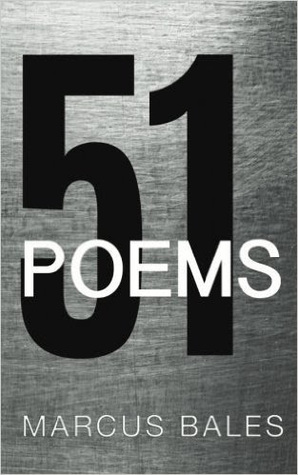
Review: ’51 Poems’ by Marcus Bales

This is poetry as it is meant to be: evocative and word-for-word memorable. Fair disclosure: I am an online friend of Marcus Bales – and I am so because his poetry is evocative, memorable, witty… and it all rhymes and scans in the most natural and elegant way.

His collection of ‘51 Poems‘ contains sections with very different moods. The first ones recapture childhood and wartime experiences and then give way to my personal favourites, a series of poems of love, love that in one way or another is unattained, incomplete: Pre-Flight, “I called goodbye. By then she couldn’t hear.//I pulled the chocks away, and she was gone.” Broken Sunlight “streaming down his face.” Have You Forgotten “it all, and all so soon?” Me and the Moon. Dancing with Abandon. And Precipice: “and knowing everybody knows//I’m dancing on a cliff edge, unaware//of where the precipice gives way to air.”

Others of his poems are portraits of very diverse people, political or social commentary, and (most memorably) flawless parodies of Keats, Poe, W.S. Gilbert, Auden, Shakespeare, Kipling among others. It is in the parodies that he shows the greatest diversity of rhyme and metre, because his ear catches the rhythms of other poets as easily as it understands iambic pentameters.

Online you will find him knocking out sarcastic little quatrains almost daily in Facebook. He was a standard contributor in The Rotary Dial (now sadly defunct), and frequently appears in the Potcake Chapbooks. Read 51 Poems for the wit and the human insights, and you will be rewarded with memorable earworms of wordplay and verbal dexterity.

Potcake Poet’s Choice: George Simmers, ‘Strip’

The pub’s old-fashioned, and is somewhat seedy.
The clientele, all male, look lumpish, needy,
And when the stripper comes, their eyes are greedy.

A smile fixed firm upon her painted face,
She starts gyrating with a teasing grace,
Smoothly undressing at a languorous pace.

She struts through routine choreography
Removes her bra, and lets her breasts go free
The silent men watch her impassively.

And still they stare unmoving as she slips
The golden panties from her mobile hips,
Pauses a sec, then sensually unzips

Her smooth pink skin, and flings it open wide, 
To show the flesh and beating heart inside.
Her audience observes all this, dead-eyed.

The flesh from bone she now expertly rends,
And now it’s just her skeleton bops and bends
Seductively until the music ends.

Silence. She picks up flesh and skin, and drawers
So often dropped before on grubby floors.
The men are stirred to offer mild applause.

She dresses quickly, picks up a pint glass,
And then begins the customary pass
Among the men, who goggle at her arse,

Say nothing, but poke fivers in the pot
Because that is expected. They do not
Even try to meet her eye, or speak of what

They’ve seen, but, weekly ritual complete,
Get up, and, bodies drooping with defeat,
They head out to the grey indifferent street.

George Simmers writes: “It must be thirty years ago that I was in a run-down district of some industrial city, looking for a pub that would sell me a pint and a sandwich. I passed one with a sign that said ‘Stripper: 1.30’ and I thought: ‘Why not?’
The audience was very much as described in the poem, though the performance was less extreme. It was a fairly melancholy occasion, and one that stayed in my memory. It was a long while ago, and the pot that day probably filled with £1 notes (maybe even ten bob) rather than fivers, but I thought £5 would be the appropriate donation today – if lunchtime pub strippers still exist. They’re an endangered species in the North of England, I gather, and lockdown has probably killed them off completely.
I wrote this in triplets because the first three lines came to me together, and I thought I’d see how well I could continue. I feel the form somehow suits the subject, or at any rate is better than couplets, which tend to be faster-moving. The triplets seem (to me at least) sluggish and a bit unusual.
I dimly remember years ago seeing an animated film in which a stripper goes on to unzip her skin, so to that extent the poem is not original. But it was the deliberately unimpressed audience I really wanted to write about, and making them still stolid even after watching the impossible made my point, I hoped.
This is one of a series of poems that I’ve written over the past couple of years, telling stories that are extreme or somewhat gothic. I may get some of them together into a short collection later in the year.”

George Simmers used to be a teacher; now he spends much of his time researching literature written during and after the First World War. He has edited Snakeskin since 1995. It is probably the oldest-established poetry zine on the Internet. His work appears in several Potcake Chapbooks.
https://greatwarfiction.wordpress.com/
http://www.snakeskinpoetry.co.uk/

Photo: “luchavavoom stripper” by ourcommon is marked with CC BY-NC-ND 2.0.

Epigram: ‘The Gods Compete’

The gods compete; some harvest verse, some tears,
Some deaths in battle, some vague hopes and fears.

This epigram is nondenominational–in the sense that I don’t have any preference for how people view, or are attracted to, some particular god.

More challenging is the punctuation. Good punctuation definitely helps guide the reader through the meanings of the passage, but what is ‘good’ varies by culture. Many Americans loathe the semicolon beloved by writers of convoluted passages. Many people argue for or against comma placements. In this piece, a 17-word sentence, the first line seems clearer than the second. “Some deaths in battle” might in this case be better written as “Some, deaths in battle” but that would suggest following it with “some, vague hopes and fears.” Then it might be preferable to separate those two parts of the line with a semicolon… but then perhaps the previous line should end in a semicolon too… but then what about the semicolon after “The gods compete”? Replace it with a colon.

I can’t help thinking of the remark often attributed to Oscar Wilde, or, as David Galef pointed out in the New York Times, Gustave Flaubert: “I spent the morning putting in a comma. In the afternoon I removed it.”

The poem was originally published in The Asses of Parnassus–thanks, Brooke Clark!

Photo: “Pergamon Museum _DSC17798” by youngrobv is marked with CC BY-NC 2.0.