Category Archives: Poetry

Poetry Resource: “Shot Glass Journal”, Poem: “In the Metal Box”

You sit in the humming metal box
And the unlikely landscape rolls
Beneath you in its crumpled seas and rocks
Seen from some miles above on long papyrus scrolls.

This little poem was recently published in Shot Glass Journal, whose motto is “… brevity is the soul of wit …” Accepting only short verse (although “16 lines or less” seems overly generous for “short”) in either free or form, it is remarkable for an American institution in reserving half its space for non-US poets. In the current issue, the left-hand column of 21 US poets is balanced by the right-hand column of 21 poets from Australia, the Bahamas, Canada, India, Ireland, Israel, New Zealand, South Korea, Turkey and the UK. This in itself adds richness and interest to the journal, all the more tasty and accessible in a short-form environment.

Normally edited by Mary-Jane Grandinetti, the current issue (#29) is guest-edited by poet R.G. Rader, the poet and playwright who founded Muse-Pie Press. Muse-Pie Press publishes Shot Glass Journal, as well as two other idiosyncratic magazines, Bent Ear Review of spoken poetry (audio or video submissions only, naturally) and the fib review of Fibonacci poetry. All are open to both formal and free verse.

Technically, this might or might not be a “throwaway poem”. That’s how I would describe it, meaning just a casual thought in verse; but on the other hand some people use the term to mean hand-written thoughts (usually not well-formed) on scraps of paper left behind on public transit or in the park. This one has a bit of form: rhyme, meter, and the last two lines lengthening in imitation of the endlessness of air travel and of the landscape that is being flown over.


Sonnet Contest: Cash prizes, no entry fee!

poetry magazine, Better than Starbucks logo

Better Than Starbucks has just opened its annual sonnet contest, an opportunity for all lovers of formal poetry to practice their skills and show off their best work.

Open through October and November (closes December 1), the contest has no entry fee but awards prizes of $100, $50 and $25 for the top three sonnets, which will be published in the magazine along with seven runners-up.

Expect the competition to be fierce! Better Than Starbucks already has a solid following among formal poets. Last year’s competition drew 560 sonnets, this year’s will undoubtedly see more. And you can only send two sonnets. Make sure they are good!

What “good” means can be gleaned from looking at last year’s results in the January 2019 issue, and more sonnets on the Formal Poetry page in March 2019. There are explanatory notes on the contest page, showing some leniency in the definition, and clarifying that previously-published work is acceptable:

This contest is for a metrical sonnet.
Your sonnet can be shakespearean, petrarchan, spenserian, rhymed, or slant-rhymed.
Blank verse is fine, as long as the sonnet form is clearly identifiable.
We’ll consider tetrameter, hexameter, etc. as well as pentameter.
Some metrical variation is fine, but don’t forget the volta!
As always, we do accept previously published work.

Good luck!

Poem: “Optimism”

Do you have a clear detection
Of an unexpired affection?
Are you reckoned to come second in her life?
Was there someone there before you?
Let it be, don’t let it bore you;
It’ll maintain her somewhat saner as your wife.

This little throwaway poem was recently published in Lighten Up Online. In my mind its value is not so much as a commentary on modern marriage, as an enjoyable way to string some rhymes together. I no longer have any idea what was on my mind when I wrote it.

Many poets would analyse this as written in trochees with lines of either four or six feet, the third line being

ARE you RECKoned TO come SECond IN her LIFE?

but to my mind the lines have only either two or three strongly accented syllables, with the third line being

Are you RECKoned to come SECond in her LIFE?

It is a short piece of patter, which is emphasised by the internally stressed rhymes of reckoned/second and maintain-her/saner. But that leads to a problem: there is a difficulty with the beginning of the last line, and it is hard to find a smooth flow.

Originally it read

‘Twill maintain her —

Archaic, said LUPO editor Jerome Betts, and requested a change for publication as

It’ll keep her —

I accepted this, not noticing that I was losing the rhyme with saner. So why not

It’ll maintain her —

Now the problem is that there is one syllable too many, and we don’t have a smooth flow from the previous line.

You’ll maintain her —, perhaps?

That gives a brand new problem, a subtle shift of meaning from the abstract “it” to the personal “you”, with a much more active sense of “maintain her” and even a suggestion of financial concern.

If it was just an oral presentation, you could probably slide by with

‘t’ll maintain her —

but is that acceptable, comprehensible, in print?

My operating principle with poetry is that there is always a solution. But in this case I haven’t yet found it. 

Poem: “My Outside”

My outside stroking your inside
Your inside gloving my outside
My outside stroking your
Inside gloving my
Stroking your
Gloving my
Stroking
Gloving
Stroking
Gloving
My your my your my your
Our

This poem was originally published in “The Fifth International Anthology on Paradoxism“, edited by Florentin Smarandache – who appears to live as a mathematician in a universe of paradox. It was republished in the Experimental section of Better Than Starbucks.

This blog advocates for the use of form, to the extent of questioning whether a piece that doesn’t rhyme and scan can even be considered poetry. Is this poetry, then? I think it hovers paradoxically on the edge. It may not rhyme or scan, but it has certain qualities of form:

It is word-for-word memorable through its expression. After all, it only uses seven different words, and they are clearly structured.

The lines are paired all the way, the second of each pair mirroring (or even fusing) the first.

There is a rhythm – a very human rhythm – to the piece, even if it doesn’t fall within poetic norms.

There is even, if you care to consider it, an aspect of concrete poetry about it.

And, if read in my English accent, the last word is a pun, being pronounced “Ahh!”

The simplicity of words, the structure of the lines, the rhythm of the piece, the aspect of concreteness and the pun all contribute to what the poem is trying to communicate.

If it is a poem.

Poem: “Diatribe Against Unversed Poets”

Heartbeat

Heartbeat – “June 1, 2014” by osseous

Ignoring clockwork towns and fertile farms
Tied to the sun-swing as the seas to moon,
They searched for verse in deserts without rhyme,
Lifted erratic rocks nonrhythmically
In search of poetry, then through the slough
Of their emotions hunted for a trail:

“The scent is cold. Its Spirit must have fled;
The body of its work, though dead,
Has been translated to some higher plane.
Look how the world’s translated verse
Comes to us plain—why can’t we emulate?
Then if the words themselves are unimportant,
If poetry in essence is idea,
And song is wrong,
Rhyme a superfluous flamboyance
(Like colour in Van Gogh),
Rhythm a distraction to the memoring mind,
Then we determine poetry’s true form is mime!”

While in the air the deafening blare
Confounds their silence everywhere:
Before our hearts began to beat
We were conceived in rhythmic heat;
So, billions strong, we sing along
For all the time, in time, our time, the song
Goes rocking on in rhythmic rhyme. Rock on!

This was originally published in Snakeskin, the monthly online poetry magazine that George Simmers has been putting out since the 1990s. He is receptive to a range of poetry, but as his original credo states: “Nor shall we sit to lunch with those / Who moralise in semi-prose. / A poem should be rich as cake.”

This poem is a rant against the vast amounts of blather that have been published as “poetry”, while anything showing formal verse skills was automatically rejected by most magazines over the past several decades. The rant is against poets who are “unversed”: “not experienced, skilled, or knowledgeable.” Why should they be given automatic acceptance, when the skilled were automatically rejected? It has been a bizarre half-century. It has a zeitgeist worth considering.

To focus on the United States as the cultural driver of the 20th century: it has always had an anarchic aspect, from the founding tenet of the right to “life, liberty and the pursuit of happiness” – though this mostly applied to adult white males who had a certain level of property. (By contrast, Canada’s constitutional requirement for the federal parliament to provide “peace, order and good government” has a social rather than individual orientation.) The US high water mark for good government came domestically with the FDR-and-Eleanor Roosevelt presidency, and internationally with the founding of the United Nations. But “big government” acquired such nasty connotations thanks to Stalin, Hitler and Mao that those who wanted the freedom to exploit others without legal restriction were able to make a case for “small government” and chip away at government structures.

In poetry, what started with Walt Whitman in the 19th century burst open a century later with Ginsberg, Ferlinghetti, and classrooms where every child was “encouraged in self-expression” without penalties for illiteracy. What was expressed became everything; the how became irrelevant. As in government, freedom from others’ rules became desirable in the literary and artistic community, and in the hippie movement, and the innovative business start-ups of Silicon Valley. There were undoubted benefits… but in literature, the suppression of poetic form was one of the less fortunate results.

Poetry takes different forms in different languages, but the forms all have the same desirable outcome: to make it easier to memorise and recite word-for-word. Alliteration, assonance, rhyme, metre – these are all useful tools for achieving this, along with less tangible tools such as fresh or startling imagery. Metre is viscerally important to us, because the mother’s heartbeat is the background to sensory development in the womb, and our own heartbeat and breathing rhythms continue throughout life. As humans we drum, we dance, we sing, just as we walk and run rhythmically, tap our fingers rhythmically when we are bored, teach small children to clap and sing, teach older children clapping and skipping games. Rhythm is built into us from before birth.

But rhythmic poetry didn’t die when it stopped being publishable. It just went into folk songs, blues, rock, country-and-western, musicals, rap, hip hop… Popular music let teenagers and adults continue to thrive with what they were not given by schools: rhythm and rhyme. This drive to make words memorable and recitable is part of who we humans are. So schools do best when they leaven “creative self-expression” with getting kids to learn things by heart, and to pay attention to the qualities that make it easy to memorise and recite.


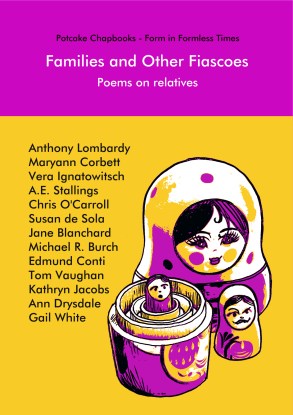
Formal Launch: Potcake Chapbook 4 – Families and Other Fiascoes

The fourth Potcake Chapbook is now launched into the wide world, with its contributors coming from England, Wales, Greece, the Netherlands, Canada, and coast to coast in the US.

04 Families and Other FiascoesPoets new to this series are, in order of appearance, Maryann Corbett, Vera Ignatowitsch, Kathryn Jacobs, Anthony Lombardy, Susan de Sola, Jane Blanchard and Michael R. Burch.  A glance at their profiles in Sampson Low’s Potcake Poets page will show you they include editors at Able Muse, Better Than Starbucks, The Hypertexts and The Road Not Taken, as well as various prizewinners.

Returning contributors are A.E. Stallings, Ed Conti, Tom Vaughan, Ann Drysdale, Gail White and Chris O’Carroll, who of course can boast their own editing and prizewinning. And returning as well is the artwork of Alban Low.

It’s hard to do justice to families in a mere chapbook. Not only are there dozens of possible family relationships (and the number is actively increasing thanks to both social changes and biotech developments), but each of those relationships can close or distant, sweet or bitter, simple or complex, present or merely remembered. It requires science fiction to describe an individual entirely without a family.

This chapbook touches on a great deal, but by no means all, of what “family” means. Send a copy to someone who appreciates the bittersweetness that accompanies family love, up and down the generations.

Poem: “Carefree Youths”

Carefree Youths

Like fishing boats sailing a landless sea,
an edgeless game-board for an endless game,
hauling their random catch from wide-spread nets,
hunting without the hunter’s hunt and aim,
but sailing, drifting, without cares or frets,
so carefree youths under the bowl of sky
will chance their drifting lives on random lips.
And then the Kraken rises, sinking ships.

“Carefree Youths” was published a couple of days ago in Bewildering Stories. It is in iambic pentameter with irregular rhyme. After the meandering start to the poem (about the youths’ meandering lifestyle), the last line is a hard punchline (reflecting the brutal ending of that lifestyle). There are no sequential rhymes until the last two lines, which thereby become the clear ending of the poem. The form of the poem accentuates the poem’s meaning. That is what form should do.

Final rhyming couplets were used extensively by Shakespeare in various ways. In his sonnets they provide a very strong ending after four quatrains, and is a reason for preferring the Shakespearean sonnet’s ABAB CDCD EFEF GG over the Petrarchan sonnet’s more mannered but less forceful ABBA ABBA CDE CDE. Many of his final couplets are well known – such as:

If this be error and upon me prov’d,
I never writ, nor no man ever lov’d.

Shakespeare did the same sort of thing throughout his plays, in which a scene or a soliloquy will be in blank verse but often terminate in a rhyme. Some of the best-known examples being:

the play ‘s the thing
Wherein I’ll catch the conscience of the king. (Hamlet)

Fair is foul and foul is fair:
Hover through the fog and filthy air. (Macbeth)

Good night! Good night! Parting is such sweet sorrow
That I shall say goodnight till it be morrow. (Romeo and Juliet)

The rhymed sentence helps sum up the scene, and signals that the scene is ending and that a new scene is about to begin – particularly useful since in Shakespeare’s time there were no stage curtains and no real sets to speak of.

Ah, formal verse! So many uses!

Poetry Resources: The Economist’s ‘Johnson’ blog

You may be surprised to hear of The Economist magazine as a poetry resource, but it is a much wider-ranging weekly than most people realise. Start from the back with its chosen Obituary (eccentric and eclectic, it has included Alex the African Grey parrot, writers such as Ray Bradbury written up in their own style, and dictators, deposed kings, and UFO abductees). Move forwards into the Books and Arts section, further into Science and Technology… there’s a lot there, before you get to the finance, business and politics that is the purpose of it all.

Apart from the half dozen book reviews (eccentric and eclectic, of course), the weekly ‘Johnson’ column or blog post covers all things word and language related. The current edition’s Johnson is headed ‘Degrees of Separation’ in the print edition, while online it calls itself ‘Words, like people, have tangled and extensive family trees – surprising connections emerge if you look back far enough’.


The article is focused on Proto-Indo-European’s development into the whole range of modern languages from Gaelic to Bengali; how different the origins may be of words that have identical spelling and pronunciation and have apparently related meaning (a pawn and to pawn); and the surprising common ancestry of apparently unrelated words (such as ‘divine’ and both halves of the word ‘Tuesday’).

Inasmuch as writing relies for much of its power on the richness of words and their ripples of meaning, association and derivation, The Economist’s Johnson column is a worthwhile and engaging weekly read for all writers, and especially poets.

Poem: Haiku: “Haiku on Haiku”

Despite my complaints yesterday about Haiku not being poetry, I can see a solution to the problem:

HAIKU ON HAIKU

Syllables are prime,
But words do more than count time;
Haiku should still rhyme.

This was originally published in Asses of Parnassus, 14 March 2018

Poem: Haiku: “Haiku on Verse”

Japanese haiku qualify as formal verse in Japanese, and in some ways in English. Traditionally they have three standard aspects as explained in Wikipedia:

The essence of haiku is “cutting” (kiru). This is often represented by the juxtaposition of two images or ideas and a kireji (“cutting word”) between them. This is the equivalent of the volta in a sonnet, the turn from the initial argument or exposition to its extension or contradiction.
Traditional haiku often consist of 17 “syllables” in three phrases of 5, 7, and 5. This is not standard in English verse, where the number of stressed syllables (i.e. the number of feet) has always been more important than the total number of syllables. Even where there are a fixed number of syllables in the foot of the particular meter being used, the feet overrule the syllables.
A kigo (seasonal reference), usually drawn from an extensive but defined list of such terms. English verse is by no means hostile to seasonal references, but is considered superior when it uses fresh words rather than drawing on a predefined list.

In addition, there is no value placed on rhyme, on the meter of the lines, or on the inclusion of either alliteration or assonance. It may be verse in Japanese, but in English the haiku (as defined above) will normally be a sentence of prose that has been artificially broken into three lines.

HAIKU ON VERSE

Haiku challenge my
Fundamental sense of verse:
(Insert last line here).

The above was published in Snakeskin in April 2017. And it doesn’t even have a kigo.