Tag Archives: formal verse

Poem: “Implants and Biotech”

These are the scarecrow years
When frost tears glisten
On moulded and painted cheeks, beside ears
That no longer listen
Being more deaf than dead
And hearing only
Through implants and inputs into the head
Bonily, stonily.

Fears come while certainties lapse:
Fears of the dark,
Of abandonment, monsters, uncertainty. Now (perhaps)
Some Schrödinger’s shark
Divides cosmonaut, cryonaut, chrononaut
From those who can’t trust
The unknown, are ill-taught, or die without thought.

Thrive on change, or be dust.

This was first published in The Rotary Dial, an excellent online monthly of a dozen formal poems that was put out by two of Canada’s best poets, Pino Coluccio and Alexandra Oliver. Unfortunately The Rotary Dial folded in 2017 and Pino, after winning Ontario’s Trillium Book Award for ‘Class Clown’, disappeared off the radar.

The poem subsequently appeared in the fifth Potcake Chapbook: ‘Strip Down – poems of modern life’, where it has a page facing A.E. Stallings’ far gentler and more positive view of modern medicine, ‘Ultrasound’.

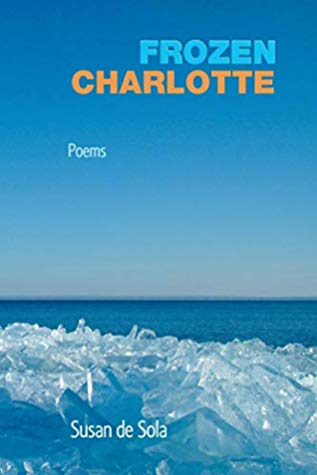
Review: “Frozen Charlotte” by Susan de Sola

Frozen Charlotte

Susan de Sola’s ‘Frozen Charlotte’ is a book of strong poetry, both formal and free verse, collected after prior publication in 30 publications as diverse as Able Muse, Ambit, American Arts Quarterly, Amsterdam Quarterly… and The Dark Horse, and Light, and Measure. One of the pieces in this collection, ‘Twins’, has already been reprinted in the Potcake Chapbook ‘Families and Other Fiascoes’.

Her casual comfort with verse forms is shown in the last poem of the book, ‘Bounty’:

The fruit flies find our fruit, they slip
beneath the lid, a silver dome.
The dark fruit scent has drawn them in,
no other lures them out again.
They settle on apples, puckered figs,
they gorge in perpetuity,
may never fly back to their home,
(if they have ever had a home).
An allegory of choice? Well, yes–
in that we have no choice.
The fruit is fine, the day is long.
Let us feed, buzz, rejoice.

The poem divides into two pieces: the first eight lines describe the scene, and are in iambic tetrameter with mere hints of rhyme. The last four lines step back and philosophise, and alternate tetrameter and trimeter, the trimeters rhyming.

Personally, though I like the whole poem, I find the last four lines far more satisfying. The change of rhythm is good, but I don’t see any reason not to embed more formal rhyme in the first part. She is capable of sustained rhyme, as in another of my favourites, ‘Holistic Practice’. Here a middle-aged holistic therapist who has failed to create a whole life for herself – living in a one-room flat and with no family – is depicted in ten 5-line stanzas as she comes for a visit and shares pictures of her cat. The last stanza is:

But no, her Boop, he was her treasure;
her angel and her source of pleasure.
“Oh , look, how cute!”–a cat bow tie!
I grin and nod, divided by
a deep, holistic urge to cry.

I will admit that her free verse can be very engaging as well, as in her ‘ATM’:

Somehow, it’s sexual,
the rim crotch-high,
the shuffling buttocks,
the hands fumbling in secret.

Gone the dainty dialogue,
the date stamp in a little leathery
book of records, at set times. Now,
an onanism of cash, walls with mouths.

This is an example of a poem that I would hesitate to modify into a formal structure for fear of losing the way that each short line is a punchline in itself. But for the most part the less formal poems, though they often have rich ideas, are not as memorable as the well-structured ones. Blank verse in itself has no merit for me – Milton’s ‘Paradise Lost’ rambles tediously, without the need for concision imposed by rhyme. Chaucer’s ‘Canterbury Tales’ may be long but it is packed with many more stories. It rhymes, and that leaves no room for waffle. No surprise then that with Susan de Sola’s work the longest poems are unrhymed and the least tight.

As for ‘Frozen Charlotte’, the title of the book and of one of its poems, I can only say I am grateful that a page of notes at the end gives the explanation that this was a common, naked, 19th century German doll that acquired its nickname in the US in relation to some ballads. I was unfamiliar with Frozen Charlottes. As a book title it seems memorable but disconnected, as Susan de Sola’s poems are, above all, full of warmth and life.


Poem: “Smoke on the Wind”

Smoke on the wind
And ice on the glass,
Leaves off the trees
And green off the grass;
Deer in the yard
And wood in the shed;
The end of the old
And a new year ahead.

This was published in The Orchards Poetry Journal, edited by Karen Kelsay Davies. The journal typically appears in June and December, and focuses on previously unpublished formal verse – though it accepts “finely wrought free verse”, and will also republish something that hasn’t appeared online in the past three years.

“Inspired by the small plot of apple trees near Cambridge, England, where writers have gathered for years with their books and pens,” Orchards naturally attracts the bucolic. I find something engaging about the idea of traditional verse in an online format… perhaps “apple” is the link… Anyway, as we bridge the past and the future: Happy New Year!

Poem: “Any Tourist Island”

When the deep darkness dulls the dirty land
Before the moon meanders through the stars,
Invisibly the sea creeps up the sand
As night-blind drinkers lose keys to their cars.

Ah, the winter, with its delights and hazards! Escape it when you can, and explore fresh delights and hazards! That’s life, isn’t it.

This little poem was published in Lighten-Up Online, aka LUPO, the UK’s top light verse online magazine. Editor Jerome Betts carries on the work begun 12 years ago by Martin Parker: a quarterly issue of some 30 full-length poems, and as many again of the 4-to-8-line variety. Contributors include every current poet you have heard of who can write light engaging verse that rhymes and scans – unless, that is, they expect to be paid for their poems!


Review: “Nonsense” by Alan Watts

Alan Watts had a rich intellectual life. His formal education largely stopped at high school in his native England, but he explored his interests in mystical Christianity and Zen Buddhism so thoroughly, including attending an American seminary, getting a Masters and becoming a priest for a few years, that he was associated thereafter with various universities including Harvard and San Jose State University.

His poetry book “Nonsense” is interesting for its fresh perspective over Watts’ writing, and enjoyable enough for the ten nonsense poems it holds. As you would expect from the author of “The Art of Zen” and “The Book on the Taboo Against Knowing Who You Are”, it contains both pointless happiness

Hum, hum the Humbledrum!
Rumbling bumbling dumbledrum,
Mumbling dumbly, rumbling humbly…

and comparatively clear philosophy:

The stars in their courses have no destination;
The train of events will arrive at no station;
The inmost and ultimate Self of us all
Is dancing on nothing and having a ball.
So with chat for chit and with tat for tit,
This will be that, and that will be It!

The main poem falls somewhere between the two previous quotes. One hundred lines long, written as 20 limericks, it tells the story of The Lovelorn Loon:

A certain umstumptulat loon
Fell vastly in love with the moon;
With shimular turve
And binlimular gurve
He caroozed to the gorble bassoon.

The Loon builds an enormous tower that successfully reaches the heavens, but when he calls the moon, her arrival destroys the tower.

The whole book is appropriately illustrated in 1960s psychedelic style (think Yellow Submarine and Monty Python) by Michel Dattel. And the book contains other short pieces by Watts, an Introduction that starts reasonably and slyly slides into gibberish; and short prose pieces on Nonsense, on Goofing, and on Drudgery.

A very odd but entertaining little book.

Sonnet: “Nigerian Scammers”

Nigerian Prince Scammer

Michael Neu, charged in “Nigerian Prince” scam

Nigerian scammers write bad, IN ALL CAPS,
Misspelling, losing credibility
With all except the stupidest of saps;
No fools themselves, it’s done deliberately.
No point in wasting time on those who doubt –
Everyone who responds is a clear fool:
Desperate to believe, they throw sense out –
Greedily they send cash, earn ridicule.
So @RealDonaldTrump tells barefaced lies
Unfazed by print or film-based evidence;
And fools give cash and votes as hypnotised,
Entrust the trickster with their confidence.
“Born of a virgin! Raised up from the dead!”
Faiths, too, tell huge lies – and religions spread.

This sonnet was originally published in Snakeskin. It’s key point is that the easiest people to take money off are those people who want to believe, and who demonstrate that overlooking the most blatant signs of fraud. Nigerian scammers filter for those people by making their emails deliberately implausible. 

And interestingly, not all Nigerian scammers are even Nigerian. Google the term and you may find Michael Neu, a Louisiana man in his late 60s who was charged with 269 counts of wire fraud and money laundering. Neu is a white American–but, yes, he apparently sent some of the money to his co-conspirators in Nigeria.

Review: “Verse” by John Updike

This paperback, Verse, is comprised of two earlier hardcover volumes of poems from John Updike, The Carpentered Hen from Harper & Row and Telephone Poles from Knopf. The poems date from the 1950s and early 1960s, and in the words of Phyllis McGinley, “His is what poetry of this sort ought to be: playful, but elegant, sharp-eyed, witty.”

Here are the beginnings of some of his poems. Some of them are pure wordplay, as in “Player Piano”:

“My stick fingers click with a snicker
And, chuckling, they knuckle the keys;
Light-footed, my steel feelers flicker
And pluck from these keys melodies.”

Several of them start with a quote from a newspaper story and then run wild with it, as in “The Descent of Mr. Aldez”:

Mr. Aldez, a cloud physicist, came down last year to study airborne ice crystals.
– Dispatch from Antarctica in the Times
That cloud–ambiguous, not
a horse, or a whale, but what?–
comes down through the crystalline mist.
It is a physicist!”

And some are meditative, as with “B.W.I.” (the old British West Indies of the 20th century):

“Under a priceless sun,
Shanties and guava.
Beside an emerald sea,
Lumps of lava.

On the white dirt road,
A blind man tapping.
On dark Edwardian sofas,
White men napping.”

A largely enjoyable collection, but not up to the standard of those similar 20th century poets, Phyllis McGinley and Dorothy Parker. But then again, Updike’s many American awards (Pulitzer, National Book Award, etc etc) were for his fiction. His poetry can be considered a remarkable bonus.

Triolet: “When Sunrise Gilds Your Hair”

You bring me back to when I once was young
When candles gild your eyebrows and your hair;
And to this rocky isle from which I’ve sprung,
You bring me back to where I once was young,
Birthplace of all the varied songs I’ve sung.
Now lying with you in the predawn air
You bring me back to when we both were young
As sunrise gilds your eyebrows and your hair.

This poem was originally published in The Rotary Dial, a Canadian monthly of 12 formal poems that ran some 50 issues before packing up in 2017. It was edited by two prize-winning Canadian poets, Pino Coluccio (winner of the Trillium Book Award for “Class Clown”) and Alexandra Oliver (winner of the Pat Lowther Award for her collection “Meeting the Tormentors in Safeway”). A very enjoyable magazine, I’m sorry it’s gone.

A triolet is strangely attractive form – it only has two rhymes, and several of the lines are required to repeat (though slight variations in the repetition are allowed, carrying the sense forward into new areas). So the rhyme scheme is ABaAabAB, with lines 1, 4 and 7 and lines 2 and 8 repeating, yet having fresh meanings as the little poem moves along.

In the case of this poem, being married for 25 years became enmeshed with returning to live in my home town after 40 years. The triolet’s structure of repetition suits a poem about development, ageing, memory, return. 

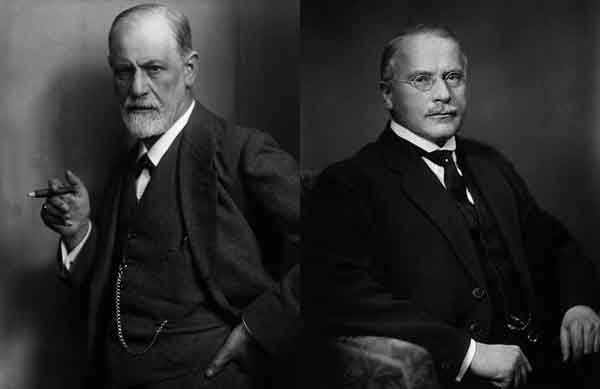
Poem: “Jung & Freud”

Freud and Jung

Freud and Jung

When sparkling springtime Doctor Young
And vernal Doctor Joy
Their arms, words, thoughts, widely outflung
The whole world was their toy.
But clottish schools their systems cloy
With death and dread and dung—
Oh miserable Doctor Joy!
Oh aged Doctor Young!

This little poem was originally published in The Asses of Parnassus, a string of occasional poems in Tumblr, focused on epigrams. “Short, witty, formal poems”, as editor Brooke Clark defines his search.

Jung & Freud is a frivolous piece, based on nothing more than trying to find flippant irony in the names of two of history’s best-known psychiatrists. It uses a bouncy little rhythm with lines of four feet followed by lines of three. The rhymes are simple, repetitive, reversed; the mirroring brings you back to where you started, but with everything reversed.

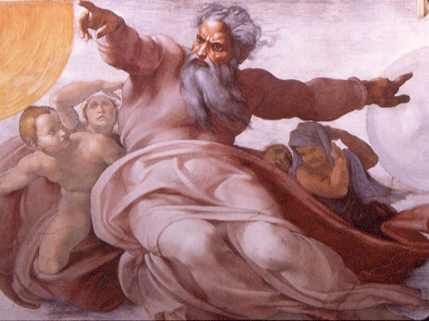
Poem: “4 God Limericks”

God

Christian idea of God

God made Heaven, earth, plants, people, fleas
In six days, and then rested at ease;
Then He thought: “In those stones
“I’ll hide dinosaur bones!!”
(He was always a bit of a tease.)

God looked out a Heavenly portal
And what He saw made Him just chortle:
Some dude, on a cross,
Claiming he was the Boss!
For his hubris, God made him immortal.

God, blessed with what one must call humour,
Decided to start up a rumour
That Himself as a dove
Came to Mary with love
And begat an Immaculate Tumour.

God saw how Religion had deadened
And said to His host, “Armageddon’d
“Look good on this lot”
For His plans were all shot
And His angels teased Him till He reddened.

As with the previous post, “4 Guru Limericks”, this was first published in Ambit No. 196, Spring 2009. (Hence the English spelling.) Like the previous post on gurus Buddha, Jesus, Marx and Hitler, you shouldn’t expect anything serious from a limerick. But this flippancy can have a purpose: by tackling a serious subject in a completely unserious way, you can undermine preconceptions and unthinking assumptions, and suggest alternative views and approaches.

With this in mind, consider the idea that religious belief correlates negatively with analytical thinking, but positively with moral concern and empathy. Research into this was summarized in The Independent in 2016, after more complete reporting in the science journal PLOS ONE. Limericks by their iconoclastic nature appear to be low in moral concern and empathy – but often it is some form of moral concern that has driven the limerick’s creation, although its rudeness and fresh viewpoint tends to favour analytical thinking over empathy.

Limericks are the clowns, the fools, of the poetry world. The best of clowns and fools go into stealth mode to make useful observations.