Tag Archives: W.H. Auden

Using form: Reese Warner, ‘Double Dactyl’

“Auden thought the triolet was too trivial a form to bother with…” –James Fenton

Practally dactally
W. H. Auden
Mastered his verse forms with
Scarcely a miss.

Some he found slight. There’s no
Abecedarius,
No triolet, and he
Didn’t write this.

*****

When I first started thinking about double dactyls I made a list of words and when I saw that James Fenton quote I knew I had a poem. I no longer recall what word got paired with Kevin E. Federline.

Reese Warner lives in Toronto and does things with computers for money. Reese’s poems have shown up in journals such as Asses of Parnassus, The Malahat Review, The Rotary Dial, The Dalhousie Review among others. For more information see http://pubs.reesewarner.com

Double Dactyl was first published in The Asses of Parnassus.

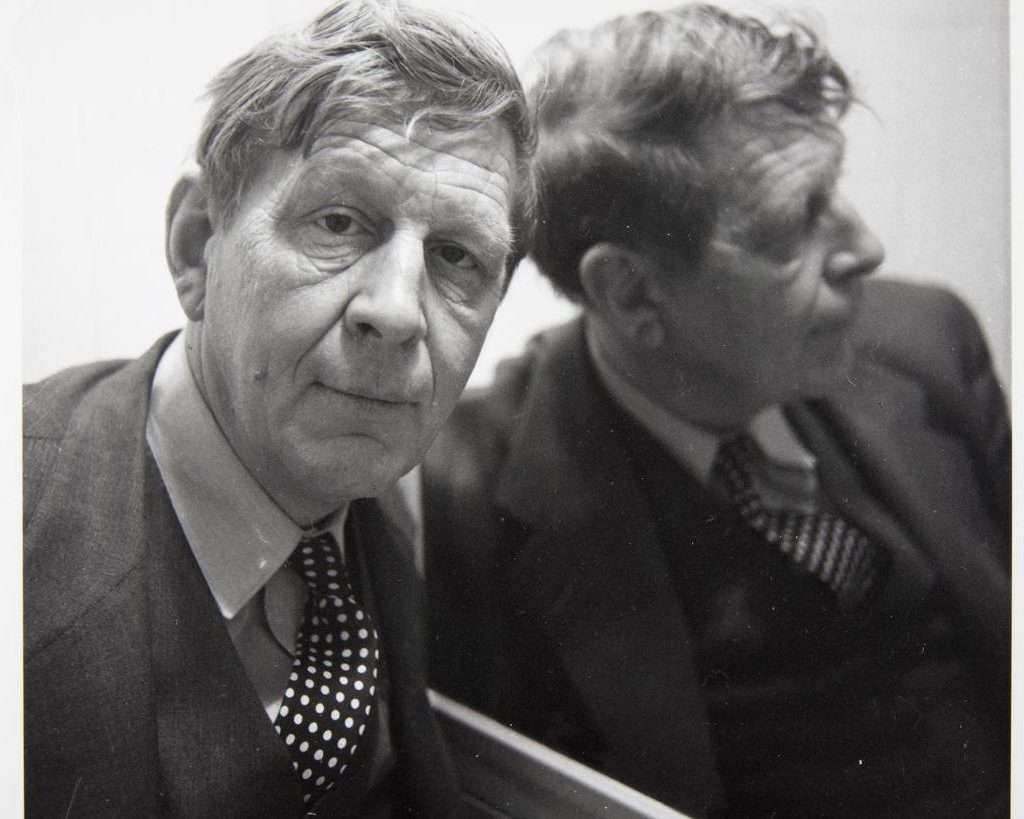
Photo: “W.H. Auden” by Cecil Beaton is licensed under CC BY-NC-ND 4.0.

Weekend read: David Galef, ‘A Question of Emphasis’ or ‘Wanna Make Something of It?’

“poetry makes nothing happen . . . .”
—W. H. Auden, “In Memory of W. B. Yeats”

Poetry makes nothing happen.
Song lyrics, on the other hand,
Wedge into people’s hearts
When sung by a heartthrob band.

Poetry makes nothing happen.
It doesn’t enforce a cause.
That’s the way of propaganda,
With all its fixed applause.

Poetry makes nothing happen.
But I’ve seen something sublime
In the eyes of a student reading
Eliot’s Prufrock the first time.

Poetry makes nothing happen.
But must events take place
For poems to be eventful—
To make a normal pulse race?

*****

David Galef writes: “This poem was inspired by the memory of a graduate seminar taught by Edward Mendelson, a professor at Columbia University and the executor of the Auden estate. What Mendelson doesn’t know about Auden probably isn’t worth knowing, and what he brought to the study of Auden’s poetry was a deep knowledge of technique, context, and Auden’s modus cogitandi. Tired of those who quoted Auden’s famous line from “In Memory of W. B. Yeats” to indicate the inutility of poetry, Mendelson pointed out that the significance of “For poetry makes nothing happen” is more a point about art versus propaganda. The emphasis shouldn’t be on “nothing” but on “makes.” The aim of agitprop is to make all minds bend in one direction. True art, on the other hand, doesn’t force one meaning on the audience, though it may be powerfully suggestive. As Auden continues (and people who quote often omit surrounding words),
“it survives
In the valley of its making where executives
Would never want to tamper, flows on south
From ranches of isolation and the busy griefs,
Raw towns that we believe and die in; it survives,
A way of happening, a mouth.

Poetry does indeed enjoy a special, immortal status, but those who want it to be a crowd-controlling megaphone will probably be disappointed.
What I wanted to accomplish in ‘A Question of Emphasis’ is just what stressing the right
word can do, and how poetry can change lives, in its own way.”

David Galef has published over two hundred poems in magazines ranging from Light and Measure to The Yale Review. He’s also published two poetry volumes, Flaws and Kanji Poems, as well as two chapbooks, Lists and Apocalypses. In real life, he directs the creative writing program at Montclair State University.
www.davidgalef.com

Editor: I can’t help adding this 6-minute exposition of emphasis from Hamlet: https://vk.com/video17165_456239062 with its star-studded cast… Enjoy!

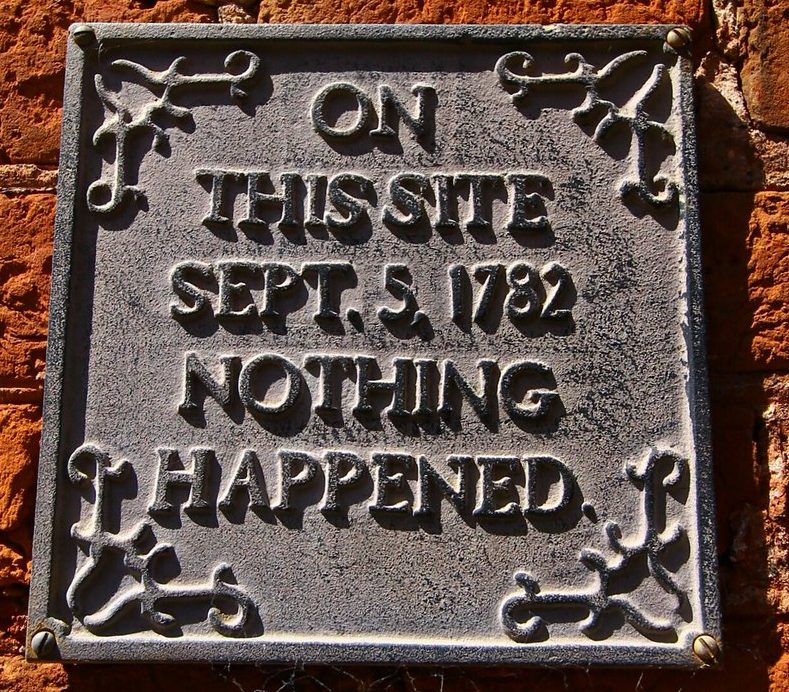
Photo: “Nothing happened” by Graham Ó Síodhacháin is licensed under CC BY-SA 2.0.

Political poem: George Simmers, ‘Navalny’

In memory of Alexei Navalny, killed at the IK-3 penal colony,
16 February, 2024.

1.
Rough and chivvying cold winds blow
The helpless dead leaves to and fro.
Leaves have no say in where they go
But we’re alive so can say no –
Let us praise those men who show
Resistance to the easy flow.

2.
Navalny, prisoner in the snow,
In numbing twenty-eight below,
Has paid the price for saying no;
He’s gone the way we feared he’d go.

That’s Putin, making sure all know
That retribution comes in tow
For those who won’t go with the flow.
‘All dissidents will finish so,’
The message is: ‘Go with the flow,
Or you too could end on Death Row.’

I imagine his warders: Did they know
A twinge of guilt at this, or show
Regret or shame? I doubt it. No –
Why should men let a conscience grow
When they can just go with the flow?
When life is so much easier so,
When every television show,
The papers and the radio
All radiate a conformist glow
Incessantly, so all men know
Life’s comfier with the status quo.
It’s only awkward sods say no,
Go their own way, not with the flow.
Those have a dangerous row to hoe,
And who can blame the average Joe
For on the whole deciding: ‘No,
That’s not for me. I’d rather toe
The line, collect my wages, know
I’m safe and needn’t undergo
What brave men have to suffer. No,
Go with the flow, go with the flow.’

3.
In Moscow brave girls risk a blow
By laying flowers in the snow
To honour him for saying ‘No’.
Brave girls. I admire them so.

*****

George Simmers writes: “This poem began because our local Arts Festival announced its theme as ‘Flow’. Which made me grumble a bit: was I supposed to write stuff about how nice it was that rivers flowed? Not my style. But then I thought about people who go against the flow by saying ‘No!’ and that suggested a subject and a rhyme scheme. It was only after I’d scribbled a few possible lines that I came across a photo of young women in Moscow placing flowers in the snow as tributes to the murdered Russian dissident, Alexei Navalny. In some towns, such protestors had been arrested or beaten up by the police.

“It’s thirty-odd years since I visited Russia. That was at the time of perestroika and hopefulness. We had a contact in Moscow who took us to see the sights, including the Arbat, a popular meeting- place. He said: ‘Can we stop and talk here for a few minutes? I ask because a few years ago If I had been seen here in conversation with a foreigner, I should have been arrested.’ Freedom was precious then, but repression returned.

“Navalny was a lawyer who campaigned against the corruption endemic in Russian political life. In 2020 he was poisoned with Novichok (probably by the Federal Security Service) ; after hospital treatment in Berlin that saved his life, he returned to Russia, even though he knew of the dangers. He was immediately arrested, and ended up in an Arctic Circle corrective colony. The exact circumstances of his death still remain unclear, but while in prison he had suffered from malnourishment and mistreatment.

“Writing this poem I remember Auden’s words: ‘Poetry makes nothing happen.’ Auden pointed out that political poems make the writer feel better, but have no positive effect in the real world. He was right, as usual, which is why I mostly avoid writing poems about politics. But I don’t really see this as a poem about Navalny. I could have chosen to write about Alan Bates and his twenty-five year battle for justice for postmasters, or about Kathleen Stock and others, who opposed the dangerous ideology of the Tavistock clinic. Going against the flow matters everywhere, not just Russia. The form is monorhyme, mostly because that’s how the poem started, and it wasn’t too difficult to keep going. Monorhyme is easier than it looks, so long as you choose the right rhyme word to start with. Don’t try it with ‘month’ or ‘silver’.

“Nalvalny’s death made a news splash in February, but since then more recent horrors have displaced it on the news pages. So maybe this poem will do a little good as a reminder of a brave man. Thank you for re-blogging it.”

The poem will be part of the film ‘Wordflow’ (a film by John Coombes with a soundtrack of stories and poems by Holmfirth Writers’ Group in a continuous showing from 10am-4pm), presented at the Holmfirth Arts Festival in Yorkshire on Sunday, June 16th, upstairs at the ‘Nowhere’ bistro, Norridge Bottom, Holmfirth, HD9 7BB.

George Simmers used to be a teacher; now he spends much of his time researching literature written during and after the First World War. He has edited Snakeskin since 1995. It is probably the oldest-established poetry zine on the Internet. His work appears in several Potcake Chapbooks, and his recent diverse collection is ‘Old and Bookish’.

Evocative fragment: W.H. Auden, ‘On the Circuit’

Another morning comes: I see,
Dwindling below me on the plane,
The roofs of one more audience
I will not see again.

God bless the lot of them, although
I don’t remember which was which:
God bless the U.S.A., so large,
So friendly, and so rich.

*****

Auden emigrated from the UK to the US in 1939, and lived as an Anglo-American academic who lectured all over the country. A left-wing poet, his ‘On the Circuit’ shows his amusement at living well in the United States. His wry reflections are built on a simple ABCB rhyme scheme in iambic tetrameter, with the last line of each stanza shortened to a trimeter for the stanza’s punchline. I’ve quoted the last two of 16 stanzas.

Speaking as a foreigner who lived in the US for 25 years, teaching business seminars across the continent to corporate audiences, I confirm the resonance of Auden’s general attitude. Parenthetically I note that despite his approval of the US as a place to live and work, it’s not where he chose to vacation each year, or where he bought a house, or where he ended his days.

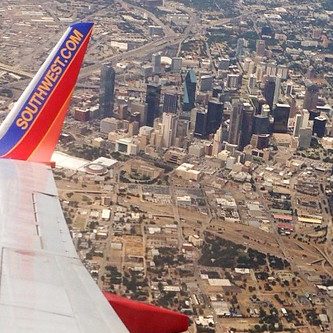
Photo: “From yesterday: @southwestair #flight 2500 #DAL-#SAT with #downtown #dallas behind the #winglet. I’m doing the opposite route later today heading back to #KC for the night before another trip. #latergram #swapic #city #texas #plane #airplane #instaplane #” by JL Johnson // User47.com is licensed under CC BY-SA 2.0.

Poems on poets: A.M. Juster, ‘Houseguests’

There’s shouting by the stove (it’s Plath & Hughes)
as Wystan wanders off without his shoes
and Whitman picks the Cheetos off his beard.
The Larkin-Ginsberg chat is getting weird,
for after countless hours they have found
bizarre pornography is common ground.
Old Emily is not
As prim as billed—
When Dylan finds her bra-hooks—
She is thrilled.
Poe strokes his bird; Pound yawps that it’s a pity
Eliot can’t sleep without his kitty.
Rimbaud’s on eBay searching for a zebra
while sneering, “Oui, a cheemp can write vers libre!”
The Doctor’s soggy chickens start to smell
and Stevens has insurance he must sell.
The readings are spectacular, I know,
but is there any way to make them go?

*****

A.M. Juster writes: “This was first published in The Barefoot Muse. It looks like I wrote it in late 2008, it was a fairly prolific period for me and I was a little distracted because I was running the Social Security Administration. (Under his unpoetic name, Michael J. Astrue. – Editor). I don’t remember now the impetus for writing it, but I did enjoy taking these poetry idols off their pedestals and making them more human for a few laughs. This was about the time that I finished my translation of Horace’s Satires in something like 1850 heroic couplets, so I was much more comfortable with the form than I would have been five years before. I think the imitation of Emily Dickinson’s form is an amusing touch for the reader, although it is undetected when I read it because it remains in rhymed iambic pentameter.”

A.M. Juster’s poems and translations have appeared in Poetry, The Paris Review, The Hudson Review and other journals. His tenth book is Wonder and Wrath (Paul Dry Books 2020) and his next book will be a translation of Petrarch’s Canzoniere, which W.W. Norton will release in early 2024. He also overtweets about formal poetry @amjuster.

Photo: “me drunk & chris’_MMVI” by andronicusmax is licensed under CC BY 2.0.

Odd poem: George Simmers on audiences on Alan Bennett’s play on W.H. Auden, ‘On “The Habit of Art”.’

The poet drinks, he stinks, he pees in sinks.
The audience, superior as shrinks,
Appraise a life amusingly in tatters.

How they appreciate a play that flatters
Their minds with chat about artistic matters!
And how much more they savour nods and winks
And saucy homosexual high-jinks!

They go home thinking:
‘Poets? Mad as hatters!
They drink, you know! They stink! They pee in sinks!’

*****

George Simmers writes: “Alan Bennett’s 2009 play The Habit of Art deals with the later life of W.H. Auden, and deals frankly with Auden’s sexual and hygenic peculiarities, as well as giving a sense of the poet’s talent. Looking back on his poem, written soon after seeing a performance at the National Theatre, I was more annoyed by the sniggering audience of London sophisticates than by Bennett’s play, which has interesting things to say about the relationship between poetry and the fallible humans who create it.”

George Simmers used to be a teacher; now he spends much of his time researching literature written during and after the First World War. He has edited Snakeskin since 1995. It is probably the oldest-established poetry zine on the Internet. His work appears in several Potcake Chapbooks, and his recent diverse collection is ‘Old and Bookish’.

https://greatwarfiction.wordpress.com/
http://www.snakeskinpoetry.co.uk/

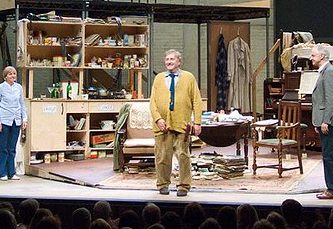
The Habit of Art by Alan Bennett, National Theatre, London” by chrisjohnbeckett is licensed under CC BY-NC-ND 2.0.

Fantasy Analysis: Auden’s ‘Jumbled in the common box’

Jumbled in the common box
Of their dark stupidity,
Orchid, swan, and Caesar lie;
Time that tires of everyone
Has corroded all the locks,
Thrown away the key for fun.

In its cleft the torrent mocks
Prophets who in days gone by
Made a profit on each cry,
Persona grata now with none;
And a jackass language shocks
Poets who can only pun.

Silence settles on the clocks;
Nursing mothers point a sly
Index finger at the sky,
Crimson with the setting sun;
In the valley of the fox
Gleams the barrel of a gun.

Once we could have made the docks,
Now it is too late to fly;
Once too often you and I
Did what we should not have done;
Round the rampant rugged rocks
Rude and ragged rascals run.

In January 1941, W.H. Auden had been living in New York for nearly two years. The Second World War had started, but not yet in the US. Auden had fallen in love with Chester Kallman who was now turning 20 and was too young to want to be sexually faithful; Auden had also returned from atheism to the existential Christianity that is common in the Anglican/Episcopalian church. It was a period of change, backgrounded by the widening war.

Regarding the poem from this time, I choose to imagine Auden rambling, reminiscing, muttering to himself: “Around the rugged rocks the ragged rascal ran… Nice metre as well as alliteration and, for people with difficulty pronouncing their Rs, a twuly tewwible tongue-twister. Rhythmic, memorable. Nonsense; not meaningful, but not meaningless; nonsense and nursery rhymes are right on the border. And it splits in two, you could easily rhyme it: rocks, box, blocks, brocks, cocks, cox, clocks, crocks… ran, Ann, ban, bran, can, clan, cran… or easy to change to run, or runs. A lot of rhymes, anyway. Run them out, see what transpires.

Once we could have made the docks, / Now it is too late to fly; that adds another rhyme, not a problem, maybe a 6-line stanza. Once too often you and I / Did what we should not have done; and into the last two lines, have to fill them out a bit to maintain the metre, keep the alliteration of course: Round the rampant rugged rocks / Rude and ragged rascals run… So that’s all right, that would make an ending.

“Then of course we can have more stanzas leading up to it. Flick a bit of paint at the canvas, see what sort of patterns we can find to elaborate on. Time, decay, trepidation, warnings… out come the words and images around the rhymes, and suddenly it’s all as evocative and semi-coherent as a reading of tarot or yarrow or horoscope. Hm, tarot or yarrow, I hadn’t noticed that before, wonder if I can use that somewhere else…”

(Remember, this is a fantasy analysis, presupposing the poem to have been written with full skill to capture both rhymes and a mood, but without any serious intent beyond that. For a completely different intellectual analysis, you can always try this…)

Photo: “Jumble Box” by .daydreamer. is licensed under CC BY-NC-ND 2.0
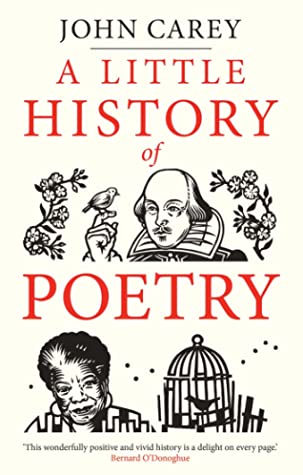
Review: ‘A Little History of Poetry’ by John Carey

A fascinating overview of the history of world poetry with a decidedly Anglo-American slant, very engaging and informative and yet inevitably irritating for wasting space on some aspects while ignoring other favourite poets–depending on the reader’s bias, of course.

Consisting of 40 seven- or eight-page chapters, the book leads with Gilgamesh and information new to me despite my familiarity with the poem; then the Greek and Latin classics, where I am vaguely interested but uninformed; then Anglo-Saxon poetry where I am incited to read more. And so it goes: a bit of this, a bit of that, with a lot of chatty biographical tidbits, clarifying who I want to read more of (Chaucer, Wordsworth, Hardy, the Thirties Poets, the Movement), confirming who is of no interest to me (Spenser, Milton, American Modernists, American Confessional poets). The chapter on Dickinson and Whitman had a very useful perspective; the one on Marianne Moore and Elizabeth Bishop was a waste of space. There seemed less insight in general as we moved into the 20th century, especially regarding American poets.

One thing that surprised me was to find how the hymns quoted in the chapter ‘Communal Poetry’–‘When I survey the wondrous cross’, ‘Rock of ages, cleft for me’, ‘Amazing grace’, ‘Abide with me’–summoned up my decade of boarding school’s daily religion and made for a long meditation on the role of religious poetry in the forced familiarity with meter and rhyme. It almost justifies daily church attendance. But missing from this History is the similar role in other religions: the hymns of Hinduism, the Hebrew chants, the hypnotic rhythm and rhyme of the Quran… all aspects of verse being used to make a message word-for-word memorable, all building the use of poetry.

The other omissions were of English-language poets outside the Anglo(including Irish)-American sphere: I think McCrae is the only Canadian mentioned (for ‘In Flanders Field’), and Claude McKay (who?) and Derek Walcott the only other Commonwealth poets; also missing are modern ballad-writing poets like Bob Dylan; and, my particular peeve, no mention of either e.e. cummings or Gwendolyn Brooks.

I find Brooks and cummings the greatest American poets of the 20th century with the exception of Auden and Eliot (however you like to classify their nationalities). Their omission may reflect ignorance on the part of author John Carey, or they may have been left out as not fitting into his groupings of Modernists and members of the Harlem Renaissance. Whatever the reason, it’s a major flaw… in what is still a highly readable and rereadable history.

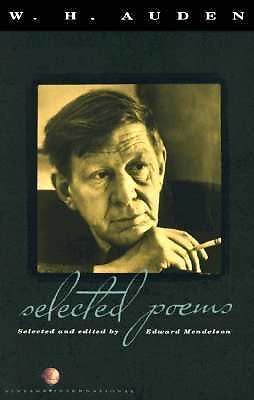
Review: “Selected Poems” by W.H. Auden

Auden

The best of Auden’s poems are so many, so varied, so technically accomplished and so witty that he stands with the greatest poets of the 20th century. My list of favourites includes:

“O where are you going?” said reader to rider
O what is that sound that so thrills the ear
A shilling life will give you all the facts
Look, stranger, at this island now
Miss Gee
As I walked out one evening
In Time of War
Musee des Beaux Arts
In Memory of W.B. Yeats
Law, say the gardeners, is the sun

and what many consider the greatest love-poem of the last 100 years:
“Lay your sleeping head, my love,
Human on my faithless arm”.
There is a universality about Auden’s depiction of relationships, an indeterminate quality that allows his thoughts to be applied to all people. This is in keeping with the fact that he was gay, and writing in a time when homosexuality was illegal. It provides an unexpected strength for his verse.

And yet, and yet… all of those poems listed above were written before he turned 33. He lived to age 66, writing longer and longer works, moving further and further away from traditional verse, and with less of the memorable genius of his youth.

It is therefore somewhat depressing to read these “Selected Poems” because they are set out chronologically, and the writing gets less interesting the further you read. Halfway through the book you run into the poem sequence “The Sea and the Mirror – a commentary on Shakespeare’s The Tempest”, which includes 25 pages of prose crammed with dense imagery and argument. Apparently Auden preferred this prose section, “Caliban to the Audience”, over all his other work. This preference was expressed at the time that he was rewriting the excellent poems of his youth to reflect his newer American, Christian, self-important academic personality. I found it unreadable.

The first edition of “Selected Poems” (selected and edited by Edward Mendelson) contains 100 poems. A more recent edition adds another 20 poems, “broadening its focus to better reflect the enormous wealth of form, rhetoric, tone, and content in Auden’s work. Newly included are such favorites as “Funeral Blues” and other works that represent Auden’s lighter, comic side”.

Unfortunately I only have the 100-poem version. If you buy a copy of this book, make sure it has the 120 poems!