Category Archives: Poetry

Review: ‘A Child’s Introduction to Poetry’ by Michael Driscoll

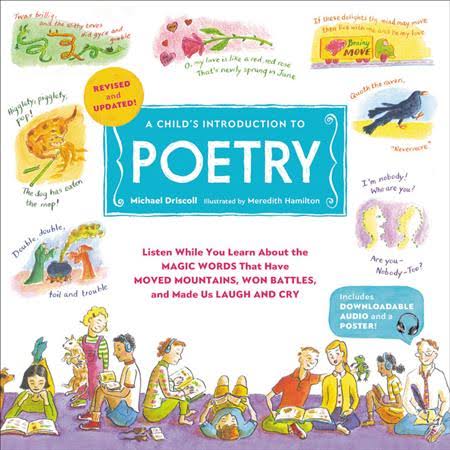
This book, “A Child’s Introduction to Poetry” by Michael Driscoll, illustrated by Meredith Hamilton, is the single best introduction to poetry that I have ever seen. It is part of a series of books aimed at 8 to 10-year-olds, and is divided into two parts: ‘The Rhymes and Their Reasons’, with two to four large pages on topics as diverse as Nonsense Rhymes, The Villanelle, Free Verse and Poems Peculiar; and ‘Poetry’s Greats’ with a couple of pages each on 21 poets such as Homer, Wordsworth, Dickinson, Belloc, Auden, Paz and Angelou. The book is richly illustrated on every page, and is packed with bits of biography, commentary, prosody, explanation and definition. Purely as a book, it is superb.

But wait! There’s more! The original edition came with a CD of all the poems, and the Revised and Updated edition comes with downloadable audio and a poster. These audio aspects are not as brilliant as the book, for two reasons: first, the poems are read “professionally” which unfortunately means without the joy, excitement, teasing, energy or naturalness that I listened for. They are clear, flat and boring, with unnecessarily exaggerated pauses between lines. I listened to the first three poems, and quit. Secondly, the CD version (which is what I have) may have been obsoleted, but the major item of comment in the Amazon reviews is that there are no explanations for downloading the audio, and that it was difficult for reviewers to figure out how to do it.

Ignore the audio, then. If you already have an interest in poetry you will probably do a better job than the unfortunate “professionals” in reading aloud from the book, and your child will have a richer experience anyway from your personal involvement and introduction. The book will soon enough be one for the child to dip into and skip back and forth in, moving from biographies to poems to illustrations to factoids as the mood takes them.

In terms of the variety of poetry–forms, moods, eras, nationalities–I have never seen anything so rich and satisfying for a good young reader as this Introduction. I wish all English-speaking children everywhere could have a copy.

Resources: Formal-friendly magazines for unknown poets

Some of the best-known and longest-established poetry magazines have either changed (often under a new editor) from being receptive to being hostile towards formal verse; others are receptive, but only to already well known poets. So it can be difficult for an unknown formalist to break into publication. For what it’s worth, here is a list of places where I have been able to publish my own uneven and very varied pieces, with some comments about what is appropriate for where.

Alabama Literary Review – US, lyrical, positive; only takes snailmail submissions (unless you have a genuine need for email)
Allegro – UK, contemporary, looking for more formal submissions than they receive
Amsterdam Quarterly – Netherlands, English-language, must address the issue’s theme
Asses of Parnassus – Canada, short, witty, formal poems, snarky is fine, hosted on Tumblr.
Better Than Starbucks – US/Canada, large magazine with many departments including formal; children’s; experimental; etc.
Bewildering Stories – Canada/UK/US, speculative and science fiction pieces
Bosphorus Review of Books – Turkey, English language
Brazen Head – UK, ideas-rich
Chained Muse – US, prefers classical themes
Libretto – Nigeria, prefers African/Afro-American/Afro-European/post-colonial pieces
Light – US, large biannual issue, also the home of weekly topical light verse
Lighten Up Online (LUPO) – UK, light formal verse, quarterly
Lyric – US, “Founded in 1921, The Lyric is the oldest magazine in North America in continuous publication devoted to traditional poetry.” Lyrical, positive… flowers and countryside.
Metverse Muse – India, publishes simple traditional verse. No website. The email for editor Dr. Tulsi is metverse_muse@yahoo.com
Obsessed With Pipework – UK, “strangeness and charm… prefers dreams to deathbeds”
Orchards Poetry Journal – US, more rural than urban
Penwood Review – US, religious streak
Poetry Porch – US, lyrical
Pulsebeat Poetry Journal – US, new; more urban than rural
Rat’s Ass Review – US, irreligious streak; whatever appeals to the editor, including things you can’t get published elsewhere.
Road Not Taken: The Journal of Formal Poetry – US, hard to find online because of its name, but a good small publication for formal and semi-formal verse.
Shot Glass Journal – US, max 16 lines, lots of international poets
Snakeskin – UK, probably the longest-established poetry zine in the world; has no interest in submission bios, only in the poems; likes work that begins light and becomes heavier.
Star*Line – US, Science Fiction poetry
The HyperTexts (THT) – US, an enormous assemblage of verse from all times and places; the editor’s preference for formal and leftist verse doesn’t rule out Walt Whitman or Ronald Reagan! The works are mostly republications, but if you have a body of strong work the editor may be interested in creating a page for you.
Verse-Virtual – US, a monthly publication for a caring community of poets
Visions International – US – I’m not sure what the status is of this magazine these days, or who is editing it…

This list doesn’t include magazines not relevant for me (like Mezzo Cammin: An Online Journal of Formalist Poetry by Women), or that moved away from formalism (like Ambit), or that have unfortunately folded (14 by 14, The Rotary Dial, Unsplendid). And there must be a lot more worthy magazines that I simply haven’t run across – I would be very glad of your recommendations about others to list.

And of course, as ever, don’t just fire off a handful of poems at random – read some samples online, determine the magazine’s orientation and moods, check whether the editor wants anything particular, note whether they love or loathe attachments, etc…

Good luck!

Magazines” by theseanster93 is marked with CC BY-SA 2.0.

Experimental Poem: ‘Pointillist’

(Note: this poem is so named because if you look at it closely you may not find as much meaning as if you step back, let it flow past you, and see an outline of a story.)

Awake
Anew
Awhile
Askew;
Afoot
Among
Amass
Along;
Abet
Aback
Ado
Alack;
Alas!

Abroad
Again
Astride
Amain;
Atop
Alight
Aglow
Afright;
Afar
Ahead
Aloft
Abed;
Alone!

Aware
Amused
Affair
Accused;
Away
Aboard
Affray
Abhorred;
Aground
Alive
Abound
Arrive;
Ahoy!

Array
Await
Assay
Abate;
Appraise
Accord
Amaze
Adored;
Apprise
Appoint
Arise
Anoint;
Adieu!

This poem started (if I remember correctly) as four or five of the early words coming into my head with a sense of rhyme and rhythm when I was on the point of falling asleep. I roused myself enough to write the words down, doing what I consider an essential part of the communication I long for with my unconscious, my Muse–acknowledge the Muse by writing whatever is offered to you, whether or not it is complete or makes sense.

The next day I wrote more, keeping to iambic monometer and words of Anglo-Saxon derivation beginning with A. As a hint of a story took shape, I kept writing. After the first two stanzas I moved over into words of Latin derivation and went for more intense rhyme. Long lists of words were involved. After four days I had the whole poem.

As for the story itself… I see a hero setting out, failing, trying again, under threat, escaping by boat, shipwrecked, and finally rewarded. Are they male or female, and of what age? Did they have a love affair? Did they end up at home or in foreign lands? If you look at the poem sideways you may find an answer that suits you. Or (of course) not.

‘Pointillist’ was the second of five poems recently published in the Poetry section of The Brazen Head.

Pointillistically abstracted” by readerwalker is marked with CC BY-NC-SA 2.0.

Potcake Poet’s Choice: Max Gutmann, ‘Raindroppings’

Can anyone make out
The quality inherent
In being with an umbrella, that makes people without
Completely transparent?

On the rainiest days,
In the hardest of showers,
People with umbrellas courteously step out of other umbrella’d people’s ways
Right into ours.

Or, if as it starts
To really pour, ya
Dash for the shelter of a little awning, sure as rain’s wet someone with an umbrella darts
Under it before ya.

And you look at the fella
As you stand in the steady
Downpour, but he ain’t gonna budge, ’cause, as any one-eyed idiot could plainly see, his umbrella
Is wet enough already.

Beyond disputation,
We already hear a lot
About the many forms of indiscriminate discrimination
Our world has got.

Still, I wish some teller’d
Deign to tell us
The reasons for the way the umbrellered
Treat the umbrell’less.

Max Gutmann writes: “In ‘Raindroppings,’ a line of OgdenNashian length is part of each otherwise regularly metered quatrain. These lines get longer and longer, and then shorter and shorter. I hope this helps the poem feel both sillily loose, and formally structured: the topic, though it may sound invented, is an actual aspect of human nature, trivial in itself but reflective of more serious attitudes.”

Max Gutmann has worked as, among other things, a stage manager, a journalist, a teacher, an editor, a clerk, a factory worker, a community service officer, the business manager of an improv troupe, and a performer in a Daffy Duck costume. Occasionally, he has even earned money writing plays and poems.

linkmaxgutmann.com

‘Raindroppings’ was first published in Light Quarterly

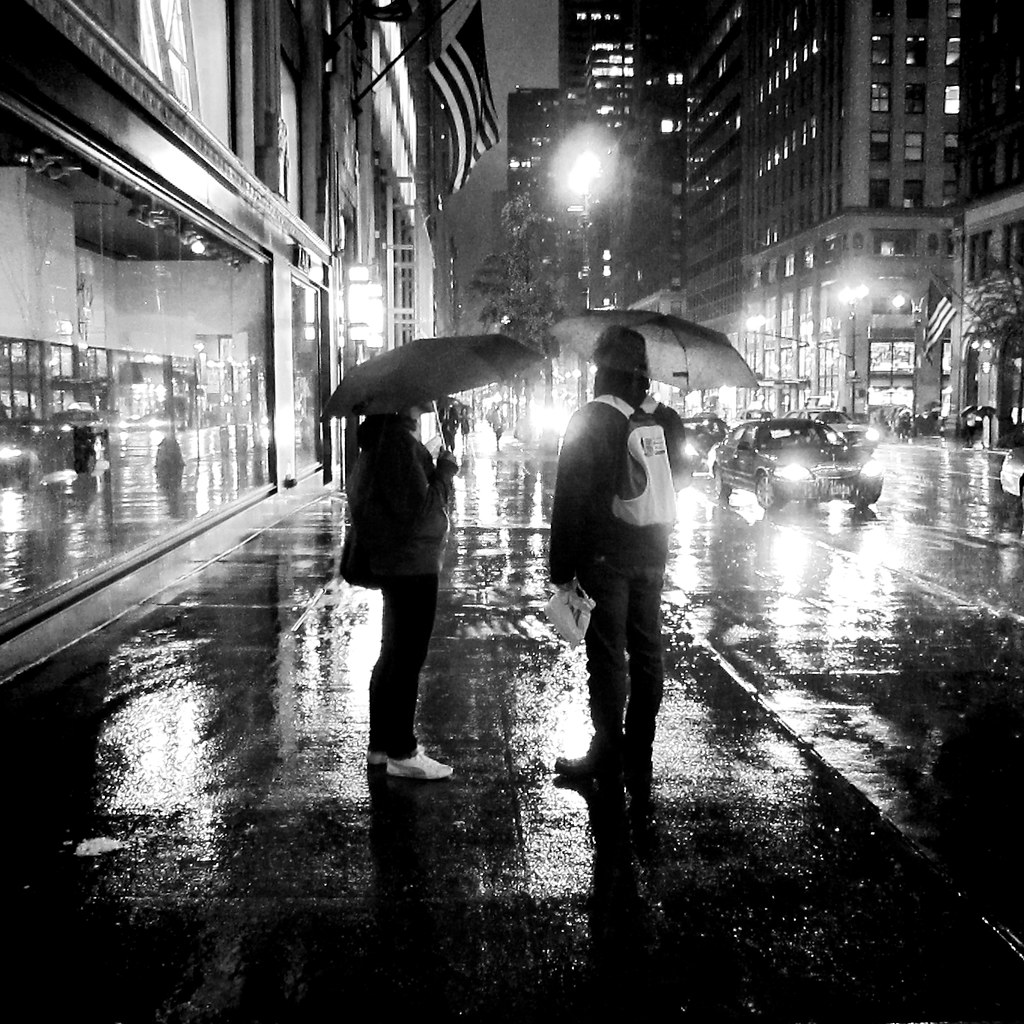
Photo: “Downpour” by roeyahram is marked with CC BY-NC-ND 2.0.

Odd poem: Edward Lear, ‘Imitation of the Olden Poets’

Time is a taper waning fast!
Use it, man, well whilst it doth last:
Lest burning downwards it consume away,
Before thou hast commenced the labour of the day.

Time is a pardon of a goodly soil!
Plenty shall crown thine honest toil:
But if uncultivated, rankest weeds
Shall choke the efforts of the rising seeds.

Time is a leasehold of uncertain date!
Granted to thee by everlasting fate.
Neglect not thou, ere thy short term expire,
To save thy soul from ever-burning fire.

This poem is a gorgeous piece of deliberately bad verse. Edward Lear had a wonderful ear for rhythm, and this appalling piece is a great jab at poets who, even to a Victorian like Lear, were long out of date: meaning, syntax and prosody are all garbled, wrapping around bland but unclear moralising exhortations.

The first line of each stanza ends with an exclamation mark even if, as in verse three, it is in the middle of a sentence.

The very first line has four simple feet in iambic tetrameter, eight syllables.
The second line also has eight syllables but manages to make the rhythm stumble through poor phrasing.
The third line has ten syllables; it can be read as iambic pentameter, but the previous lines encourage an attempt to keep to four slightly crowded feet.
The fourth line goes to twelve syllables, at which point the prosody is collapsing towards Lear’s younger contemporary, William McGonagall–you either cram everything into four feet, or let the stanza dribble out in too many iambics.

The second stanza begins “Time is a pardon of a goodly soil!” Very affirmative, but what does it mean? And are we back to pentameters now? It’s not clear–the second line is definitely tetrameter… so how to read the third and fourth lines?

The last stanza is pure iambic pentameter. The chaos is in the confused understanding of time, “a leasehold of uncertain date”, but is somehow part of “everlasting fate”. Similarly “thy short term” is shadowed by “ever-burning fire”. On balance, time appears to be represented as infinite–events are portrayed as everlasting–but time is also called “a leasehold of uncertain date”; that phrase is merely a poor expression that confuses Time with the time of a human’s life.

The poem has been set to music by Bertram Wooster with a Betty Boop video. They credit Lear, and the poem shows up in PoemHunter and a couple of other places… and I want to believe it is Lear… but I’d be happier if I could find more about the origin of the piece.

Candle” by kkalyan is marked with CC BY-SA 2.0.

Sonnet: ‘We Know We Will Be Dead’

We know we will be dead, who are alive.
But should some element of us survive –
fragment of consciousness or memory –
what value could it have? What should it be
that the whole universe might benefit?
The atom matters – what’s not made of it?
And we’re not large – not like a conscious star
(if time will let us all evolve that far).
You’re not much different in real magnitude
from an ant crushed for going for your food,
a gnat rubbed out, its tiny consciousness
a dot… but does it build the universe?
If that gnat can’t, I don’t see how you can:
there’s not much difference between gnat and man.

Does a poem of 14 lines, rhymed in pairs, count as a sonnet? Perhaps, but it doesn’t feel quite right. Petrarchan and Shakespearian sonnet structures, with more complex structures of rhyme, produce a much greater impact with the final line–a sense of revelation, inevitability, an impression of absolute truth–purely by the successful rounding out of the pattern. I like this poem’s ending couplet… but it would be stronger if the previous 12 lines were better structured.

‘We Know We Will Be Dead’ was published in the most recent Allegro, edited by British poet Sally Long.

Hubble’s colourful view of the Universe” by Hubble Space Telescope / ESA is marked with CC BY 2.0.

Poem: ‘The Entertainer’s Servant’

See the violinist
blocking, enchanting passing crowds with his bowing
and watch some ragged child, the very thinnest,
with held-out cap through those crowds coming and going.

Or the organ grinder
haunting the emotions and memories of all,
his songs life’s bittersweetness’s reminder….
but it’s his well-dressed monkey makes the coins fall.

And more: the child’s home work handed in
though mostly done by mummy;
and more: the wisecracks bandied in,
seemingly by the ventriloquist’s dummy…

This is the poet’s story:
somewhere some unseen Maker
wrings from a wild wand
magnificence, sadness, glory…
while the mere poet capers,
postures, and holds out a hand.

All of which is merely a complicated rumination on not knowing where poetry comes from. It feels like the initial impulse and the key words come from outside, from some muse or god of poetry… and the poet is merely a puppet: observed, apparently autonomous, but not the true artist.

This poem was published in The Road Not Taken: The Journal of Formal Poetry. It may not be as formal as you would expect, but it has a steady structure complete with rhymes. I make no apologies for its inadequacies – the poem itself allows me to blame the unknown puppeteer.

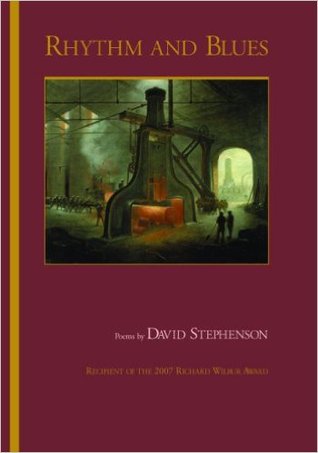
Review: ‘Rhythm and Blues’ by David Stephenson

David Stephenson’s ‘Rhythm and Blues’ was the 2007 Richard Wilbur Award winner, and contains some excellent poems. Its back-cover blurbs are accurate–as Kim Bridgford states, the collection has “wisdom, a plain-spoken, convincing style, and a sense of irony… all the time with impressive technical skill.”

Several of the sonnets are excellent: ‘Pilate’ meditates on the harshness of the law,
But why waste breath? In six months, who will mourn
This insect, or recall that he was born?

The ‘Geologist’ speaks of his passion for the history of rocks, ending:
The present is a world of dirt and sand
And people–they of the immortal soul–
Whom I do not pretend to understand,
Though I admire them in their long-term role
As precursors to limestone, chalk, and coal.

And beyond the sonnets are villanelles, and longer blank verse monologues in the voices of a toll collector, a housebreaker, a corporate hatchet man, and so on; and poems with various structures of stanza.

But there is a problem: the ruthless, relentless, metronomic use of iambics. The entire collection is in either iambic pentameter or iambic tetrameter. In general, the shorter pieces are good; the longer pieces are thematically interesting, but I find pages of blank verse unappealing. Stephenson can obviously think easily in iambic pentameter; but that skill tends towards blather. As the book title suggests, there is rhythm; but with insufficient variety for the claim of music.

But maybe this is expecting too much. Stephenson is a committed formalist, to the extent of having started his own Pulsebeat Poetry Journal for formal verse. His sonnets in particular are very good. And the book is highly readable and rereadable–though in small doses, not straight through in one go.

And there is actually one break in the unremitting use of iambics, in the shortest and most whimsical poem in the book–and for all those reasons perhaps my favourite. It is ‘To a Garbage Truck’:

Stop for me, romantic sloop,
When all your cargo is on board
And your ride low upon the waves,
For I would cast my lot with yours

And put forth on the open street
En route to some strange orient
Full of exotic ports of call
Beyond the gray horizon.

Review: ‘Extreme Formal Poems – Contemporary Poets’, ed. Beth Houston

Beth Houston has compiled an excellent anthology of formal verse (i.e. poems that use traditional structures of exact rhyme and tightly controlled meter; typically in familiar forms like the sonnet, villanelle, ballade, etc, but sometimes in a nonce form, a form specially created by the poet for that particular poem, and then rigorously maintained for all its stanzas). What is unusual in this day and age is these are all contemporary poets, for the most part American, though with half-a-dozen who at least started out in the UK. (In the interests of disclosure: two of my poems are in this book, and I am one of the non-Americans.)

The poems range in a variety of moods through a whole host of modern topics. With examples from first stanzas only, we have a flippant take on nature:

The female fly is nearly chaste.
She hasn’t any time to waste;
Her life’s a span of weeks, not months,
And so she copulates just once.

– Max Gutmann, The Fly

a rueful look at the military:

You’ve made us proud–the prosperous and free.
It doesn’t matter that a GED
was all the education you could get,
or that you signed up on a drunken bet.

– Barbara Loots, Thank You For Your Service

lighthearted memories:

In sloppy FM waves nostalgia rolls:
I wanna hold! You are the sunshine of!
Each oldie on the golden dial extols
Your soul, your body’s curves, your rockin’ love.

– Chris O’Carroll, Classic Hits

Villon-reflecting reflections on time and mortality:

Where are the flushed and frantic teens,
The hormones’ fevered ebbs and flows?

(Fire buckets, water, verbal screens.)
The girls–good grief!–that parents chose
And others–how the mind’s eye glows!
Who floated inches off the floor?

(Flout censor’s ruling–fish-net hose.)
With dodo, great auk, dinosaur.
– Jerome Betts, Ballade of Inevitable Extinction

pastoral descriptions of nature:

On moorland, on meadow, from dark sky I’m falling,
through peat, into pavement, I’m seeping, I’m sinking.
Above me the crows and the curlews are calling,
and of me the hares and the horses are drinking.

– Tim Taylor, Water of Holme

witty observations flavored with wordplay and interior rhymes:

I’m far from young enough to know it all.
With age my inner sage has paled and died.
My dimmer, dumber cerebellum’s fall
Leaves ever-clever youth aloof and snide.

– Susan Jarvis Bryant, I’m Far From Young Enough

But what you don’t get from the openings to the poems is that most of them pack a punch at the end. There will be a twist to the story, or a summation that recasts everything in a different light, or a straight-out contradiction of what the reader was being led to expect. The poems may be extremely formal. They are also extremely good.

The only regret I have is that some of the very best contemporary formal poets are missing: both the publicity-prominent (e.g. A.E. Stallings, Amit Majmudar, Gerry Cambridge, Wendy Cope) and the more reclusive (Pino Coluccio, Rose Kelleher, Marcus Bales). But happily there are still 37 excellent and prize-winning poets in Beth Houston’s well-selected anthology. So the good news is that a great many superb formalists are writing today, and–believe it or not–this looks like a Golden Age for formal verse. And ‘Extreme Formal Poems‘ is a very good manifestation of it.

Poem on poetry: ‘Diatribe Against Unversed Poets’

Ignoring clockwork towns and fertile farms
Tied to the sun-swing as the seas to moon,
They searched for verse in deserts without rhyme,
Lifted erratic rocks nonrhythmically
In search of poetry, then through the slough
Of their emotions hunted for a trail:

“The scent is cold. Its Spirit must have fled;
The body of its work, though dead,
Has been translated to some higher plane.
Look how the world’s translated verse
Comes to us plain—why can’t we emulate?
Then if the words themselves are unimportant,
If poetry in essence is idea,
And song is wrong,
Rhyme a superfluous flamboyance
(Like colour in Van Gogh),
Rhythm a distraction to the memoring mind,
Then we determine poetry’s true form is mime!”

While in the air the deafening blare
Confounds their silence everywhere:
Before our hearts began to beat
We were conceived in rhythmic heat;
So, billions strong, we sing along
For all the time, in time, our time, the song
Goes rocking on in rhythmic rhyme. Rock on!

“Unversed” means “not experienced, skilled, or knowledgeable”. Poetry takes different forms in different languages, but the forms all have the same desirable outcome: to make it easier to memorise and recite word-for-word. Alliteration, assonance, rhyme, metre – these are all useful tools for achieving this, along with less tangible tools such as fresh or startling imagery. Metre/beat/rhythm is viscerally important to us, because the mother’s heartbeat is the background to sensory development in the womb, and our own heartbeat and breathing rhythms continue throughout life. As humans we drum, we dance, we sing, just as we walk and run rhythmically, tap our fingers rhythmically when we are bored, teach small children to clap and sing, teach older children clapping and skipping games. Rhythm is built into us from before birth.

Rhythmic poetry didn’t die when it almost stopped being publishable. It just went into folk songs, blues, rock, country-and-western, musicals, rap, hip hop… Popular music let teenagers and adults continue to thrive with what they were not given by schools: rhythm and rhyme. This drive to make words memorable and recitable is part of who we humans are. So schools do best when they leaven “creative self-expression” with getting kids to learn things by heart, and getting them to pay attention to the qualities that make it easy to memorise and recite.

Photo: “Lost in desert” by Rojs Rozentāls is licensed under CC BY-SA 2.0