Category Archives: Poetry

Sonnet: ‘The Four Duties’

First, to your family, the spouse you chose,
children you gained who themselves had no choice;
to give a space wherein to find their voice
with safety, happiness, as each one grows.

To self: to keep yourself happy and whole,
free of both physical and mental pain
through yoga, exercise, good stress, good strain,
a moderate diet, peaceful self-control.

To all humanity: using some gift,
some insight, skill set, asset, useful tool
to better people’s lives through work or school,
some mast and sail or oar for those adrift.

And to the Muse that underlies the world:
express yourself—banners are useless furled.

This sonnet feels a little uncomfortably preachy, pretentious, self-righteous, and generally out of touch with the flippant persona I prefer. But it’s what I actually believe deep down. To me, it’s self-evident in terms not just of personal morality, but also as regards what makes a person feel fulfilled and happy. And the last bit is important: everyone has a creative aspect, and everyone has a Muse. The Muse is just part of how the world works, perhaps how your creative subconscious communicates with your conscious mind, perhaps how God or gods or angels communicate with you… it’s a little mysterious, but it’s part of your reality. And the correct thing to do is to express yourself creatively when you have an idea for it: that turns on the tap for further creativity. Not doing anything with the creative idea you get turns the tap off, and reduces future creativity. You need to honour the Muse when he/she/it appears.

‘The Four Duties’ has just been published in the Winter 2020 edition of The Orchards magazine of formal poetry. A few days late for that year, perhaps, but I just saw a weather forecast for “six more weeks of 2020”. Indeed, a sense of calm and responsibility is what the world needs, now and always.

Photo: “Her duty” by Go-tea 郭天 is licensed under CC BY 2.0

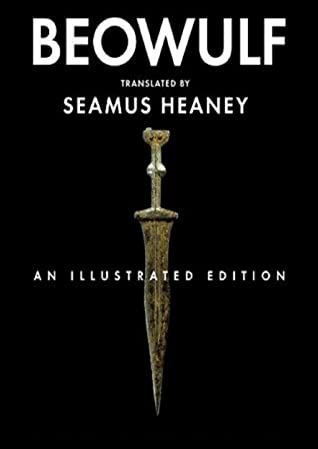
Review: ‘Beowulf’, translated by Seamus Heaney

I can’t imagine a better version of Beowulf than this brilliant rendition into appropriately alliterative verse by Nobel prizewinning poet Seamus Heaney, with full colour photographs on alternating pages of the massive 3,000-line poem. It has the rhythm of the original, it is essentially faithful to the original, and the illustrations (even more than the notes) give a sense of landscape, ships, weapons, jewelry, halls, etc that helps bring the entire story to life.

The story itself is in three parts: Beowulf travels from what is now Sweden to help the king of the Danes against a monster, Grendel, that is attacking and devouring his people, and Beowulf defeats Grendel by tearing an arm off. Gifts are given, and everyone relaxes. However Grendel’s mother comes the next night seeking revenge, and Beowulf goes after her the next day, diving into her murky pool and killing her with a sword. More gifts are given, and Beowulf returns home. Fifty years later Beowulf, now himself a king, goes to fight a dragon that has been roused and is pillaging the countryside; he fights the dragon and they kill each other; the dragon’s hoard is buried with Beowulf in the tomb that is built for him.

The historical persons in the tale, and the Danish king’s hall at Lejre, date to the mid-6th century. Then and for the next 500 years Scandinavia was innocent of Christianity, and the warrior society and the constant blood-feuds are a part of the story. But the poem as we have it have it was apparently composed in the 9th century in Christiansed England, and the will of a very Old Testament God is referenced throughout as overruling the abilities of humans. This feels like no more than an unimportant veneer of a modern religion over a Scandinavian sense of weird, wyrd, or destiny.

The poem is important as the beginning of English poetry, and its place and relevance is heightened by Heaney’s long and delightful introduction in which he details how he, as a Northern Ireland Catholic who felt deprived of his Gaelic birthright, came to fuse Gaelic, Old English and modern English into a sense of community and identity.

So because of the Introduction and the photos and illustrations as well as the superbly rhythmic and semi-alliterative translation, this is the Beowulf if you want a Beowulf!

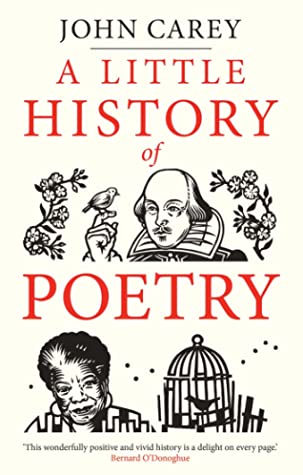
Review: ‘A Little History of Poetry’ by John Carey

A fascinating overview of the history of world poetry with a decidedly Anglo-American slant, very engaging and informative and yet inevitably irritating for wasting space on some aspects while ignoring other favourite poets–depending on the reader’s bias, of course.

Consisting of 40 seven- or eight-page chapters, the book leads with Gilgamesh and information new to me despite my familiarity with the poem; then the Greek and Latin classics, where I am vaguely interested but uninformed; then Anglo-Saxon poetry where I am incited to read more. And so it goes: a bit of this, a bit of that, with a lot of chatty biographical tidbits, clarifying who I want to read more of (Chaucer, Wordsworth, Hardy, the Thirties Poets, the Movement), confirming who is of no interest to me (Spenser, Milton, American Modernists, American Confessional poets). The chapter on Dickinson and Whitman had a very useful perspective; the one on Marianne Moore and Elizabeth Bishop was a waste of space. There seemed less insight in general as we moved into the 20th century, especially regarding American poets.

One thing that surprised me was to find how the hymns quoted in the chapter ‘Communal Poetry’–‘When I survey the wondrous cross’, ‘Rock of ages, cleft for me’, ‘Amazing grace’, ‘Abide with me’–summoned up my decade of boarding school’s daily religion and made for a long meditation on the role of religious poetry in the forced familiarity with meter and rhyme. It almost justifies daily church attendance. But missing from this History is the similar role in other religions: the hymns of Hinduism, the Hebrew chants, the hypnotic rhythm and rhyme of the Quran… all aspects of verse being used to make a message word-for-word memorable, all building the use of poetry.

The other omissions were of English-language poets outside the Anglo(including Irish)-American sphere: I think McCrae is the only Canadian mentioned (for ‘In Flanders Field’), and Claude McKay (who?) and Derek Walcott the only other Commonwealth poets; also missing are modern ballad-writing poets like Bob Dylan; and, my particular peeve, no mention of either e.e. cummings or Gwendolyn Brooks.

I find Brooks and cummings the greatest American poets of the 20th century with the exception of Auden and Eliot (however you like to classify their nationalities). Their omission may reflect ignorance on the part of author John Carey, or they may have been left out as not fitting into his groupings of Modernists and members of the Harlem Renaissance. Whatever the reason, it’s a major flaw… in what is still a highly readable and rereadable history.

Sonnet: ‘Where Are The Lightning Bolts’

Where are the lightning bolts of poetry?
The rolls of thunder and the shattered oaks?
Where, beyond anger, is the ecstasy?
There must be more than parodies, kitsch, jokes–
Elvis-on-velvet, kittens in a room,
jibes at the Lords, the House, the Holy See,
unmetered waffling on a flower in bloom…
Come now, tap Earth’s potential energy!

Our planet on which tens of millions die
from some war, ’flu, government famine, plague–
we pillage land and sea, yet learn to fly
while stories, music, art, reshape the vague
into sublime, emotional or vatic…
Humans can’t last – so be brief, be ecstatic!

Here we are, putting the chaos of 2020 behind us, moving optimistically into the forever-changed and forever-changing future. The storm gods appear to rule our lives: our ape cousins respond in their way, and we should respond to the bigger forces we feel with the wider range of creative outlets that we have–dance, poetry and ecstasy are all appropriate!

This sonnet was first published in The Orchards Poetry Journal, edited by Karen Kelsay Davies who also heads up the four imprints of Kelsay Books. Technically it’s a Shakespearean sonnet by the rhyme scheme, but there is no particular significance in that. Sonnets of all kinds share the compression to 14 lines, and the volta, the redirection of discussion after the halfway mark, and, typically, the sonorous rhetoric of the iambic pentameter. But the driving need of the argument and the near inevitability of the best words will tend to move the rhyme scheme into one form or another. It is better to say powerfully what the poem demands, rather than to weaken the words by trying to strengthen a preconceived rhyme scheme. As elsewhere, “Go with the flow” has a logic to it here.

Photo: “Lightning Bolt Over Atlantic Ocean from Jupiter Coast” by Captain Kimo is licensed under CC BY-NC-ND 2.0

Teaching ESL with Songs and Poems

Babies learn by play and imitation. Children learn by play and imitation. There is no reason this isn’t the easiest way for adults to learn, as well (and I speak as someone who has made a successful career of using board games to teach business finance rapidly and enjoyably).

The imitation of language, with a baby learning to speak, is enhanced by repetition–not just simple sentences and phrases used again and again, but also lullabyes and nursery rhymes. The advantages to songs and poems are that they are engaging to the ear (even if the words are not understood); that they are repeated virtually identically each time the same person sings or recites them; that the repetition and music, the rhythm and rhyme, make it easy to learn; learning then moves from passive (understanding) vocabulary to active (speaking) vocabulary; and the word-for-word learning teaches the structure of the language, the syntax, the grammar, as well as basic vocabulary and playful other words.

The principles are no different for someone learning a second language, whether as a child or an adult. To make the process engaging, to develop active use of the language with a confident vocabulary and grammar, there is nothing better for the beginner than songs and poems. Recorded music is fine–then the repetition will always be exact, and learning to sing simple songs (The Beatles’ ‘Hello Goodbye’ comes to mind) will contribute to developing a native speaker’s accent. With ESL–English as a Second Language–you may need to decide if you want the Queen’s English, or Liverpool, or Nashville, or what.

But singing isn’t always a practical solution. In that case, look at the resources developed for ESL teachers. Here is a webpage developed by the British Council and the BBC. And here for teens and adults is an excellent website with ‘Popular Poems to Teach‘. Note that most of the poems (though not all) whether British or American are using rhyme and metre. And this, again, is because those factors make it easier to learn things by heart–and that is what songs and poems will achieve: learning not just words and rules, but rather entire sentences with their grammar and vocabulary, learnt by singing or reciting, far more enjoyably than by studying lists and charts.

And the advantage is universal. Songs and poetry are part of the human experience, whether you come from China, India, Saudi Arabia, Nigeria or Brazil. Learning to sing or recite in English is not to start again from scratch, but to enjoyably refresh a childhood experience, a skill that has already been mastered.

Photo: “Wittenberg International Student Party” by Matt Cline is licensed under CC BY-NC-ND 2.0

Poem: ‘Humankind at Dusk’

It’s in your newsfeed update every day:
The AI obsolescence on its way,
Replacing all tasks, everything we do.
There’ll be no need for people. That means you.
How much is merely existential dread
And how much knowledge of a road ahead:
Unlit, black ice, and your tires have no tread?

With the world stage held by strutters
While the UN talks and mutters.
They’re all out of date tut-tutters.
People in the street
Stand there angry, with lips pursed,
Feeling they’ve been conned, coerced,
Life has gone from best to worst.
Blame the rich elite.

Man, man, think fast:
With the AI racing
And our genes debasing,
Basic humans’ place in
Life won’t last.

Warnings now the TV utters:
Hurricane! But we’ve no shutters,
Power is out, the candle gutters,
Roofs are blown away.
Thrown into the storm head-first
No response can be rehearsed,
Save yourself though you be cursed:
Everything’s in play.

Man, man, think fast:
With the Hive replacing
Every human trace in
Life, be self-effacing
Or be past.

The rest ride the AI-bombs down the sky,
Waving their Stetsons: “We’re all going to die!”
Life always moves on from the old to new.
There’ll be no need for people. That means you.

‘Humankind at Dusk’ was originally published in the Speculative Fiction & Verse zine Bewildering Stories. It reflects my serious concern that we have no idea where we’re going as a species, with everything from genetic modification to brain implants now becoming a reality. Not that I object to it, any more than I object to hurricanes or earthquakes; they’re all part of the nature of things. As humans, we tinker, experiment, explore, run into problems, seek solutions, create all kinds of new problems, and so on. That’s just the way it is.

Technically, I was trying to replicate the nonce structure of a much earlier poem I wrote, ‘Camelot at Dusk‘, to see if this was a form that I could use when trying to create a sense of urgency and disaster bracketed within more reflective and dispassionate statements. So the opening and closing stanzas are in that nice and boring, meditative iambic pentameter; while the middle pieces switch back and forth between two other forms, with shorter, choppier lines and more repetitive rhyme. I created the form to meet the needs of the earlier poem, where I think it worked very well. I’m still (years later) pondering whether it was appropriate to try to reuse the form for this piece. I think I like it, but I’m not entirely sure.

Photo: “silence” by Cornelia Kopp is licensed under CC BY-ND 2.0

Odd Poems: Oxbridge rivalry

The King, observing with judicious eyes
The state of both his universities,
To Oxford sent a troop of horse, and why?
That learned body wanted loyalty;
To Cambridge books, as very well discerning
How much that loyal body wanted learning.

This poem was written by Joseph Trapp in response to events in England in 1714. King George I, to celebrate his coronation, purchased the entire library of the recently deceased bibliophile Bishop of Ely and donated it to Cambridge University, more than tripling the number of books in the university library. Meanwhile Oxford had been having one of its frequent periods of disorder, and the King had had to send in troops to restore calm.

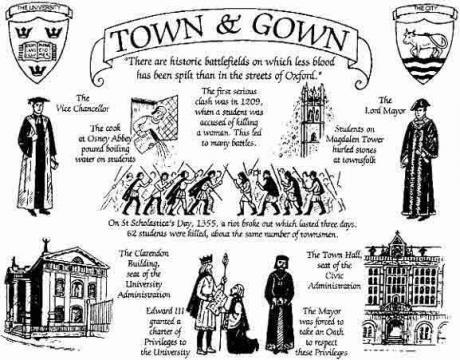
Oxford has a long history of riots, beginning in 1209 with “the hanging of the clerks”. In his 1220s history of England, Roger of Wendover wrote:

“About this time, a certain clerk engaged in the liberal arts at Oxford killed a certain woman by accident and when he found that she was dead he decided to flee.

“But when the mayor of the city and many others who had gathered found the dead woman they began to search for the killer in his house which he had rented together with three of his fellow clerks.

“Not finding the man accused of the deed they seized his three fellow clerks who said they were wholly ignorant of the murder and threw them into prison; then a few days later they were, by order of King John, in contempt of the rights of the church, taken outside the city and hanged.

“When the deed had been done, both masters and pupils, to the number of three thousand clerks, left Oxford so that not one remained out of the whole university; they left Oxford empty, some engaging in liberal studies at Cambridge and some at Reading.”

In effect, Cambridge University was founded by refugee scholars from Oxford–though there is some dispute about the actual timing and the numbers. Then the Pope got involved as part of his disputes with King John, and sent a Papal Legate who, among other things, imposed a payment by the town of Oxford to its University of 52 shillings per year in perpetuity.

The disputes between Town and Gown have continued for centuries, the most severe being the St Scholastica Day riot of 1355. This began with two students complaining about the quality of wine in a pub and ended three days later with 63 University people dead, as well as 30 people from the town and surrounding countryside. And you can read a 1990s anarchist analysis of the continuing conflict in our own time here.

But let’s go back to 1714. George I had been brought in from Hanover to be King with the support of the Whig party; their opposition, the Tories, were on uncertain ground as many of them supported the rival Stuart claim to the throne. George therefore looked favourably on Cambridge with its Whig establishment, while Oxford was a Tory stronghold. Hence the response to Joseph Trapp’s poem by William Browne:

The King to Oxford sent a troop of horse,
For Tories own no argument but force:
With equal skill to Cambridge books he sent,
For Whigs admit no force but argument.

And the rivalry between Oxford and Cambridge continues to this day.

Poem: ‘Hobo’

Come you young gunsel and sit by my fire of old skids.
They don’t like you in school, not the teachers and not other kids.
You’re different, I know it, you’re wise in that body of yours
that has grown past their rules and your parents’ commandments and chores.
Have a smoke, have a drink, you can tell me of pills that are new.
Here you’re safe in the open, I’m staying a night, maybe two.
We can share all you want, for the sadness you know I have known,
and the paths that you fear are the strictures that I have outgrown
and the dreams in your mind I now live on the paths that I roam,
for the life that I live is a life where the world is my home.
So go home, go to school, and come back in the evening again.
I’ll be here for a while, until I get on the next train
and you’ll stay, more mature, and experienced in a new world –
or you’ll come on that train, and you’ll see the whole country unfurled –
and you’ll end up like me, and your friends will be such as you were.

This poem was originally published in Rat’s Ass Review, a long string of poems both formal and free, ordered alphabetically by author. As suggested by its name, the magazine’s editors don’t give a rat’s ass for anyone’s opinions or objections, they publish whatever appeals to them. You will find a random mix of work, much of it edgy, much of it about sex and love and death.

I don’t think of myself as a hobo–although, yes, I have jumped a freight train as part of my hitchhiking 25,000 miles on four continents, back before I became a respectable management consultant… But I have great affection for W.H. Davies, a fine nature poet and the author of the superb ‘Autobiography of a Super-Tramp‘.

‘Hobo’ has elements of anti-establishment and counter-culture; and they in turn are part of the human social animal’s constant dialogue between alienation and the search for community. Or, say, about wanting to be free but still have friends. Technically it is written in anapaestic pentameter–each line having five feet of da-da-DUM (with casual exceptions, of course). I don’t have a strong sense of this being the most appropriate metre for this piece, but it feels conversational and flowing. It’s comparatively unusual for me, I normally write in iambics. But the form of a poem is determined for me by the first phrases that occur to me, and that is presumably what happened here.

Photo: “Hobo sitting on a fence, ca.1920 (CHS-1428)” by  is licensed under CC BY 2.0

Political poem: Hilaire Belloc’s epitaph on a politician

Here richly, with ridiculous display,
The Politician’s corpse was laid away.
While all of his acquaintance sneered and slanged
I wept: for I had longed to see him hanged.

The US and UK have been so polarised for the past several years that it seems everyone has a politician they would like to see executed–or jailed at the very least. But this is neither a recent phenomenon nor a merely Anglo-American one. All round the world notorious pillagers of their countries go to the grave with great pomp, while most of their countrymen and -women are simply glad that they are finally going.

This sarcastic little poem by Anglo-French writer Hilaire Belloc suggests two things: that all successful political leaders are loathed by a large percentage of the population; and that to make your sarcastic comment truly memorable if it is more than five or six words long, you do well to put it in verse. The rhyme and meter not only make the words easier to remember, they also lend a magical impression of inevitability and authenticity to the idea expressed. Well-constructed verse provides a fraudulent but powerful proof that the idea expressed is valid. Rhetoric and oratory inhabit this area also. Well-expressed ideas have more credibility than badly expressed ones, regardless of the relative merits of the ideas themselves.

Perhaps we should count ourselves lucky that few politicians exhibit much interest in poetry…

November 2023 update: I’ve been quoting this poem with reference to the death of Henry Kissinger.

Photo: “President Cyril Ramaphosa attends former President Robert Mugabé’s State Funeral in Harare” by GovernmentZA is licensed under CC BY-ND 2.0

Poem: ‘Winter Night Roads’

Full midnight moon on fields that yield but snows,
Air apple-clean, crisp, sweet
In lungs and nose,
The only sound your feet
Past silent woods –
Inhaling moods and modes
Of midnight roads.

In twenty minutes, you hear only this:
A dog bark twice. An owl hoot once.
A horse snort by a fence.
Some heavy breath behind a hedge: a cow.
A mile away a car’s lights show, then go.
You walk unknown, alone, towards some place
With light and life, perhaps a warm cafe
To make a break in travelling towards day.

This quiet little winter poem (sorry about the timing, Australia…) was first published in The Orchards Poetry Journal. The editors tend toward the bucolic and the formal… but they make exceptions, thank goodness, because this piece is not quite formal. It may be in iambics, but without a pattern to the line length or to what rhyme there is.

But it’s true to the winter outdoor experience–and pleasant enough, so long as you have good boots and adequate clothes!

Photo: “Moonlight” by Jyrki Salmi is licensed under CC BY-NC-SA 2.0