Category Archives: Poetry

Potcake Poet’s Choice: D.A. Prince, “The Window”

D.A. Prince

That was my first job, he said, as we gazed
at the insignificant window. Down
the slate steps, and looking from the raised
salt-pitted pavement, where this end of town
gets hammered by the sea, it looked so small.
But sturdy, strongly-made enough to prove
that here his father fitted him with all
the craftsmanship he’d need. It wouldn’t move
or crumble. Each year he’d return, to see
his work enduring. Then brought me, to know
a detail of our family history
and let this shabby mullioned window show
something inherited – that stone and wood,
well-built, can last a lifetime and go on
drawing the clean light in and doing good.
I think about it often now he’s gone.

D A Prince writes: “Sometimes a poem travels far further than expected. When I wrote ‘The Window’ I felt it was a quiet and, for me, unusually personal poem which would have a limited readership. It was published in South, and the editors subsequently submitted it to the Forward 2020 Anthology. I was pleased they had chosen it but given the cutting-edge nature of the Forward anthologies I never thought it would be selected. After all, it’s formal; that’s not how twenty-first century poetry is. To my astonishment it was selected and included — perhaps a reminder that rhyme and metre are still part of our landscape.”

D A Prince lives in Leicestershire and London. Her first appearances in print were in the weekly competitions in The Spectator and New Statesman (which ceased its competitions in 2016) along with other outlets that hosted light verse. Something closer to ‘proper’ poetry followed, with three pamphlets, followed by a full-length collection, Nearly the Happy Hour, from HappenStance Press in 2008. A second collection, Common Ground, (from the same publisher) followed in 2014 and this won the East Midlands Book Award in 2015. HappenStance published her pamphlet Bookmarks in 2018.
Light verse continues to be an essential part of her writing as a way of honing technical skills while having fun.

http://www.happenstancepress.com

Poem: “Blues Sonnet for the Bahamas, 1929”

Storm track of the 1929 hurricane, stalling over Nassau and Andros

The hurricane of 1929–
That massive killer storm of ’29–
Came when boats sailed, thinking the weather fine.

The storm came violent as a warrior–
Crept up in silence, struck like a warrior
The Ethel, Myrtle and Pretoria.

The three were bound for Andros, two escaped–
The Ethel and the Myrtle, they escaped–
But 35 drowned when the sea’s mouth gaped.

The storm sat over Nassau for three days–
It killed a hundred, sitting for three days–
Three quarters of all houses just erased.

Bahamians now don’t know what happened then…
They just sing ‘Run Come See Jerusalem’.

The September 1929 hurricane is memorialised in the old Blind Blake calypso ‘Run Come See Jerusalem‘. Poorly-built structures and ships were destroyed throughout the Bahamas. 142 people were killed, out of a population of less than 50,000. Andros Island was within the envelope of the storm’s hurricane-force winds and storm surge for two days. Parts of the island were inundated by a 12 ft (3.7 m) surge that advanced 20 mi (32 km) inland, wiping out all crops and most fruit trees and livestock.

A wind gust of 164 mph (264 km/h) was measured in Nassau, which also experienced the calm of the hurricane’s eye for two hours. An estimated 73% of the city’s homes and businesses sustained damage, leaving more than 5,000 people without homes. The hurricane was a heavy blow to the declining sponge industry on the islands. Following the storm, wild birds and crops were brought from the Caribbean to replenish their losses in the Bahamas. New building codes were enacted after the 1929 storm to prevent similarly extensive destruction. (Wikipedia)

For the most part, hurricanes in this part of the world come west from Africa, turn northwest before or after reaching the Caribbean, and somewhere around Florida turn northeast, ending up as gales in Ireland and the UK. That’s their natural track, anyway. It seems that the storms that do the most damage in the Bahamas are those that get off track in the Atlantic, turn southwest into the Bahamas, and then pause for a couple of days while the surrounding weather systems slowly force them north again. That was true of Joaquin in 2015, Betsy in 1965, and the unnamed 1929 hurricane. 

This week is the anniversary of Hurricane Dorian, the storm that devastated Abaco and Grand Bahama last year. Dorian turned from north-northwest to west, then stalled over Grand Bahama for a couple of days before turning north again. If the hurricane just keeps moving it may be powerful and destructive like Andrew in 1992 and Floyd in 1999, but no location will have strong winds for more than a couple of hours. Buildings can withstand this. But when a hurricane stalls, and the strong winds continue for a couple of days and nights, with storm surges on top of several high tides… that’s when the most damage can happen. But we’re into September. Hurricanes happen at this time of year.

As for the poem, it’s a Blues Sonnet, an established mashup of European sonnet and Afro-American blues. It contains less information than a regular sonnet because of the amount of repetition, but it works well to express a mood of lamentation. The Poet’s Garret has Hillary Clinton singing the blues as an example.

The Spectator Competition: “Paradise Lost in four lines”

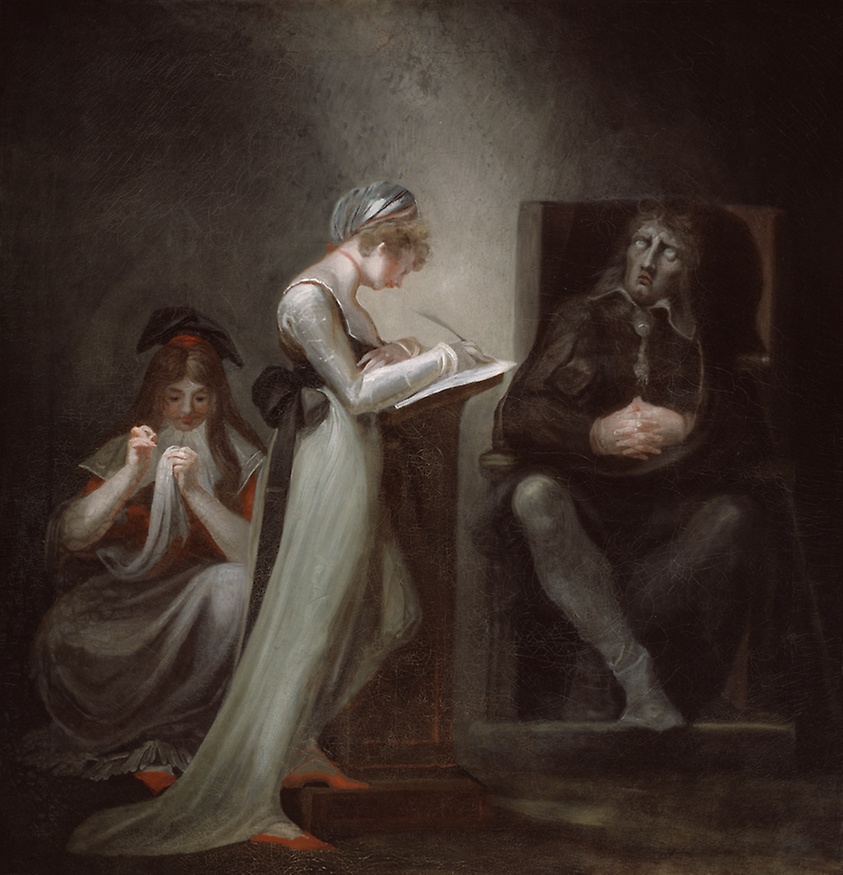
Milton Dictating to his Daughter, 1793, Henry Fuseli

Lucy Vickery runs a competition in the British weekly The Spectator–a truly venerable publication which recently reached its 10,000th weekly issue. Its politics are a bit too conservative for my taste, but the competition is in a class of its own (The New Statesman having dropped its similar competition a few years ago).

The most recent challenge was this: “In Competition No. 3163 you were invited to submit well-known poems encapsulated in four lines.” The gorgeous responses prompted Lucy Vickery to call the results “Paradise Lost in four lines”, after this entry by Jane Blanchard:

Satan found himself in hell —
Eve and Adam also fell —
Good gone bad got even worse —
Milton wrote too much blank verse —

(which exactly reflects my feelings, having had to waste too much of my A Level studies on Paradise Lost at the expense of more interesting poets such as John Donne and Matthew Arnold.)

My personal delight in The Spectator’s competitions is in seeing so many Potcake Poets there (in this case not just Jane Blanchard, but also Chris O’Carroll, Martin Parker, Jerome Betts, George Simmers and Brian Allgar), and in identifying more poets to keep an eye on for possible future chapbooks.

Anyway, if you want to see nice condensations of famous poems, have a look at that specific competition’s results. My favourite is Martin Parker’s take on e.e. cummings’ ‘may i feel said he‘:

foreplay
(more play)
errings, ummings
(and cummings)

Potcake Poet’s Choice: Edmund Conti, “My Son the Critic”

Edmund Conti

Edmund Conti

Read me a bedtime poem, said my son.
So I read him this:

We say hippopotami
But not rhinoceri
A strange dichotomy
In nature’s glossary.

But we do say rhinoceri, he said.  Look it up.
So I read him this:

Life is unfair
For most of us, therefore
Let’s have a fanfare
For those that it’s fair for.

I smell a slant rhyme, he said, sniffing.
So I read him this:

While trying to grapple
With gravity, Newton
Was helped by an apple
He didn’t compute on.

My teacher says that’s not poetry, he said.
So I read him this:

René Descartes, he thought
And therefore knew he was.
And since he was, he sought
To make us think.  He does.

That made me think, he said.  But not feel.
So I read him this:

My hair has a wonderful sheen.
My toenails, clipped, have regality.
It’s just all those things in between
That give me a sense of mortality.

Did the earth move?  I asked.  Anything?
Nothing moved.  He was asleep.

Ed Conti writes: “I sent the following quatrain to John Mella at Light and he accepted it (those were the good old days).

We say hippopotami
But not rhinoceri
A strange dichotomy
In nature’s glossary.

I don’t remember what the title was but I’m sure it didn’t hurt the poem.  A few weeks later dis-accepted the poem.  He had consulted with a fellow editor (I didn’t know they did that!) and found out you do say ‘rhinoceri.’  Now what?  I didn’t want to trash the quatrain, not with ‘t those felicitous rhymes.  So how to keep the verse and note the error. That was it, link a whole bunch of poems with their shortcomings (and I have a lot of those) and do a learned dissertation on what their problems were.  And who better to do that than one of my two sons.  Which one? It wouldn’t matter, I wouldn’t name him.  That way if one of them said he didn’t remember that happening, I would say it was the other son. Besides they were too young to worry about personas (personae?) And I wasn’t sure if I actually knew what they were.

So what does the reader get out of this poem?  Probably nothing. I write for myself because it’s fun.  If the reader chooses to enjoy this poem, that’s his problem.”

Edmund Conti has recent poems published in Light, Lighten-Up Online, The Lyric, The Asses of Parnassus, newversenews, Verse-Virtual and Open Arts Forum. His book of poems, Just So You Know has been recently released by Kelsay Books.
https://www.amazon.com/Just-You-Know-Edmund-Conti/dp/1947465899/

http://www.short-humour.org.uk/10writersshowcase/10writersshowcase.htm#EDCO

https://www.facebook.com/edmund.conti/

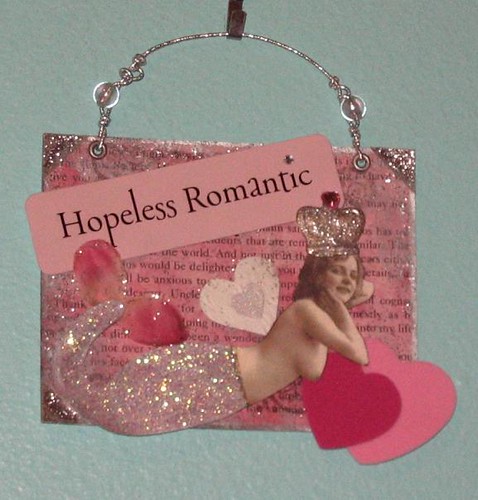
Limerick: On a Hopeless Romantic


Like Jesus, she felt God-forsaken,
like Joan of Arc, wanted a stake in
     a life full of meaning,
     a life undemeaning—
like Jung, she was simply myth-taken.

This limerick was originally published in Light. As far as I remember, I didn’t have anyone in mind when writing it, it was done for the pure wordplay of the rhythm and rhyme, the repetition of the J-names in the long lines and the near-identical nature of the short lines, and of course the final pun.

Formal verse covers a lot of territory from limericks at one extreme to Paradise Lost at the other. Personally, I’ll take Lear over Milton any day.

Potcake Poet’s Choice: Claudia Gary, “Blues Manqué”

Claudia Gary

Claudia Gary

I’ve suffered, but I can’t quite sing the blues.
My troubles are occasional, not chronic.
My angst is true, but not the kind you’d use

against the everyday, to find or lose
your heart. My chords are major and harmonic.
I’ve suffered, but I don’t dare sing the blues.

Any attempt would probably amuse,
but not in ways your songs have made iconic.
Your angst is true, while mine’s nothing to use

in threatening to blow a major fuse
or skip to Paris on the supersonic.
I’ve not suffered enough to sing the blues.

Saying I have is asking for a bruise.
You’ll throw tomatoes. They’ll be hydroponic.
This angst is true, but nothing I can use

to make you say mine is the pain you’d choose.
The plates I spin are porcelain, not tectonic.
I suffer from a need to sing the blues
with insufficient angst, too kind to use.

Claudia Gary writes: “I chose this poem because people have seemed to enjoy it at various readings, as did the wonderful editors who chose to include it in “Love Affairs at the Villa Nelle.” Also, villanelle is one of the forms I love to teach at writer.org—currently online, so people can “Zoom” from anywhere in the world and wear their pajamas to class.”

Claudia Gary teaches villanelle, sonnet, and meter “crash courses” at The Writer’s Center (writer.org). A three-time finalist for the Howard Nemerov Sonnet Award and semifinalist for the Anthony Hecht prize (Waywiser books), she is author of Humor Me (David Robert Books, 2006), chapbooks including Genetic Revisionism (2019), and poems appearing in journals and anthologies internationally. She also writes chamber music, art songs, and health/science articles. See also pw.org/content/claudia_gary, @claudiagary (twitter), and claudiagarypoet (instagram).

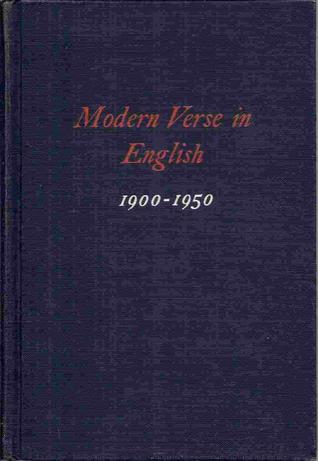
Review: “Modern Verse in English, 1900-1950”

Modern Verse in English

I’m reading ‘Modern Verse in English, 1900-1950‘, ed. David Cecil and Allen Tate, published in 1958. It provides a good look at a large number of poets from that time period–some have lasted, some haven’t. It is an extensive and useful volume, but it raises some concerns:

1. Lord David Cecil‘s introduction (to the English poems) includes “though during the twenties there was a fashion for free and rhymeless verse, it has passed. Most young poets today write in strictly regular forms.” This was published in 1958, remember. Not really prescient, unfortunately, so you question his insight. He regrets omitting “the work of writers who have made their reputation since 1950, for example, Miss Audrey Beecham, Mr. Philip Larkin and Mr. Thom Gunn.” Well, two out of three’s not bad.

2. The ‘1900-1950′ seems a bit misleading, given that the poets include Emily Dickinson and Gerard Manley Hopkins who both died in the 1880s. True, Hopkins’ poetry wasn’t published until the 1930s–but would we consider an unknown Shakespeare poem 21st century if it was only discovered and published today? And as for Dickinson, three Series of her poems were published in the 1890s.

3. Although a couple of poets born in Ireland and South Africa, and Kipling, are included, the volume contains nothing by Canadians (Bliss Carman, Robert Service and F.R. Scott would fit the time line), Australians, West Indians, etc; and nothing by any people of colour such as Langston Hughes or Gwendolyn Brooks (one of my absolute favourites). Any of these would be far more worthy of inclusion than, for example, Donald Davidson whose chief merit for the editor of the American poems, Allen Tate, must have been their shared support for racial segregation. The volume would be better titled ‘Modern White English and American Verse, from Emily Dickinson to Richard Wilbur‘. Still not perfectly accurate, but so it goes.

It is a useful book. But it is less complete than its title suggests, and it is tainted.

Wired Magazine: Poetry, Doctors, Patients and the Pandemic

Dr. Rafael Campo

Dr. Rafael Campo

Here is an excerpt from a recent Wired interview with Dr. Rafael Campo, Poetry Editor at the Journal of the American Medical Association! (The full thing is here.)

WIRED: Why do you think poetry has become so important to so many doctors during the pandemic?

Rafael Campo: I think doctors in particular are really searching for ways to give voice to their experiences of this terrible disease and what we’re all going through in confronting it.

It’s particularly poignant, I think, because we’re so isolated by this virus. We’re all practicing physical distancing and social distancing, so I think poetry becomes a way of connecting with other people and having our story heard. So I find it actually really energizing. It helps me feel less isolated, less disconnected, as I read through these poems.

WIRED: Is there something unique about poetry that makes that kind of connection possible?

RC: We’re hardwired to hear the kinds of rhythms that are present in poetry and the ways in which the rhythms of our bodies are expressed in meter, in the music of poetry. I think especially now, when we’re feeling in some ways estranged from our own bodies and disconnected, having that visceral experience of hearing the music and language is just compelling.

I think other reasons have to do with the brevity of poetry. In a way, poetry fits into the fragmented spaces that we have as doctors, as we’re running around trying to deal with this crisis.

Then one other thing is that I always associate poetry with activism. When we think of some of the protests that are going on in the streets now—people are out there chanting—they’re actually using a spoken-word form of poetry.

Poetry has that ability to grab us and to speak in the most urgent terms. It’s a very physical language. It calls us to action. I always think back to my time when I was really early in my training as a physician, during the height of the AIDS crisis. Similarly, then people were out in the streets shouting: “Silence equals death! Silence equals death!” That still resonates in my mind today. Those poems, that urgent language, really changed the course of that pandemic.


And he’s a poet in his own right.

And then there’s Dr. Campo’s Ted Talk

Potcake Poet’s Choice: Tom Vaughan, “Save the Last Page for Me”

We choose what gives us meaning. I
chose you. That’s why
when people ask
me to unmask
and tell them if I’m ‘happy’, they
head off astray:
that’s not the glue.
But what I knew –
in the first minute, when we met
(part pledge, part threat) –
was that our text
defines, connects.

Of course, it’s only when you turn
the last page, learn
its backward view,
say farewell too,
that you can fully understand
an author’s plan.
So bugger books
and how we’ll look
to hooked, impatient readers who
will hurry through
to reach the end.
Leave that unpenned.

Tom Vaughan writes: “The poem I would choose to represent myself, Save the Last Page for Me, first published in Staple, represented a particular challenge. I’d come across the form (‘minute’ poems, i.e. 60 syllables in each stanza, with rhyming couplets and a pattern of four or two foot lines) which it was suggested was only for comic poetry. I wanted to say something serious, and hope I succeeded. Writing the poem was also another reminder that at least sometimes the more you work within the confines of a strict form, the more you discover what you wanted to say. The poem is about my wife, Anne.”

Tom Vaughan is not the real name of a poet whose previous publications include a novel and two poetry pamphlets (A Sampler, 2010, and Envoy, 2013, both published by HappenStance). His poems have been published in a range of poetry magazines. He currently lives and works in London.

https://tomvaughan.website


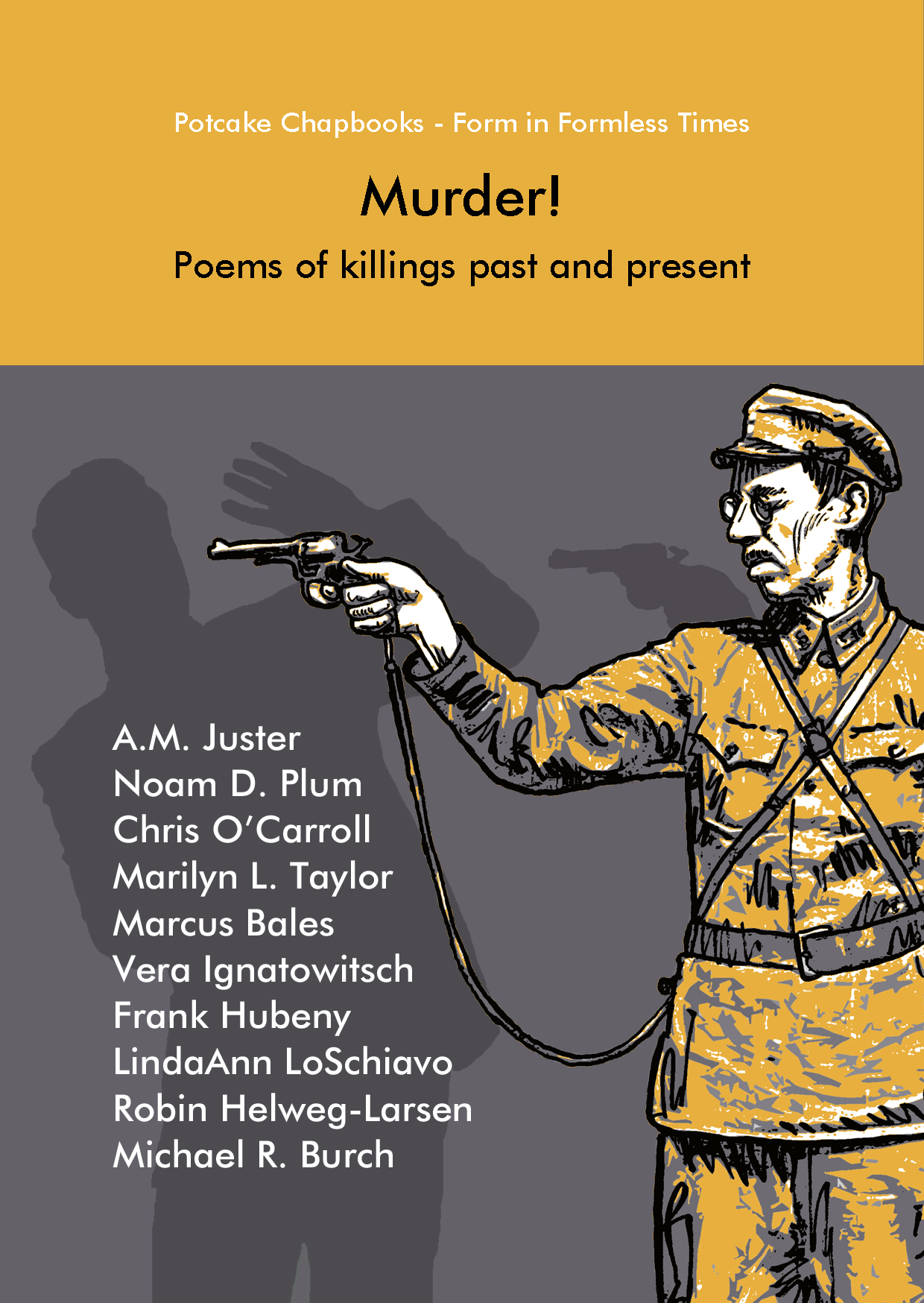
Launch: Potcake Chapbook 7, ‘Murder ! – poems of killings past and present’

07 Murder!

Potcake Chapbook 7: ‘Murder!’

Murder needs no formality of gats,
violin cases or fedora hats
or any other long-outdated memes.
Murder is merely social discord that’s
taken to interpersonal extremes.

Murder. Here we present victims ranging from the unidentifiably unknown to the rich and powerful, and from the time of the Emperor Constantine to the present day. It appears to be something with which we humans are permanently infected. 

The poems–all formal, of course!–are as usual in a variety of forms. This chapbook contains sonnets, a double dactyl, quatrains, rubaiyat, parody and nonce forms. They were authored by Potcake newcomers A.M. Juster, Marilyn L. Taylor, LindaAnn LoSchiavo and Frank Hubeny, and old-timers Chris O’Carroll, Marcus Bales, Vera Ignatowitsch, Noam D. Plum, Michael R. Burch and myself. And powerfully illustrated, as always, by Alban Low.

For the price of a fancy greeting card you can, through the wonders of PayPal, get this 16-page chapbook online for £2.60 + £1.20 P&P to a UK or European address, or £2.60 + £2.20 P&P to a Worldwide address.

Or you might prefer to browse themes and poets here, and photos and bios here, and choose between poems on travel, or love affairs, or the working life… or relatives, or modern life, or poems to amuse and amaze. Life, after all, is more than just Murder!