Category Archives: Poetry

Review: “Verse” by John Updike

This paperback, Verse, is comprised of two earlier hardcover volumes of poems from John Updike, The Carpentered Hen from Harper & Row and Telephone Poles from Knopf. The poems date from the 1950s and early 1960s, and in the words of Phyllis McGinley, “His is what poetry of this sort ought to be: playful, but elegant, sharp-eyed, witty.”

Here are the beginnings of some of his poems. Some of them are pure wordplay, as in “Player Piano”:

“My stick fingers click with a snicker
And, chuckling, they knuckle the keys;
Light-footed, my steel feelers flicker
And pluck from these keys melodies.”

Several of them start with a quote from a newspaper story and then run wild with it, as in “The Descent of Mr. Aldez”:

Mr. Aldez, a cloud physicist, came down last year to study airborne ice crystals.
– Dispatch from Antarctica in the Times
That cloud–ambiguous, not
a horse, or a whale, but what?–
comes down through the crystalline mist.
It is a physicist!”

And some are meditative, as with “B.W.I.” (the old British West Indies of the 20th century):

“Under a priceless sun,
Shanties and guava.
Beside an emerald sea,
Lumps of lava.

On the white dirt road,
A blind man tapping.
On dark Edwardian sofas,
White men napping.”

A largely enjoyable collection, but not up to the standard of those similar 20th century poets, Phyllis McGinley and Dorothy Parker. But then again, Updike’s many American awards (Pulitzer, National Book Award, etc etc) were for his fiction. His poetry can be considered a remarkable bonus.

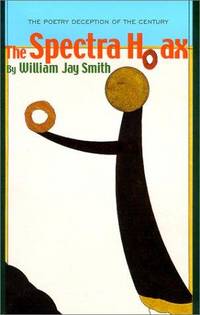
Review: “The Spectra Hoax” by William Jay Smith

Spectra Hoax

In ten days in 1916, two brash young poets – Witter Bynner and Arthur Davison Ficke – produced a volume of poetry parodying the Imagists. Writing as Emanuel Morgan and Anne Knish, and claiming to represent a whole new school, the Spectrics, their manuscript of Morgan’s formal poetry and Knish’s free verse, together with the blathery and pretentious preface, was unexpectedly accepted by a serious publisher and for 18 months was a major success on the American poetry scene. Poetry‘s editor requested half a dozen of their poems, but unfortunately the hoax was uncovered before publication; the editor was embarrassed and angry.

This book tells the full story of the Spectrism hoax, its defense, its termination, and how the hoaxers were in turn hoaxed by others… as well as telling the story of other 20th century poetry hoaxes from Australia and the US. It also contains the full text of Bynner and Ficke’s hoax poetry book, “Spectra”, and a selection of subsequent poems.

As Bynner and Ficke and others subsequently acknowledged, their parodies were unfortunately strong, better than much of the work of the Imagists and in some ways better than their own regular poetry. Consider these:

If bathing were a virtue, not a lust,
I would be dirtiest.

To some, housecleaning is a holy rite.
For myself, houses would be empty
But for the golden motes dancing in sunbeams.

Tax-assessors frequently overlook valuables.
Today they noted my jade.
But my memory of you escaped them.

– Anne Knish, Opus 118

Hope
Is the antelope
Over the hills;
Fear
Is the wounded deer
Bleeding in the rills;
Care
Is the heavy bear
Tearing at meat;
Fun
Is the mastodon
Vanished complete…

And I am the stag with the golden horn
Waiting till my day is born.

– Emanuel Morgan, Opus 2

Whatever else they are, the poems are fun. The story of the hoax and the collection of poems are both worth reading (especially if you like the Imagist poets), and go extremely well together in this book by William Jay Smith.

Triolet: “When Sunrise Gilds Your Hair”

You bring me back to when I once was young
When candles gild your eyebrows and your hair;
And to this rocky isle from which I’ve sprung,
You bring me back to where I once was young,
Birthplace of all the varied songs I’ve sung.
Now lying with you in the predawn air
You bring me back to when we both were young
As sunrise gilds your eyebrows and your hair.

This poem was originally published in The Rotary Dial, a Canadian monthly of 12 formal poems that ran some 50 issues before packing up in 2017. It was edited by two prize-winning Canadian poets, Pino Coluccio (winner of the Trillium Book Award for “Class Clown”) and Alexandra Oliver (winner of the Pat Lowther Award for her collection “Meeting the Tormentors in Safeway”). A very enjoyable magazine, I’m sorry it’s gone.

A triolet is strangely attractive form – it only has two rhymes, and several of the lines are required to repeat (though slight variations in the repetition are allowed, carrying the sense forward into new areas). So the rhyme scheme is ABaAabAB, with lines 1, 4 and 7 and lines 2 and 8 repeating, yet having fresh meanings as the little poem moves along.

In the case of this poem, being married for 25 years became enmeshed with returning to live in my home town after 40 years. The triolet’s structure of repetition suits a poem about development, ageing, memory, return. 

Poem: “Jung & Freud”

Freud and Jung

Freud and Jung

When sparkling springtime Doctor Young
And vernal Doctor Joy
Their arms, words, thoughts, widely outflung
The whole world was their toy.
But clottish schools their systems cloy
With death and dread and dung—
Oh miserable Doctor Joy!
Oh aged Doctor Young!

This little poem was originally published in The Asses of Parnassus, a string of occasional poems in Tumblr, focused on epigrams. “Short, witty, formal poems”, as editor Brooke Clark defines his search.

Jung & Freud is a frivolous piece, based on nothing more than trying to find flippant irony in the names of two of history’s best-known psychiatrists. It uses a bouncy little rhythm with lines of four feet followed by lines of three. The rhymes are simple, repetitive, reversed; the mirroring brings you back to where you started, but with everything reversed.

Sonnet: “The Quincentenarian Looks Back”

“Twentieth century”! – hard to think it through,
remember details in that distant view…
At her tenth birthday party, why’d I throw
her in the pool, all dressed up? Still don’t know.
Later we lived together overseas;
I had no clue of female hygiene needs,
never bought tampons, she used toilet paper.
Later she had a child. Mine? I wonder.
I’d left, we lived with others, better fit…
or did we marry, and have kids, then split?
I married once or twice, had kids, I’m sure.
Sent her too rude a joke, and heard no more.
We knew so little in those small young lives…
I miss you, though, my girl, or wife, or wives.

This science fiction sonnet, maybe a little flippant, was published recently in the Rat’s Ass Review edited by Roderick Bates. But what will happen when people live longer and ever longer? At what point will be stop bothering to remember things that were once essential to our lives? And the photo is a little flippant, too – if we start living to 500, it can only be because we can reverse aging. There may be a few eccentrics who choose to maintain their bodies as “old”, like in the photo, but I think most people would opt for something in the biological 20s.

And, really, it’s not so much a sonnet as 14 lines rhymed in pairs. And even the rhymes are pretty iffy. Oh well. But so long as you amuse or otherwise engage Rick Bates, you have a good chance of being published in RAR. His basic advice for anyone who has something they are dithering about sending out is: “Go ahead and submit.”


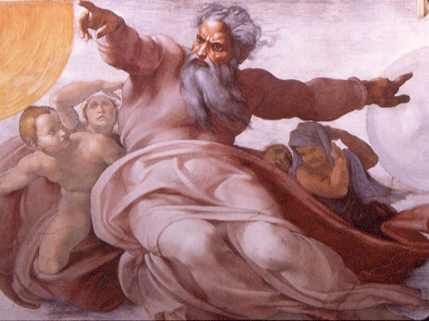
Poem: “4 God Limericks”

God

Christian idea of God

God made Heaven, earth, plants, people, fleas
In six days, and then rested at ease;
Then He thought: “In those stones
“I’ll hide dinosaur bones!!”
(He was always a bit of a tease.)

God looked out a Heavenly portal
And what He saw made Him just chortle:
Some dude, on a cross,
Claiming he was the Boss!
For his hubris, God made him immortal.

God, blessed with what one must call humour,
Decided to start up a rumour
That Himself as a dove
Came to Mary with love
And begat an Immaculate Tumour.

God saw how Religion had deadened
And said to His host, “Armageddon’d
“Look good on this lot”
For His plans were all shot
And His angels teased Him till He reddened.

As with the previous post, “4 Guru Limericks”, this was first published in Ambit No. 196, Spring 2009. (Hence the English spelling.) Like the previous post on gurus Buddha, Jesus, Marx and Hitler, you shouldn’t expect anything serious from a limerick. But this flippancy can have a purpose: by tackling a serious subject in a completely unserious way, you can undermine preconceptions and unthinking assumptions, and suggest alternative views and approaches.

With this in mind, consider the idea that religious belief correlates negatively with analytical thinking, but positively with moral concern and empathy. Research into this was summarized in The Independent in 2016, after more complete reporting in the science journal PLOS ONE. Limericks by their iconoclastic nature appear to be low in moral concern and empathy – but often it is some form of moral concern that has driven the limerick’s creation, although its rudeness and fresh viewpoint tends to favour analytical thinking over empathy.

Limericks are the clowns, the fools, of the poetry world. The best of clowns and fools go into stealth mode to make useful observations.

Poem: “4 Guru Limericks”

A wealthy young prince called Gautama
Loathed worship of Krishna and Rama;
“It’s inside you,” he said
But, once he was dead,
He was worshipped…. That’s interesting karma!

A radical rabbi called Jesus
Assumed if he loved us he’d please us;
Though he loved Mary Magdalene,
John, and small children,
His power was no match for Caesar’s.

A second-rate father, Karl Marx
Let his kids die while writing remarks
On Struggle and Might
And the duty to fight
For state-owned newspapers and parks.

Hitler, son of a half-Jewish bastard
Dreamed of occult power; Europe, aghast, heard
Race-hate psychodrama;
His unending trauma
Destroyed the whole state that he’d mastered.

I love limericks. Their elegant form, rhythmic and rhyme-rich, and their frivolous and chatty anapestic feet, allow you to be rude and insulting without causing more offence than a well-dressed wit who has had one too many drinks at a party. And as such, they say things with very few words in a way that is very easy to remember.

As for gurus… well, it’s always good to be able to listen to people with more experience and wisdom than oneself, but that doesn’t necessarily make them correct in their analysis, infallible in their prescriptions and proscriptions. They’re still only human, full of half-aware dreams and unconscious bias. And if they have swarms of devotees and go off the rails, well, they really go off the rails.

Haiku: “Young Man”

Ageing Man in Mirror

(In the mirror)

Where’s the young man gone,
who lived in mirrors so long?
Putting old masks on.

This was published in Asses of Parnassus, a most worthy site for short verse, especially the flippant, frivolous or sarcastic. “Young Man” seems to be a theme I keep returning to, probably because I keep having birthdays. It’s easy enough to feel in your early 30s when you’re climbing a tree to pick fruit, or swimming, or reading; but a mirror may offer an unexpectedly different opinion.

Technically a loose sort of haiku, this poem meets the requirements of 5-7-5 syllables and the volta between lines 2 and 3, but hardly addresses a season and its sensibilities. The rhyme and near-rhyme of the three lines is not something required in Japanese, but seems to me to be necessary in an English haiku to make it a poem, i.e. to differentiate it from 17 syllables of prose written over three lines.

Poem: “Said Poor Mrs. Owen”

Wilfred Owen

(“Futility” by Robbie Kerr) 

Said poor Mrs. Owen
To her son Wilfred
Why must you always
Write of the trenches?
Why can’t you write
Like that nice Mr. Wordsworth
Of flowers?

Said Mrs. Picasso
To her son Pablo
Why must you always
Paint so distortedly?
Why can’t you paint
Like that nice Mr. Monet
Some flowers?

Because we don’t always
Create what we celebrate,
Sometimes we model the
Things that we’d like to change,
Things we don’t like, or just
Things that we think about –
Thoughts of ours.

This poem was published in The Road Not Taken – a journal of formal poetry that is edited by Kathryn Jacobs in connection with Texas A&M University at Commerce, TX.

Technically the poem lacks some aspects of what we tend to assume is “form”, notably extensive rhyme, alliteration or assonance. But each of the stanzas has the same seven-line form, with two stressed syllables in each of the first six lines and a shorter seventh line. The first two stanzas have virtually identical structure, though one deals with poetry and the other with painting, and the third stanza answers them. The last lines repeat and rhyme.

It is really the natural rhythm of the poem that allows it to be included in a journal of formal poetry. In the sense that “form” is any trick of verse that allows it to be remembered word for word, form can be a lot broader than some of the narrow definitions of formal verse.

Poetry Resource: “SF&F Poetry Association”; Sonnet: “On a Dead Spaceship”

Spaceship

(“Golconda Uranium (2012)” by Alexey Kashpersky)

On a dead spaceship drifting round a star
The trapped inhabitants are born and die.
The engineers’ broad privileges lie
In engine room and solar panel power.
The fruit and vegetables and protein coops
Are run by farmers with genetics skills:
The products of their dirt and careful kills
Help service trade between the several groups.
Others – musicians, architects – can skip
Along the paths of interlinking webs.
Beyond these gated pods that the rich carve
For their own selves (but still within the ship),
In useless parts, are born the lackluck plebs.
Heard but ignored, they just hunt rats or starve.

This sonnet was published in Star*Line, the official journal of the Science Fiction & Fantasy Poetry Association, a quarterly edited by poet and English prof Vince Gotera. Each issue contains a vast diversity of sf&f poetry. Not much of it is formal, but that is all part of the diversity which is appropriate to its genre.

So a sonnet is fine. And this one, like so much sf, is a metaphor for Earth today: circling the Sun, carrying highly unequal societies.

Technically, it is a sonnet to be sneered at by purists: it rhymes ABBA CDDC EFGEFG, the second quartet failing to rhyme with the first, making it a flawed Petrarchan sonnet. In addition, rhyming “star” with “power” is a bit of a stretch, one syllable against two, and none of them sharing quite the same vowel… Oh well, it’s only Science Fiction…