Tag Archives: death

Poem: “The Train Will Stop”

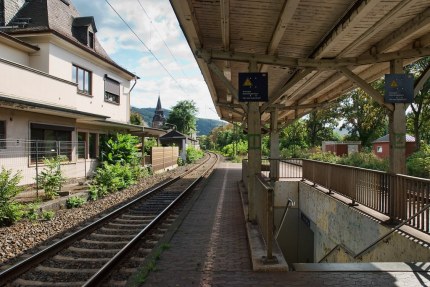
“The train will stop for ten minutes at the next station.
If you wish to make this your annual vacation,
please reboard in nine minutes.” The travellers gaze
at the countryside slowing past, consider ways
to take more than nine minutes for a break
but, looking down a slight curve in the track,
see no way to get out and back
nor a real reason they should take
the risk. The train will go…
and what else do they know?
They’ll stay till dropped
at some end stop.
Descend.
The end.

This little piece of existential angst appears in the current Bewildering Stories. It was written, submitted and accepted long before the current Covid-19 crisis came along, which it in no way relates to. In fact, in the awareness that we are all mortal and that everyone’s journey will have an end stop regardless, you might even say this suggests that in the Grand Scheme of Things the Covid-19 situation is trivial. The bigger issue is: eventually we all die. A solution to that would be far more dramatic than a successful Coronavirus vaccine.

Technically? Not a tightly formed poem – the initial lines are straggly, but as they shorten they tighten into iambics. The rhymes too are erratic, mostly in couplets but not quite. Not a perfect poem. Flippantly you could ask, In the Grand Scheme of Things and in the present circumstances, why should this matter? And the answer is, The level of artistic quality always matters; ultimately, it’s the most you can hope to achieve and be remembered by.

Poem: “Head of the Table”

Your grandparents die
And your children are born;
Then your parents die
Then grandchildren are born;
And you move one more seat
Round the mad table
To the head of the table,
At which point you’re expected to go.

As when the crow came
Wild, not tame – all the same
It cawed you the news
That confirmed death and time;
So when your time comes
And you feel in your bones
That the body is over
Where will you, the guest, go?

Then bring food and drink!
Glasses clink! Glance and wink
As you move to the brink
Of eternity.
Who knows what follows next?
“Afterlife” is absurd –
But then all life’s absurd –
We just know, when it’s time, that we go.

This is about as religious as I’ve found myself in the past 30 or 40 years – in other words, I waver between mild atheism (“None of this God stuff makes sense”) and militant agnosticism (“I don’t know, and neither do you.”) But at least you have a seat at the table! Enjoy the party while you can (preferably while being pleasant to others).

Originally published in Snakeskin No. 232 (or #232).

Poem: “Zombie Apocalypse”

Zombie Apocalypse –
humans have always had
end-times fear: Ragnarok,
Judgement Day, World War III,
comet strike, Y2K,
supervolcano – well,
you get my drift.

Zombie Apocalypse –
there’s a pandemic and
AI has run amuck –
this is no practice round,
this is for real!

Zombie Apocalypse –
head for a tropic isle,
live on fish, coconuts –
solar will last a few
years, then corrode.

Zombie Apocalypse –
walls can be built without
concrete or plastering,
fight infestations of
zombies and dogs.

As the world splits in two
all the Enhanced are gone,
gone to the Cloud and space;
only the Left Behind
scrabble, deteriorate,
left in the dirt and ash,
left on the Earth.

I, the last poet am
here on Earth’s farthest beach,
toweled, not panicking,
waiting for Branson and
Musk in their ships.

Yes, humans love the threat of the end of the world, the collapse of civilisation, all apocalyptic disasters. We don’t want the disasters to be inflicted on us… but we love thinking about them. Perhaps it’s a way of thinking about our own mortality, without actually thinking that it is we who will die one day.

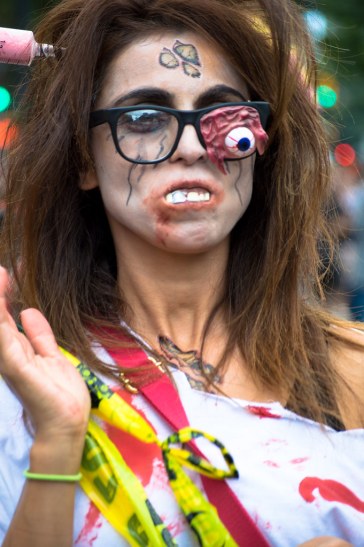
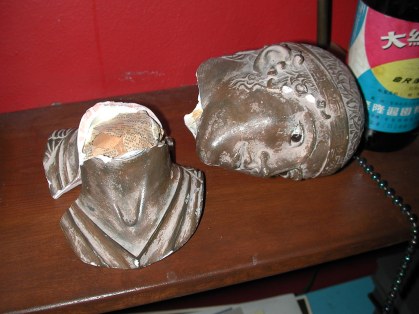
The Zombie Apocalypse is wonderful because it is both a complete fantasy (as in the photo) and an image for the kind of catastrophic real-world disaster that an out-of-control plague can inflict–a medieval Black Death killing a third of the population… an early 20th century Spanish Flu infecting a third of the world’s population (but “only” killing maybe 50 million)… or, of course, a coronavirus leaping out of a food market in Wuhan and spreading around the world before anyone can get a proper handle on it. Death is real. Around the world, 150,000 people die every day. What can you do but work to minimize death–and laugh at it?

And then there’s the fantasy of being one of the lucky few survivors, faced with the difficulties of a post-apocalyptic world, a post-nuclear Wasteland, a flooded Waterworld, a Biblical Left Behind, reminiscent of Nevil Shute’s On The Beach, John Christopher’s The Death of Grass (No Blade Of Grass in the US), even Ursula Le Guin’s post-alien-invasion City of Illusions. Carrying a towel like Ford Prefect to hitchhike through the galaxy, away from doomed Earth. Dramatically, heroically, surviving the destruction of the world as we know it. As though you can dramatically, heroically, survive the time-driven destruction of your body…

The poem itself (yet another one published in Bewildering Stories) is unrhymed, but written in a form inspired by double dactyls. Technically double dactyls are eight-line poems with a few additional requirements–the form was created by Anthony Hecht, Paul Pascal and Naomi Pascal in 1951, and popularized by Hecht’s and John Hollander’s collection Jiggery Pokery… the name of the book being a double dactyl, naturally. So this poem is only “inspired by” double dactyls. But, as with limericks, the bouncy rhythm adds to a mood of flippancy, frivolity, which is always suitable (in my mind) when discussing existential catastrophe. I tip my hat to Country Joe and the Fish for the I Feel Like I’m Fixin To Die Rag, and to all political cartoonists everywhere.

Life is short; enjoy each day.
Sonnet: “Body Modding”

It starts with teeth, for even the healthiest:
Fillings put in, and “extra” teeth pulled out
Or realigned, the whole jaw moved about,
New faces for the kids of the wealthiest.
Tonsils, appendix, out. The stealthiest
Inject, use pills, every fluid reroute
With tourniquets, with tampons, condoms… flout
Flow, through to adult nappies. Atheist
As Science makes us with creative powers,
We add pumps, implants, radio, wires, chips,
Casually as tattoos, replacement hips;
Graft patchwork skin from humans, pigs, plants, flowers,
Joined in flamboyant Frankensteinish suture,
Racing against decay to cyborg future.

Like most of my sonnets, this was first published in Snakeskin. And like most of my sonnets, it has an existential theme. Ever since I was in high school (Stowe, a traditional British “public school” i.e. private school) and lost my belief in that Anglican school’s religion, I’ve been writing poetry about life and death. It’s a fascinating subject for those who are able to accept that death is inescapable except in religious fantasies, and science fiction, and the dreams of scientists out on the furthest limbs. Death may have proved universal so far, but so have the stories of the search for immortality in all the world’s cultures. Striving against death is part of what makes us human. And success will involve becoming something other than the humans that we are today.


Sonnet: “Unanswered”

The Afterlife – some Happy Hunting Ground?
Or Jesus, virgins, merging flesh and breath?
Or god of your own world, white-robed and crowned?
Or ghost? Rebirth? Just, please, no final death!

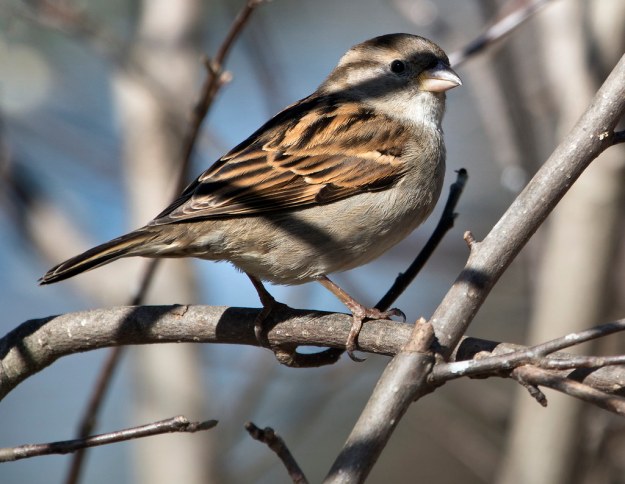
The sparrow through the Saxon hall at night –
Brief light and warmth, then cold obscurity.
Is this our life? But yet the bird in flight
lived in the dark, both pre and post. Do we?

Frogs, living in a buried water tank,
spend all their time in darkness. Then the lid
is lifted and sun shines into the dank –
lid down, light gone… but they live on, though hid.

We work and play throughout our brief day’s sun –
Day raises many questions – night, just one.

This sonnet was published in Snakeskin No. 265, edited by George Simmers. I write both religious and irreligious poetry as the muse suggests, but my own personal views are Fundamentalist Agnostic: “Nescio et tu quoque”, “I don’t know and neither do you.” The sparrow reference is to a passage in the Venerable Bede’s Ecclesiastical History of the English People which usually seems to resonate well.

Technically the sonnet is Shakespearean: iambic pentameter rhyming ABAB CECD EFEF GG. The three quatrains are each self-contained, but leading to the resolution (or lack of resolution) in the couplet. The last line is the strongest, which is always satisfying.

Sonnet: “Beat This Level”

Forget that crap about some God or Devil –
you’re on your own against the Universe;
but till you’re free of our Stage One’s perverse
orientation, you won’t beat this level.
The Heaven idea is fraudulent, and worse:
Father McKenzie wields a deadly shovel.
Stage Two’s extended life – hard, but don’t snivel.
Stage Three: genetic change, youthful reverse.

You must want Life – must fight Death all the way,
ignoring social norms, pressure from peers;
such life will need a gamer’s vigilance.
Your other futures are: ashes, or clay.
And if help’s late, as you slide down the years,
cryonics is your waiting ambulance.

This sonnet, written over 20 years after the previous “Death Will Be Harder Now”, was first published as a pair to it in Ambit No. 190, October 2007. (Also like the earlier sonnet, it was reprinted in Bewildering Stories, edited by Don Webb.)

The theme is our age-long human dream of avoiding death, including that celebrated by Father McKenzie, “wiping the dirt from his hands as he steps from the grave.” (No one was saved.) For the first time in history we can see the realistic prospect of indefinite lifespans coming closer, if we can just live long enough for genetic modification to give us not only better hair and wrinkle-free skin, but actual rejuvenation. If you die before that happens, cryonic suspension is your ambulance to the future… you may not survive the ride, but you’ll have a better chance of a fresh lease of life than if you let them cremate you or pass you through the bodies of worms.

Technically the sonnet is unconventional, reversing the rhymes in the second quartet rather than echoing them, so that the poem reads ABBABAAB CDECDE. I don’t think that’s a problem; probably the bigger sin was splitting noun from adjective in lines 3 and 4, breaking the rhythm of the pentameters, which the other lines hold comfortably.


Sonnet: “And Then You Die”

And then you die. So what have you achieved?
Your house, your place of work, both turn to dust.
You’re honoured? But who’s on a marble bust
none knows or cares, or if the honour’s thieved.
You cheated? Centuries later, none’s aggrieved.
You fought for Freedom? But in history’s dust
no war is seen as necessary or just.
You were a saint? None cares what you believed.
Why all this striving, more than to survive?
Millennia hence a random rubbish heap
will be more studied than your claimed success.
So find a sunny sea, be calm, alive,
swim, then float on your back and fall asleep.
Life can be no more perfect; death no less.

This sonnet was published in Snakeskin a couple of weeks ago. I was very happy with its formal Petrarchan rhyme scheme, until I suddenly noticed, reading it for the umpteenth time, that I had used the word “dust” twice in the rhymes. Given the enormous number of alternatives I could have chosen from, I’m a little embarrassed. All I can say is, the word just seemed so natural, in both places…

But, in the spirit of the poem, so what? The swimming is lovely today!

New Poem: “Buried in the Garden”

I have a poem published in May’s Snakeskin which (shock, horror!) is not formal.

Snakeskin logo

Buried in the Garden

Now I lie dead, buried in the garden,
And the plants take over.
Two hibiscus bushes grow from my eyes,
Oleander from my nose,
A sapodilla will fruit from my mouth,
Casuarinas grow to sigh from my ears.
From my chest a love vine straggles out
And black crabs live in the cavities of my lungs.
A chicken boa curls around and hunts up and down
And from my private parts grows
That least private of plants, a coconut palm.
From my feet termites are building tunnels out around the world.
So is my body divided, reused, and the birds take hair for their nests
And the calcium of bones and teeth for their eggs
And the body, the body is gone.
And what am I, but a body? What would remain in your sieve if you sift my remains?
Only some thoughts, others’ memories of some thoughts,
Blown away on the wind when the rememberers themselves are gone.

At a stretch, you could claim it has elements of formality. It has a structured sequence of appropriate tropical plants and other creatures growing from body parts – the most visually arresting from the eyes, the most highly scented from the nose, and so on. It has a volta, a turn in the argument from the description of transformation as positive, to the dismissal of that process as being mere erasure.

But are those things enough to make the whole piece word-for-word memorable? Because that is my test of poetry. And I think the answer is no. So no, it is not real poetry. There may be one or two memorable phrases, but that’s not enough. The underlying concept may be memorable, the images may be memorable; still not enough. Only if the entire piece is easy to recite because of the actual expression of the words, I argue, can it be called poetry.

Should you then put your time into transforming the images into formal verse, creating perhaps a Shakespearean sonnet, iambic pentameter and all?

Buried in the Garden (Take 2)

In garden buried, I sprout from my eyes
Hibiscus; oleander from my nose;
From mouth, a sapodilla; a pine sighs
From out my ear; from chest a love vine grows;
Black crabs in lungs, small boa in my guts;
From feet, ants tunnel out around the world;
My privates sprout a palm with coconuts.
Birds peck my bones, my teeth, hair that once curled,
For calcium for eggs and for a nest…
Sift my remains: what remains in your sieve?
Of my whole body I’ve been dispossessed,
Only the memory of some thoughts still live
Within the thoughts of others’ memories;
When those rememberers go, all traces cease.

So we come back to the old questions of poetry: is the expression itself richer or poorer for having been put into verse? And is the formal verse expression (whether richer or poorer) more memorable than the non-formal expression? What do you think?

I wonder if Snakeskin editor George Simmers has an opinion.