Tag Archives: travel

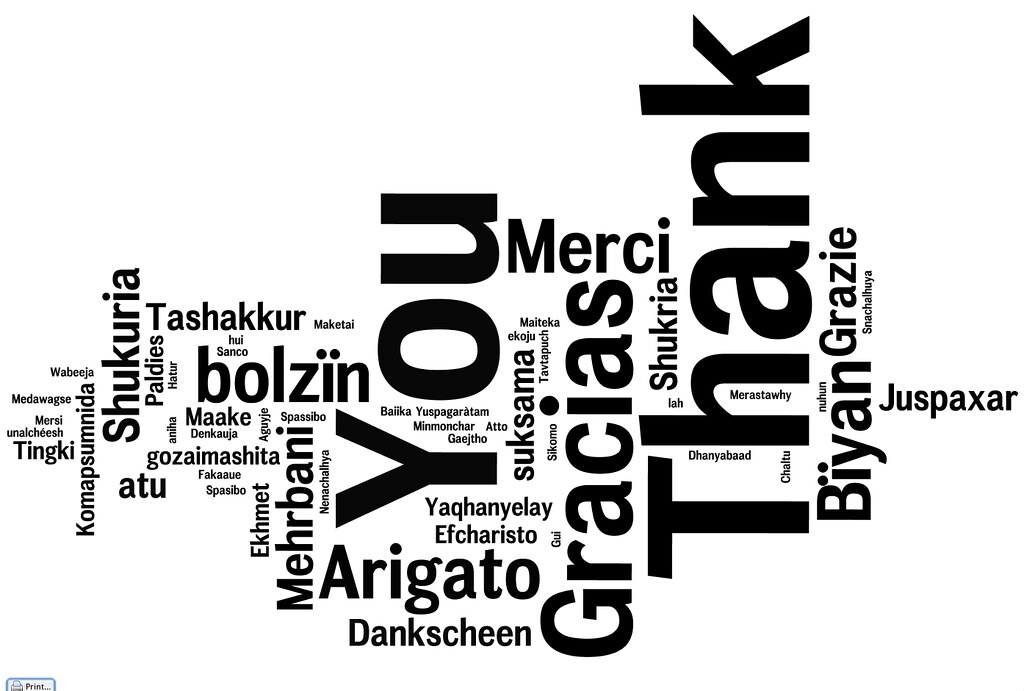
David Galef, ‘How to Say “Thank You” Abroad’

Donkey, mercy, grassy ass,
Effin’ Christ, something with God?
Spacey bow and airy ghetto,
Tic-tac-toe—or smile and nod.

Glossary: danke, merci, gracias, efcharisto, deo gratias, spasibo, arigatō, tak.

*****

David Galef comments: “The idea for this short (previously unpublished) poem came to me years ago when I was learning Japanese, and the mnemonic for the phrase “you’re welcome” (dō itashimashite) was explained to me as “don’t touch my mustache.” From there, it was a short step to “airy ghetto” for arigatō or “thank you.” A recent bout of Spanish language instruction yielded “grassy ass,” not that gracias is hard to remember, and the rest, as they say, is hiss Tory. As you can see in the poem, I’ve got eight or so examples, and I’d welcome more.”

David Galef has published over two hundred poems in magazines ranging from Light and Measure to The Yale Review. He’s also published two poetry volumes, Flaws and Kanji Poems, as well as two chapbooks, Lists and Apocalypses. His latest book is the novel Where I Went Wrong. In real life, he directs the creative writing program at Montclair State University.

Photo: “universal thank you note” by woodleywonderworks is licensed under CC BY 2.0.

Using form: RHL, ‘(on the value of learning languages when) Roughing It In Europe’

One two three four
Is OK, but you need more:

Un deux trois quat’
If you want a welcome mat

En to tre fire
With the krone getting dearer,

Bir iki uç dirt
Selling off your jeans or shirt

Wahid zoozh teleta arba
In a cafe by the harbour

Üks kaks kolm neli
For some food to fill your belly;

Jeden dwa trzy cztery
Language may be shaky, very,

Uno dos tres cuatro
But they’ll love you if you’re up to

Eins zwei drei vier
Trying freely, laughing freer.

*****

This is one of my youthful hitchhiking days poems… It has just been republished in Firewords Campfire, but was originally in Unsplendid (and then in Better Than Starbucks, and Orchards Poetry Journal).

Firewords paired it with a short story, and commented they were “very different adventures, both centred on the art of connection: one through clumsy but charming attempts to bridge language gaps abroad, the other via a game that becomes a quiet battleground for attention, memory, and something close to intimacy. In both, every word counts.” It is always interesting to hear other people’s takes.

Artwork by Jay Carter, an illustrator from Lancashire who enjoys creating bold, colourful images, often finding inspiration in books, films, history, nature and travel. jaycarterillustrator.com

Melissa Balmain, ‘Notes From a Jaded Traveler’

I dreamed I went to Heaven–
it wasn’t all that great.
The angel choir was tone deaf;
its harps were second rate.
St. Pete was glumly scrubbing
the bird shit off one gate.

I dreamed I went to Hell next–
it wasn’t all that grim.
I’d felt worse heat in Brooklyn,
worse torture at the gym;
Satan and his minions
were belting out a hymn.

I dreamed that neither visit
surprised me much–oh sure,
the Bible promised plenty
that wasn’t on my tour,
but what location ever
lives up to its brochure?

*****

From Walking in on People © Melissa Balmain, 2014. Used by permission of Able Muse Press.

Melissa Balmain writes: “This poem, first published in Light Quarterly (now Light), sparked one of my rare disagreements with LQ‘s founding editor, John Mella. He balked at the term “bird shit.” It might offend older readers, he said, and he asked for a substitute. This led to the following message, which is undoubtedly the sort of high-toned correspondence that poetry readers imagine happening behind the scenes:

Dear John,
Thanks for your latest note on “Notes from a Jaded Traveler.” I think we may have had a communication glitch—my preference is “bird doo,” not “doo-doo.” I agree with you that the latter does smack of the nursery. Plus, it doesn’t make the bird connection clear.
“Bird doo” is a fairly common expression—a Google search of the term yields more references than “bird poop.” But the main reason I prefer it to “bird poop” is that—at least among parents I know—“poop” is the nursery term for diaper contents.
So… if “bird shit” is out, I vote for “bird doo.”
All best,

Melissa

John went with “bird doo.”  When ‘Notes from a Jaded Traveler’ ran in my first collection, I finally got to change it back.”

Melissa Balmain’s third poetry collection, Satan Talks to His Therapist, is available from Paul Dry Books (and from all the usual retail empires). Balmain is the editor-in-chief of Light, America’s longest-running journal of light verse, and has been a member of the University of Rochester’s English Department since 2010. She will teach a three-day workshop on comic poetry at the Poetry by the Sea conference in Madison, CT, in May 21-24, 2024.

Photo: “Life’s Trail” by quinn.anya is licensed under CC BY-SA 2.0.

Barbara Loots, ‘Villanelle for the Road’

The true way may be found, but at a cost.
The dashboard deity presides and judges.
Recalculating really means You’re lost.

Is this a bridge that I’ve already crossed?
I wonder as the snake of traffic nudges
between the tollbooths.  What’s it going to cost?

I have my doubts, refusing to be bossed
by bland advice a nagging voice begrudges,
recalculating how you got so lost.

This muse would never suit you, Mr. Frost.
Bear left.  Turn right.  Take ramp.  She never fudges.
The road not taken clearly has a cost.

But I’m footloose again, my baggage tossed
behind me.  Good-bye, all you drudges!
Recalculating, nothing to be lost,

I roll along the road, a stone unmossed,
a stubborn certainty that never budges,
finding my way regardless of the cost,
recalculating, yes, but never lost.

*****

Barbara Loots writes: “A villanelle seemed like the perfect form to capture the frustration of getting around (or going around and around) with the “help” of a technology I reluctantly employ. This poem and another villanelle of mine appear in Extreme Formal Poems (Rhizome Press). I’m also pleased to be among the 60 poets in Love Affairs at the Villa Nelle (Kelsay Books), an anthology as delicious as it sounds.”

Barbara Loots resides with her husband, Bill Dickinson, and their boss Bob the Cat in the historic Hyde Park neighborhood of Kansas City, Missouri. Her poems have appeared in literary magazines, anthologies, and textbooks since the 1970s. She is a frequent contributor to lightpoetrymagazine.com. Her three collections are Road Trip (2014), Windshift (2018), and The Beekeeper and other love poems (2020), at Kelsay Books or Amazon. More bio and blog at barbaraloots.com

Photo: “gps fail” by marichica88 is licensed under CC BY-NC-SA 2.0.

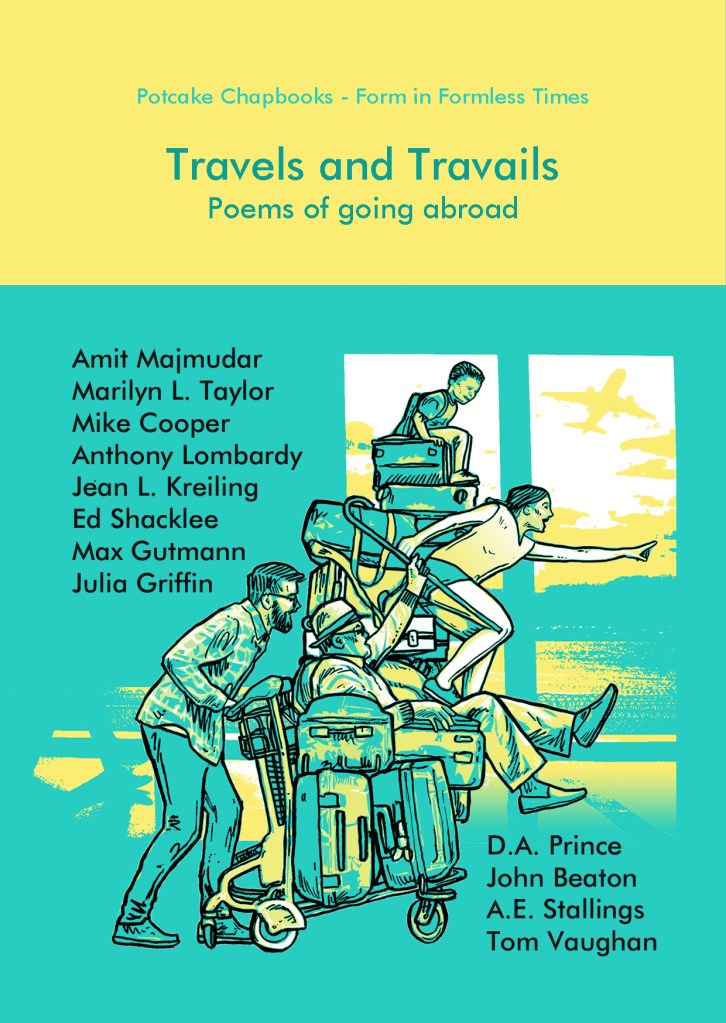
Launch: Potcake Chapbook 10, ‘Travels and Travails’

Maybe it’s just wishful thinking, but surely we’re going to get back to casual international travel again some day soon? The 10th chapbook in the Potcake series is now being mailed out from London, and I trust it augurs well for the happily peripatetic. As usual, the chapbook contains an assortment of the bright (D.A. Prince), the dark (Tom Vaughan) and the flippant (Max Gutmann), with everything in between, and all in rhythm and rhyme–and illustrated of course by Alban Low!

Returning poets are A.E. Stallings, John Beaton, Julia Griffin, Anthony Lombardy, Marilyn L. Taylor, D.A. Prince and Tom Vaughan; joining them are Amit Majmudar, Mike Cooper, Jean L. Kreiling, Ed Shacklee and Max Gutmann. (The links in the names are a mixture of websites, bios, and places to buy their books.) Most, but not all, of the poets are listed on Sampson Low’s webpage of Potcake Poets.

Let’s get everyone vaccinated so we can all start travelling again!

Evocative Fragments: from Arnold’s ‘A Summer Night’ (2)

And the rest, a few,
Escape their prison and depart
On the wide ocean of life anew.
There the freed prisoner, where”er his heart
Listeth, will sail;
Nor doth he know how there prevail,
Despotic on that sea,
Trade-winds which cross it from eternity.
Awhile he holds some false way, undebarred
By thwarting signs, and braves
The freshening wind and blackening waves.
And then the tempest strikes him; and between
The lightning-bursts is seen
Only a driving wreck,
And the pale master on his spar-strewn deck
With anguished face and flying hair
Grasping the rudder hard,
Still bent to make some port he knows not where,
Still standing for some false, impossible shore.
And sterner comes the roar
Of sea and wind, and through the deepening gloom
Fainter and fainter wreck and helmsman loom,
And he too disappears, and comes no more.

This fragment is the response to the previous fragment from Matthew Arnold’s ‘A Summer Night’ that I blogged a few days ago. As a teen in a well-regimented boarding school I found that previous fragment terrifying with its prospect of living as a bored wage-slave forever, and this second fragment exhilarating in its freedom despite the expectation of catastrophe. Altogether a very subversive poem, and I thank my schooling for including such works. For the next couple of decades I followed its path, failing to earn a degree at universities in three countries, never holding a job for more than 18 months, frequently moving. Eventually I found an occupation that was constantly changing, where I was my own boss, and that took me to dozens of countries to teach business seminars. So it all worked out.

Arnold originally ended his poem:

Is there no life, but these alone?
Madman or slave must man be one?

but ten years later added a much more wishy-washy piece about learning from the pure heavens and seeing what a nice life you could make for yourself. I always thought he should have stopped with the original “madman or slave” view of life. Much more dramatic – even though I have to admit his addition may have been justified.

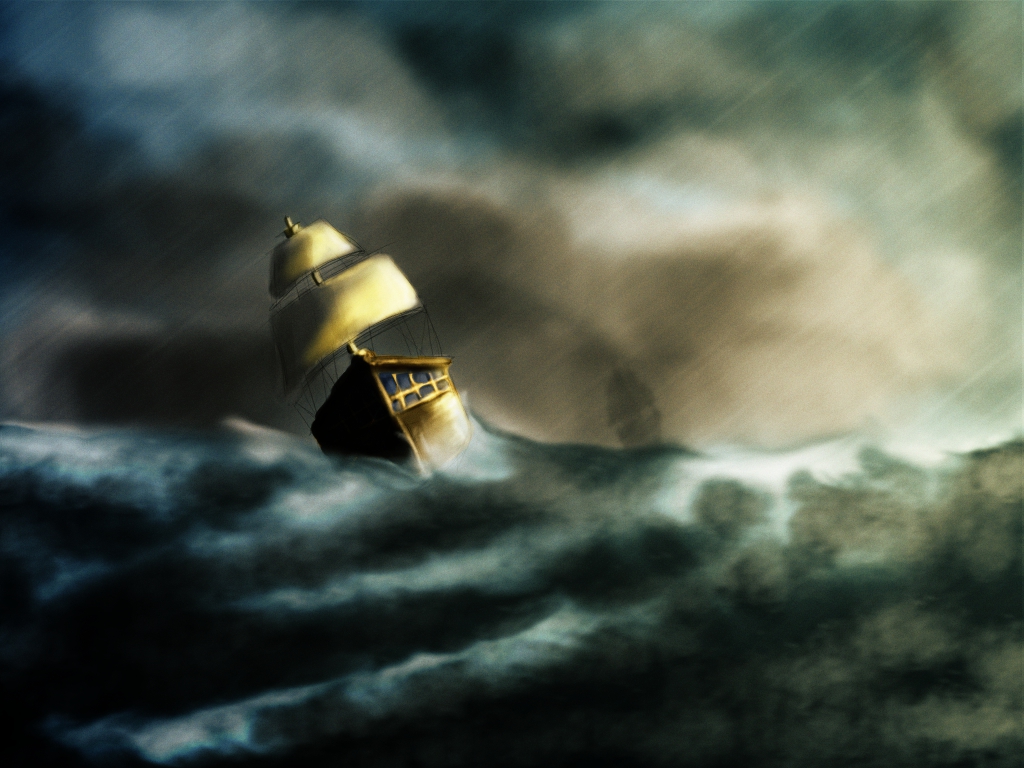
“Storm at Sea” by gentlemanbeggar is licensed under CC BY-NC-SA 2.0

Poem: ‘Ex-Rover’

I was a rover, footloose treasure-trover,
Bahamian, Brit, Dane, Aussie, Canadian,
Easily settling, never for very long,
Followed the sun and the moon with a song.

Now roving is over, Death’s raving and raging,
The threatening madman, waving a knife.
Even my babies have babies, are ageing –
Aren’t there any more decades left in my life?

I was a rover – no grass
Grew under my feet as I’d pass.
Now grass grows and I cut it.
And it grows, and I cut it.
I was wired, now I’m tired;
Fired up, now I’m mired.
And the grass grows again… I give up.

Let me sleep in the sun, and sleep slow.
Let me sleep deep.
When was that rover me?
Let the grass grow.
Let the moon be the stone over me.

This poem has just been published in The Orchards Poetry Journal, where it immediately follows the poem I posted here a couple of days ago, ‘Roughing It In Europe‘. It makes a nice, somewhat sardonic, pairing. Appropriately, this one was written several years after the more enthusiastic earlier one. (From the Orchards link above you can download the Journal as a pdf for free, or buy the very lovely finished product.)

‘Ex-Rover’ is one of those poems that stretches the meaning of the word “formal”. But it has enough rhythm and rhyme to make it relatively easy to learn word for word, and that is a lot of the point of poetry in any language. I feel barely any shame in putting it into the world in this ragged form. The ragged form suits the mood of the piece, after all.

“wanderer” by Cornelia Kopp is licensed under CC BY 2.0

Nonce Poem: “Roughing It In Europe”

One two three four
Is OK, but you need more:

Un deux trois quat’
If you want a welcome mat

En to tre fire
With the krone getting dearer,

Bir iki uç dirt
Selling off your jeans or shirt

Wahid zoozh teleta arba
In a cafe by the harbour

Üks kaks kolm neli
For some food to fill your belly;

Jeden dwa trzy cztery
Language may be shaky, very,

Uno dos tres cuatro
But they’ll love you if you’re up to

Eins zwei drei vier
Trying freely, laughing freer.

This poem, more fully titled “(On the value of learning languages, when) Roughing It In Europe”, was originally published in Unsplendid, actually a splendid magazine that unfortunately has been quiet for the past couple of years. Now the poem is just being reprinted in The Orchards Poetry Journal whose Summer edition is due out today. The poem dates back to my early hitchhiking days, when I was based in Copenhagen but wandering around Europe, North Africa and North America. My experience was that you could wander into any country without any plans, prior contacts or knowledge of the language, and survive so long as you quickly learned to say Yes, No, Please, Thank you, Hello, Goodbye and to count from one to ten – and so long as you smiled, and were comfortable being laughed at for all kinds of mistakes. Case in point: the word “zoozh” that I learned for “two” in Morocco won’t get you very far in most Arabic-speaking countries… So it goes.

Technically, this poem was written in a simple form, nine rhymed couplets, four feet to a line. The second line of each couplet has mostly trochaic feet (i.e. with two syllables, a stressed or accented one followed by an unstressed one). But the first line of each couplet is simply counting out 1-2-3-4 in different languages, and therefore the feet vary with the words of the language. But as we are used to counting to four in a steady rhythm, everything sounds rhythmic regardless of the number of syllables.

So this shows another type of “form”: each couplet is structured the same with the first line counting 1-2-3-4, always in a new language, and the second line having four feet and rhyming with its first line’s “four”. And therefore the poem has a “nonce” form – I created this form for this specific poem; it was created “for the nonce”. You’d be unlikely to find another poem structured quite like this.

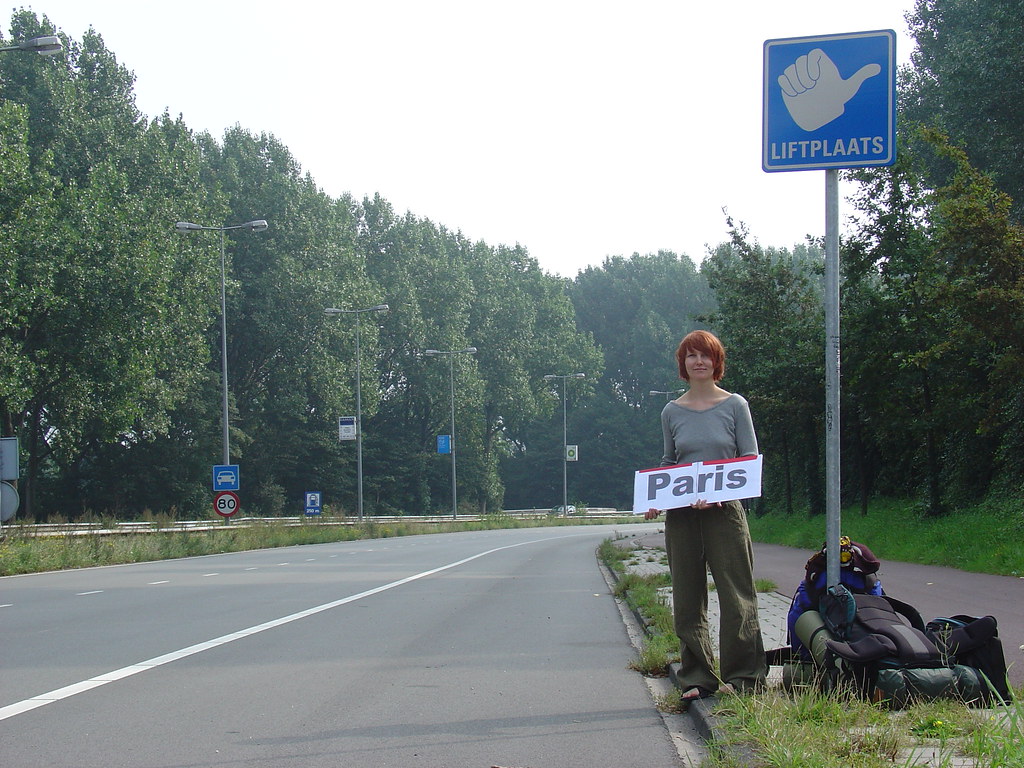
Photo: “Hitchhiking in Amsterdam” by Teppo is licensed under CC BY-NC 2.0

Sonnet: ‘Mythic Memories’

From all the mythic memories we make
Of childhood’s forests, gardens, beaches, seas,
Disturbed by adults’ eccentricities,
Come all the world’s religions – Tree and Snake,
Hero and Mother, Martyr, Saint and Fake.
Then let us make our mythic memories
(Implying endless possibilities)
From all that follows in the island’s wake:

Climbing up banyans, palms and tamarinds –
Firelight and starlight – total black of caves –
Spearing a lionfish – running on pink sand –
And unknown flowers scented on sea winds –
And jagged cliff heights where the ocean raves –
And views of huge horizons past all land.

I think it is important for children to experience the diversity of the world in different ways: when very small they need to feel the rhythms of day and night, winter and summer, and celebrate them with memorable festivals. When they are a little older, say six to eight, it is useful to experience the diversity of the world: if they live in cities, to go to farms and mountains and forests and beaches; if they grow up in a rural area as I did, it is a huge experience to spend a few days in a city. In either of those cases, the experiences make school learning much more relevant, something that can understood and believed in, because of the personal memories. I was fortunate to experience cities and countryside, jungles and deserts, before I started school. History, geography and languages were always very interesting as a result.

For even older children our family advocates a further step: in grade 10–i.e. at age 15–each of our kids got to choose where they were going for a year of schooling overseas. The only restriction was: Not an English-speaking country! They went away for Grade 11 and returned to finish high school with their friends for Grade 12. They went through competent organizations (YFU–Youth For Understanding, and AFS… though one went to the family of a boy we had hosted the previous year). The normal structure was that they went to a family (best if there are other children in the family) in which one parent spoke English; they had a week or two of prep time with the organization in the new country before the school year started; in school, initially they sat at the back of the class and didn’t know what was being said except in English classes and maybe Maths; by Christmas they understood everything; by Easter they spoke fluently; by the end of the year they had acquired the regional accent. The five kids each chose different countries: Denmark, Costa Rica, Italy, Japan and France.

They came back several years more mature than when they left. Instead of dreaming of owning a car, they none of them wanted a car particularly: they had learned to get around a strange city by bus and metro, which is cheap and flexible. Instead of believing that there is only one appropriate style of clothing and only one good type of music for their generation, they realized that even if all teens think that, those clothes and music are different in different countries, and it is a matter of choice. Instead of fighting with us, their parents, over teenage complaints of lack of freedom, they came home delighted to return to the rules and life they had known, with a year of living differently under their belt. And they had seen a lot of the world in a very deep way, the childhood and school experience, the local family experience, all the seasonal foods and songs and rituals, something that is very hard for an adult to ever experience in a foreign country.

And as it is from our childhood experiences that we derive our understanding of the world, and make the myths we live by and the goals we strive for, it is beneficial for us to have as wide and deep a range of childhood experiences as possible. So I believe, anyway.

This poem was originally published in Snakeskin. It may feel like an unfortunate post for a time of Covid and lockdowns in various parts of the world, but the days of good travel should return soon, and we can start planning…

Photo: “Pink Sand Beach” by Cédric Z is licensed under CC BY-NC-ND 2.0
Poetry Resource: “Shot Glass Journal”, Poem: “In the Metal Box”

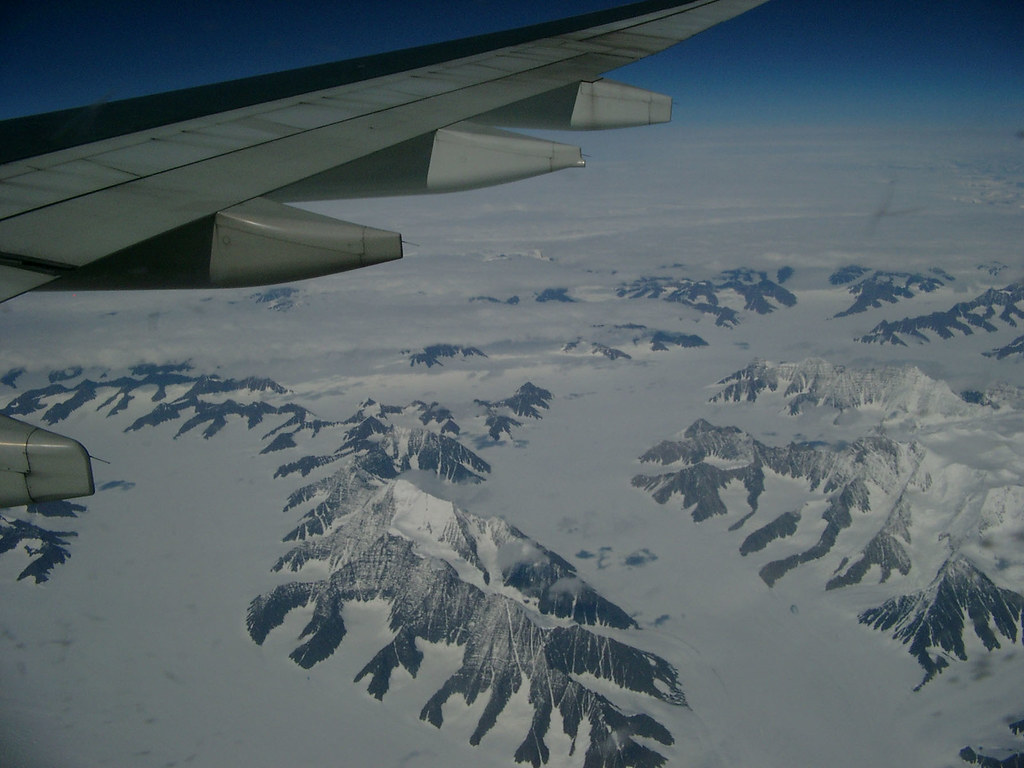
You sit in the humming metal box
And the unlikely landscape rolls
Beneath you in its crumpled seas and rocks
Seen from some miles above on long papyrus scrolls.

This little poem was recently published in Shot Glass Journal, whose motto is “… brevity is the soul of wit …” Accepting only short verse (although “16 lines or less” seems overly generous for “short”) in either free or form, it is remarkable for an American institution in reserving half its space for non-US poets. In the current issue, the left-hand column of 21 US poets is balanced by the right-hand column of 21 poets from Australia, the Bahamas, Canada, India, Ireland, Israel, New Zealand, South Korea, Turkey and the UK. This in itself adds richness and interest to the journal, all the more tasty and accessible in a short-form environment.

Normally edited by Mary-Jane Grandinetti, the current issue (#29) is guest-edited by poet R.G. Rader, the poet and playwright who founded Muse-Pie Press. Muse-Pie Press publishes Shot Glass Journal, as well as two other idiosyncratic magazines, Bent Ear Review of spoken poetry (audio or video submissions only, naturally) and the fib review of Fibonacci poetry. All are open to both formal and free verse.

Technically, this might or might not be a “throwaway poem”. That’s how I would describe it, meaning just a casual thought in verse; but on the other hand some people use the term to mean hand-written thoughts (usually not well-formed) on scraps of paper left behind on public transit or in the park. This one has a bit of form: rhyme, meter, and the last two lines lengthening in imitation of the endlessness of air travel and of the landscape that is being flown over.