Tag Archives: formal verse

Poem: ‘Winter Night Roads’

Full midnight moon on fields that yield but snows,
Air apple-clean, crisp, sweet
In lungs and nose,
The only sound your feet
Past silent woods –
Inhaling moods and modes
Of midnight roads.

In twenty minutes, you hear only this:
A dog bark twice. An owl hoot once.
A horse snort by a fence.
Some heavy breath behind a hedge: a cow.
A mile away a car’s lights show, then go.
You walk unknown, alone, towards some place
With light and life, perhaps a warm cafe
To make a break in travelling towards day.

This quiet little winter poem (sorry about the timing, Australia…) was first published in The Orchards Poetry Journal. The editors tend toward the bucolic and the formal… but they make exceptions, thank goodness, because this piece is not quite formal. It may be in iambics, but without a pattern to the line length or to what rhyme there is.

But it’s true to the winter outdoor experience–and pleasant enough, so long as you have good boots and adequate clothes!

Photo: “Moonlight” by Jyrki Salmi is licensed under CC BY-NC-SA 2.0

Odd poem: ‘The Influenza’ by Winston Churchill, age 15

Oh how shall I its deeds recount
        Or measure the untold amount
        Of ills that it has done?
        From China’s bright celestial land
        E’en to Arabia’s thirsty sand
        It journeyed with the sun.

I omit the next nine stanzas, as the influenza makes its way to Britain. The poem ends:

        For though it ravaged far and wide
        Both village, town and countryside,
        Its power to kill was o’er;
        And with the favouring winds of Spring
        (Blest is the time of which I sing)
        It left our native shore.

        God shield our Empire from the might
        Of war or famine, plague or blight
        And all the power of Hell,
        And keep it ever in the hands
        Of those who fought ‘gainst other lands,
        Who fought and conquered well.

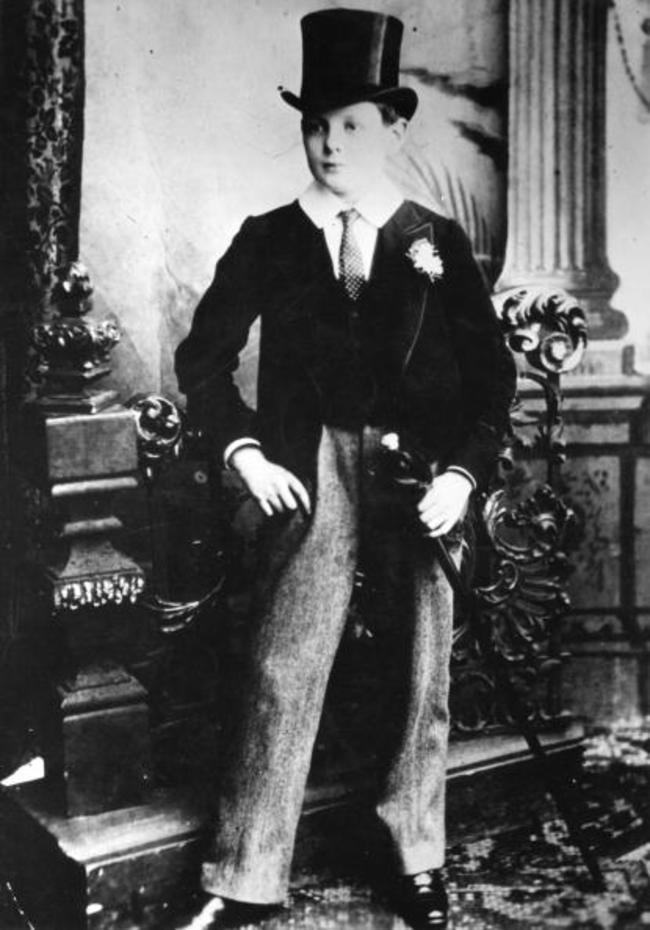
Written in 1890 when he was a lazy 15-year-old Harrow schoolboy who did badly at everything except English, Winston Churchill partially redeemed himself with this prizewinning poem on the global influenza epidemic (which may have been a Coronavirus) of his day. This “Asiatic Flu” or “Russian Flu” killed about a million people worldwide.

The photograph shows Churchill in his school clothes at age 14.

So there you have him: a teenage Churchill, with excellent control of English and an early exposition of his oratory, bombast, nationalism, imperialism, and enjoyment of warfare. And fifty years later he did brilliantly for Britain in the Second World War (but thank goodness for Clement Attlee picking up the pieces afterwards).

Potcake Chapbooks: Updated Call for Submissions

The “Potcake Chapbook” series is named for the dogs of the Bahamas and the Caribbean – strays that live off the burnt scrapings of cooking pots. The poems in the series are a mixed bunch – but the potcake of our logo wears a bow tie to show that he and all the poems are formal. These poems are memorable in part because they rhyme and scan, as all truly memorable (i.e. easily memorisable) poetry does. We subscribe to the use of form, no matter how formless the times in which we live.

Potcakes hunt around the back streets and beaches, looking for something unguarded to eat. Like a potcake, I’m always looking to see if there is some good poem to carry off. The plans for the chapbooks are a bit sketchy, always changing–everything depends on what I run across and what Alban Low would like to illustrate. Perhaps half the poems we have published have come from my poking around back issues of online poetry magazines; and the other half have come from material that has been sent for me to look at.

When there is enough good material on a single theme to fill 13 pages of a chapbook (still leaving room for Alban’s work, of course), then it may become the next project. But until a chapbook actually goes to print everything is subject to change. An even better poem may show up and displace one tentatively placed. A slew (or slough) of poems on a new theme may cause a reprioritisation of planned chapbooks.

This is one of the reasons that I prefer to consider only poems that have already been published–so that I don’t feel guilty about having a bunch of poems that will sit with me for months, years, and may or may not be included in the Potcake series. I have flagged a thousand poems that interest me; but I can only publish a dozen in a chapbook, and only a few chapbooks will get produced in a year.

However I am always keen to read and consider rhymed and metered verse that has already been published. There are several chapbooks that are jostling in the queue for completion and publication:

Travels and Travails (travel)
City! O city! (urban life)
Just a Little Naughty
Portraits Unpleasant
Various Heresies (religion)
Lost Loves
The Horror of Spring! (seasons)

and there are more; but the next one in the series, to come out early in 2021, will be one of science fiction, tentatively ‘Rockets and Robots’. Like all the chapbooks listed above, it is nearly full already. As with all of them, if I run across another poem I really like, I’ll include it.

Poems in the chapbooks run from two or three lines to some 40 lines in length–obviously, with space at a premium, poems over 20 lines and running over one page are less likely to be included… but it does happen. Other criteria: I’m looking for wit, elegance, a variety of traditional and nonce forms, a variety of voices and moods: happy, sad, angry, sardonic, meditative… anything interesting I can scrounge. If you have something you think I might like, on any topic, please send it along to robinhelweglarsen@gmail.com

I can’t promise to use it, but I will read it and reply!

Odd poem: Hemingway’s last poem, untitled

If my valentine you won’t be,
I’ll hang myself on your Christmas tree.

This is the 88th and last poem of the ‘Complete Poems’ of Ernest Hemingway (edited with introduction and notes by Nicholas Gerogiannis). Given that Hemingway ended his life by suicide, this might seem a worrying final poem; but he wrote it five years before his death, and it was truly light-hearted.

He was living with his fourth wife, Mary Welsh Hemingway, at “Finca Vigía” (“Lookout Farm”), a 15-acre property he bought and lived in for 22 years. She writes that he became so fond of the Christmas tree that he wouldn’t allow it to be removed for months after Christmas. This was his 1956 Valentine for her.

Hemingway’s poems are unremarkable at best (despite Eliot having apparently told him that he had promise as a poet). They are not what he won the Nobel Prize for in 1954. But if you like reading biographies, reading his poems is an interesting way of finding out about his thoughts and activities.

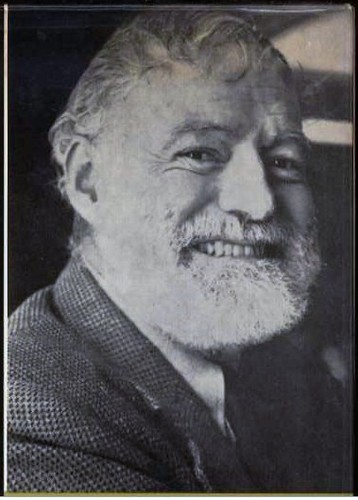
Photo: “Ernest Miller Hemingway” by tonynetone is licensed under CC BY 2.0

Review: ‘Selected Poems’ by Louis MacNeice

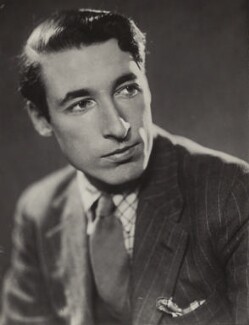
Louis MacNeice was born in 1907. By his early 30s he had published four volumes of verse (as well as other material), sufficiently good and well-received for him to publish this early selection in 1940. The tone is set with the opening lines of the first piece, ‘An Eclogue for Christmas’:

A:  I meet you in an evil time.
B:                                The evil bells
    Put out of our heads, I think, the thought of everything else.
A:  The jaded calendar revolves,
    Its nuts need oil, carbon chokes the valves,
    The excess sugar of a diabetic culture
    Rotting the nerve of life and literature.

Throughout the book we have the passage of time with the deterioration of society, culture and one’s own life, expressed in a blending of old and new images, in rhyme. They are poems of the 1930s, of the Great Depression and the imminent war, all from the same man, all on the same theme.

And yet one or two stand out: ‘The Sunlight on the Garden’ is one of the best poems in the English language, casting a spell with its dazzling intricate rhymes sustained over four stanzas, insightful, wistful, immediately memorable, endlessly anthologised. It relates specifically to his first wife having left him – he wrote this “love-song” for her after their divorce was finalised.

The sunlight on the garden
Hardens and grows cold,
We cannot cage the minute
Within its nets of gold,
When all is told
We cannot ask for pardon.

‘Bagpipe Music’ is also very commonly anthologised because of its bounce, cynicism and humour:

The Laird o' Phelps spent Hogmanay declaring he was sober,
Counted his feet to prove the fact and found he had one foot over.
Mrs. Carmichael had her fifth, looked at the job with repulsion,
Said to the midwife 'Take it away; I'm through with over-production'.

A good question, then, is why these two poems stand out against the rest in the book. What makes them so successful, with their very different moods? I think their common quality, largely lacking in all the other pieces, is that they are very easy to learn by heart and recite, they are almost singable even on a first reading. Pure poetry.

Odd poem: by a young pirate, before his hanging

In youthful blooming years was I,
When I that practice took
Of perpetrating piracy
For filthy gain did look.
To wickedness we all were bent,
Our lusts for to fulfil;
To rob at sea was our intent,
And perpetrate all ill.

I pray the Lord preserve you all
And keep you from this end;
O let Fitz-Gerald’s great downfall
Unto your welfare tend.
I to the Lord my soul bequeath,
Accept whereof I pray;
My body to the earth beneath:
Dear friend, adieu for aye.

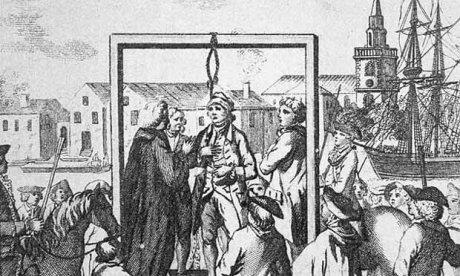
Written by the 21-year-old John Fitz-Gerald of Limerick, Ireland, apparently on the night before his execution. It is quoted in The Pirates of the New England Coast, 1630-1730 (Rio Grande Press, 1923), which in turn is proudly excerpted by the Online Review of Rhode Island History, as well as by David Cordingly’s extensive history and analysis of the Golden Age of piracy, Under the Black Flag.

On 11th June 1723, Captain Peter Solgard, commander of His Majesty’s Ship Greyhound, a man-o-war, engaged two pirate sloops off Long Island, New York, capturing one of them, Ranger, and taking 37 of its 48 crew alive. He brought them in to Newport, Rhode Island, and they went on trial the following month. Those who could show that they had been forced to join the pirates and had not taken part in violence were released, but the pirate captain and 25 others–including our young poet, of course–were “hanged by the neck until dead” on 19th July 1723, between twelve and one o’clock in the afternoon.

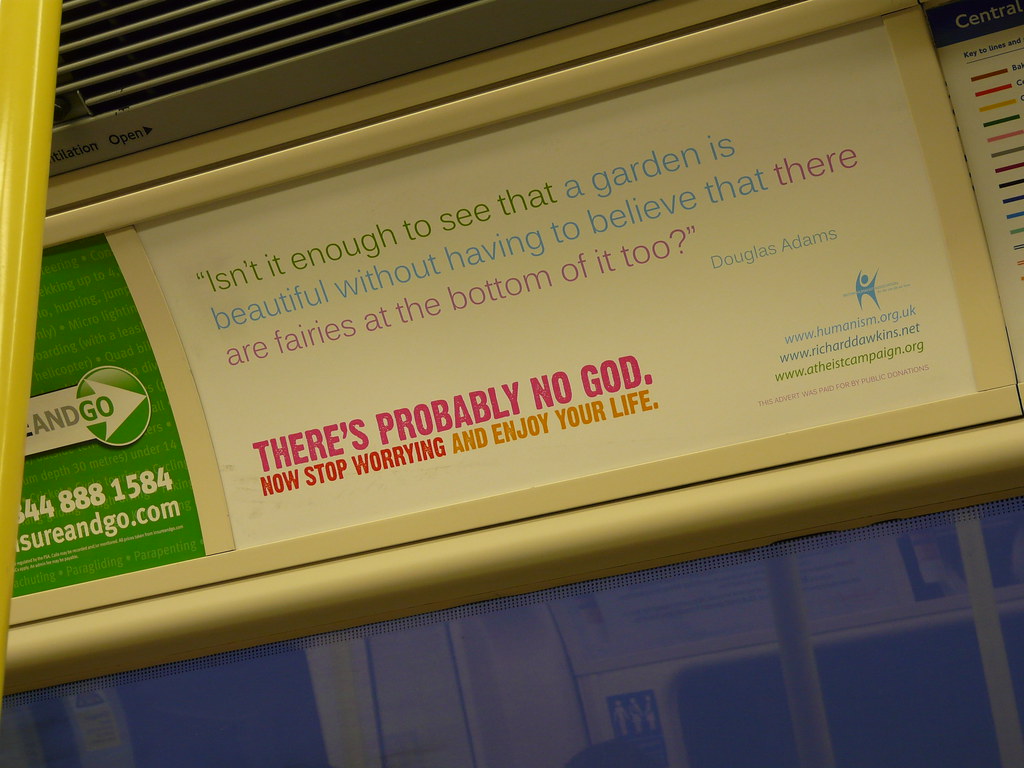
Poem: ‘An Atheist Demands Access to Heaven’

There flows in my veins the most ancient of ardours:
not power, or love, nor yet worship of God;
the fight that each tiniest baby fights hard as
fought earliest man: “Understand!” Pry and prod
with unquenchable flame of the world-disregarders
for Truth! – be it complex, destructive or odd.
If this fire is from Heaven, then Heaven I’ve earned;
so write on my grave: “This stone too shall be turned.”

This teasingly paradoxical little poem was originally published in the Shot Glass Journal, a thrice-a-year journal of 20-30 American poems and an equal number of international ones. Why the name? Because this is a journal for short poems, none over 16 lines. Most of the material they publish is free verse, but they like to have a full range of styles in each issue… which is good news for formal poets.

Photo: “Atheist Campaign on Tube Train” by Loz Flowers is licensed under CC BY-SA 2.0

Poem: ‘Sandcastles’

We’re only children, making castles in the sand.
Enjoy the day.
Night comes, and tides wash all away.

The northern summer is over. Snowy places have snow. Even in the Bahamas and Florida the water temperature is dropping below what locals will swim in (though it doesn’t bother tourists). The day ages towards dark. The year ages towards winter. And we age too. But we know this when we sign up for morning, for spring, for life–and we sign up for everything because there is so much joy, beauty, discovery and love to be experienced.

In Kipling’s ‘Just So Stories‘ one of my favourite passages is the beginning of the story, ‘The Crab That Played With The Sea’:

Before the High and Far-Off Times, O my Best Beloved, came the Time of the Very Beginnings; and that was in the days when the Eldest Magician was getting Things ready. First he got the Earth ready; then he got the Sea ready; and then he told all the Animals that they could come out and play. And the Animals said, ‘O Eldest Magician, what shall we play at?’ and he said, ‘I will show you.’ He took the Elephant—All-the-Elephant-there-was—and said, ‘Play at being an Elephant,’ and All-the-Elephant-there-was played. He took the Beaver—All-the-Beaver-there-was and said, ‘Play at being a Beaver,’ and All-the Beaver-there-was played. He took the Cow—All-the Cow-there-was—and said, ‘Play at being a Cow,’ and All-the-Cow-there-was played. He took the Turtle—All-the-Turtle there-was and said, ‘Play at being a Turtle,’ and All-the-Turtle-there-was played. One by one he took all the beasts and birds and fishes and told them what to play at.

To me this is one of the great secrets of happiness: Play! Play at being who you are, what you are. That includes all your dreams and aspirations, because they are part of who you are. So play at them, as part of playing at what is to be done today. Just play. Play at being yourself.

‘Sandcastles’ was originally published in The Asses of Parnassus, a Tumblr site of “short, witty, formal poems”. This poem isn’t particularly formal, but it has iambics and a rhyme… and it’s short.

Photo: “Sandcastles” by RobW_ is licensed under CC BY-NC-ND 2.0

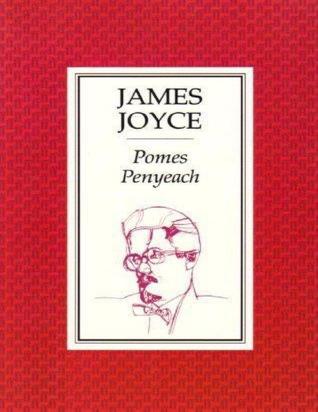
Review: James Joyce, ‘Pomes Penyeach’

That James Joyce would have written and published formal poetry seems out of keeping with his image of the writer of chaotic language (as in how he chose to spell his work’s title rather than Poems, a penny each), but the poems he wrote in the early 20th century are in the language of the time… moderated by his rich words.

Wind whines and whines the shingle,
The crazy pierstakes groan;
A senile sea numbers each single
Slimesilvered stone.

His poetry is often repetitive, but occasionally rich and memorable. (Another of his slim volumes, “Chamber Music”, is arguably more interesting than “Pomes Penyeach”.)

Pomes Penyeach was so small–14 poems of less than a page each–that when Faber republished it they added three more pieces: The Holy Office, Gas from a Burner, and Ecce Puer. The first two are early, crude and bombastic multi-page rants against poets and publishers:

Thus I relieve their timid arses,
Perform my office of Katharsis.

Ecce Puer (“Behold the Boy”) is a later light, sweet meditation on his newborn grandson:

Young life is breathed
On the glass;
The world that was not
Has come to pass.

You never know quite what you’re going to get with Joyce, and that in itself is one of the pleasures of reading him.

Odd poems: Tennyson dialect verse, ‘The Northern Farmer’, Old Style and New Style

Wheer ‘asta beän saw long and meä liggin’ ‘ere aloän?
Noorse? thoort nowt o’ a noorse: whoy, Doctor’s abeän an’ agoän;
Says that I moänt ‘a naw moor aäle; but I beänt a fool;
Git ma my aäle, fur I beänt a-gawin’ to breäk my rule.

This is the opening stanza of Alfred, Lord Tennyson‘s poem ‘The Northern Farmer: Old Style’. The farmer is dying, but obstinately overrules the doctor’s order that he not drink any more ale, just as he obstinately clings to traditional attitudes towards land and class, farming and money.

Where have you been so long and me lying here alone?
Nurse? You’re no good as a nurse; why, the doctor’s come and gone:
Says that I mayn’t have any more ale; but I’m not a fool;
Get me my ale, because I’m not going to break my rule.

It’s one of a series of poems he wrote that recapture the dialect of his Lincolnshire youth, and that reflect the old traditions and the modern changes of that part of the country. It is paired specifically with ‘The Northern Farmer: New Style’–Here the “new style” farmer, out in a cart with his son Sammy, hears the horse’s hooves clip-clopping “Property, property” and chides his son for not thinking enough about money:

Me an’ thy muther, Sammy, ‘as been a’talkin’ o’ thee;
Thou’s beän talkin’ to muther, an’ she beän a tellin’ it me.
Thou’ll not marry for munny–thou’s sweet upo’ parson’s lass–
Noä–thou ‘ll marry for luvv–an’ we boäth of us thinks tha an ass.

Seeä’d her todaäy goä by–Saäint’s-daäy–they was ringing the bells.
She’s a beauty, thou thinks–an’ soä is scoors o’ gells,
Them as ‘as munny an’ all–wot’s a beauty?–the flower as blaws.
But proputty, proputty sticks, an’ proputty, proputty graws.

or, in more modern words:

Me and your mother, Sammy, have been talking of you;
You’ve been talking to mother, and she’s been telling me.
You don’t want to marry for money–you’re sweet on the parson’s daughter–
No, you want to marry for love–and we both think you’re an ass.

Saw her today going by–Saint’s day–they were ringing the bells.
She’s a beauty, you think–and so are scores of girls,
Those with money and everything–what’s a beauty?–a flower that fades.
But property, property sticks, and property, property grows.

Tennyson was meticulous in trying to recapture the life and language of his youth. He wrote:

When I first wrote ‘The Northern Farmer’ I sent it to a solicitor of ours in Lincolnshire. I was afraid I had forgotten the tongue and he altered all my mid-Lincolnshire into North Lincolnshire and I had to put it all back.

And apart from the accuracy of the dialect, Tennyson was as skilled as ever with his carefully conversational metre, and natural rhymes working comfortably with the natural breaks of the lines.