Tag Archives: humanity

RHL, ‘The Sun is Always Setting’

The sun is always setting, always setting on your day;
you sense the dark approaching, wish that it would stay away.
Do you want a life unchanging? Wish to still be a newborn?
Don’t you know life’s not a rosebud, but has root and leaf and thorn?

The sun is always setting and the black drapes are unfurled;
but notice that the sun sets on your world, not on the world:
it’s rolling into brightness in another’s happy land,
and the dark is evanescent and the brightening is grand.

The sun is always setting on the dinosaurs, but birds
are flocking into being, as are Serengeti herds;
and the sun that lights humanity? Of course it’s going to set,
and elsewhere light new tales of which we’ll just be a vignette.

The sun is always setting, but that view is just your choice;
I say the world is turning and evolving; I rejoice.

*****

Sometimes I’m told that my poetry is too bleak. But I think that’s only so if you want everything to stay as it is now. If, on the other hand, you expect change, and that change will ultimately provide more benefit than loss to the universe as a whole, then <shrug>… so it goes.

This poem has 14 lines but is hardly a sonnet. It was recently published in Pulsebeat Poetry Journal. Thanks, David Stephenson!

Photo: “Sunset Sadness” by BaboMike is licensed under CC BY-NC 2.0.

Isabel Chenot, ‘Echoes of Love’

The house is creaking like a rocking chair.
I’m small again,
comforted by the sway of matter in a shift of air,
cosseted by wind.

Undulate earth, how do you slip your hum
around our roar
of concrete, needles, neon, wadded gum,
demented hungers, war,

discarded children? Your lap is full of us
and of our wrong.
How can you simplify the noise
to cradle our first song?

*****

First published in Shot Glass Journal.

Isabel Chenot has loved and practiced poetry for as long as she can remember. Her poems have been published in Shotglass and other places, and some of them are collected in The Joseph Tree, available from Wiseblood books.

Man, woman and child on verandah of weatherboard house” by State Library Victoria Collections is licensed under CC BY-NC 2.0.

Odd poem: Muhammad Ali, ‘Me, We’

Me?
We.

*****

Muhammad Ali was invited to talk to a group of Harvard students on June 4, 1975. Someone shouted, ‘Give us a poem, Muhammad’ and he paused, looked up and said: ‘Me? We’. But as it was spontaneous and spoken, the punctuation is what you will, and evokes a variety of ideas and responses. Questions of identity… of Ali himself being part of the roomful of attendees… of the needs of the group outweighing the needs of the individual… the human journey from selfishness to altruism… Certainly all that is in keeping with the speech he gave that night, excerpted here.

It claims title to the World Championship for the shortest poem, at least in the English language.

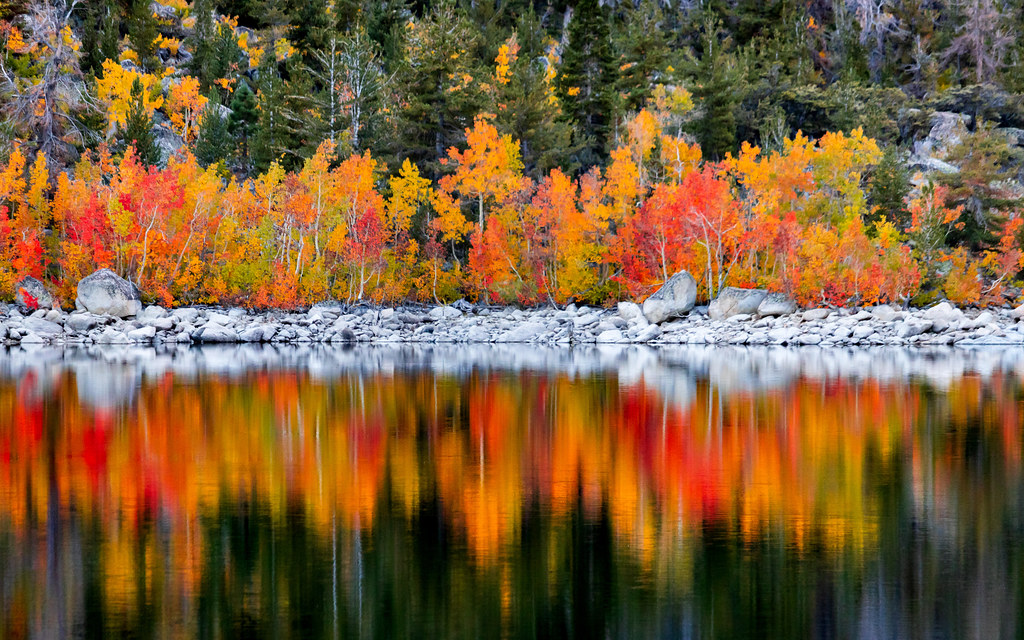
Short poem: ‘North American Fall’

The red leaves in the sunshine are
So red! So red! So red!
There are no buried Caesars here – instead,
The dispossessed of all the Earth,
With native wisdoms, human worth,
Bleed through the trees like a reopened scar.

*****

Today is Canadian Thanksgiving; in the US, Columbus Day; in the Bahamas, National Heroes Day; in all of them “aka Indigenous Peoples’ Day”. Yes, we’re all here, across the Atlantic or the Pacific from where we or our ancestors came. Yes, there are things to be thankful for, and things to regret. But that’s the story of modern humans, walking out of Africa for the past 200,000 years, and of earlier versions walking out of Africa for the previous couple of million years.

Reparations for everything done to each other is impossible… will the Italians pay reparations to the British for 300 years of occupation and slavery? (Not that the reparations would be paid to the English, who didn’t show up until after the Romans left; payment would be to the people the English pushed out: the Welsh, Cornish, some Irish and maybe some Scots…) People have been invading and massacring, invading and enslaving, invading and intermarrying, in all parts of the world since forever.

What would be reasonable would be for all governments to grant all citizens good quality universal education and good quality universal health care at least for the first 20 years of life. Reparations to the dead may be impossible, but giving everyone a decent chance going forward would seem appropriate. And it would be in the interests of everyone who would like a healthy, well-educated society in which to live.

Fall Colors at Lake Sabrina in the Eatsern Sierra” by RS2Photography is licensed under CC BY-NC-ND 2.0.

Semi-formal poem: ‘Thin Thin Skin’

Life on the earth is thin as dust on an apple.
25,000 miles round the planet, and if we go 2 miles high
we struggle to breathe, claw at the air, fight it, grapple.
25,000 miles round the planet, mostly sea
and if sea levels rise a foot, whole communities are lost
and if a storm gives 10 foot waves, houses and lives are lost.
We live on the thin thin skin of the earth.
Is the soil three inches deep, or a foot, or five?
Can we grow enough to survive?
We live on that thin thin skin of dirt.
And people too are fragile, their bones, organs, held in
by their thin thin skin. A knife,
a bullet, even too much sun,
will break the thin thin skin and drain the life.
And society too is fragile, with too many knives and guns,
too little respect for sun, ocean, climate change;
too many people with a thin thin skin
leading their ignorant people into the razorwire of unpredicted change.

*****

This poem was originally published in Lighten-Up Online (or LUPO) last year – thanks, Jerome Betts! It’s not really a formal poem, though there are some rhymes. As for the subject matter, all I can say is: If you haven’t run across the delightful XKCD graphic of the past 12,000 years of temperature change, please click here!

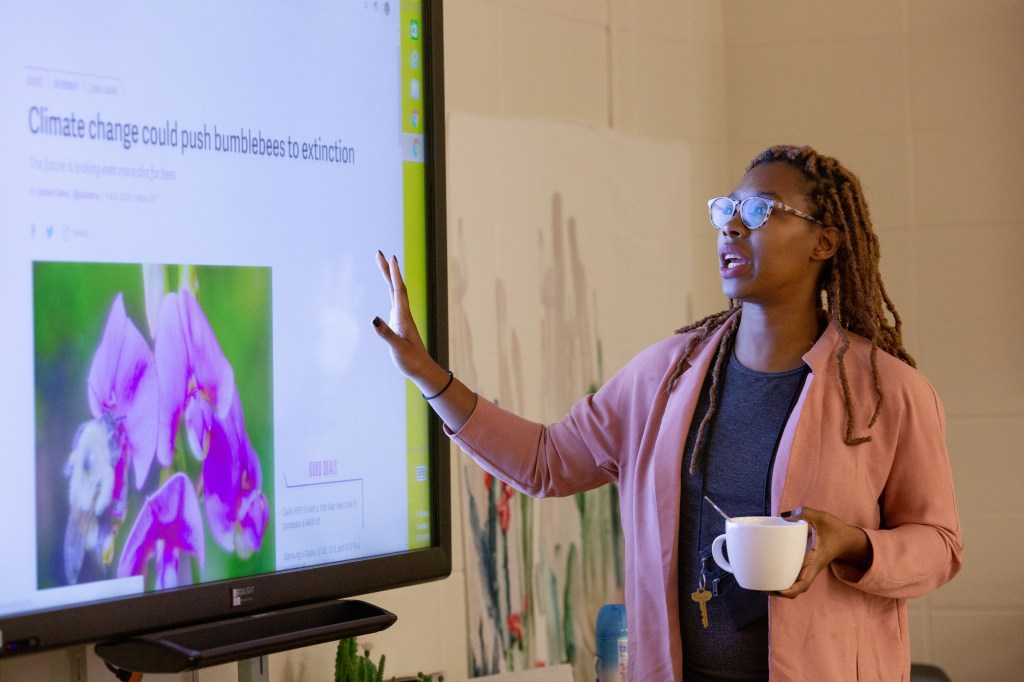
Photo by Allison Shelley for EDUimages: A middle school science teacher explains a lesson on climate change using a SMART board. Copyright CC BY-NC 4.0

Poem: ‘Warfare’

The mother’s nightmare
The child’s terror
The rapist’s freedom
The girl’s death.
The killer’s ecstasy
The band’s brotherhood
The youth’s excitement
The dying breath.

The glory of the lucky
The scream of the unlucky
The lost limbs, blindness, madness
The lifelong PTSD, homeless in the streets.
The poet’s puzzle
The politician’s porn
The aphrodisiac
The power-soaked sheets.

The demagogue’s cause
The demagogue’s solution
The warmonger’s profits
The fearmonger’s skill.
The blacksmith’s trade
The scientist’s incentive
The human fascination
The tribe’s need to kill.

The acceptance by the boys
The eagerness of teens
The avoidance by the men
The manipulation by the old.
The girl’s adoration
The woman’s greed
The widow’s grief
The body cold.

The king’s invocation
The priest’s sanctification
The scared population
The desolation.

The peasant’s loss
The trader’s loss
The teacher’s loss
The city’s loss.

The mortician’s gain
The tombstone maker’s gain
The coffin maker’s gain
The graveyard’s gain.

The medal maker’s gain.

And over it all God sits in His rocking chair
On His front porch in the sky
Saying, A crop, a very fine crop, an excellent crop this year.

Sits in His deck chair to look at the warfare waves
In the shade of a cloud in the sky
Watching the sandcastles washing away.

Sits in the night coming down on the battlefield
Watching crows, ravens, hyenas, stray dogs
Men and women pulling gold teeth from the dead.

Sits in His laboratory, looking at His guinea pigs
Sits in His concert hall, listening to the music
Thinking, All this is so interesting
All this is so tragic
All so inspiring
How far will they get till they blow themselves up?
Will these ones escape? Will they figure it out?
Can they conquer themselves and discover the universe?

Maybe it’s out of line to put this poem into a ‘formal verse’ blog… But there are two points to consider. First, there is a lot of form in the outraged chant of the beginning half–rhyme, rhythm, balance, some alliteration. Second, transitioning from that form to a less structured meditation in itself a use of form; it transitions the entire poem from one viewpoint to another by making the two halves so different. That’s my argument, anyway. Is it reasonable?

The poem originally appeared in Bewildering Stories. Thanks Don Webb and John Stocks!

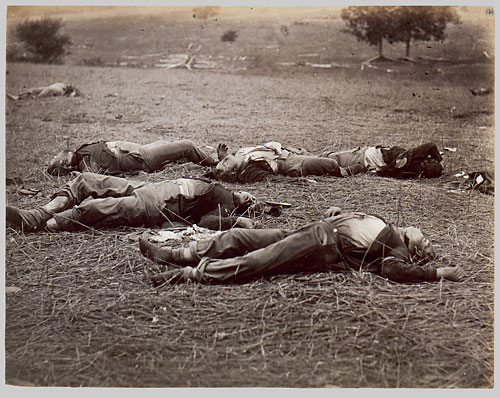
Photo: “Battlefield Dead After the Battle of Gettysburg” by elycefeliz is licensed under CC BY-NC-ND 2.0

Sonnet: ‘Where Are The Lightning Bolts’

Where are the lightning bolts of poetry?
The rolls of thunder and the shattered oaks?
Where, beyond anger, is the ecstasy?
There must be more than parodies, kitsch, jokes–
Elvis-on-velvet, kittens in a room,
jibes at the Lords, the House, the Holy See,
unmetered waffling on a flower in bloom…
Come now, tap Earth’s potential energy!

Our planet on which tens of millions die
from some war, ’flu, government famine, plague–
we pillage land and sea, yet learn to fly
while stories, music, art, reshape the vague
into sublime, emotional or vatic…
Humans can’t last – so be brief, be ecstatic!

Here we are, putting the chaos of 2020 behind us, moving optimistically into the forever-changed and forever-changing future. The storm gods appear to rule our lives: our ape cousins respond in their way, and we should respond to the bigger forces we feel with the wider range of creative outlets that we have–dance, poetry and ecstasy are all appropriate!

This sonnet was first published in The Orchards Poetry Journal, edited by Karen Kelsay Davies who also heads up the four imprints of Kelsay Books. Technically it’s a Shakespearean sonnet by the rhyme scheme, but there is no particular significance in that. Sonnets of all kinds share the compression to 14 lines, and the volta, the redirection of discussion after the halfway mark, and, typically, the sonorous rhetoric of the iambic pentameter. But the driving need of the argument and the near inevitability of the best words will tend to move the rhyme scheme into one form or another. It is better to say powerfully what the poem demands, rather than to weaken the words by trying to strengthen a preconceived rhyme scheme. As elsewhere, “Go with the flow” has a logic to it here.

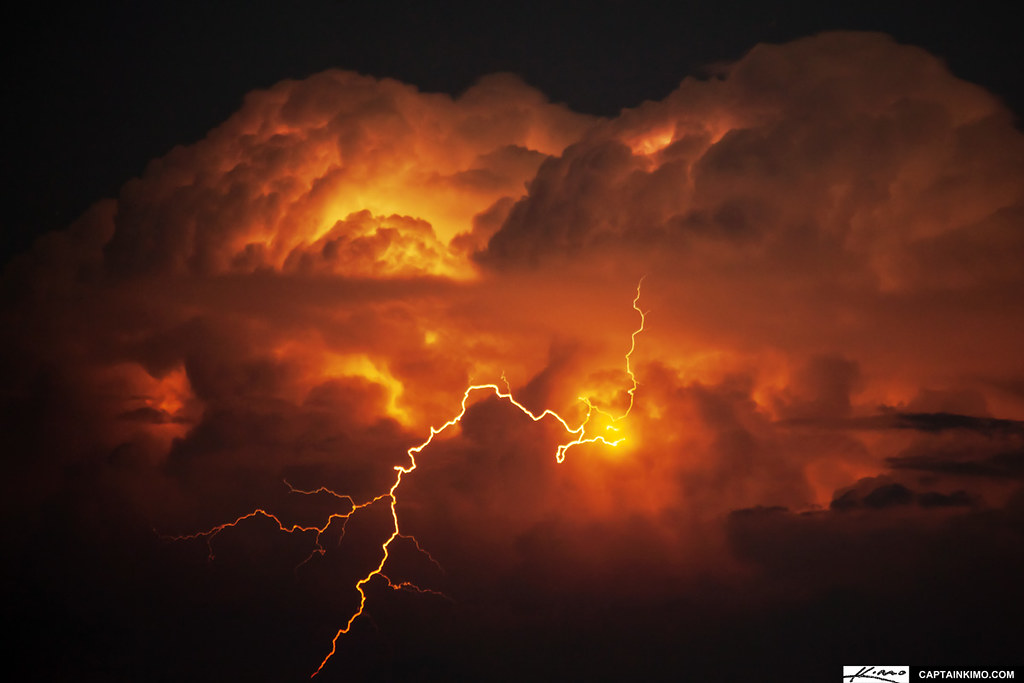
Photo: “Lightning Bolt Over Atlantic Ocean from Jupiter Coast” by Captain Kimo is licensed under CC BY-NC-ND 2.0

Poem: ‘Humankind at Dusk’

It’s in your newsfeed update every day:
The AI obsolescence on its way,
Replacing all tasks, everything we do.
There’ll be no need for people. That means you.
How much is merely existential dread
And how much knowledge of a road ahead:
Unlit, black ice, and your tires have no tread?

With the world stage held by strutters
While the UN talks and mutters.
They’re all out of date tut-tutters.
People in the street
Stand there angry, with lips pursed,
Feeling they’ve been conned, coerced,
Life has gone from best to worst.
Blame the rich elite.

Man, man, think fast:
With the AI racing
And our genes debasing,
Basic humans’ place in
Life won’t last.

Warnings now the TV utters:
Hurricane! But we’ve no shutters,
Power is out, the candle gutters,
Roofs are blown away.
Thrown into the storm head-first
No response can be rehearsed,
Save yourself though you be cursed:
Everything’s in play.

Man, man, think fast:
With the Hive replacing
Every human trace in
Life, be self-effacing
Or be past.

The rest ride the AI-bombs down the sky,
Waving their Stetsons: “We’re all going to die!”
Life always moves on from the old to new.
There’ll be no need for people. That means you.

‘Humankind at Dusk’ was originally published in the Speculative Fiction & Verse zine Bewildering Stories. It reflects my serious concern that we have no idea where we’re going as a species, with everything from genetic modification to brain implants now becoming a reality. Not that I object to it, any more than I object to hurricanes or earthquakes; they’re all part of the nature of things. As humans, we tinker, experiment, explore, run into problems, seek solutions, create all kinds of new problems, and so on. That’s just the way it is.

Technically, I was trying to replicate the nonce structure of a much earlier poem I wrote, ‘Camelot at Dusk‘, to see if this was a form that I could use when trying to create a sense of urgency and disaster bracketed within more reflective and dispassionate statements. So the opening and closing stanzas are in that nice and boring, meditative iambic pentameter; while the middle pieces switch back and forth between two other forms, with shorter, choppier lines and more repetitive rhyme. I created the form to meet the needs of the earlier poem, where I think it worked very well. I’m still (years later) pondering whether it was appropriate to try to reuse the form for this piece. I think I like it, but I’m not entirely sure.

Photo: “silence” by Cornelia Kopp is licensed under CC BY-ND 2.0

Sonnet: “We’ve Reached Earth’s Edge”

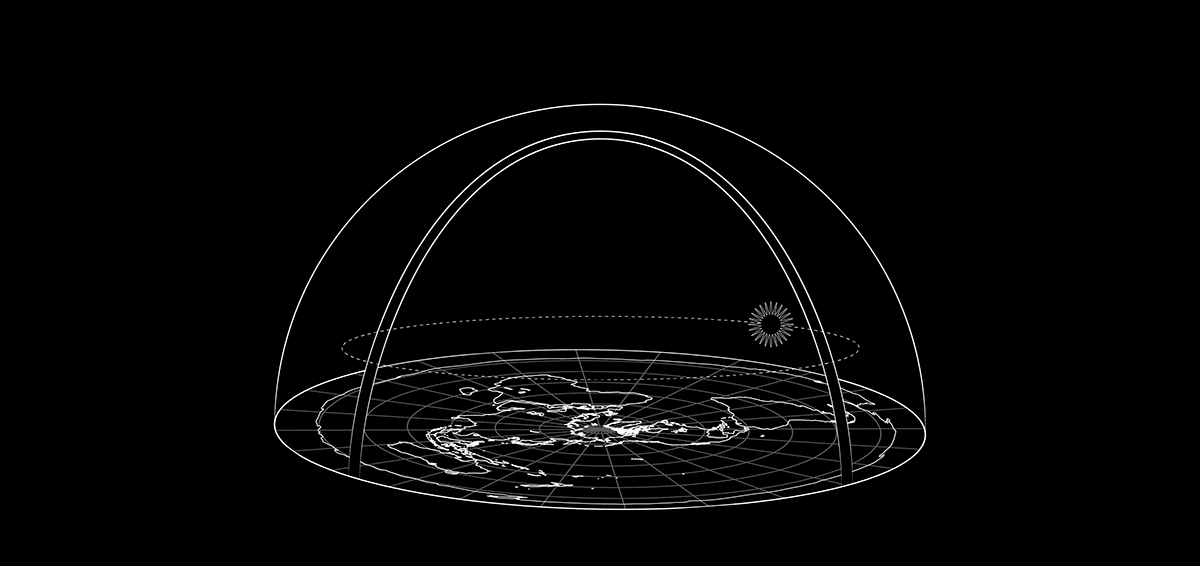
The Earth’s explored, and flat. And I know this
despite Earth’s shadow in lunar eclipse,
and how horizons hide the hulls of ships.
We’ve reached Earth’s edge, stare into the abyss
with Branson, Musk, NASA and the Chinese,
toppling into blackness, falling prey
with Kurzweil, CRISPR, Google, Bostrom, de Grey,
businesslike scientists battling disease,
entrepreneurs with dark unearthly schemes:
the outer darkness space’s endlessness,
the inner darkness immortality.
Pushing and leaning into stellar space,
the event horizon of our thoughts and dreams,
the black hole of our post-humanity.

Published in the Formal & Rhyming Poetry section of this month’s Better Than Starbucks, the “Earth’s edge” idea is just another way of trying to express my ongoing fascination with the end of humanity-as-we-know-it, and the beginning of something that we can’t even visualize yet, let alone make confident predictions about. Close to the idea of the “posthuman god” at the bottom of the Wikipedia page.

Technically, this is a poorly-structured sonnet (ABBA CDDC EFG FEG), with a really weak rhyme of endlessness / space. Sorry about that. But I hope you can enjoy it for the ideas, anyway!


Poem: “The Ape in the Landscape”

Ape

I. THE APE

Like a chimp in a storm
we revert to a norm,
tree-swinging, branch-breaking,
stick-shaking, noise-making;
each baby’s a bomb
and their poise and aplomb
is a jack-in-a-box
full of fireworks and shocks,
full of colour, noise, light
full of anguish, delight,
rending, mending and tending,
exploiting, befriending,
and losing and finding,
abusing and minding,
both stupid and clever
but moving forever,
and dancing and singing
thought-prancing, word-winging,
for there’s no escape
from the million year ape,
from our in-built, inherited shape.

II. EXTERNAL LANDSCAPE

Somewhere a cleft cliff overhang, a cave
where we can stay dry, have a fire, and sleep;
though lions and bears growl outside, we feel brave–
Worship the Cave, Earth’s Deep.

Somewhere, huge in an open plain, a tree–
to climb for refuge, or the whole world see,
loving its fruit, leaves, wood, its shade from glare–
Worship the Tree, Earth’s fountain into air.

Somewhere a river ends where sea’s begun
and marshlands hold vast clouds of birds and fish,
and moon and tides swing like the winds and sun–
Worship the Waters, fresh, salt, both Earth’s gifts.

Somewhere the lightning strikes, a forest burns;
only one thing runs to it, not away,
one creature uses it to make night day,
cook food, stay warm, make tools, dance round and play–
Worship the Fire, on which being human turns.

Somewhere the landscape most potential shows:
more people, and some wary bird or beast;
by integrating them the human grows
into the landscape’s richness, Nature’s feast–
Worship the Richness with which life’s increased.

III. INTERNAL LANDSCAPE

Climbing, foraging and hunting,
running, loping, chasing something–
we were built for this.

An open field with a large tree,
a path towards a far blue sea–
the landscape we think bliss.

Keeping dogs, cats, birds as friends,
sharing food for no clear ends–
extended family.

Pigs, cows, sheep, ducks, geese as pets,
eating them without regrets–
that’s humanity.

And talking, dancing, running, singing,
friends and lovers, parents, children,
social, single, energetic,
meditative or frenetic…
we’re a tribal ape at heart,
without the wild we fall apart,
the ape’s our essence, end as well as start.

This poem was just published in Snakeskin, a very appropriate magazine from the point of view of its name, whose meaning is spelled out in the Credo in its first issue back in 1995:

The serpent whispered unto Eve:
“Think and feel; don’t just believe.”
This made the earth’s foundations shake.
We are the kindred of that snake. (…)

We trust no level tones; we ride
The roller-coaster of our pride.
The gonads’ rage, and yearning’s ache
Speak through the kindred of the snake.

In other words, no matter how much we develop our civilisation, no matter how much we tinker with our genetics, no matter how much we turn our decision-making over to AI, we need to acknowledge and work with – and enjoy – the primitive drivers and needs that are inherent in our physical and psychological makeup.

In other words (this time Nietzsche’s), “Stay true to the earth, my brothers,” even while looking forward to the coming of the Superman, for we are still part ape, and our coheret progress depends on our awareness of that, and of self-knowledge in general.

Technically the poem is a mish-mash of forms, somewhat casual in structure by formal standards, but rich in rhythm and rhyme. And this too is in keeping with Snakeskin’s Credo:

Nor shall we sit to lunch with those
Who moralise in semi-prose.
A poem should be rich as cake,
Say the kindred of the snake.

Enjoy! And my thanks to Snakeskin’s George Simmers.