Category Archives: Robin Helweg-Larsen

Poem: “4 God Limericks”

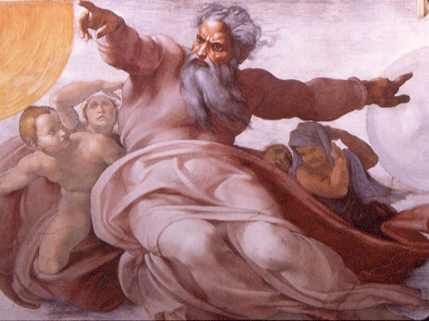
God

Christian idea of God

God made Heaven, earth, plants, people, fleas
In six days, and then rested at ease;
Then He thought: “In those stones
“I’ll hide dinosaur bones!!”
(He was always a bit of a tease.)

God looked out a Heavenly portal
And what He saw made Him just chortle:
Some dude, on a cross,
Claiming he was the Boss!
For his hubris, God made him immortal.

God, blessed with what one must call humour,
Decided to start up a rumour
That Himself as a dove
Came to Mary with love
And begat an Immaculate Tumour.

God saw how Religion had deadened
And said to His host, “Armageddon’d
“Look good on this lot”
For His plans were all shot
And His angels teased Him till He reddened.

As with the previous post, “4 Guru Limericks”, this was first published in Ambit No. 196, Spring 2009. (Hence the English spelling.) Like the previous post on gurus Buddha, Jesus, Marx and Hitler, you shouldn’t expect anything serious from a limerick. But this flippancy can have a purpose: by tackling a serious subject in a completely unserious way, you can undermine preconceptions and unthinking assumptions, and suggest alternative views and approaches.

With this in mind, consider the idea that religious belief correlates negatively with analytical thinking, but positively with moral concern and empathy. Research into this was summarized in The Independent in 2016, after more complete reporting in the science journal PLOS ONE. Limericks by their iconoclastic nature appear to be low in moral concern and empathy – but often it is some form of moral concern that has driven the limerick’s creation, although its rudeness and fresh viewpoint tends to favour analytical thinking over empathy.

Limericks are the clowns, the fools, of the poetry world. The best of clowns and fools go into stealth mode to make useful observations.
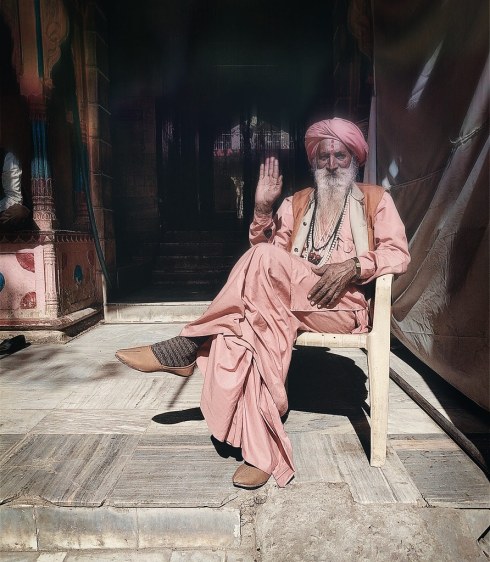
Poem: “4 Guru Limericks”

A wealthy young prince called Gautama
Loathed worship of Krishna and Rama;
“It’s inside you,” he said
But, once he was dead,
He was worshipped…. That’s interesting karma!

A radical rabbi called Jesus
Assumed if he loved us he’d please us;
Though he loved Mary Magdalene,
John, and small children,
His power was no match for Caesar’s.

A second-rate father, Karl Marx
Let his kids die while writing remarks
On Struggle and Might
And the duty to fight
For state-owned newspapers and parks.

Hitler, son of a half-Jewish bastard
Dreamed of occult power; Europe, aghast, heard
Race-hate psychodrama;
His unending trauma
Destroyed the whole state that he’d mastered.

I love limericks. Their elegant form, rhythmic and rhyme-rich, and their frivolous and chatty anapestic feet, allow you to be rude and insulting without causing more offence than a well-dressed wit who has had one too many drinks at a party. And as such, they say things with very few words in a way that is very easy to remember.

As for gurus… well, it’s always good to be able to listen to people with more experience and wisdom than oneself, but that doesn’t necessarily make them correct in their analysis, infallible in their prescriptions and proscriptions. They’re still only human, full of half-aware dreams and unconscious bias. And if they have swarms of devotees and go off the rails, well, they really go off the rails.

Poem: “On Rousseau’s Dream”

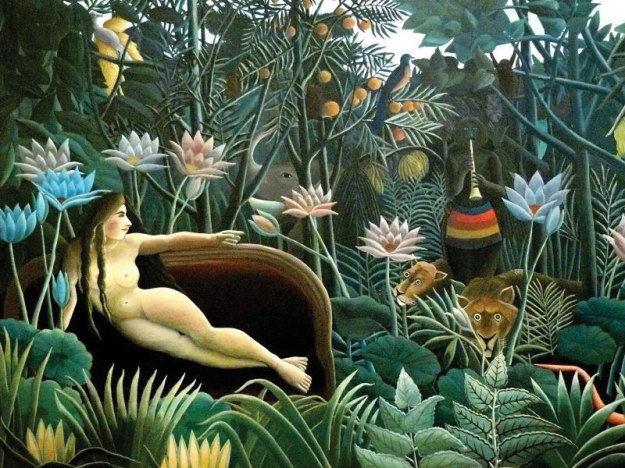
Rousseau, The Dream

Henri Rousseau, “The Dream”

I will be a flutist
standing in the trees
with the lions and tigers
stalking past my knees;

you, my naked lady
languid on a couch –
is the tiger standing,
or is it in a crouch?

Enormous tropic blossoms
open in the heat;
your hand is out toward me,
the pipe I play is sweet.

You have no need to answer
if things are as they seem.
The scene will last forever,
A moment, and a dream.

Henri Rousseau’s 1910 painting, The Dream, is one of his jungle-themed paintings, and hangs in one of the world’s greatest museums, MoMA, New York’s Museum of Modern Art. It is very powerful seeing the original – for one thing, it’s big – 2 x 3 metres. But my immediate inspiration for the poem was the Chaleur coffee mug of the painting – the colours are brighter (or they were, until I put the mug through the dishwasher too many times), and the flute player is more prominent.  

Technically the poem is… well, ekphrastic, because it’s about a painting, or at least a coffee mug. First published in The Lyric, it is a simple poem; perhaps colloquially you could say it is in hymn format. Regular quatrains. Three iambic beats to the line, with an extra syllable on the first and third line of each quartet. Just like

“From Greenland’s icy mountains
To India’s coral strand…”

But unlike a lot of hymns, only rhyming the 2nd and 4th lines. That’s just me being lazy. The painting itself is far better (of course!). My poem doesn’t even mention the elephant, trumpeting away in the foliage…

Poem: “Eva’s Trip”

Eva

(Poster for Prostitution Support Centre, Norway)

Some of the girls I know
Go to the University
Sit so pretty
Prissy
Kiss-kiss and cissy
With beautiful boys that they know
Friends to drink tea with
Chat with and be with
Feather-headed into the feather-bedded night.

Oh no, sweet Jesus, hear me. I scream.
Such a life of show
Is beyond what I dream.
Give me a man who I’ll never know
A man without feelings, without wrong or right
Without obligations
Except for the money.
Let him be cold and hard as the money
And the money as dirty and evil as me.
I can’t trust feelings, I never trust feelings
And I don’t care
That I can’t care…
I don’t dare.

Some of the girls that I’ve seen
Listen to that classy music, they sit
And play piano while they drink their tea.
That’s somewhere I’ve never been.
Cello! Piano!! What SHIT!

Sweet JESus CATCH me beFORE I SCREAM
give me ROCK, ROCK, give me ROCK oh give me ROCK
ROCK, give me ROCK, give me ROCK
blast my MIND let me DROWN give me SO much of ALL
that my HEAD and my BODy are FINally SOUND
give me ROCK, ROCK, give me ROCK, ROCK
give me ROCK rock ROCK rock ROCK, ROCK
DROWN me DROWN me, LET me go DOWN
aWAY
aWAY
aWAY.

Some of the kids from my school
Would sit down to a smoke, have a toke and cool down,
Drift round the town feeling cool.
Not me.

Some of the students I’ve seen
Trip out on acid, they want to expand.
They want to feel all that they can, and still more.
Not me.

Give me JUNK.
Give me the rush and the bliss of fuck-all.
Give me the unsatisfaction of life.
Give me the treadmill toward the next fix,
The stealing or whoring, the need, the despair
Of being whipped up an unending stair.
A problem of Now I can just about handle,
The safety in knowing tomorrow’s the same
And the whole problem, thank God, unthinkable,
Only the treadmill toward the next fix,
The fix of nothingness, of peaceful nothing.
And let me not think
LET me not THINK
Sweet JESus if I THINK even ONCE
I’ll SCREAM I’ll SCREAM I’ll SCREAM
I’ll DIE.

This poem was originally published in Ambit in the UK when the delightful Martin Bax was editor, and has been reprinted various times, most recently under the name “Eva’s Trip” by Bewildering Stories, edited by Don Webb and John Stocks.

I wrote the poem when I was living in Copenhagen at a time that there was a lot of concern about young people from across Europe running away to Denmark, especially to Copenhagen’s “Freetown Christiania”, and ending up in prostitution. A big newspaper investigation on the subject gave the pseudonym Eva to a teenager they interviewed, and I thought the name well-chosen for the combination of innocence together with the knowledge of good and evil that such people have.

Poem: “All Aboard!”

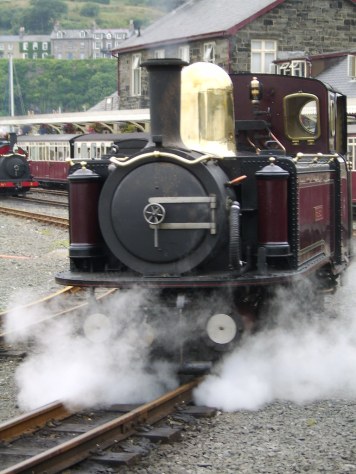
If an emotion pulls into your mental station
Like a steam locomotive, whatever dream motive
I second the motion, I say, “All aboard!”

Why do I, I who try not to die,
Welcome a hurricane? Waves walk, trees fly,
Houses unbuild. I don’t know why, but: All aboard!

Why do I, bride-bridled and stably stabled,
Let other girls turn my head to no purpose nor bed?
I don’t know; it’s a ride! All aboard!

Why, in hot sun or cold rain, do I take my stand
Protesting war not my war in some other land?
I don’t know; need a hand? All aboard!

Why even think? And why, from thought’s rubble,
Write without fright, and freight me with trouble?
Listen, that whistle that bristles with power! – We now are
All aboard!

This poem was published in Bewildering Stories #822. It is a paean to action, excitement, adventure, exploration and self-exploration, including both brave moral stands and dangerous irresponsibility. There is something very human in the reckless drive for experience and achievement, from Pandora’s box and Eve’s apple to the Manhattan Project, the Apollo Program and Nike’s “Just Do It”. This drive can’t be suppressed without warping or destroying the human, but it can certainly be channeled into constructive rather than destructive activities… although who is to say which is which? And then this becomes yet another area for ruthless research.

Technically the poem has formal elements rather than being “formal verse” as such. It has a scattering of rhyme and a ragged rhythm; each stanza has a similar length and structure, ending in the “All aboard!” Tricks of rhetoric, designed like all formal poetry to make the passage memorable and able to be recited. But is that enough to designate it a formal poem? I’m dubious.

Haiku: “Young Man”

Ageing Man in Mirror

(In the mirror)

Where’s the young man gone,
who lived in mirrors so long?
Putting old masks on.

This was published in Asses of Parnassus, a most worthy site for short verse, especially the flippant, frivolous or sarcastic. “Young Man” seems to be a theme I keep returning to, probably because I keep having birthdays. It’s easy enough to feel in your early 30s when you’re climbing a tree to pick fruit, or swimming, or reading; but a mirror may offer an unexpectedly different opinion.

Technically a loose sort of haiku, this poem meets the requirements of 5-7-5 syllables and the volta between lines 2 and 3, but hardly addresses a season and its sensibilities. The rhyme and near-rhyme of the three lines is not something required in Japanese, but seems to me to be necessary in an English haiku to make it a poem, i.e. to differentiate it from 17 syllables of prose written over three lines.

Poem: “Said Poor Mrs. Owen”

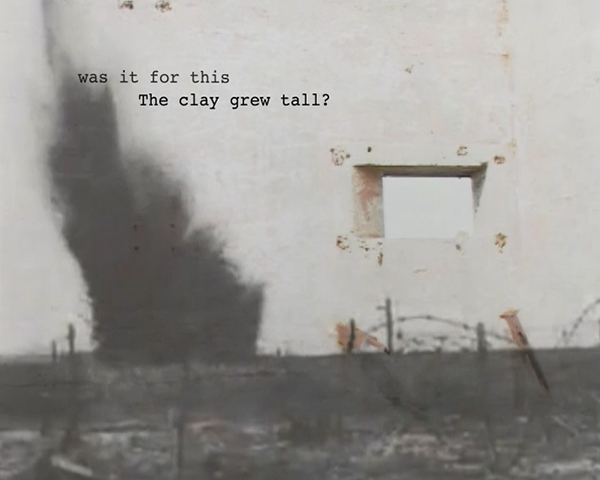
Wilfred Owen

(“Futility” by Robbie Kerr) 

Said poor Mrs. Owen
To her son Wilfred
Why must you always
Write of the trenches?
Why can’t you write
Like that nice Mr. Wordsworth
Of flowers?

Said Mrs. Picasso
To her son Pablo
Why must you always
Paint so distortedly?
Why can’t you paint
Like that nice Mr. Monet
Some flowers?

Because we don’t always
Create what we celebrate,
Sometimes we model the
Things that we’d like to change,
Things we don’t like, or just
Things that we think about –
Thoughts of ours.

This poem was published in The Road Not Taken – a journal of formal poetry that is edited by Kathryn Jacobs in connection with Texas A&M University at Commerce, TX.

Technically the poem lacks some aspects of what we tend to assume is “form”, notably extensive rhyme, alliteration or assonance. But each of the stanzas has the same seven-line form, with two stressed syllables in each of the first six lines and a shorter seventh line. The first two stanzas have virtually identical structure, though one deals with poetry and the other with painting, and the third stanza answers them. The last lines repeat and rhyme.

It is really the natural rhythm of the poem that allows it to be included in a journal of formal poetry. In the sense that “form” is any trick of verse that allows it to be remembered word for word, form can be a lot broader than some of the narrow definitions of formal verse.

Poetry Resource: “SF&F Poetry Association”; Sonnet: “On a Dead Spaceship”

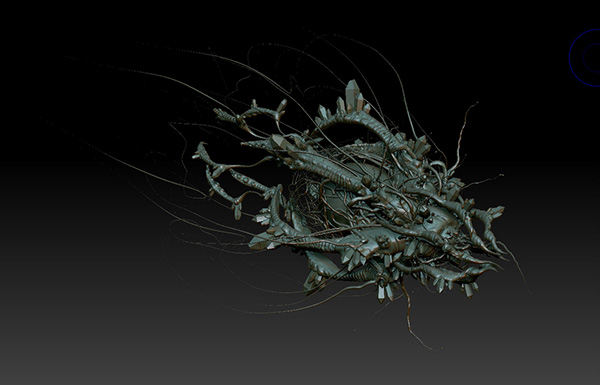
Spaceship

(“Golconda Uranium (2012)” by Alexey Kashpersky)

On a dead spaceship drifting round a star
The trapped inhabitants are born and die.
The engineers’ broad privileges lie
In engine room and solar panel power.
The fruit and vegetables and protein coops
Are run by farmers with genetics skills:
The products of their dirt and careful kills
Help service trade between the several groups.
Others – musicians, architects – can skip
Along the paths of interlinking webs.
Beyond these gated pods that the rich carve
For their own selves (but still within the ship),
In useless parts, are born the lackluck plebs.
Heard but ignored, they just hunt rats or starve.

This sonnet was published in Star*Line, the official journal of the Science Fiction & Fantasy Poetry Association, a quarterly edited by poet and English prof Vince Gotera. Each issue contains a vast diversity of sf&f poetry. Not much of it is formal, but that is all part of the diversity which is appropriate to its genre.

So a sonnet is fine. And this one, like so much sf, is a metaphor for Earth today: circling the Sun, carrying highly unequal societies.

Technically, it is a sonnet to be sneered at by purists: it rhymes ABBA CDDC EFGEFG, the second quartet failing to rhyme with the first, making it a flawed Petrarchan sonnet. In addition, rhyming “star” with “power” is a bit of a stretch, one syllable against two, and none of them sharing quite the same vowel… Oh well, it’s only Science Fiction…

Poetry Resource: “Shot Glass Journal”, Poem: “In the Metal Box”

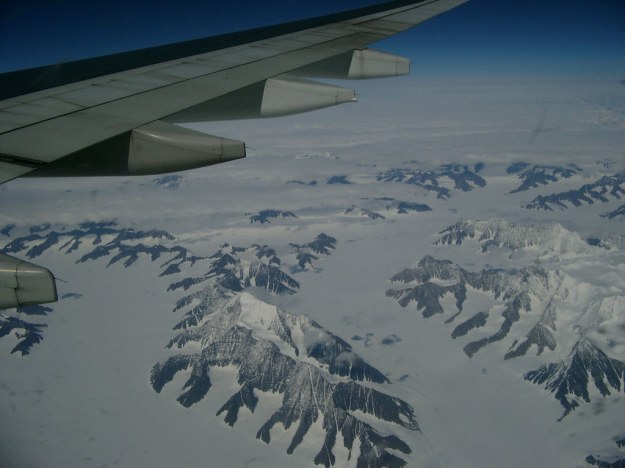
You sit in the humming metal box
And the unlikely landscape rolls
Beneath you in its crumpled seas and rocks
Seen from some miles above on long papyrus scrolls.

This little poem was recently published in Shot Glass Journal, whose motto is “… brevity is the soul of wit …” Accepting only short verse (although “16 lines or less” seems overly generous for “short”) in either free or form, it is remarkable for an American institution in reserving half its space for non-US poets. In the current issue, the left-hand column of 21 US poets is balanced by the right-hand column of 21 poets from Australia, the Bahamas, Canada, India, Ireland, Israel, New Zealand, South Korea, Turkey and the UK. This in itself adds richness and interest to the journal, all the more tasty and accessible in a short-form environment.

Normally edited by Mary-Jane Grandinetti, the current issue (#29) is guest-edited by poet R.G. Rader, the poet and playwright who founded Muse-Pie Press. Muse-Pie Press publishes Shot Glass Journal, as well as two other idiosyncratic magazines, Bent Ear Review of spoken poetry (audio or video submissions only, naturally) and the fib review of Fibonacci poetry. All are open to both formal and free verse.

Technically, this might or might not be a “throwaway poem”. That’s how I would describe it, meaning just a casual thought in verse; but on the other hand some people use the term to mean hand-written thoughts (usually not well-formed) on scraps of paper left behind on public transit or in the park. This one has a bit of form: rhyme, meter, and the last two lines lengthening in imitation of the endlessness of air travel and of the landscape that is being flown over.


Sonnet: “Unanswered”

The Afterlife – some Happy Hunting Ground?
Or Jesus, virgins, merging flesh and breath?
Or god of your own world, white-robed and crowned?
Or ghost? Rebirth? Just, please, no final death!

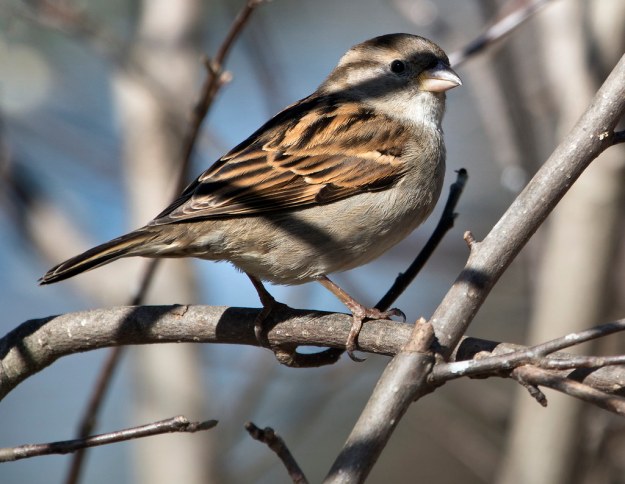
The sparrow through the Saxon hall at night –
Brief light and warmth, then cold obscurity.
Is this our life? But yet the bird in flight
lived in the dark, both pre and post. Do we?

Frogs, living in a buried water tank,
spend all their time in darkness. Then the lid
is lifted and sun shines into the dank –
lid down, light gone… but they live on, though hid.

We work and play throughout our brief day’s sun –
Day raises many questions – night, just one.

This sonnet was published in Snakeskin No. 265, edited by George Simmers. I write both religious and irreligious poetry as the muse suggests, but my own personal views are Fundamentalist Agnostic: “Nescio et tu quoque”, “I don’t know and neither do you.” The sparrow reference is to a passage in the Venerable Bede’s Ecclesiastical History of the English People which usually seems to resonate well.

Technically the sonnet is Shakespearean: iambic pentameter rhyming ABAB CECD EFEF GG. The three quatrains are each self-contained, but leading to the resolution (or lack of resolution) in the couplet. The last line is the strongest, which is always satisfying.