Category Archives: short poems

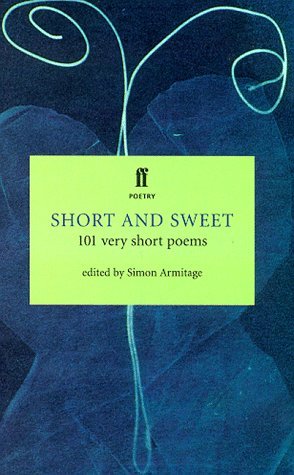
Review: ‘Short and Sweet – 101 very short poems’

One of a series of short poetry collections that Faber produced in the 1990s, this one features a good introduction by the anthologist (and poet well-known in the UK) Simon Armitage, discussing and justifying the short poem:
“The short poem, at its best, brings about an almost instantaneous surge of both understanding and sensation unavailable elsewhere; its effect should not be underestimated and its design not confused with convenience.”

Of course I love them, they are my children.
This is my daughter and this my son.
And this is my life I give them to please them.
It has never been used. Keep it safe. Pass it on.

– The Mother, by Anne Stevenson

Armitage defines the short poem as no more than 13 lines, thereby ruling out the sonnet as something more than short. Other people define it in other ways: the Shot Glass Journal publishes anything up to 16 lines under its “Brevity is the soul of wit” motto, while another of my favourite collections of verse defines the short poem as ‘Eight Lines or Less’. There is no agreed definition of “short poem”. And as Armitage shows, in 13 lines you can still cover a lot of ground.

She lay a long time as he found her,
Half on her side, askew, her cheek pressed to the floor.
He sat at the table there and watched,
His mind sometimes all over the place,
And then asking over and over
If she were dead: ‘Are you dead, Poll, are you dead?’

For these hours, each one dressed in its figure
On the mantelpiece, love sits with him.
Habit, mutuality, sweetheartedness,
Drop through his body,
And he is not able now to touch her–
A bar of daylight, no more than
Across a table, flows between them.

– As He Found Her, by Jeffrey Wainwright

Some of the poems in the collection were new to me, including both the above. Some of the poems are extremely well-known but always a joy to read: Yeats’ ‘The Lake Isle of Innisfree’, William Carlos Williams’ ‘This is Just to Say’. And others hover half-known:

Where is the grave of Sir Arthur O’Kellyn?
Where may the grave of that good man be?
By the side of a spring, on the breast of Helvellyn,
Under the twigs of a young birch tree!
The oak that in summer was sweet to hear,
And rustled its leaves in the fall of the year,
And whistled and roared in the winter alone,
Is gone, — and the birch in its stead is grown. —
The Knight’s bones are dust,
And his good sword is rust; —
His soul is with the saints, I trust.

– The Knight’s Tomb, by Coleridge

Starting off with the 13-liners, the poems get shorter and shorter as you read on, but without losing their punch–perhaps, as the introduction suggests, condensing their power.
Shakespearean fish swam the sea, far away from land;
Romantic fish swam in nets, coming to the hand;
What are all those fish that lie gasping on the strand?

– Three Movements, by Yeats

… all the way down to the final poem with no text at all, but only its title:
– On Going to Meet a Zen Master in the Kyushu Mountains and Not Finding Him, by Don Paterson.

Most but not all of the 101 poems are formal; most are originally in English, though there are a few translations: Paz, Sappho, Apollinaire, Salamun and – most surprising in its elegant translation from the Polish – this one, ‘Bodybuilders’ Contest’:
From scalp to sole, all muscles in slow motion,
The ocean of his torso drips with lotion.
The king of all is he who preens and wrestles
with sinews twisted into monstrous pretzels.

Onstage, he grapples with a grizzly bear
the deadlier for not really being there.
Three unseen panthers are in turn laid low,
each with one smoothly choreographed blow.

He grunts while showing his poses and paces.
His back alone has twenty different faces.
The mammoth fist he raises as he wins
is tribute to the force of vitamins.

– Bodybuilders’ Contest, by Wislawa Szymborska.

Altogether an excellent and well-rounded collection.

Poem: ‘Hail Deth’

Hail Deth, that from alle Natur’s birth
Hast kept each living thing thy thrall!
Teech me to love thy quiet call,
To rest
Among the blest,
To be at peace with every thing on earth.

Come soft, without impediment;
Let mee slide sleeping to thy armes,
Discover alle thy soothing charmes;
And kill
My every ill,
Leave mee uninterrupted sediment.

This is one of my very earliest poems, with the form, theme and erratic spelling all obviously influenced by studying the Metaphysical Poets in school. I’ve always been fascinated by death–at least since the time I gave up Christianity, thanks to my excellent Church of England schooling. The poem was written tongue-in-cheek, of course: I’m in no hurry to die.

‘Hail Deth’ has just been published in the Shot Glass Journal which, in accordance with Shakespeare’s “brevity is the soul of wit”, publishes both formal and free verse so long as a poem doesn’t exceed 16 lines. It also divides contributions into American and International groups and lists them separately, which is interesting if not necessarily useful in any functional sense.

Photo: “NS-01023 – Death Head” by archer10 (Dennis) is licensed under CC BY-SA 2.0

Odd Poems: Oxbridge rivalry

The King, observing with judicious eyes
The state of both his universities,
To Oxford sent a troop of horse, and why?
That learned body wanted loyalty;
To Cambridge books, as very well discerning
How much that loyal body wanted learning.

This poem was written by Joseph Trapp in response to events in England in 1714. King George I, to celebrate his coronation, purchased the entire library of the recently deceased bibliophile Bishop of Ely and donated it to Cambridge University, more than tripling the number of books in the university library. Meanwhile Oxford had been having one of its frequent periods of disorder, and the King had had to send in troops to restore calm.

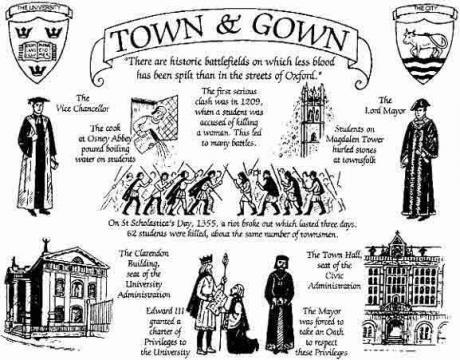
Oxford has a long history of riots, beginning in 1209 with “the hanging of the clerks”. In his 1220s history of England, Roger of Wendover wrote:

“About this time, a certain clerk engaged in the liberal arts at Oxford killed a certain woman by accident and when he found that she was dead he decided to flee.

“But when the mayor of the city and many others who had gathered found the dead woman they began to search for the killer in his house which he had rented together with three of his fellow clerks.

“Not finding the man accused of the deed they seized his three fellow clerks who said they were wholly ignorant of the murder and threw them into prison; then a few days later they were, by order of King John, in contempt of the rights of the church, taken outside the city and hanged.

“When the deed had been done, both masters and pupils, to the number of three thousand clerks, left Oxford so that not one remained out of the whole university; they left Oxford empty, some engaging in liberal studies at Cambridge and some at Reading.”

In effect, Cambridge University was founded by refugee scholars from Oxford–though there is some dispute about the actual timing and the numbers. Then the Pope got involved as part of his disputes with King John, and sent a Papal Legate who, among other things, imposed a payment by the town of Oxford to its University of 52 shillings per year in perpetuity.

The disputes between Town and Gown have continued for centuries, the most severe being the St Scholastica Day riot of 1355. This began with two students complaining about the quality of wine in a pub and ended three days later with 63 University people dead, as well as 30 people from the town and surrounding countryside. And you can read a 1990s anarchist analysis of the continuing conflict in our own time here.

But let’s go back to 1714. George I had been brought in from Hanover to be King with the support of the Whig party; their opposition, the Tories, were on uncertain ground as many of them supported the rival Stuart claim to the throne. George therefore looked favourably on Cambridge with its Whig establishment, while Oxford was a Tory stronghold. Hence the response to Joseph Trapp’s poem by William Browne:

The King to Oxford sent a troop of horse,
For Tories own no argument but force:
With equal skill to Cambridge books he sent,
For Whigs admit no force but argument.

And the rivalry between Oxford and Cambridge continues to this day.

Political poem: Hilaire Belloc, on elections

The accursed power which stands on Privilege
(And goes with Women, and Champagne, and Bridge)
Broke–and Democracy resumed her reign:
(Which goes with Bridge, and Women and Champagne).

The precise phrasing of Hilaire Belloc‘s little squib may have been outdated by the likes of Margaret Thatcher, Angela Merkel and Kamala Harris… but the complaint by the common voter (or disillusioned non-voter) is valid, that professional politicians live in a very comfortable club that takes care of all its members regardless of who actually wins an election; and no fundamental change occurs.

A nice little quatrain, iambic pentameter, the simplicity strengthened by the bite of the repetition contradicting the idea of change. Easy to remember and quote because – of course – it rhymes and scans.

“2009 Five Presidents, President George W. Bush, President Elect Barack Obama, Former Presidents George H W Bush, Bill Clinton & Jimmy Carter, Standing” by Beverly & Pack is marked with CC PDM 1.0

Political poem: Hilaire Belloc’s epitaph on a politician

Here richly, with ridiculous display,
The Politician’s corpse was laid away.
While all of his acquaintance sneered and slanged
I wept: for I had longed to see him hanged.

The US and UK have been so polarised for the past several years that it seems everyone has a politician they would like to see executed–or jailed at the very least. But this is neither a recent phenomenon nor a merely Anglo-American one. All round the world notorious pillagers of their countries go to the grave with great pomp, while most of their countrymen and -women are simply glad that they are finally going.

This sarcastic little poem by Anglo-French writer Hilaire Belloc suggests two things: that all successful political leaders are loathed by a large percentage of the population; and that to make your sarcastic comment truly memorable if it is more than five or six words long, you do well to put it in verse. The rhyme and meter not only make the words easier to remember, they also lend a magical impression of inevitability and authenticity to the idea expressed. Well-constructed verse provides a fraudulent but powerful proof that the idea expressed is valid. Rhetoric and oratory inhabit this area also. Well-expressed ideas have more credibility than badly expressed ones, regardless of the relative merits of the ideas themselves.

Perhaps we should count ourselves lucky that few politicians exhibit much interest in poetry…

November 2023 update: I’ve been quoting this poem with reference to the death of Henry Kissinger.

Photo: “President Cyril Ramaphosa attends former President Robert Mugabé’s State Funeral in Harare” by GovernmentZA is licensed under CC BY-ND 2.0

Poem: ‘Politics’

He played the game and loved its vicious tricks,
deceit, despair, all power-politics;
and made good progress, never in retreat,
with no despair at politics’ deceit…
and now still climbs that endless rain-slick stair
of power-politics, deceit, despair.

If you search for photos of politicians, this is the kind of thing you get… There are (occasionally) really, really good people who devote their lives to trying to improve their part of the world; but… Anyway, it seems like a good time to blog this poem!

This short piece was originally published in Snakeskin. Couplets of iambic pentameter, with politics, deceit and despair in the second line of every couplet and providing the rhymes. But you could see that.

Photo: “President Trump at the Israel Museum. Jerusalem May 23, 2017 President Trump at the Israel Museum. Jerusalem May 23, 2017” by U.S. Embassy Jerusalem is licensed under CC BY 2.0

Poem: ‘Poems Like Mice’

Poems should be concise:
quick, small, like mice.
Then one day you find
they’ve made a nest in your mind.

I seem to be writing shorter, more epigrammatic verse recently. Probably influenced by reading too much FitzGerald/Khayyam.

This little poem was published in the December 2020 issue of Snakeskin–which celebrates 25 years as a monthly online poetry magazine, presumably the oldest (or rather “the most venerable”) such magazine in the world. Congratulations to its creator and sustainer, George Simmers!

Photo: “Look at the cute mouse ^^” by letmehearyousaydeskomdeskom is licensed under CC BY-SA 2.0

Odd poem: Hemingway’s last poem, untitled

If my valentine you won’t be,
I’ll hang myself on your Christmas tree.

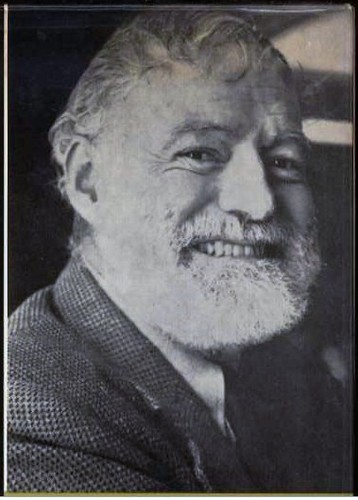
This is the 88th and last poem of the ‘Complete Poems’ of Ernest Hemingway (edited with introduction and notes by Nicholas Gerogiannis). Given that Hemingway ended his life by suicide, this might seem a worrying final poem; but he wrote it five years before his death, and it was truly light-hearted.

He was living with his fourth wife, Mary Welsh Hemingway, at “Finca Vigía” (“Lookout Farm”), a 15-acre property he bought and lived in for 22 years. She writes that he became so fond of the Christmas tree that he wouldn’t allow it to be removed for months after Christmas. This was his 1956 Valentine for her.

Hemingway’s poems are unremarkable at best (despite Eliot having apparently told him that he had promise as a poet). They are not what he won the Nobel Prize for in 1954. But if you like reading biographies, reading his poems is an interesting way of finding out about his thoughts and activities.

Photo: “Ernest Miller Hemingway” by tonynetone is licensed under CC BY 2.0

Poem: ‘The Future as Event’

The future like an avalanche
is roaring down the sky.
If you’ve prepared no hiding place
then be prepared to die.
You never reason why.

The future like a question mark
is scything humankind.
If you can see, then handle it –
you’ll be cut down if blind.
The future doesn’t mind.

The future like a giant wave
is heading for the shore.
If you can ride that wall-like wave
it’s no wall, but a door
into forever more.

I was looking for one of my poems that might be appropriate for the aftermath of the 2020 US election, regardless of any of the possible outcomes. This is the best I could find: no matter who wins which election in any country in the next couple of decades, the world is going to be struggling to play catch-up with enormous changes happening in the climate, the sea, cyber warfare, space militarisation, A.I., genetic modifications… Trump, Biden, BoJo, Putin, Xi, they are all corks on an ocean with a hurricane coming.

‘The Future as Event’ was originally published in the much-lamented ‘Rotary Dial’, produced in Toronto by award-winning poets Pino Coluccio and Alexandra Oliver. A delightful monthly of formal verse, it ceased without warning. So it goes.

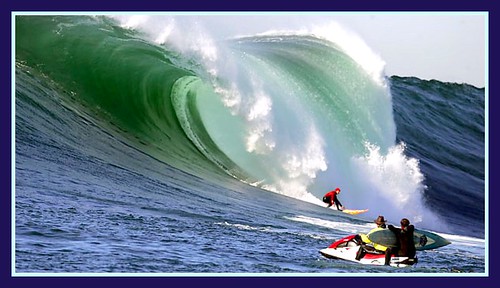
Photo: “Giant waves at Half Moon Bay in Calif.” by robertg6n1

Poem: ‘An Atheist Demands Access to Heaven’

There flows in my veins the most ancient of ardours:
not power, or love, nor yet worship of God;
the fight that each tiniest baby fights hard as
fought earliest man: “Understand!” Pry and prod
with unquenchable flame of the world-disregarders
for Truth! – be it complex, destructive or odd.
If this fire is from Heaven, then Heaven I’ve earned;
so write on my grave: “This stone too shall be turned.”

This teasingly paradoxical little poem was originally published in the Shot Glass Journal, a thrice-a-year journal of 20-30 American poems and an equal number of international ones. Why the name? Because this is a journal for short poems, none over 16 lines. Most of the material they publish is free verse, but they like to have a full range of styles in each issue… which is good news for formal poets.

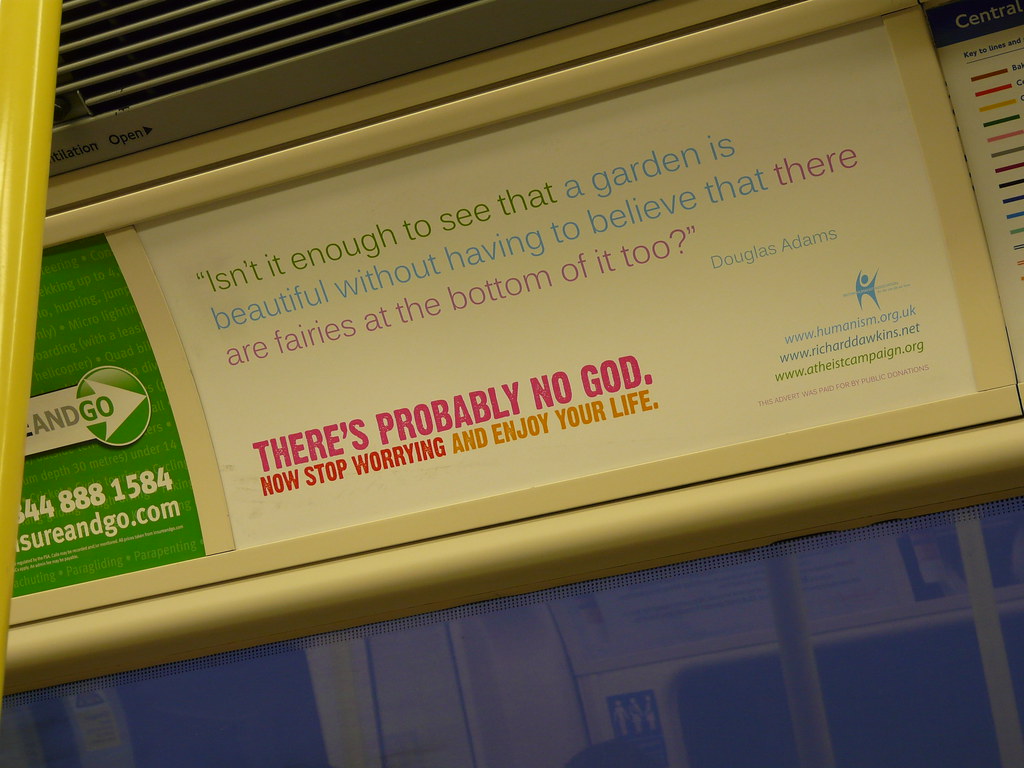
Photo: “Atheist Campaign on Tube Train” by Loz Flowers is licensed under CC BY-SA 2.0