Category Archives: poets

Limerick: On a Hopeless Romantic


Like Jesus, she felt God-forsaken,
like Joan of Arc, wanted a stake in
     a life full of meaning,
     a life undemeaning—
like Jung, she was simply myth-taken.

This limerick was originally published in Light. As far as I remember, I didn’t have anyone in mind when writing it, it was done for the pure wordplay of the rhythm and rhyme, the repetition of the J-names in the long lines and the near-identical nature of the short lines, and of course the final pun.

Formal verse covers a lot of territory from limericks at one extreme to Paradise Lost at the other. Personally, I’ll take Lear over Milton any day.

Potcake Poet’s Choice: Claudia Gary, “Blues Manqué”

Claudia Gary

Claudia Gary

I’ve suffered, but I can’t quite sing the blues.
My troubles are occasional, not chronic.
My angst is true, but not the kind you’d use

against the everyday, to find or lose
your heart. My chords are major and harmonic.
I’ve suffered, but I don’t dare sing the blues.

Any attempt would probably amuse,
but not in ways your songs have made iconic.
Your angst is true, while mine’s nothing to use

in threatening to blow a major fuse
or skip to Paris on the supersonic.
I’ve not suffered enough to sing the blues.

Saying I have is asking for a bruise.
You’ll throw tomatoes. They’ll be hydroponic.
This angst is true, but nothing I can use

to make you say mine is the pain you’d choose.
The plates I spin are porcelain, not tectonic.
I suffer from a need to sing the blues
with insufficient angst, too kind to use.

Claudia Gary writes: “I chose this poem because people have seemed to enjoy it at various readings, as did the wonderful editors who chose to include it in “Love Affairs at the Villa Nelle.” Also, villanelle is one of the forms I love to teach at writer.org—currently online, so people can “Zoom” from anywhere in the world and wear their pajamas to class.”

Claudia Gary teaches villanelle, sonnet, and meter “crash courses” at The Writer’s Center (writer.org). A three-time finalist for the Howard Nemerov Sonnet Award and semifinalist for the Anthony Hecht prize (Waywiser books), she is author of Humor Me (David Robert Books, 2006), chapbooks including Genetic Revisionism (2019), and poems appearing in journals and anthologies internationally. She also writes chamber music, art songs, and health/science articles. See also pw.org/content/claudia_gary, @claudiagary (twitter), and claudiagarypoet (instagram).

Review: “Modern Verse in English, 1900-1950”

Modern Verse in English

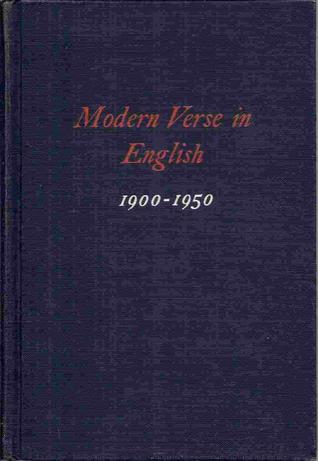
I’m reading ‘Modern Verse in English, 1900-1950‘, ed. David Cecil and Allen Tate, published in 1958. It provides a good look at a large number of poets from that time period–some have lasted, some haven’t. It is an extensive and useful volume, but it raises some concerns:

1. Lord David Cecil‘s introduction (to the English poems) includes “though during the twenties there was a fashion for free and rhymeless verse, it has passed. Most young poets today write in strictly regular forms.” This was published in 1958, remember. Not really prescient, unfortunately, so you question his insight. He regrets omitting “the work of writers who have made their reputation since 1950, for example, Miss Audrey Beecham, Mr. Philip Larkin and Mr. Thom Gunn.” Well, two out of three’s not bad.

2. The ‘1900-1950′ seems a bit misleading, given that the poets include Emily Dickinson and Gerard Manley Hopkins who both died in the 1880s. True, Hopkins’ poetry wasn’t published until the 1930s–but would we consider an unknown Shakespeare poem 21st century if it was only discovered and published today? And as for Dickinson, three Series of her poems were published in the 1890s.

3. Although a couple of poets born in Ireland and South Africa, and Kipling, are included, the volume contains nothing by Canadians (Bliss Carman, Robert Service and F.R. Scott would fit the time line), Australians, West Indians, etc; and nothing by any people of colour such as Langston Hughes or Gwendolyn Brooks (one of my absolute favourites). Any of these would be far more worthy of inclusion than, for example, Donald Davidson whose chief merit for the editor of the American poems, Allen Tate, must have been their shared support for racial segregation. The volume would be better titled ‘Modern White English and American Verse, from Emily Dickinson to Richard Wilbur‘. Still not perfectly accurate, but so it goes.

It is a useful book. But it is less complete than its title suggests, and it is tainted.

Wired Magazine: Poetry, Doctors, Patients and the Pandemic

Dr. Rafael Campo

Dr. Rafael Campo

Here is an excerpt from a recent Wired interview with Dr. Rafael Campo, Poetry Editor at the Journal of the American Medical Association! (The full thing is here.)

WIRED: Why do you think poetry has become so important to so many doctors during the pandemic?

Rafael Campo: I think doctors in particular are really searching for ways to give voice to their experiences of this terrible disease and what we’re all going through in confronting it.

It’s particularly poignant, I think, because we’re so isolated by this virus. We’re all practicing physical distancing and social distancing, so I think poetry becomes a way of connecting with other people and having our story heard. So I find it actually really energizing. It helps me feel less isolated, less disconnected, as I read through these poems.

WIRED: Is there something unique about poetry that makes that kind of connection possible?

RC: We’re hardwired to hear the kinds of rhythms that are present in poetry and the ways in which the rhythms of our bodies are expressed in meter, in the music of poetry. I think especially now, when we’re feeling in some ways estranged from our own bodies and disconnected, having that visceral experience of hearing the music and language is just compelling.

I think other reasons have to do with the brevity of poetry. In a way, poetry fits into the fragmented spaces that we have as doctors, as we’re running around trying to deal with this crisis.

Then one other thing is that I always associate poetry with activism. When we think of some of the protests that are going on in the streets now—people are out there chanting—they’re actually using a spoken-word form of poetry.

Poetry has that ability to grab us and to speak in the most urgent terms. It’s a very physical language. It calls us to action. I always think back to my time when I was really early in my training as a physician, during the height of the AIDS crisis. Similarly, then people were out in the streets shouting: “Silence equals death! Silence equals death!” That still resonates in my mind today. Those poems, that urgent language, really changed the course of that pandemic.


And he’s a poet in his own right.

And then there’s Dr. Campo’s Ted Talk

Potcake Poet’s Choice: Tom Vaughan, “Save the Last Page for Me”

We choose what gives us meaning. I
chose you. That’s why
when people ask
me to unmask
and tell them if I’m ‘happy’, they
head off astray:
that’s not the glue.
But what I knew –
in the first minute, when we met
(part pledge, part threat) –
was that our text
defines, connects.

Of course, it’s only when you turn
the last page, learn
its backward view,
say farewell too,
that you can fully understand
an author’s plan.
So bugger books
and how we’ll look
to hooked, impatient readers who
will hurry through
to reach the end.
Leave that unpenned.

Tom Vaughan writes: “The poem I would choose to represent myself, Save the Last Page for Me, first published in Staple, represented a particular challenge. I’d come across the form (‘minute’ poems, i.e. 60 syllables in each stanza, with rhyming couplets and a pattern of four or two foot lines) which it was suggested was only for comic poetry. I wanted to say something serious, and hope I succeeded. Writing the poem was also another reminder that at least sometimes the more you work within the confines of a strict form, the more you discover what you wanted to say. The poem is about my wife, Anne.”

Tom Vaughan is not the real name of a poet whose previous publications include a novel and two poetry pamphlets (A Sampler, 2010, and Envoy, 2013, both published by HappenStance). His poems have been published in a range of poetry magazines. He currently lives and works in London.

https://tomvaughan.website


Launch: Potcake Chapbook 7, ‘Murder ! – poems of killings past and present’

07 Murder!

Potcake Chapbook 7: ‘Murder!’

Murder needs no formality of gats,
violin cases or fedora hats
or any other long-outdated memes.
Murder is merely social discord that’s
taken to interpersonal extremes.

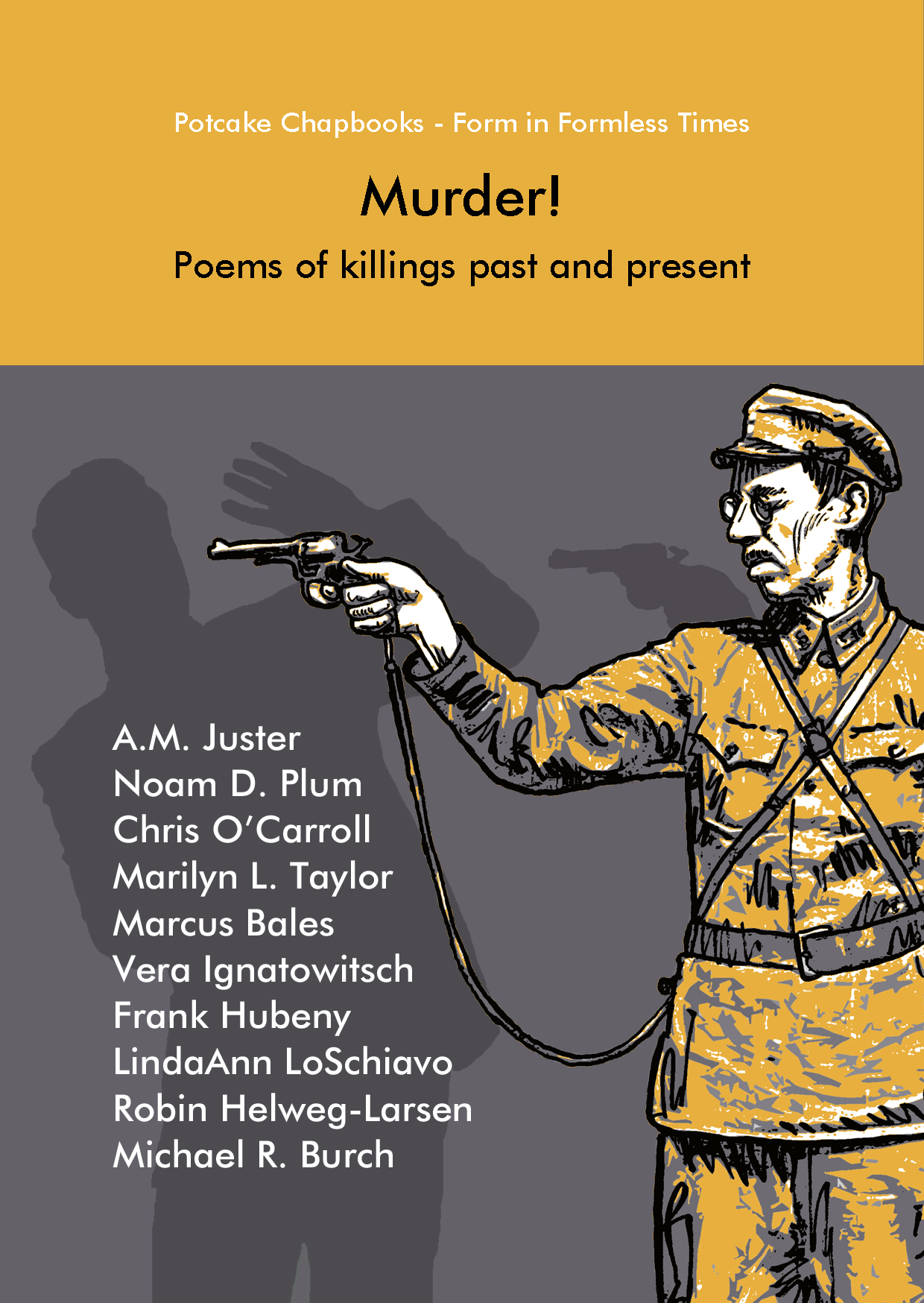
Murder. Here we present victims ranging from the unidentifiably unknown to the rich and powerful, and from the time of the Emperor Constantine to the present day. It appears to be something with which we humans are permanently infected. 

The poems–all formal, of course!–are as usual in a variety of forms. This chapbook contains sonnets, a double dactyl, quatrains, rubaiyat, parody and nonce forms. They were authored by Potcake newcomers A.M. Juster, Marilyn L. Taylor, LindaAnn LoSchiavo and Frank Hubeny, and old-timers Chris O’Carroll, Marcus Bales, Vera Ignatowitsch, Noam D. Plum, Michael R. Burch and myself. And powerfully illustrated, as always, by Alban Low.

For the price of a fancy greeting card you can, through the wonders of PayPal, get this 16-page chapbook online for £2.60 + £1.20 P&P to a UK or European address, or £2.60 + £2.20 P&P to a Worldwide address.

Or you might prefer to browse themes and poets here, and photos and bios here, and choose between poems on travel, or love affairs, or the working life… or relatives, or modern life, or poems to amuse and amaze. Life, after all, is more than just Murder!

Eliot, Woolf and Vivien

T.S. Eliot, Virginia Woolf and the unfortunate Vivienne Eliot

“T. S. Eliot and Virginia Woolf were almost exact contemporaries, readers and critics of each others’ work, and friends for over twenty years. Their writings, though, are rarely paired.” So says the Amazon entry on Modernism, Memory, and Desire by Gabrielle Mcintire, which “proposes that some striking correspondences exist in Eliot and Woolf’s poetic, fictional, critical, and autobiographical texts, particularly in their recurring turn to the language of desire, sensuality, and the body to render memory’s processes.”

An article in the New Yorker from some years ago paints a different picture of Eliot: “he held all the English writers in contempt. It was a cool and disinterested contempt; it came from arrogance, not from pettiness or insecurity, and he gave just enough of a hint of it to make people nervous. The only contemporary writers he considered his peers were Pound and Lewis (though he knew their limitations extremely well). The only one he looked up to was Joyce.”

Virginia Woolf is only mentioned later in passing in the article, with a quote from her diary wishing “poor dear Tom had more spunk in him, less need to let drop by drop of his agonized perplexities fall ever so finely through pure cambric. One waits; one sympathizes, but it is dreary work.”

As for Eliot’s first wife, Vivienne, Virginia Woolf wrote in her diary: “Oh – Vivienne! Was there ever such a torture since life began! – to bear her on one’s shoulders, biting, wriggling, raving, scratching, unwholesome, powdered, insane, yet sane to the point of insanity, reading his letters, thrusting herself on us, coming in wavering trembling … This bag of ferrets is what Tom [Eliot] wears round his neck.”

Tim Miller, who blogs interesting excerpts of whatever he is reading, has more from Virginia Woolf’s diary: you can read it via First Person: Virginia Woolf Meets T. S. Eliot

Potcake Poet’s Choice: Maryann Corbett, “Dutch Elm”

Maryann Corbett

That trees would die
yearly, we knew. The columns of the nave
of Summit Avenue, the architrave
of openwork where canopies unfold,
green or briefly gold,
the arched, leaf-dripping limbs
backlit with sky—

in every year, some go.
Some ends arrive with force: the papers warn
with pictures, after every storm,
of fallen branches, hollow at the heart,
or great trunks snapped apart,
battering cars and houses with the blows.
(We knew, but now we know.)

Some ends are quiet: the red
stripes appearing, like a garotting wound,
on trunks where the inspectors found
beetles in bark, bare limbs lurking in shade.
The tree crew and the chainsaw blade
will come—we know now—soon—
The stripe says, This is dead.

They make short work of things
with sweat and cherry pickers, saws and zeal
rope and rappelling acrobatic skill
and limb-shredding machines.
Only the stump remains
and is soon sawdust: nothing left to chance
but next year’s fairy rings.

No help for it, then.
This cut to sky, this coring of the heart.
These trees too far apart.
This just delivered balled-and-burlapped stick,
its trunk two inches thick,
decades from beauty. What we always knew:
We start again.

Maryann Corbett writes: “All day today I’ve been hearing, and sometimes watching, the process of the removal of my neighbor’s enormous elm, which peeled apart suddenly in a recent storm, exposing a hollow core. I was reminded that I’ve seen this process so many times in my city that it prompted a poem over a decade ago, and it’s a poem I’m happy to remember. It first appeared in The Lyric and is included in my second book, Credo for the Checkout Line in Winter.”

Maryann Corbett earned a doctorate in English from the University of Minnesota in 1981 and expected to be teaching Beowulf and Chaucer and the history of the English language. Instead, she spent almost thirty-five years working for the Office of the Revisor of Statutes of the Minnesota Legislature, helping attorneys to write in plain English and coordinating the creating of finding aids for the law. She returned to writing poetry after thirty years away from the craft in 2005 and is now the author of two chapbooks, five full-length collections already published, and a forthcoming book. Her fifth book, In Code, contains the poems about her years with the Revisor’s Office. Her work has won the Willis Barnstone Translation Prize, has appeared in many journals on both sides of the Atlantic, and is included in anthologies like Measure for Measure: An Anthology of Poetic Meters and The Best American Poetry 2018.

Her web page: maryanncorbett.com
Poem: “Time”

Time takes the young child by the hand
and leads it through a golden land
so timeless it will never note
Time’s other hand is at its throat.

This little poem was just published in Snakeskin, in one of its richest issues ever. I’m glad to have been included, along with several others–Claudia Gary, Tom Vaughan, George Simmers, Marcus Bales–of the formalist poets who appear in the Potcake Chapbooks. And a shout-out to Nikolai Usack, who made me clear up clumsy pronouns in the original draft.

August 3: Annual Surreptitious Sonnet Day

Wallace_Stevens,_1948

Wallac Stevens

“Engaged at the office all day on a sonnet – Surreptitiously.” This charming journal entry by Wallace Stevens for August 3, 1906, triggered a fine sonnet by Frank Osen some years ago:

Cover Memo

To Distribution:
Stevens was aware
That many poets must go leopard-like
Among the striped, yet not be spotted there.
This isn’t easy, when desire may strike
At work, although it called in sick last night,
And, stricken, one must chase in search of tea
Or oils or oranges, to some distant height—
Or only to the nearest OED.
Yet, when protective coloration’s risked,
A job transcends that mental game preserve
Where fauna don’t go frolic, but get frisked.
For all who bear an office to observe,
We ought to mark each August third this way:
As Annual Surreptitious Sonnet Day.

This in turn caused a rueful villanelle by Marcus Bales:

August Third

On August Third I have to write a sonnet
As Wallace Stevens did in Nineteen Six —
And here I’ve got a villanelle, doggone it.

And ever since Frank Osen got right on it
By writing his he’s put us in a fix:
On August Third I have to write a sonnet.

I hope you’ll Vladimir-and-Estragon it,
While I arrange my sonnet’s final mix
Cause here I’ve got a villanelle, doggone it.

It may be that allusion’s over-drawn – it
May not be your cliques that I transfix
When August Third I have to write a sonnet.

I haven’t got a shocking denouement – it
Isn’t how a villanelle does tricks,
And here I’ve got a villanelle, doggone it,

So as you don your writing hat, or bonnet,
Don’t mix your forms as I did, dicks and chicks —
Cause here I’ve got a villanelle. Doggone it,
On August Third I have to write a sonnet.

Well! What will today bring, I wonder?