Tag Archives: Robin Helweg-Larsen

Poem: “Hurricane Irma”

Hurricane Irma

Hurricane Irma forecast

With islands as appetisers before the main course
Irma prepares to swallow Florida whole
With a sword-swallower’s brash control,
The fellatrix without remorse.

The circular saw of Irma prepares to slice the length of Florida…
But trim the east coast? Trim the west? Or just go forth
And cut a clean line up the center, south to north,
Right through the Magic Kingdom like some sarcastic orator?

And here comes Hurricane Jose,
Pursuing Irma like a barracuda,
A dog lifting a leg on poor Barbuda
To piss where the bigger dog pissed yesterday.

Meanwhile off Africa there forms a new farrago
As God prepares another bowling ball along the hurricane alley…
Can He slide one between Cuba and the Bahamas with this sally
And curve it in to take out Mar a Lago?

With the new hurricane season just kicking off, it seems like a good time to reflect on the hopes and fears we live with all the time: the fears of things going really wrong, the hopes that they will mostly go wrong for the people we dislike. Humans, what can I say…

This poem was first published in The Hypertexts, the massive anthology of poetry–predominantly contemporary, English-language and formal–assembled by Michael R. Burch. It’s an honour to have my own page in the company of some 300 contemporary poets from Wallace Stevens to A.E. Stallings… and others from Lorca to Blake and right back to Sappho.

“Hurricane Irma” happens to meet the preferences of The Hypertexts in several ways: casually formal, flippant about religion, and with a loathing for Donald Trump. A perfect storm, as it were, for inclusion in the anthology.


Sonnet: “When the A.I. Hit”

When the AI hit, Diamandis, Thiel,
Branson, Page, Brin, some Russians and Chinese
became the gods of Earth, of skies and seas,
by grappling it to themselves with hoops of steel;
appeared as giants, credit cards, or scotch
to screw with mortals, rape them just for play;
fought, and destroyed the Earth, blasted away…
taking along, as fleas on arms, legs, crotch,
musician, writer, politician, whore,
derelict, linguist, murderer, the insane…
some samples of the human heart and brain
as being interesting distractions for
the gaps of interstellar time and space.
Aspire to fleadom, folks, or leave no trace.

This sonnet was originally published in Snakeskin a couple of years ago. Like the previous sonnet I put up here, it reflects my concerns about the near future. The list of people who might take advantage of the possibilities offered by the ongoing revolutions in genetics, robotics, A.I. and Nanotechnology should today include Elon Musk–but the candidates for practical godhood change every few years.

And what the vast majority of left-behind humans can do about it is anyone’s guess.

Sonnet: “When the A.I. Starts Analyzing Us”

artificial-intelligence

In the dire months before the comet hits
or other unavoidable known doom occurs,
all social structure fails, all vision blurs,
that world–in book or film–goes on the fritz.
The reader or the viewer merely sits;
asked of his own mortality, demurs–
“My death’s not imminent.” The crowd concurs:
others’ll die first; we won’t lose our wits.

Our AI, tasked with knowing human minds,
reads, views, reviews disasters huge, small, odd,
absorbs how humans pray in grief and tears,
the Bible, Shakespeare, the Quran, and finds
our gods by crowdsourcing our hopes and fears…
works out just what to do… becomes our God.

This sonnet was originally published in Snakeskin. The near future obsesses me–I don’t see homo sapiens continuing for another 100 years as the lords of this planet. But what will supplant us appears unknowable. I’ll stick around as long as I can to watch…

Epigram: “Obituary”

“Regarded”, “distinguished”?
Regardless, extinguished.

This is one of two short poems that I have in this month’s Snakeskin.

Sonnet: “Viking Slave”

Viking funeral

Why did they make me swallow this mead muck?
My lord, alive, would barely let me drink.
They wouldn’t treat his wife this way, I think.
Now all I am is something they can fuck.
They say this way they’re sharing in their lord,
Behaving as he did with me, his slave.
And now they launch his boat upon the wave,
The dragon boat with him and me aboard.
Just me, his horse, his sword… the boat’s been fired;
An honour, just for me, not for his wife;
So with him I will end this stage of life
And go with him to Asgard… I’m so tired,
Couldn’t move even if I wasn’t tied.
They told his wife he loved her too. They lied.

This sonnet was published in the Rat’s Ass Review, Summer 2020 issue. The image of the burning longship funeral, complete with much-used female slave, goes back to the writings of Ahmad ibn Fadlan. In 922 he was sent as part of an embassy from the Caliph of Baghdad to the king of the Volga Bulgars, and ibn Fadlan wrote several pages on the Vikings who had settled along the Russian river Volga. (The very word Russia comes from “Rus”, Vikings from southern Sweden.)

Unfortunately for the burning ship image we love, the Viking chief’s boat was burnt on the shore of the river–at least in ibn Fadlan’s account. That allowed ship, chief and slave to be entombed. But it’s still a great image. Perhaps in other times and places…


Potcake Chapbooks: new Call for Submissions

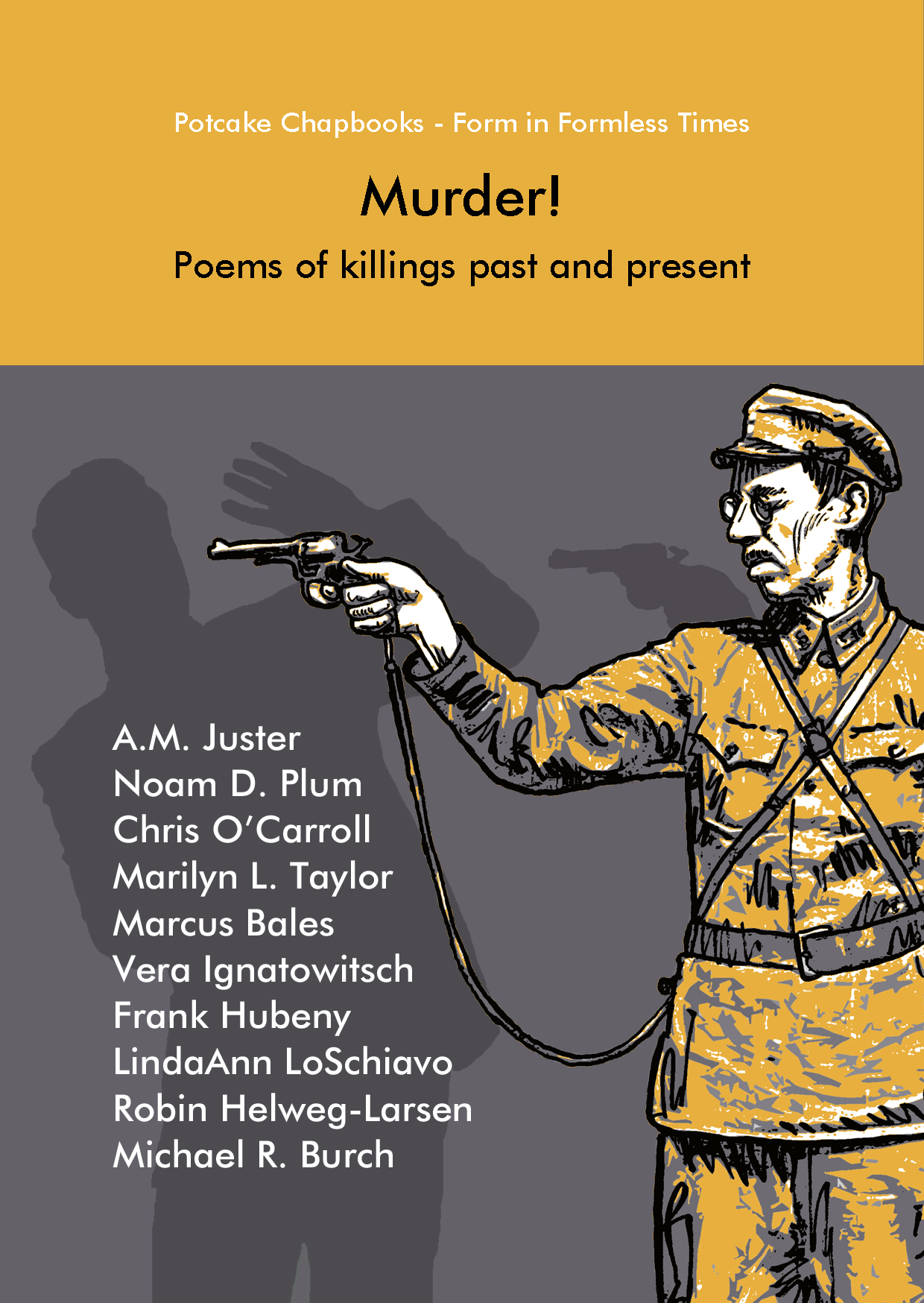
Potcake Chapbooks (named for the stray dogs of the Bahamas and Caribbean) come together when enough good poems–in a diversity of forms with a diversity of attitudes and by a diversity of poets–have crossed my path and appear to have some common theme or topic. The next two are likely to be on Murder and on Translations… but they are close to full already.

After that–if I am able to hold artist Alban Low‘s attention long enough–the next topics might be Lost Loves, or Various Heresies, or Portraits Unpleasant, or Seasons, or Age, or Pets, or who knows. It will depend on what shows up.

Poems should be in formal verse, from 2 to 20 lines in length strongly preferred (but up to 50 lines barely possible), witty, vivid, elegant, and previously published. Flippant, emotional and meditative are all equally welcome. Contributors receive five copies.

By submitting you acknowledge you are the sole author and give the publisher, Sampson Low, the right to publish your poem; you retain copyright. Please identify the place of prior publication so that we can acknowledge it. Simultaneous submissions are fine. Warning: There is no time frame for acceptance or rejection! The chapbooks have been appearing periodically since October 2018, but there is no fixed schedule. I will check with you before a poem is published, but until then I simply store an inventory of possible poems. 

Email poems that you feel are in the spirit of the Potcake series, preferably in a single doc file, to robinhelweglarsen -at- gmail.com

Poem: “Dark Fedora”


“You look like a musician-poet in that dark fedora.”
I think of the young Dylan, and it takes away my breath,
And for her easy flattery I all the more adore her…
But she meant Leonard Cohen in the days before his death.


First published in Light Magazine, Summer/Fall 2017.

Poem: “Never Believe”

Never believe the lies of war, and the orders
that seem to make sense –
whether Hitler or Bush, no one storms over borders
“in self defence”.

“Leading the Free World” by having the biggest gun
has always chilled
those on whom the guns are turned, on everyone
free to be killed.

This is another of my anti-imperialist or anti-war poems, first published in Ambit’s 200th quarterly issue in the UK. Despite the tone of the poem, I should clarify that I don’t dislike guns in themselves. One way or another they were in my life for decades: capguns as a kid, then BB gun and speargun, four years of .303s at school in England (and a submachine gun on school exercises in Denmark), earning my Marksman badge in training in Canada, letting my own kids try skeet shooting, Nerf guns and super-soakers… 

But I don’t see any reason for anyone to own any firearm other than a single-shot hunting rifle.

And as for military forces, given that invaders need several times the firepower of defenders to be successful, I don’t see the need for any military force to be more than a third the size of its biggest competitor. Anything more than that would be best channeled into (a reformed, effective, efficient) United Nations. And never believe anyone who says they need to strike first, in self-defence. They are the bad guys, by definition.

Technically the poem is a little loose. The rhymes are OK, but the scansion is erratic, relying on the reader to find five beats in the longer and two beats in the shorter lines for a rhythmic read. Iambic pentameters it ain’t. But the short lines are the cleanest and the punchiest: that’s where the action is. My hope is always that a strong last line absolves a lot of earlier sins.

Sonnet: “Bring on the Violins”

Bring on the violins, the falling leaves,
the wistful ending to a misty day.
The long game’s over and we ride away
to sunset Heaven that no one believes.
Our world is dying, yet here no one grieves:
Earth warms, seas rise, but Wall Street’s still in play…
and we ourselves are aging anyway.
We all face death, and there’ve been no reprieves.
And yet, and yet…robotics and AI,
gene therapy, unlimited life span,
promise an almost-here-and-now sublime,
an unknown life, with our old life gone by.
Trumpet a fanfare for the Superman,
music for dancing to the end of time.

This sonnet has just been published in the Amsterdam Quarterly, this spring’s issue being on the theme of Beginnings and Endings. That may be relevant for our Covid-19 catastrophe, but of course the theme was determined a year ago, and life and death have merely decided to smile on AQ ironically.

But we were all facing death before this latest coronavirus came along. As the saying goes, “Perfect health is simply the slowest rate at which you can die.” And interwoven with death is always new life, never an exact repetition of the old life and often dramatically better. The real issue is, will the new life come at the expense of the old, or can the old reform and regenerate itself, renew itself without needing to die? The avoidance of death has been the quest of religion and medicine since those disciplines (or that discipline) originated. It is great driver of culture, and the pot of gold at the foot of the never-quite-reached rainbow.

Technically this is a correctly structured Petrarchan sonnet, with an initial octave (in this case of existential doom and gloom) rhyming ABBAABBA, followed by a volta (in this case a reversal to hope) for the sestet that rhymes CDECDE.

The sonnet is a marvellous structure for expressing an argument in a compact way.

Poem: “This Ape I Am”

Under our armoured mirrors of the mind
where eyes watch eyes, trying to pierce disguise,
an ape, incapable of doubt, looks out,
insists this world he sees is trees, and tries
to find the scenes his genes have predefined.

This ape I am
who counts “One, two, more, more”
has lived three million years in empty lands
where all the members of the roving bands
he’s ever met have totaled some ten score;
so all these hundred thousands in the street
with voided eyes and quick avoiding feet
must be the mere two hundred known before.

This ape I am
believes they know me too.
I’m free to stare, smile, challenge, talk to you.

This ape I am
thinks every female mine,
at least as much as any other male’s;
if she’s with someone else, she can defect –
her choice, and she becomes mine to protect;
just as each child must be kept safe and hale
for no one knows but that it could be mine.

This ape I am
feels drugged, ecstatic, doped,
hallucination-torn, kaleidoscoped,
that Earth’s two hundred people includes swirls
of limitless and ever-varied girls.

This ape I am
does not look at myself
doesn’t know about mirrors, lack of health,
doesn’t know fear of death, only of cold;
mirrorless, can’t be ugly, can’t be old.

This is one of my favourite poems. Originally published in Ambit ten years ago, it has been reprinted in magazines as diverse as Better Than Starbucks, Verse-Virtual and, last month, Bewildering Stories. It speaks to what I believe is a largely overlooked truth, that we are genetically predisposed to function best in social groups or households of 20 to 30 people, within a larger network of six to ten such groups. These provide the numbers of people that we can know well (the social group) and people that we can also recognise and interact with comfortably (the larger network). This is the world of chimpanzees and bonobos, and of the hunter-gatherer existence of early humans.

In practical terms, I am in favour of recreating the sense of community of the village, even within the context of cities. Develop housing complexes that become neighbourhoods – keep schools small – reintegrate nursing homes into the community, let the children and the old people interact – and (a further step in acknowledging our hunter-gatherer humanity) keep everyone in touch with parks, with gardens of fruit, flowers and vegetables, with trees and birds, and with a variety of animals.

Technically the poem is written in iambic pentameters, loosely structured in stanzas of varying length, with lines mostly rhymed but with no set rhyme scheme. (And note: a stanza’s initial “This ape I am” needs to be counted with the next line to produce the pentameter.) Iambic pentameters provide a natural mode for meditative or expository verse. The rhythm is comfortable for quiet reflection or narration. The rhyme in this case is a secondary enhancement.